
Tbilisi
Tbilisi is the capital of Georgia — the country in the South Caucasus, not the US state — and its largest city, home to around 1.2 million people. It sits along the Mtkvari (Kura) River in a valley ringed by hills, which is why the city looks the way it does: houses and churches stacked up steep slopes, linked by staircases and twisting lanes rather than a grid. For most international travelers, Tbilisi is the entry point to Georgia and the natural base for trips to the wine country of Kakheti, the Greater Caucasus around Kazbegi (Stepantsminda), and the ancient town of Mtskheta.
The Old Town sits on the valley floor at around 380 meters; residential districts climb the surrounding hillsides to roughly 770 meters. That spread matters on foot — short distances on a map can involve real climbing.
Planning your visit? See our full guide to things to do in Tbilisi for specifics, timings, and local tips.
What is Tbilisi known for?
Tbilisi is known for a walkable historic core of carved wooden balconies, working sulfur bathhouses fed by natural hot springs, one of the world's oldest wine cultures, and a food scene that has drawn steady international attention over the past decade. The city carries about 1,500 years of layered history — Persian, Ottoman, Russian imperial, and Soviet influences sit side by side — which makes it unusually varied for a capital of its size.
How many days do you need in Tbilisi?
Most travelers spend two to three days in Tbilisi itself. Two days covers the Old Town, the sulfur baths, Narikala Fortress, Rustaveli Avenue, and a couple of museums at a reasonable pace. A third day leaves room for the food and wine scene, the newer neighborhoods, or a half-day at Mtskheta. If you plan to use Tbilisi as a base for day trips to Kakheti or Kazbegi, add a day for each.
A common mistake is rushing the city in a single day on the way to the mountains. You can do it, but you'll miss most of what makes Tbilisi worth the stop.
The Old Town (Dzveli Tbilisi)
The Old Town occupies the valley floor and lower slopes below Narikala Fortress on the right bank of the Mtkvari. It is the oldest continuously inhabited part of Tbilisi and the area that best reflects the city's pre-19th-century character.
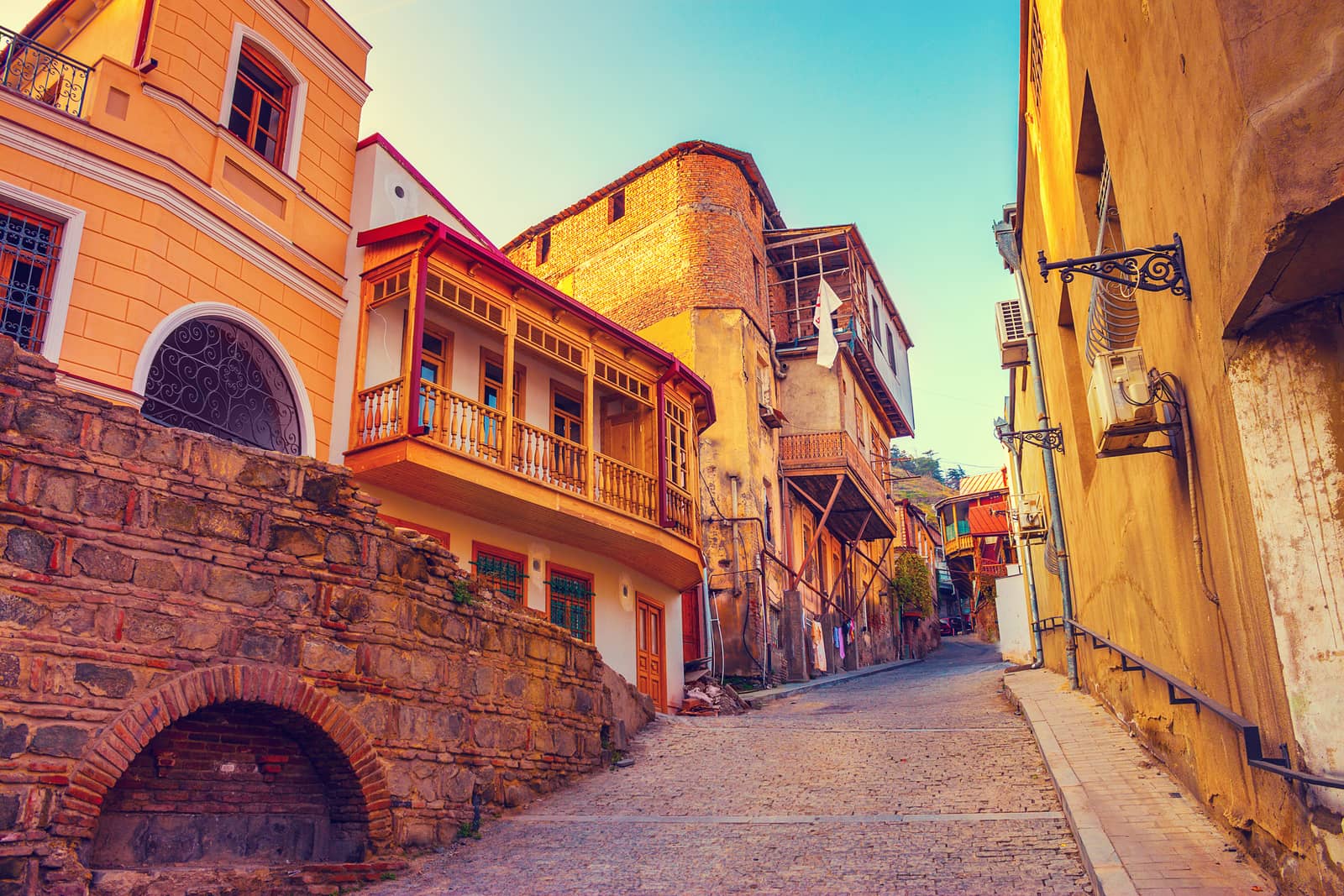
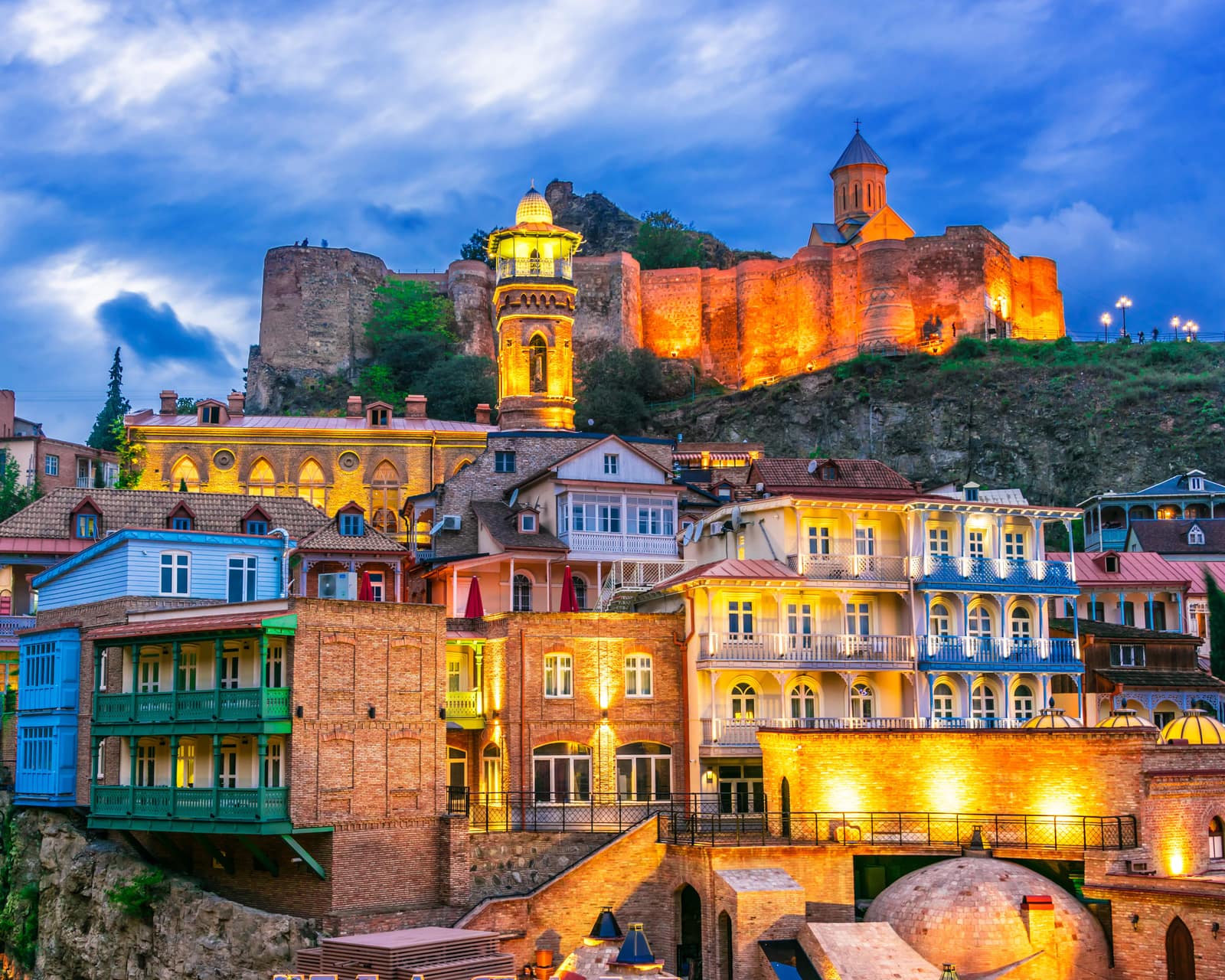
Its signature feature is the traditional Tbilisi house with a carved wooden balcony — a style that developed over centuries and is found in this form almost nowhere else. Many balconies survive today, but restoration is uneven: some houses are beautifully restored, others are propped up and visibly crumbling. That contrast is part of how the Old Town actually looks, not a polished tourist set.
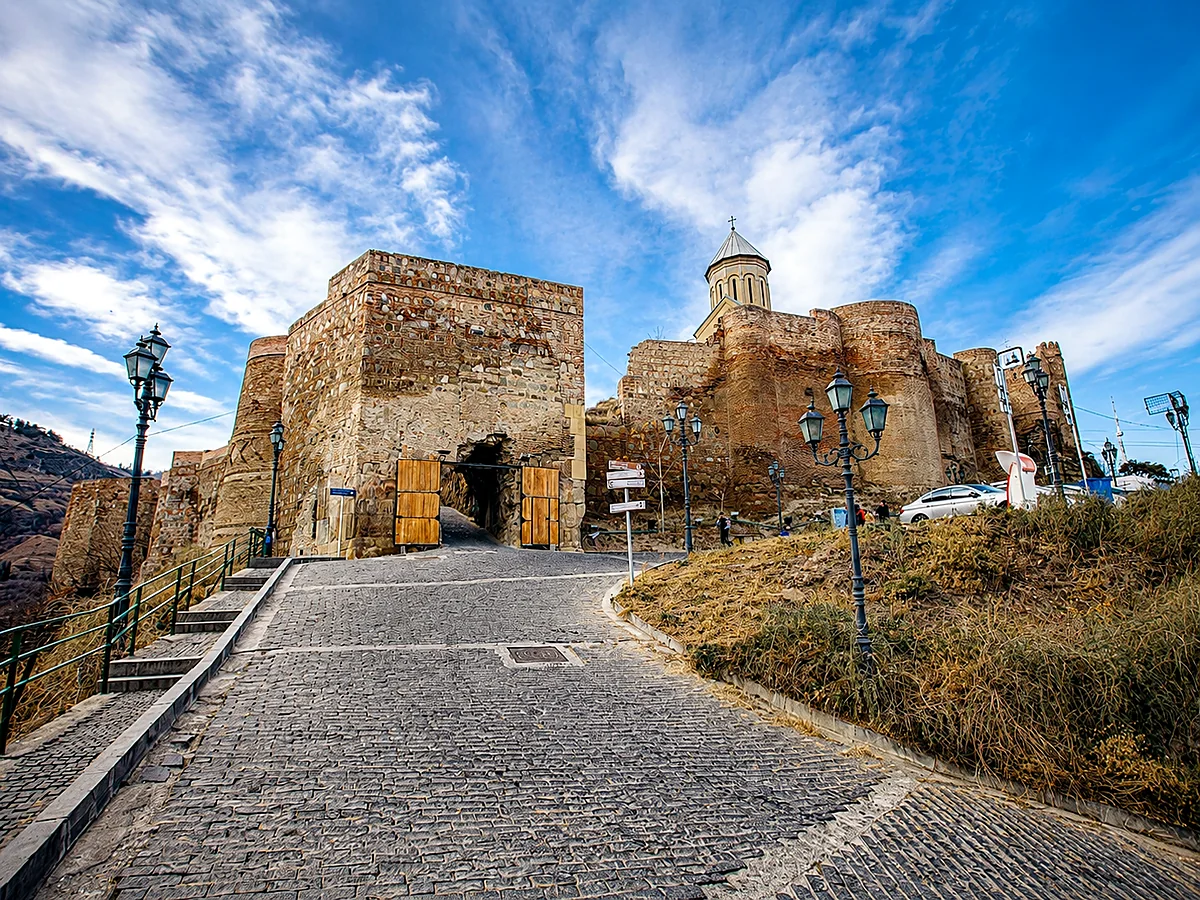
Narikala Fortress, on the ridge above, was first built in the 4th century and expanded under Arab and later Georgian rule. An earthquake in 1827 set off an explosion in a gunpowder store the Russian garrison kept inside the fortress, and Narikala was never fully rebuilt. What remains is a ruin rather than an intact castle, but its position makes it one of the best viewpoints in Tbilisi. A cable car connects the Old Town to the fortress and the park beside it.
At the base of the fortress is Abanotubani, the sulfur bath district. The domed brick bathhouses here are fed by natural hot springs and have operated in some form since the city's earliest days; the current buildings mostly date from the 17th to 19th centuries, and several still work as public baths. The water surfaces at roughly 37–47°C and is reheated for use. Historically these baths were where merchants met and deals were made — social spaces as much as places to wash.
Churches and cathedrals in Tbilisi
Few cities of Tbilisi's size have this density of significant religious buildings, and they span several traditions.
Sameba Cathedral — formally the Cathedral of the Holy Trinity — is the most prominent religious building in modern Tbilisi. Completed in 2004 after about a decade of construction, it stands on Elia Hill in the Avlabari district and is one of the largest Orthodox cathedrals in the world by floor area. Its golden dome rises about 84 meters and is visible across much of the city. The cathedral is the seat of the Catholicos-Patriarch of All Georgia.
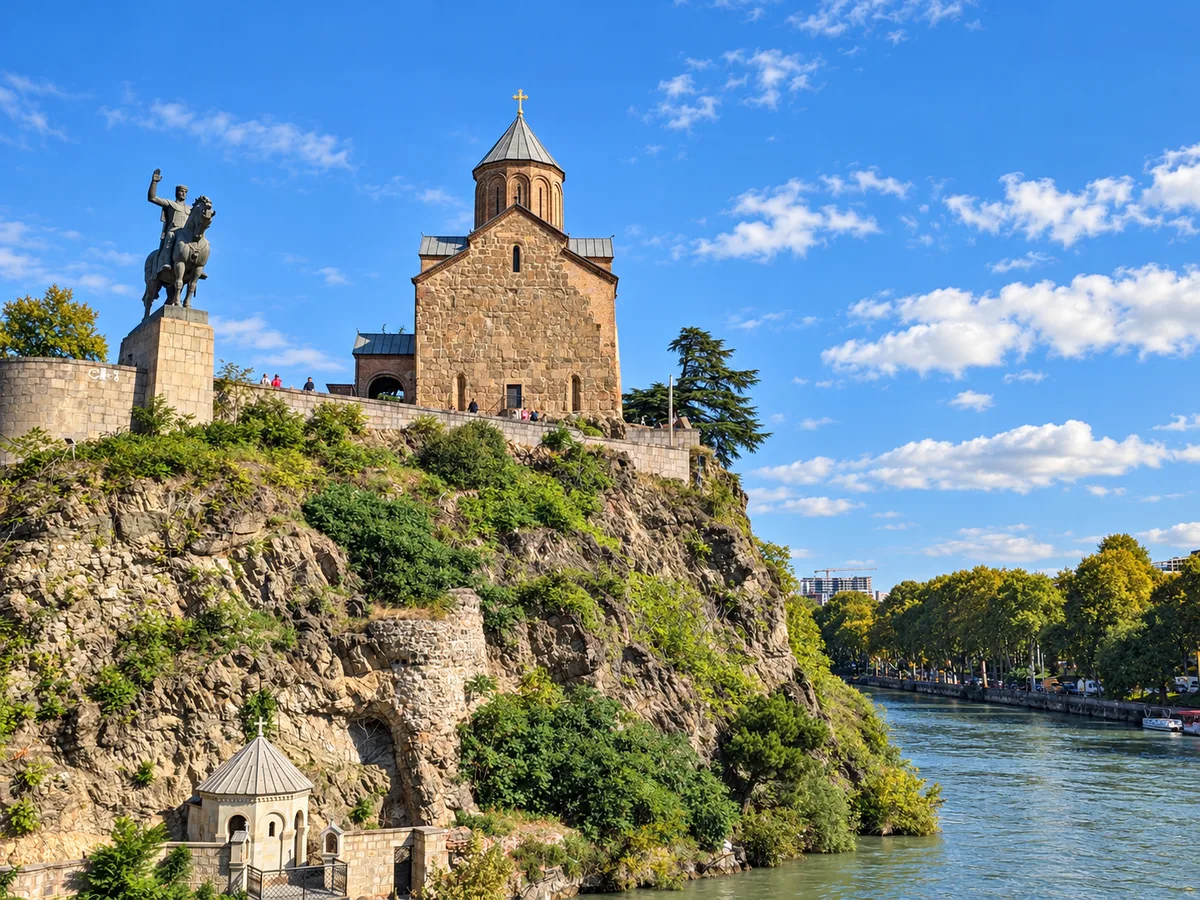
Metekhi Church sits on a cliff above the Mtkvari at the eastern edge of the Old Town. The current church dates to the 13th century, rebuilt several times since. The equestrian statue of King Vakhtang Gorgasali beside it is one of the most photographed spots in Tbilisi.
Anchiskhati Basilica, in a quieter corner of the Old Town, is the oldest surviving church in Tbilisi, built in the 6th century during the reign of King Dachi. It is still an active parish church.
Sioni Cathedral served as the main cathedral of the Georgian Orthodox Church for centuries, and the Jumah Mosque has served Tbilisi's Muslim community since the 17th century — a reminder of how mixed the Old Town's population has long been.
The 19th-century city center: Rustaveli and Freedom Square
North of the Old Town, Tbilisi changes character. This district was largely built or rebuilt in the 19th century under Russian imperial rule, with wider streets, taller buildings, and a clear European influence.
Rustaveli Avenue is the main boulevard, running east to west through this district. Named after the 12th-century poet Shota Rustaveli, it is lined with the Georgian National Museum, the Rustaveli National Theatre, the Parliament building, the Kashveti Church, and several historic hotels. It remains the city's main public space for major events.
Nearby Freedom Square — Lenin Square in the Soviet period — is the central civic plaza, with a gilded statue of St. George at its center where a Lenin statue once stood. Both Rustaveli and Freedom Square are functional civic spaces more than attractions in their own right; worth walking through, but not where you'll spend hours.
Neighborhoods worth knowing in Tbilisi
Beyond the Old Town and center, Tbilisi is a city of distinct districts.
Avlabari, on the left bank of the Mtkvari, has historically been the Armenian quarter and keeps several Armenian churches. Sameba Cathedral and its complex sit here.
Marjanishvili and Chugureti, west of the center, grew as mixed residential and commercial districts around 1900. Today they hold a dense run of cafés, restaurants, theaters, and independent shops in renovated historic buildings, and are among the liveliest parts of Tbilisi for going out.
Vera and Vake, further northwest, are mostly residential, developed through the Soviet era, and now hold many of the city's universities, embassies, and higher-end restaurants. Vake Park is one of the main green spaces for residents.
Museums and cultural institutions
The Georgian National Museum on Rustaveli Avenue is the single best place to understand Georgian history, with collections from prehistoric gold and medieval manuscripts to a Soviet occupation exhibition that gives essential 20th-century context. Within the same complex, the Simon Janashia Museum holds the Dmanisi hominid fossils — among the earliest human-ancestor remains found outside Africa.
The Museum of Fine Arts holds Georgian and Caucasian applied art, including the cloisonné enamelwork medieval Georgia was known for. The Open Air Museum of Ethnography, on the slopes of Mtatsminda, gathers traditional houses and farm buildings from across Georgia's regions on one hillside — a quick way to see how building styles differ between, say, Svaneti and the lowlands.
Georgian food in Tbilisi
Georgian cuisine has drawn real international attention recently, and Tbilisi is the best place to explore it in depth because the capital's restaurants cover every region. The food varies by area — Adjara on the Black Sea coast, the mountains of Svaneti and Tusheti, and the wine country of Kakheti all cook differently.
Khinkali, the large pleated dumplings filled with spiced meat and broth, are Georgia's most internationally recognizable dish. Khachapuri, cheese-filled bread, comes in regional forms; the Adjarian boat-shaped version with egg and butter is the richest. Lobiani is the same idea filled with spiced beans instead of cheese. Walnuts, pomegranate, tkemali (a tart plum sauce), and large amounts of fresh herbs run through the cuisine. Meat dishes lean toward pork and lamb, but the Orthodox fasting tradition also gives Georgia an unusually deep range of vegetable and bean dishes — useful to know if you're vegetarian.
Georgian wine in Tbilisi
Wine sits at the center of Georgian culture. Georgia is widely considered one of the oldest wine-producing regions in the world, with archaeological evidence of winemaking going back roughly 8,000 years. The traditional method ferments grapes — skins, seeds, and all — in large clay vessels called qvevri, sealed and buried in the ground. This produces the amber or "orange" wines Georgia is now known for, plus reds with a character quite unlike conventional European wine.
Georgia has more than 500 indigenous grape varieties, around 40 of them in commercial use. The main white is Rkatsiteli, grown mostly in Kakheti, with Mtsvane another important white; Saperavi is the dark-skinned grape behind the country's best-known reds. Tbilisi's wine bars often pour traditional qvevri styles and modern winery wines side by side, which makes the city a good place to taste before heading to the wineries themselves in Kakheti.
Getting around Tbilisi
Tbilisi has a two-line metro that covers the central corridor and several outlying districts — limited in reach but cheap and efficient for the center and major transit hubs. Buses and minibuses (marshrutkas) fill the gaps; marshrutkas are cheap but cramped and don't always run to a fixed timetable. Taxis are widely available and inexpensive by Western European standards, and ride-hailing apps work reliably. The Old Town and historic center are compact enough to walk, though the hilly terrain means some routes climb steeply.
Most travelers arrive at Tbilisi International Airport, with a bus and taxis connecting it to the center.
Best time to visit Tbilisi
The best time to visit Tbilisi is spring (April–June) and autumn (September–October), when daytime temperatures sit around 15–25°C and the weather is generally settled. Tbilisi has a humid subtropical climate with four seasons. Winters are mild — January averages around 2–4°C — with occasional snow on the hills. Summers are hot: July and August regularly reach 35°C or above, and the Old Town offers little shade. Most rain falls in spring and early summer. If wine matters to you, the September–October grape harvest is the liveliest time in the surrounding regions.
Day trips from Tbilisi
Tbilisi's central location makes it a strong base for day trips.
Mtskheta, the ancient capital and a UNESCO World Heritage Site, sits 20 kilometers north at the meeting of the Mtkvari and Aragvi rivers. The Jvari Monastery above the town and the Svetitskhoveli Cathedral within it are among Georgia's most important historic sites, and Mtskheta fits comfortably into a half day.
Kakheti, the main wine region, lies roughly 80–120 kilometers east, with the towns of Telavi, Sighnaghi, and Kvareli reachable in under two hours by road. This is where the highest concentration of visitable wineries sits, along with the Alaverdi Cathedral and the Bodbe Convent.
Kazbegi (Stepantsminda) in the Greater Caucasus is around 150 kilometers north via the Georgian Military Highway, built around the Gergeti Trinity Church above the village at over 2,000 meters. It's one of the most visited places in Georgia and can be done as a long day trip from Tbilisi, though staying overnight gives a much better experience and avoids the round trip in one day.
How Tbilisi fits into a Georgia itinerary
Almost every Georgia itinerary starts in Tbilisi. A typical first trip uses the city for two to three days, then branches out: east to Kakheti for wine, north to Kazbegi (Stepantsminda) for the high Caucasus, and — on longer trips — further west to Svaneti's mountain towers or the Black Sea coast. Because the road network radiates from the capital, Tbilisi works well either as a fixed base for day trips or as the first leg of a one-way route across the country.
Who Tbilisi suits
Tbilisi suits travelers who like cities with depth — history, food, wine, and neighborhoods to wander — and who don't mind some rough edges alongside the restored parts. If you're mainly after mountains and hiking, you'll want to treat Tbilisi as a short stop and spend your time in Kazbegi, Svaneti, or Tusheti instead. Two to three days is usually the right balance.
A brief history of Tbilisi
The Tbilisi area has been settled since at least the Bronze Age, but the city's traditional founding is credited to King Vakhtang Gorgasali in the 5th century AD. By Georgian chronicles, he found the site's hot springs while hunting and chose it for both its strategic position and its geothermal water; his son Dachi moved the capital from Mtskheta to Tbilisi in the early 6th century. The name comes from the Georgian tbili, "warm," after the sulfur springs that still flow beneath the city.
Sitting on trade routes between Europe and Asia made Tbilisi one of the most contested cities in the region. It was sacked by the Arab general Marwan ibn Muhammad in the 8th century, held under Arab rule for centuries, and later taken by the Seljuk Turks. The city peaked politically and culturally under King David the Builder in the early 12th century and Queen Tamar in the late 12th and early 13th centuries — the high point of medieval Georgia.
The Mongol invasions of the 13th century ended that era, and Tbilisi then changed hands repeatedly between Persian and Ottoman empires. The Persian Shah Agha Mohammad Khan burned much of the city in 1795. In 1801 Russia annexed the Kingdom of Kartli-Kakheti, and Tbilisi became the administrative center of the whole Caucasus under Russian rule — the period that shaped much of today's city center. Georgia declared independence in 1918, fell under Soviet rule in 1921, and restored independence in 1991. The early post-Soviet years were hard, with civil conflict and economic collapse; recovery picked up after the 2004 Rose Revolution, and the city has modernized steadily since.
Caucasus Travel FAQ
Two to three days covers Tbilisi itself — the Old Town, sulfur baths, Narikala Fortress, Rustaveli Avenue, and a couple of museums. Add a day for each day trip to Kakheti or Kazbegi.
Spring (April–June) and autumn (September–October), when temperatures are around 15–25°C. Summers can exceed 35°C with little shade in the Old Town; winters are mild with occasional snow. The September–October grape harvest is best for wine.
Yes, especially for travelers who like history, food, and wine. It combines a walkable old quarter, working sulfur baths, strong restaurants, and easy access to wine country and the Caucasus mountains. Travelers focused only on hiking should keep their Tbilisi stop short.
Mtskheta (20 km, half a day), the Kakheti wine region (about 80–120 km east), and Kazbegi/Stepantsminda in the Greater Caucasus (about 150 km north). Kazbegi can be done in a long day but is better overnight.
A two-line metro covers the center, with buses, marshrutkas, taxis, and ride-hailing apps filling the rest. The historic center is walkable, though hilly.