
Mother of Georgia (Kartlis Deda): Tbilisi's Guardian Statue
The Mother of Georgia stands on the Sololaki ridge above the Old Town of Tbilisi, capital of Georgia (the country in the South Caucasus) — a 20-meter aluminum figure visible across a wide arc of the city below. She has watched over Tbilisi since 1958, when the original statue was raised to mark the city's 1,500th anniversary, and she has become so thoroughly identified with the skyline that the city is now hard to picture without her. From the Old Town, from the river, from the Metekhi cliff across the water, the figure appears on the ridge beside the Narikala walls — always at the same elevation, always in the same posture, the sword and the wine bowl raised against the sky.
What is the Mother of Georgia?
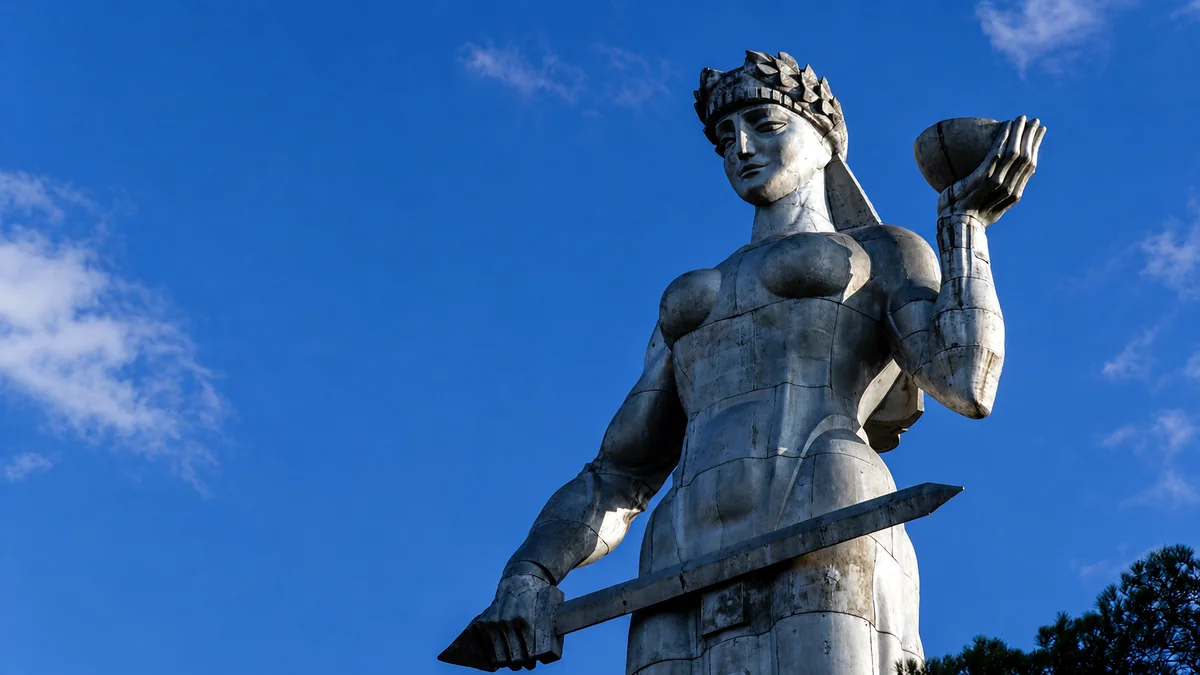
The Mother of Georgia — Kartlis Deda, "Mother of Kartli" — is a 20-meter aluminum statue on the Sololaki ridge above Tbilisi's Old Town, beside the Narikala Fortress. Designed by the Georgian sculptor Elguja Amashukeli and first erected in 1958 for the city's 1,500th anniversary, she depicts a woman in Georgian national dress holding a bowl of wine in her left hand — for those who come as friends — and a sword in her right — for those who come as enemies. The two objects capture the Georgian self-image: openness and hospitality toward guests, readiness to defend the country against threats. She's one of Tbilisi's defining landmarks, reached by cable car from Rike Park, and the ridge beside her offers some of the best views in the city.
The symbolism
The two objects she holds are worth pausing on, because they capture something real about how Georgia has understood itself. The bowl of wine in her left hand is extended toward those who arrive in peace — an expression of the hospitality that is among the most deeply held values in Georgian culture: the tradition of the supra (feast) and the tamada (toastmaster), the near-sacred obligation to feed and shelter a guest that runs through Georgian social life at every level. The sword in her right hand faces those who come with hostile intent — a reference to the long military history of a small country that has spent much of its existence defending its territory and identity against larger neighbors. The combination of radical openness to friends and readiness to fight enemies isn't a contradiction in the Georgian self-image but a single coherent stance — and Kartlis Deda expresses it with a directness more sophisticated public art rarely achieves.
The statue and its setting
The figure was designed by the Georgian sculptor Elguja Amashukeli — who also created the equestrian statue of Vakhtang Gorgasali at Metekhi across the river — and built in the form of a traditional Georgian woman in national dress. The silhouette of the long tunic and the way the garments fall are recognizably Georgian rather than generically classical, which gives the monument a specificity that generic allegorical figures lack. (Amashukeli originally titled it simply "Capital"; the people renamed it Kartlis Deda, and he was awarded the Shota Rustaveli State Prize for it in 1966.)
At 20 meters she's large enough to be a genuine landmark without being so enormous that human proportion is lost. The aluminum surface, which weathers to a slightly matte silver-grey, catches different qualities of light through the day — bright and reflective in direct midday sun, warmer and more textured in late afternoon. Her history mirrors the city's care for her: the original 1958 figure was wooden, intended as a temporary decoration for the anniversary; it proved so popular that it was made permanent, clad in aluminum in 1963, and in 1997 replaced with a faithful new version that preserves the original image and proportions — the statue that stands today.
She sits immediately beside the Narikala Fortress walls, and the two — the medieval fortification and the 20th-century monument — share the same elevated position in a pairing less incongruous than it first seems. Both express the same basic idea: that this ridge above the river is where Tbilisi asserts itself, where the city places its most public symbols of identity and defense. The fortress was built to protect the city physically; the statue to represent what the city believes itself to be. That continuity of function, across some fifteen centuries, is part of what makes the Sololaki ridge one of the most historically layered sites in Tbilisi.
The views
The views from the ridge beside the statue are among the best from any accessible point in the city. Looking north over the Old Town, the full spread of the historic district lies below — the Mtkvari making its characteristic bend, the wooden-balconied houses climbing the hillside, the Metekhi Church on its cliff across the river, the Bridge of Peace and the newer left-bank developments beyond. On clear days the view reaches well past the city to the Greater Caucasus foothills on the northern horizon. Looking south and east, the forested Sololaki slopes and the deeper valleys beyond show how quickly the urban fabric gives way to natural terrain at the city's southern edge.
Sunset is the most popular time, for good reason — the low western light catches the Old Town facades from the ideal angle, the city lights come on progressively as the light fades, and the shift from afternoon to evening seen from this height is genuinely beautiful. The ridge is busy at that hour but large enough that a clear viewpoint is only a short walk along the walls away.
Getting there
The most enjoyable approach is the cable car from Rike Park to the upper station, which sets you down by the Narikala walls, a short (3–5 minute) walk along the ridge from the statue. The walk up from the Old Town through the streets below Abanotubani is steeper but passes through characterful residential lanes and takes around 20–30 minutes at a comfortable pace. A road behind the ridge gives car/taxi access. The most satisfying way to experience both the monument and its surroundings is to ride the cable car up and walk back down through the Old Town.
Getting there and visiting
- Location: Sololaki ridge, above the Old Town, Tbilisi — beside the Narikala Fortress.
- Getting there: Cable car from Rike Park to the upper (Narikala) station, then a 3–5 minute walk along the ridge; or a 20–30 minute uphill walk from the Old Town; or by taxi via the road behind the ridge.
- Hours: Open-air, freely accessible 24 hours.
- Admission: Free.
- Best time: Sunset, for the light over the Old Town and the city lights coming on.
- Combine with: Narikala Fortress (right beside it), the cable car and Rike Park, the Leghvtakhevi gorge and Botanical Garden, Abanotubani, and the Old Town below — the whole southeastern ridge-and-Old-Town cluster.
Caucasus Travel FAQ
The Mother of Georgia — Kartlis Deda ("Mother of Kartli") — is a 20-meter aluminum statue on the Sololaki ridge above Tbilisi's Old Town, beside the Narikala Fortress. Designed by the Georgian sculptor Elguja Amashukeli and first raised in 1958 for the city's 1,500th anniversary, she depicts a woman in Georgian national dress holding a bowl of wine in her left hand (for those who come as friends) and a sword in her right (for those who come as enemies). She's one of Tbilisi's defining landmarks, visible across much of the city, and the ridge beside her gives some of the best views in Tbilisi.
They capture the Georgian self-image. The bowl of wine, held out to friends, stands for the country's deep tradition of hospitality — the supra (feast), the tamada (toastmaster), the near-sacred duty to welcome a guest. The sword, raised toward enemies, stands for the readiness to defend the country, reflecting the long history of a small nation guarding its identity against larger neighbors. The two together — open to friends, ready to fight foes — aren't a contradiction but a single coherent stance, and the statue expresses it with unusual directness.
It was designed by the prominent Georgian sculptor Elguja Amashukeli (who also made the Vakhtang Gorgasali statue at Metekhi) and first erected in 1958, the year Tbilisi celebrated its 1,500th anniversary. Amashukeli originally titled it "Capital," but locals called it Kartlis Deda and the name stuck; he won the Shota Rustaveli State Prize for it in 1966. The original 1958 figure was wooden, intended as temporary; it was made permanent and clad in aluminum in 1963, and in 1997 it was replaced with a faithful new version (preserving the original image and proportions) — the statue you see today.
The easiest and most scenic way is the cable car from Rike Park up to the Narikala station, from which it's a 3–5 minute walk along the ridge to the statue. You can also walk up from the Old Town (a steeper 20–30 minute climb through the residential lanes below Abanotubani), or come by taxi on the road behind the ridge. A popular plan is to ride the cable car up and walk back down through the Old Town. The site is open-air, free, and accessible at any hour.
Yes — both for the statue itself and, just as much, for the setting. It stands right beside Narikala Fortress, so the two are visited together, and the ridge offers some of the best views in Tbilisi: north over the Old Town, the Mtkvari, the Metekhi cliff and the Bridge of Peace, with the Greater Caucasus foothills beyond on clear days. Sunset is the most popular time, when the low light catches the Old Town and the city lights come on — the ridge gets busy then, but there's room to find a clear spot along the walls.