
The Chronicles of Georgia: Tbilisi's Monumental History in Stone and Bronze
On a hill above the Tbilisi Sea in the northern outskirts of the city, the Chronicles of Georgia rise from the landscape at a scale that stops most visitors on first sight. Sixteen massive columns, each up to around 35 meters tall, are covered from base to summit in dense relief depicting the full sweep of Georgian history and Christian faith. Created by the celebrated Georgian sculptor Zurab Tsereteli (1934–2025), the monument was begun in 1985 and left unfinished when the Soviet Union collapsed — a circumstance that adds a layer of meaning to the site, as a work never formally completed or inaugurated, yet standing as one of the most powerful artistic statements in Georgia (the country in the South Caucasus). It's well off the usual tourist trail, and the combination of the monument and the wide views over the reservoir gives a visit here a real sense of discovery.
What are the Chronicles of Georgia?
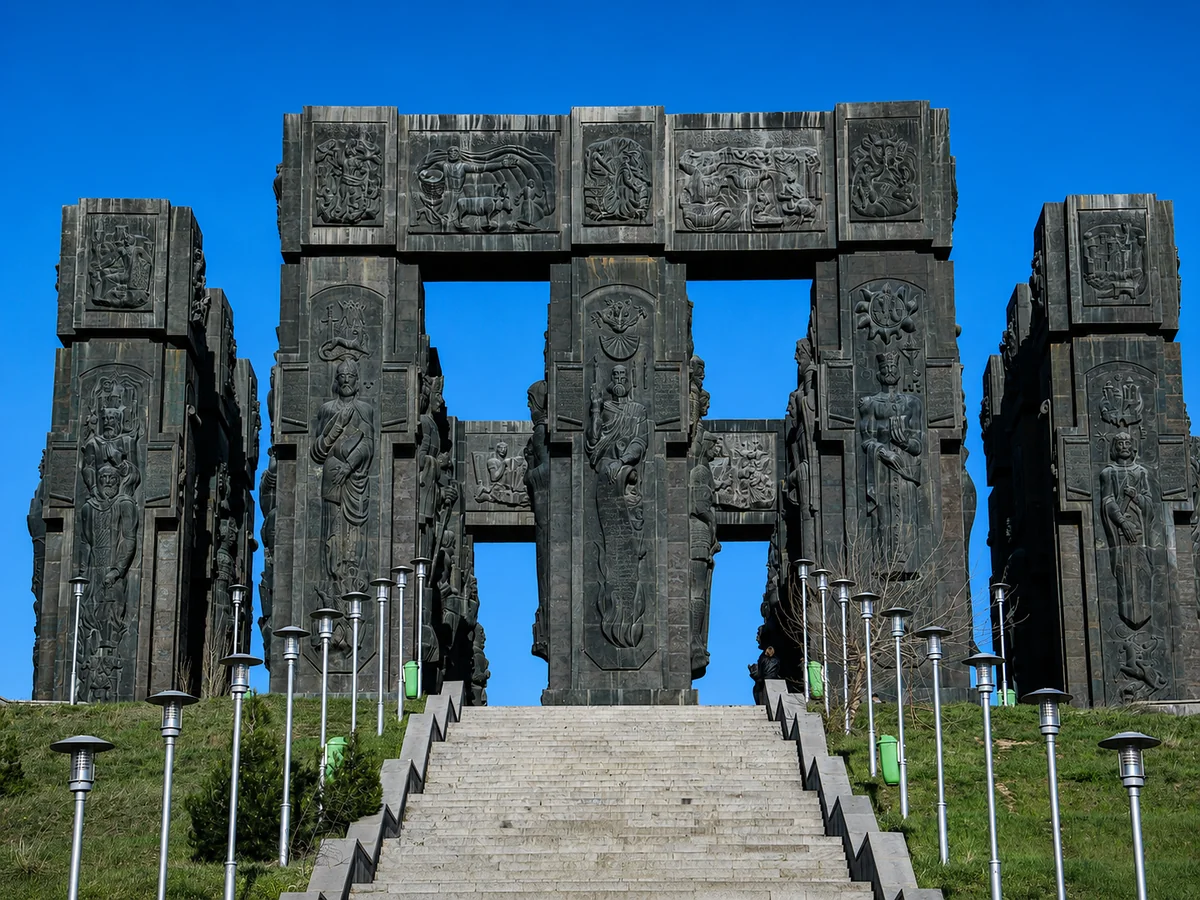
The Chronicles of Georgia (also called the History Memorial of Georgia, and nicknamed the "Georgian Stonehenge") is a monumental sculpture on Keeni Hill above the Tbilisi Sea, in the northern outskirts of Tbilisi. Created by Zurab Tsereteli from 1985 and never fully finished, it consists of 16 huge columns, up to about 35 meters tall, clad in bronze and stone relief: the upper sections depict the kings, queens, and heroes of Georgia, the lower sections scenes from the life of Christ and Georgian Christian history. It was conceived to commemorate 3,000 years of Georgian statehood and 2,000 years of Christianity. Reached by a long flight of stairs and freely open at all hours, it's a dramatic, lesser-visited landmark with sweeping views — at its best at sunset.
The monument
The sixteen columns are arranged into facing groups around a central space, reached by a grand staircase. Each column carries two iconographic programs stacked vertically. The upper sections depict the kings, queens, and national heroes of Georgia — the great rulers whose reigns defined the country's political and cultural history. The lower sections carry scenes from the life of Christ and from Georgian Christian history, grounding the nation's political story in the religious identity that has been inseparable from Georgian statehood since the 4th century. The whole was conceived as a tribute to roughly three millennia of Georgian statehood and two millennia of Christianity — a striking choice of subject given that it was begun under the officially atheist Soviet system.
The carving is dense and assured, the individual faces specific enough to reward close looking. The columns are clad in monumental bronze relief (with stone), and the dark, near-black weathered surfaces give the reliefs a heaviness and permanence that lighter materials wouldn't; in low, angled light — especially late afternoon and evening — the carved surfaces take on a three-dimensionality that photographs struggle to convey. Between and around the columns, further figures and relief panels extend the narrative into the surrounding space, so the overall effect is of a whole landscape of stone-and-bronze figures — a compressed version of Georgian history made physically present at a scale that insists on being taken seriously.
A few additional elements reward attention. At the foot of the approach stairs stands a row of statues of the Thirteen Assyrian Fathers — the 6th-century monks who, by tradition, spread Christianity and founded monasteries across Georgia (also Tsereteli's work). Near the stairway is a cross representing St. Nino's grapevine cross — the cross of vine bound with her own hair, carried by the saint credited with converting Georgia. And behind the columns sits a small chapel (dedicated to the Annunciation), modest and frescoed, in the understated manner of Georgian churches.
An unbuilt Stalin, an unfinished monument
The site has its own layered backstory. By several accounts, the hilltop had originally been set aside in the earlier Soviet period for a planned, enormous (around 100-meter) statue of Stalin that was never built — the spot sat empty for decades until Tsereteli's project was assigned to it in the 1980s. There's an irony worth sitting with: a place once intended to glorify a Soviet leader instead became a vast monument to Georgian statehood and the Christian faith. And then it, too, was overtaken by history — work began in 1985, the Soviet Union collapsed before the monument could be completed, and Tsereteli (by then based in Moscow) continued only intermittently. It has never been formally finished or inaugurated. That unfinished, unofficial quality is part of what gives the site its particular, slightly haunted power.
The setting and views
The hill overlooks the Tbilisi Sea — a large artificial reservoir built in the early 1950s — and the views from the monument across the water and the surrounding landscape are among the more expansive anywhere near Tbilisi. The site sits well out from the center, in a part of the city most visitors never reach, and the combination of the monument and the open panorama gives the visit a quality of discovery that more central attractions rarely offer.
Sunset is the most dramatic time: the low western sun catches the reliefs, the reservoir below turns gold, the columns seem to glow against the darkening sky, and the full scale of the composition becomes apparent in a way midday light flattens. The site is open-air and freely accessible at any hour, so an early-morning or late-evening visit — without other people present — is entirely possible (it's sometimes illuminated at night).
Getting there and visiting
- Location: Keeni Hill, above the Tbilisi Sea, northern outskirts of Tbilisi — well out from the center.
- Getting there: It's a fair way from the city center and not on the main tourist routes; most visitors come by taxi or as part of a tour (public transport gets you only partway, then a walk/climb). Allow time for the journey.
- Hours: Open-air, freely accessible 24 hours.
- Admission: Free; no ticket office.
- Best time: Sunset (or sunrise) for the light and the views; midday sun on the open hilltop can be harsh and hot.
- Bring: Sun protection and water (little shade); comfortable shoes for the stairs.
- Combine with: The Tbilisi Sea itself; it pairs as a half-day with a trip out of the center rather than with the Old Town sights.
Caucasus Travel FAQ
The Chronicles of Georgia (also called the History Memorial of Georgia, and nicknamed the "Georgian Stonehenge") is a monumental sculpture on a hill above the Tbilisi Sea, in the northern outskirts of Tbilisi. Created by the sculptor Zurab Tsereteli from 1985 and never fully finished, it's made up of 16 huge columns — up to about 35 meters tall — clad in bronze-and-stone relief depicting Georgian history and Christianity: the upper parts show the kings, queens, and heroes of Georgia, the lower parts scenes from the life of Christ and Georgian Christian history. It was conceived to commemorate 3,000 years of Georgian statehood and 2,000 years of Christianity, and it's reached by a long staircase, with sweeping views over the reservoir.
It was created by Zurab Tsereteli (1934–2025), the celebrated Georgian sculptor also responsible for the St. George statue on Tbilisi's Freedom Square and many large-scale works around the world. He began the monument in 1985, but the collapse of the Soviet Union and the funding problems that followed left it incomplete; Tsereteli, based in Moscow, continued only intermittently, and it was never formally finished or inaugurated. That unfinished, unofficial state is part of the site's atmosphere. Interestingly, the hilltop had reportedly once been set aside for a giant statue of Stalin that was never built — so a spot once meant to glorify a Soviet leader became a monument to Georgian statehood and faith instead.
It's a nickname based on atmosphere rather than architecture — walking among the towering columns and looking up at the carved faces of kings and saints against the sky gives a sense of being dwarfed by something on a more-than-human scale, which reminds people of Stonehenge. But unlike Stonehenge, the Chronicles are densely narrative: every surface is covered with figures, scenes, and symbols telling specific stories from Georgian history and Christianity.
Besides the main columns, look for the row of statues of the Thirteen Assyrian Fathers (the 6th-century monks who spread Christianity in Georgia) near the approach stairs, a cross representing St. Nino's grapevine cross, and a small frescoed chapel behind the columns. But the real draw alongside the monument is the setting: the hill overlooks the Tbilisi Sea, a large artificial reservoir from the early 1950s, with some of the widest views available near the city.
It's well out from the center, in the northern outskirts on Keeni Hill, and not on the main tourist routes — most visitors come by taxi or as part of a tour (public transport only gets you partway, followed by a walk and a climb up the stairs). It's open-air, free, and accessible 24 hours. The best time to visit is sunset (or sunrise), when the low light catches the reliefs and the reservoir below turns gold; midday sun on the exposed hilltop can be harsh, so bring water, sun protection, and comfortable shoes.