
Holy Trinity Cathedral (Sameba): Tbilisi's Great Modern Cathedral
The Holy Trinity Cathedral — Tsminda Sameba in Georgian — stands on Elia Hill in the Avlabari district, on the left bank of the Mtkvari in Tbilisi, capital of Georgia (the country in the South Caucasus). Its gold-covered dome rises around 84–87 meters above the city and is visible from an extraordinary range of vantage points across Tbilisi. It is the largest cathedral in Georgia, the seat of the Catholicos-Patriarch of All Georgia, and one of the tallest Orthodox Christian churches in the world. Consecrated in 2004 after roughly a decade of construction, it was built to mark the 1,500th anniversary of the autocephaly of the Georgian Orthodox Church and the 2,000th anniversary of Christianity — conceived not merely as a place of worship but as a physical statement about the continuity and post-Soviet revival of Georgian religious and national identity.
What is Sameba Cathedral?
Sameba (the Holy Trinity Cathedral) is the main cathedral of the Georgian Orthodox Church and the largest church in Georgia, standing on Elia Hill above the Avlabari district of Tbilisi. Designed by the architect Archil Mindiashvili and consecrated on 23 November 2004 (St. George's Day), it's a vast modern cathedral in a synthesis of historic Georgian styles, with a gold-covered central dome rising around 84–87 meters (and over 100 meters measured from its foundation in the hillside) — making it the tallest church in the country and among the tallest Orthodox churches in the world. It was built to commemorate 1,500 years of the Georgian Church's autocephaly and 2,000 years of Christianity, and funded largely by donations. It's an active cathedral, free to enter, and its golden dome is one of Tbilisi's defining landmarks.
A landmark unlike the city's others
Among Tbilisi's landmarks, Sameba occupies an unusual position. It's neither ancient nor architecturally experimental — it draws on the established vocabulary of medieval Georgian church architecture rather than attempting anything new — but its scale, hilltop position, and significance to the Georgian Orthodox community give it a presence and atmosphere that make it worth visiting, not just seeing from a distance. It was, notably, the one large-scale building project Georgia undertook during the 1990s — one of the darkest periods of the country's modern history, marked by civil war, economic collapse, and shortages of even electricity and running water — which says something about the symbolic weight invested in it.
Architecture and exterior
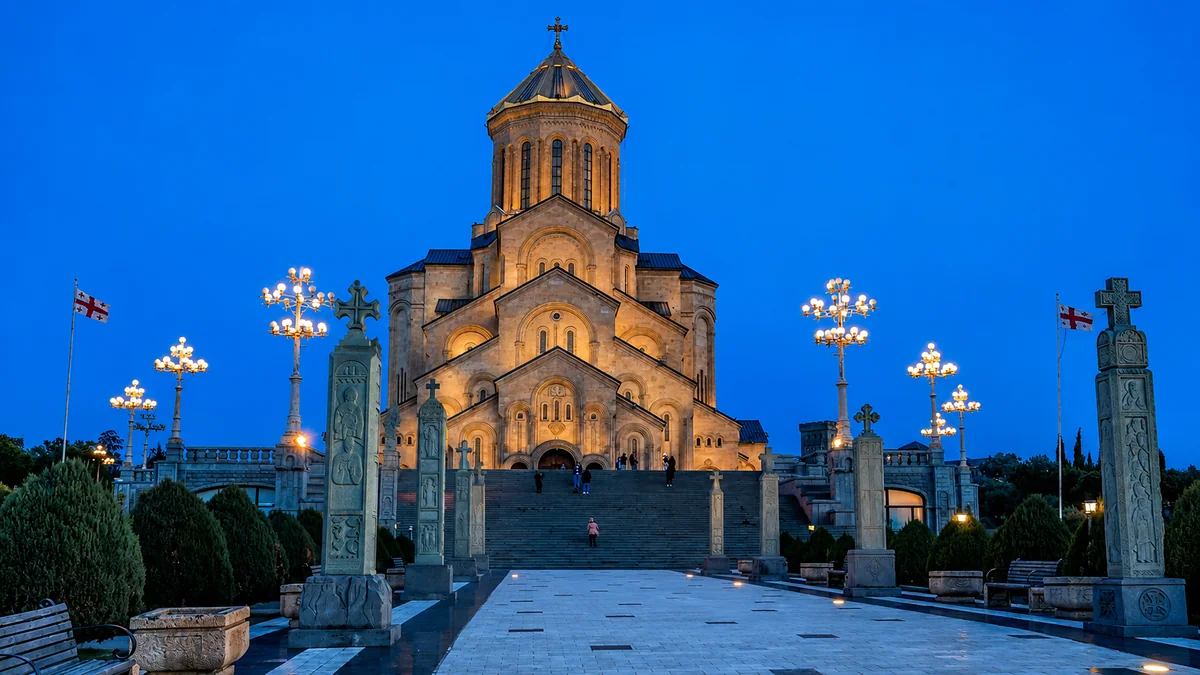
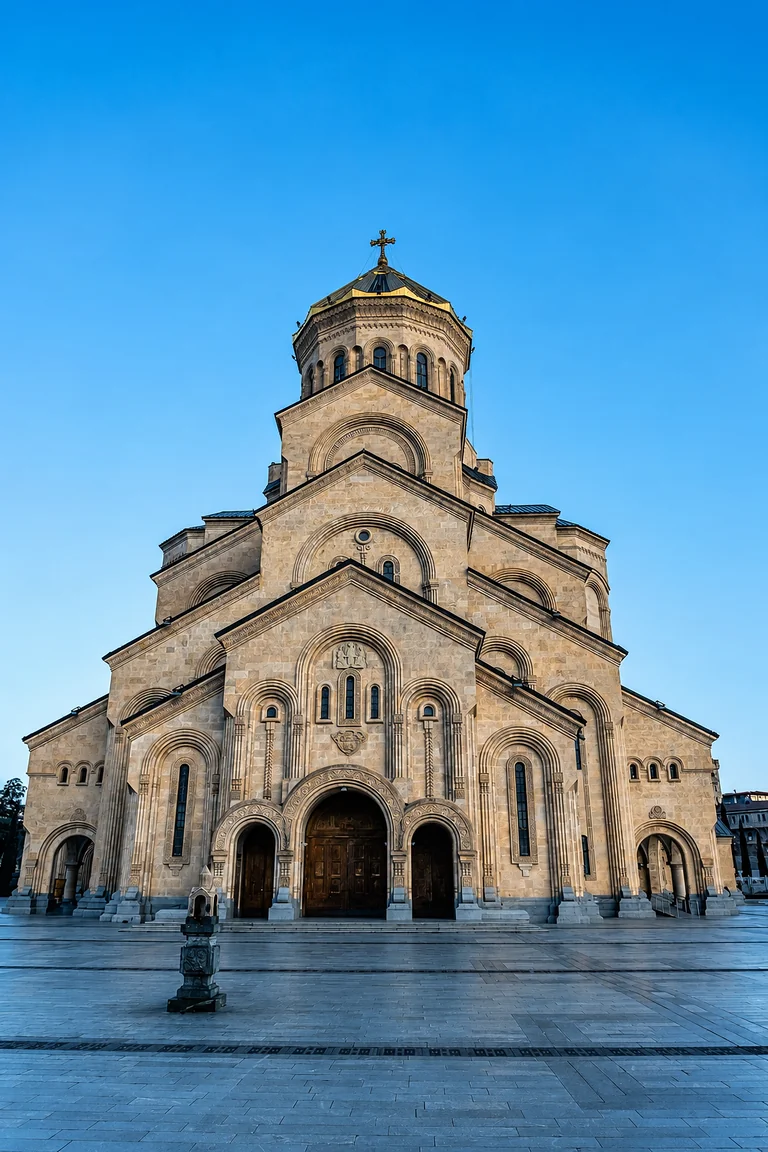
The cathedral consciously references the great medieval Georgian churches — the cruciform plan, the carved stone ornament, the conical drum and dome — while working at a scale medieval builders never attempted. Architecturally it's a cross-dome cathedral: a cruciform plan with a central dome carried on eight pillars and four smaller domes around it, synthesizing styles from different periods of Georgian church architecture with Byzantine undertones. What sets it apart from older Georgian churches is its pronounced verticality — the emphasis is upward, the effect closer to a single many-bulwarked tower than the compact, grounded form of the medieval churches it echoes. The result feels at once traditional and overwhelming, the familiar Georgian vocabulary amplified to dimensions that make even the largest medieval churches in the country look modest.
The exterior is clad in warm, light-toned stone in the Georgian tradition, which shifts through different registers with the light — pale and bright at midday, warm and saturated in late afternoon, almost amber at sunset when the low light catches the carved relief. The gold-covered dome and cross are the dominant feature from a distance and the element most visible across the city. Up close, the carved stone ornament repays examination — the decorative programs reference medieval Georgian motifs, executed by contemporary craftsmen working in a tradition over a thousand years old. Because the foundation is built into the hillside, the rear of the church sits partly underground, which is why its height measured from the foundation (over 100 meters) far exceeds its visible height above the courtyard.
The complex extends well beyond the main church: a bell tower, a lower/underground church, the Patriarch's residence, a seminary and monastery, ecclesiastical offices, gardens with viewpoints over the city, and a large paved courtyard for the substantial gatherings on major feast days — the whole precinct enclosed within walls on the hilltop.
A site with a contested history
The choice of site carries a difficult history that's worth knowing. Elia Hill was the location of Khojivank (Khojavank), a historic Armenian cemetery, and its Holy Mother of God (St. Astvatsatsin) church. The church and most of the cemetery had already been destroyed in the Soviet period (in the 1930s), and the area turned into a park; but graves remained, and during the cathedral's construction much of what was left was destroyed, with reports of unearthed remains and gravestones — which caused significant controversy and lasting hurt in the Armenian community. A small remnant survives nearby as the Armenian Pantheon of Tbilisi. The cathedral is venerated by many Georgians as a symbol of national and spiritual revival; for many Armenians the same site carries a painful loss. Both of those are true, and a visitor is better for knowing it.
Interior
The interior is vast, with the central space rising to a height that dwarfs the human figure — the vertical immensity that has been a deliberate effect of church architecture since the Byzantine period. The huge dome admits more light than older Georgian churches, making the central space notably brighter; the walls and dome carry fresco and mosaic work in the medieval Georgian iconographic tradition (by the artist Amiran Goglidze), and the gilded iconostasis catches the light from candles and high windows. The cathedral is relatively spare compared with some older churches, but it holds many of Georgia's most important icons.
The atmosphere is shaped as much by use as by architecture. Sameba is in continuous daily use, and at almost any hour people are present — some at services, some praying privately at the icon stands along the walls, some simply sitting in the quiet of the great space. That living worshipping community, rather than a museum-like stillness, is one of the more memorable aspects of a visit.
Visitors are expected to dress modestly — shoulders and knees covered, women with heads covered (headscarves are usually available at the entrance). Photography is generally permitted in the main interior but not during services, and the usual courtesies of an active place of worship apply throughout.
The surrounding area
The hilltop gives good views over the eastern parts of Tbilisi and across the city, though Narikala and Mtatsminda offer more sweeping panoramas. The approach passes through Avlabari — one of Tbilisi's older residential neighborhoods, historically Armenian in character (a connection that makes the Khojivank history all the more pointed) — and the streets around the cathedral's base are worth walking for their own interest: traditional houses, small churches, and ordinary neighborhood life continuing around the edges of the great ecclesiastical complex above.
Getting there and visiting
- Location: Elia Hill, Avlabari district, Tbilisi — left bank of the Mtkvari.
- Getting there: About a 10–15 minute uphill walk from Avlabari metro station, or 15–20 minutes uphill from Rike Park; also reachable by taxi. The golden dome is visible from much of central Tbilisi, so it's easy to orient toward.
- Hours: Open daily, roughly 08:00–20:00; services held through the day (visit outside service times for a fuller look, or quietly during them).
- Admission: Free.
- Dress code: Modest dress required — shoulders and knees covered; women cover their heads (scarves usually available at the entrance).
- Combine with: Avlabari's streets and the Armenian Pantheon; Rike Park, the cable car, and the Bridge of Peace below; the Old Town across the river.
Caucasus Travel FAQ
Sameba — the Holy Trinity Cathedral (Tsminda Sameba) — is the main cathedral of the Georgian Orthodox Church and the largest church in Georgia, standing on Elia Hill above the Avlabari district of Tbilisi. Designed by the architect Archil Mindiashvili and consecrated in 2004, it's a vast modern cathedral with a gold-covered central dome rising around 84–87 meters, making it the tallest church in Georgia and one of the tallest Orthodox churches in the world. It was built to commemorate 1,500 years of the Georgian Church's autocephaly and 2,000 years of Christianity, and its golden dome is one of Tbilisi's defining landmarks, visible from across the city.
Construction ran from 1995 to 2004 — the cathedral was consecrated on 23 November 2004, St. George's Day. It was conceived as a symbol of Georgian national and spiritual revival after the Soviet period, marking two great anniversaries: 1,500 years of the autocephaly (self-governance) of the Georgian Orthodox Church and 2,000 years since the birth of Christ. Notably, it was the one large-scale building project Georgia undertook during the 1990s — a decade of civil war, economic collapse, and severe shortages — which gives a sense of the symbolic weight placed on it. It was funded largely by donations.
It deliberately draws on the medieval Georgian church tradition — a cruciform, cross-dome plan with a central dome carried on eight pillars and four smaller domes around it, in a synthesis of historic Georgian styles with Byzantine undertones — but at a scale far beyond anything medieval builders attempted, and with a pronounced upward, vertical emphasis uncommon in older Georgian churches. The exterior is clad in warm, light-toned stone with carved relief ornament, topped by a gold-covered dome and cross. Because the foundation is built into the hillside, the rear sits partly underground, so its height measured from the foundation exceeds 100 meters. Inside, the huge dome makes the central space brighter than most older Georgian churches; it holds frescoes, mosaics, a gilded iconostasis, and many of Georgia's most important icons.
Yes, and it's worth knowing. The cathedral stands on Elia Hill, the site of Khojivank (Khojavank), a historic Armenian cemetery and its church. Most of the cemetery and the church had already been destroyed in the Soviet period, but graves remained, and much of what was left was destroyed during the cathedral's construction, with reports of unearthed remains — which caused significant controversy and lasting hurt in the Armenian community. A small surviving remnant is preserved nearby as the Armenian Pantheon of Tbilisi. The cathedral is deeply venerated by many Georgians as a symbol of revival; for many Armenians the same site represents a painful loss. Both are part of its story.
It's on Elia Hill in Avlabari — about a 10–15 minute uphill walk from Avlabari metro, or 15–20 minutes up from Rike Park, and easy to orient toward since the dome is visible from much of the city. It's open daily (roughly 08:00–20:00), with free entry; services run through the day, so visiting outside service times gives a fuller look. Dress modestly — shoulders and knees covered, and women cover their heads (scarves are usually available at the entrance). Photography is generally fine in the main interior but not during services. It's an active cathedral, so the usual respect for a place of worship applies.