
Uplistsikhe: Georgia's Ancient Rock-Hewn Cave Town
Uplistsikhe is carved into a sandstone cliff above the north bank of the Mtkvari River, about 10–15 kilometers east of Gori, in the Shida Kartli region of Georgia (the country in the South Caucasus). A rock-cut city of roughly 3,000 years' standing, it was one of the most important urban and religious centers of the Kartli region for well over a millennium — a pre-Christian cult center, then a royal stronghold, its streets, halls, temples, and tunnels cut directly into the living rock. The name means "the lord's fortress" (Georgian tradition ascribes its founding to the legendary Uplos), and what you walk through today is the layered record of a single hilltop's transformation from pagan sanctuary to Christian town across three millennia. It's the headline archaeological site of central Georgia, and the centerpiece of any Gori-area day.
What is Uplistsikhe?
Uplistsikhe is an ancient rock-hewn town carved into a sandstone outcrop above the Mtkvari River, about 10–15 km east of Gori in Shida Kartli, central Georgia. One of the oldest urban settlements in the country, it dates back roughly 3,000 years (to the late Bronze / early Iron Age) and was a major political and religious center of pre-Christian Kartli — a cult center for a sun goddess, later a royal stronghold during the Arab occupation of Tbilisi. Hundreds of rooms, halls, tunnels, and streets are cut into the rock across three levels over some 40,000 m², including the famous coffered-ceiling "Hall of Queen Tamar," a "pharmacy," wine-pressing pits, a rock-cut theatre, and a 9th–10th-century Christian basilica crowning the summit. Largely destroyed by the Mongols in the 13th century and then abandoned, it's now a museum-reserve and one of Georgia's most remarkable sites. It's on the UNESCO Tentative List.
History: pagan sanctuary to Christian town
The earliest traces of settlement at Uplistsikhe go back to around the late 2nd / early 1st millennium BC — making it one of the oldest urban sites in Georgia, with a story spanning roughly 3,000 years. For centuries before Christianity it was one of the most important political and religious centers of pre-Christian Kartli (the kingdom the classical world knew as Iberia), and a place of pagan worship — archaeologists have found temples and material linked to a sun goddess cult.
When Christianity became the Georgian state religion in the 4th century, Uplistsikhe lost ground to the new Christian centers of Mtskheta and Tbilisi — but it didn't die. It found a second life: during the Arab occupation of Tbilisi (8th–10th centuries), the Christian rulers of Kartli used Uplistsikhe as a principal stronghold and residence, and it flourished again as a town and a stop on the caravan trade between Asia and Europe. Its political purpose faded once King David the Builder retook Tbilisi in 1122, and the Mongol raids of the 13th century (around 1240) brought its long life to an end. After that it was largely abandoned, used only occasionally as a refuge, and gradually buried under soil and sand until Soviet archaeologists began uncovering it in 1957 (parts had also been lost to the 1920 earthquake that struck the region).
Walking the city
Moving through Uplistsikhe is unlike any other archaeological visit in Georgia. The arrival itself is part of it — from a distance the cliff looks like an unremarkable pale ridge, then the dark openings resolve into rows of windows and doorways and the rock becomes, suddenly, a city. The carved spaces keep their forms with the clarity sandstone allows: smooth walls and ceilings still bearing tool marks, clear floor levels, and spatial relationships that read as genuine urban planning. Threading through the internal tunnels, emerging onto open terraces above the Mtkvari, and climbing between the levels gives a physical sense of how the place was lived in that no museum case can match. The complex spreads over about 40,000 m² across three levels (lower, central, upper), and of an original ~700 rock-cut rooms, roughly 150 survive today.
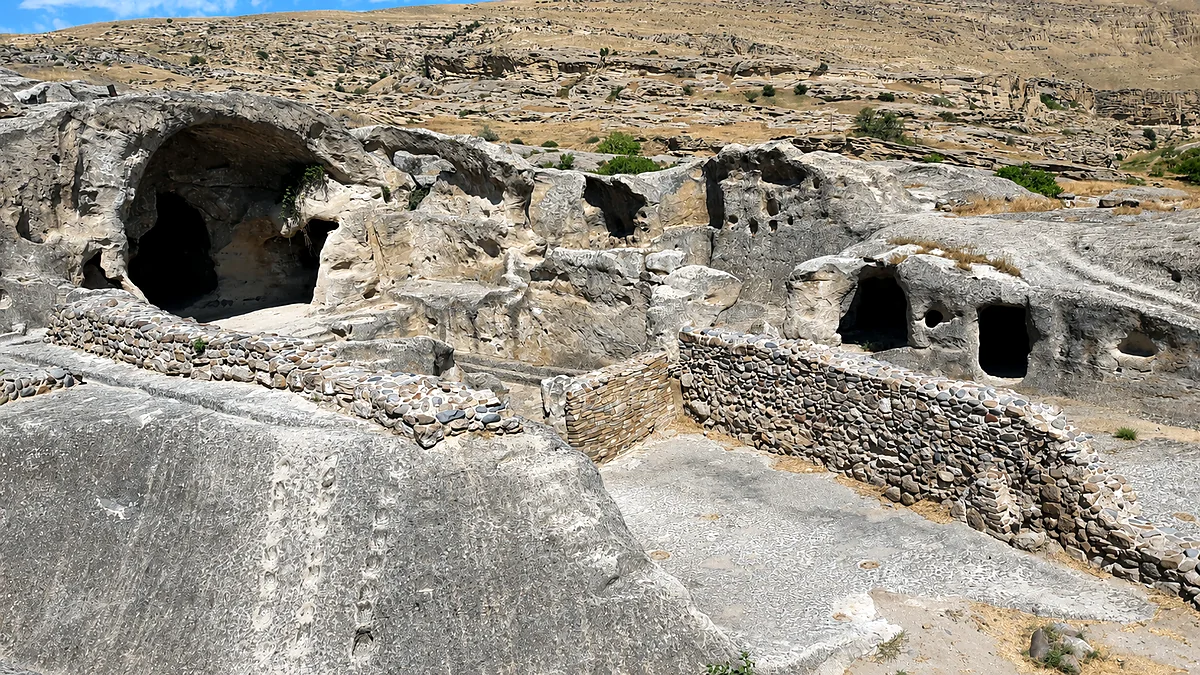
Several spaces stand out. The most celebrated is the "Hall of Queen Tamar" (Tamaris Darbazi) — a large ceremonial hall whose stone ceiling is carved to imitate the coffered beams of a timber roof, the carvers reproducing in permanent rock the forms of the wooden architecture they also built. (The name is traditional and honorific: Queen Tamar is firmly associated with the cave town of Vardzia, not Uplistsikhe, and almost certainly never lived here.) The so-called pharmacy (or apothecary), identifiable by carved stone shelving sized for vessels — with traces of medicinal herbs found in it — points to the scholarly character of the city's religious establishment. A rock-cut theatre near the main gate, possibly 1st–2nd century AD, still carries sound from its center to the back rows, its acoustics no accident; it may have hosted religious mystery plays as much as performances. And wine-pressing pits, storage chambers, a bakery, and water channels document the everyday economy of a self-sufficient town.
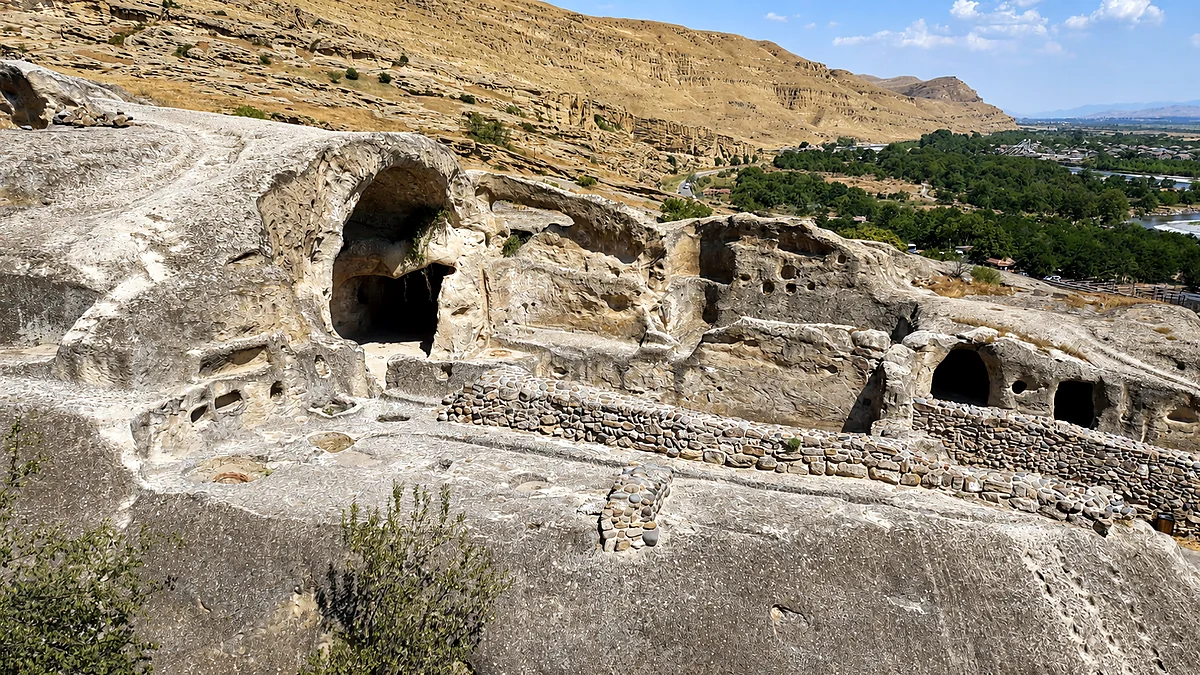
The layers of religion, in stone
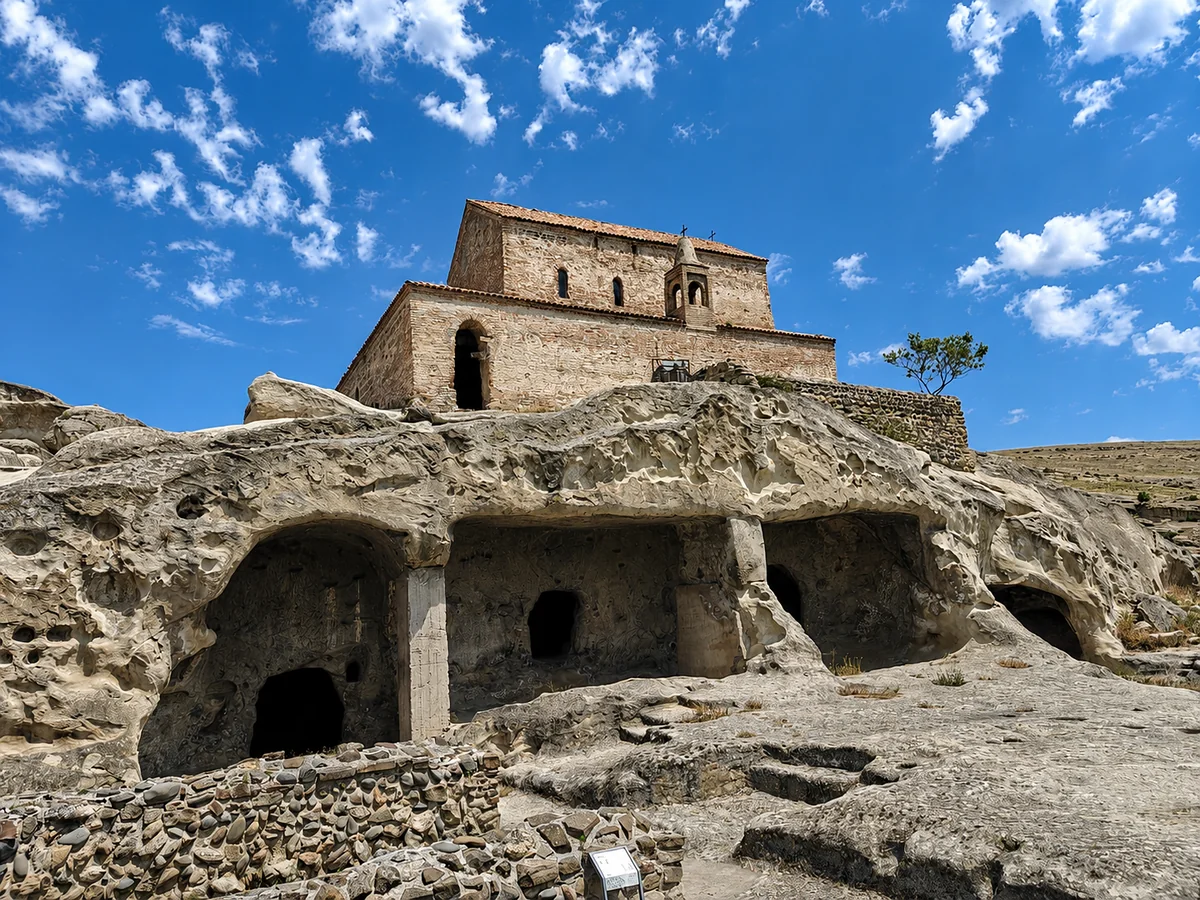
Uplistsikhe's great theme is the layering of faiths within a single site. The pre-Christian temple spaces are still identifiable in their orientation and organization, even where the specific rituals are less documented than the rooms themselves. After Christianity arrived, the old religious structures were modified or replaced: an early rock-cut basilica was carved in the 6th century, and at the very summit a three-church basilica of stone and brick was built in the 9th–10th centuries — the Uplistsulis Eklesia, or "Prince's Church" — raised directly over what was almost certainly the town's most important pagan temple, and partly from stone salvaged from earlier sacred buildings. It was one of the few structures to survive the Mongol destruction, and it remains a functioning church today. That physical stacking of pagan temple, early Christian basilica, and medieval church within one outcrop is one of the most eloquent things about the site.
The setting and the views
Uplistsikhe's position above the Mtkvari gives it sweeping views that are part of the pleasure of a visit: the river below the cliff, the Shida Kartli plain reaching out in both directions, and the hilltop of Gori Fortress visible to the west. The landscape here is open, dry, and exposed — quite different from the forested hills to the north or the lush valleys of western Georgia — and that spaciousness and light suit the site's ancient character.
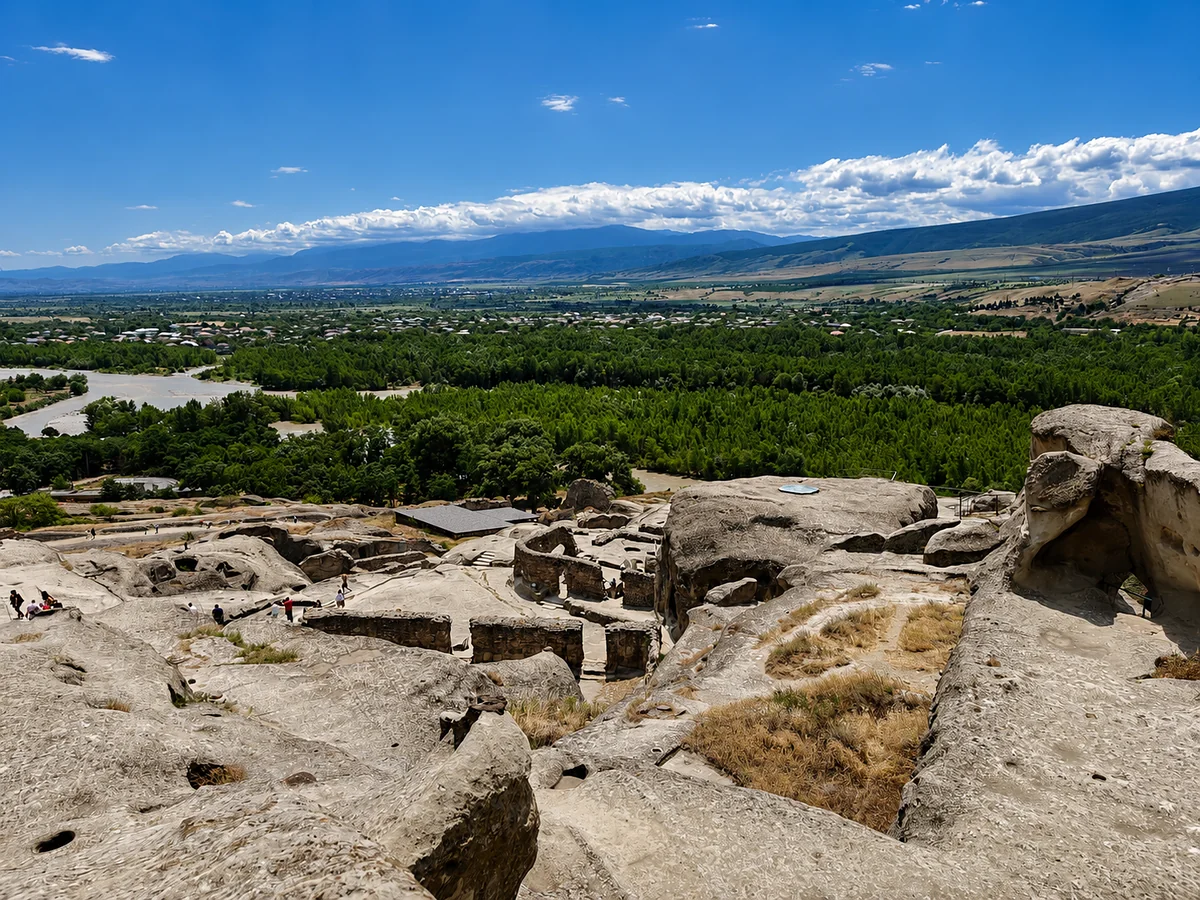
A practical note: the sandstone surfaces take direct sun, and the cliff reflects heat, so midday in summer is hot — early morning (or late afternoon) is the most comfortable time for an unhurried exploration, and also the best light. Footwear with grip is essential: centuries of foot traffic have polished the carved floors, especially in the tunnels, and the worn sandstone can be slippery.
Getting there and visiting
- Location: Near Uplistsikhe village, Gori municipality, Shida Kartli, Georgia — about 10–15 km east of Gori along the north bank of the Mtkvari.
- Getting there: A short taxi ride from Gori (roughly 15 minutes). From Tbilisi it's around 1.5 hours; most visitors come on a Gori day trip. By public transport, a marshrutka along the Tbilisi–Gori road drops you at the Uplistsikhe junction, from where it's a walk or short local taxi to the entrance.
- Admission: Paid entry at the site entrance; a small museum at the entrance gives archaeological context and is worth a look before you walk the site.
- Combine with: Gori Fortress and the Stalin Museum (the classic Gori day), plus the Giorgi Tatulashvili ceramics studio and Ateni Sioni nearby — covering pagan antiquity, the medieval, and the 20th century in one day. Often paired with Mtskheta on the Tbilisi side.
Caucasus Travel FAQ
Uplistsikhe is an ancient rock-hewn town carved into a sandstone cliff above the Mtkvari River, about 10–15 km east of Gori in the Shida Kartli region of central Georgia. One of the oldest urban settlements in the country — roughly 3,000 years old — it was a major political and religious center of pre-Christian Kartli, a cult site and later a royal stronghold. Hundreds of rooms, halls, tunnels, and streets are cut into the rock across three levels, including the famous coffered-ceiling "Hall of Queen Tamar," a "pharmacy," wine-pressing pits, a rock theatre, and a 9th–10th-century church at the summit. It's one of Georgia's most remarkable sites and the centerpiece of a Gori day trip.
Very old — the earliest traces of settlement date to around the late 2nd / early 1st millennium BC, so the site spans roughly 3,000 years of history. It flourished as a pre-Christian center of the Kartli kingdom, had a second life as a stronghold during the Arab occupation of Tbilisi (8th–10th centuries), declined after King David the Builder retook Tbilisi in 1122, and was largely destroyed by the Mongols in the 13th century, after which it was abandoned. It was rediscovered and excavated by Soviet archaeologists from 1957.
The site spreads over about 40,000 m² across three levels, with around 150 of an original 700 or so rock-cut spaces surviving. Highlights include the "Hall of Queen Tamar," a ceremonial hall whose stone ceiling is carved to imitate a wooden beamed roof; a carved "pharmacy" with stone shelving (where traces of medicinal herbs were found); a rock-cut theatre with surprising acoustics; wine-pressing pits and storage rooms; pre-Christian temple spaces; and, crowning the summit, the 9th–10th-century "Prince's Church," a stone-and-brick basilica built over the site's main pagan temple and still in use. Moving through the tunnels and out onto the terraces above the Mtkvari is the real experience.
No — despite the name of its most famous hall (the "Hall of Queen Tamar"), Queen Tamar is firmly associated with the cave town of Vardzia, not Uplistsikhe, and almost certainly never lived here. The hall's name is traditional and honorific rather than historical. It's a genuinely impressive space, though: a large ceremonial hall whose stone ceiling was carved to imitate the coffered beams of a timber roof — the craftsmen reproducing in permanent rock the wooden architecture of their day.
It's about 10–15 km east of Gori along the Mtkvari valley road — a 15-minute taxi ride from Gori, or roughly 1.5 hours from Tbilisi. Most people visit on a Gori day trip; by public transport, a marshrutka on the Tbilisi–Gori road drops you at the junction, from where it's a short walk or local taxi to the entrance. Entry is paid, with a small museum at the entrance worth a look first. It combines naturally with Gori Fortress and the Stalin Museum (the classic Gori day), and with the Giorgi Tatulashvili ceramics studio and Ateni Sioni nearby — and is often paired with Mtskheta toward Tbilisi. (Confirm current hours and ticket price before you go.)