
The Stalin Museum in Gori: A Soviet Shrine, Read Critically
The Joseph Stalin Museum in Gori is one of the most visited and most debated museums in Georgia (the country in the South Caucasus) — not for the quality of its exhibitions, but for what it is, what it chooses to show, and what it leaves out. Built in the 1950s in the reverential, carefully selective, entirely uncritical manner of Soviet commemoration, it has barely been revised since, and it survives today as a remarkably intact piece of Soviet-era memorial culture — which, for a thoughtful visitor, is exactly what makes it worth seeing. It's the main reason most travelers come to Gori, and it works best approached as a document of how political power shapes historical memory, rather than as an objective account of its subject.
What is the Stalin Museum?
The Joseph Stalin Museum is a museum complex in central Gori, in the Shida Kartli region of Georgia, dedicated to Joseph Stalin (born here in 1878). It has three parts: a grand 1957 exhibition building, the modest house where Stalin was born (preserved under a neoclassical pavilion built in 1937), and his personal armored railway carriage. The exhibition presents Stalin's life in the celebratory, hagiographic style of its Soviet origins and largely omits the atrocities of his rule — the Great Terror, the Gulag, the famine of forced collectivization, the mass deportations — making the museum itself a striking, almost unchanged artifact of Soviet commemoration. It's Gori's main attraction and a common day trip from Tbilisi (about 85 km), best visited with prior knowledge and a critical eye.
Stalin and Gori
Stalin was born in Gori in 1878 as Ioseb Jughashvili, the son of a cobbler and a washerwoman, in genuinely poor circumstances. He grew up here, was educated at the local church school, and left for a seminary in Tbilisi and then the revolutionary world that would carry him to the leadership of the Soviet Union. His connection to Gori is real and biographical, not invented — and the city's relationship with its most famous son is itself a subject of interest: a complicated mix of local pride, Soviet-era institutional momentum, and the discomfort that serious reckoning with Stalin's legacy inevitably produces. Surveys still show a significant share of Georgians, especially older and rural ones, holding some positive view of Stalin as "a Georgian who ruled the world," while younger Georgians overwhelmingly see him as a dictator responsible for immense suffering — including suffering inflicted on Georgia itself.
A note on what the museum shows — and doesn't
This is the essential thing to understand before visiting. The exhibition is a near-complete survival of Soviet hagiography: photographs, documents, maps, personal effects, and the lavish gifts foreign delegations sent him, arranged chronologically to present Stalin as a humble-born genius, revolutionary, and victorious wartime leader. It is detailed and, on the bare facts of his life and career, often informative.
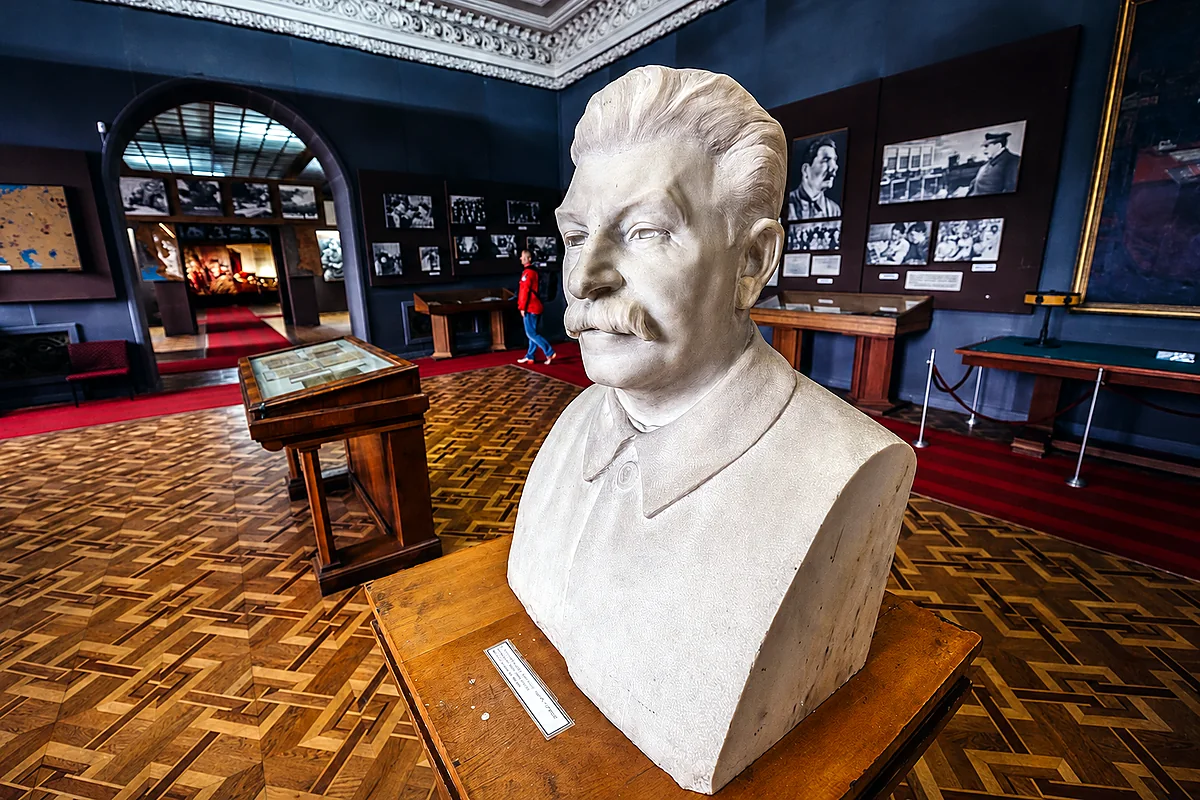
What it systematically leaves out is just as informative. The Great Terror, the Gulag, the forced collectivization that killed millions by starvation, and the mass deportation of entire peoples — the documented, systematic atrocities of Stalin's rule — are essentially absent from the main exhibition as a coherent account. This is not a neutral gap but an active curatorial choice, made in one political context and maintained through later ones in which revision was possible. Reading the museum as that choice — as a study in how regimes shape memory — is what gives the visit its real value, and visitors who arrive with that frame tend to find it far more rewarding than those expecting either objectivity or a simple object display.
There is one partial exception: after the 2008 Russo-Georgian War, the museum added a small, easily missed "Hall of Repressions" — a single modest room, mostly English-language panels, with brief acknowledgement of the purges and some victims' names. It's worth seeking out, but it sits off to the side and doesn't alter the overwhelmingly celebratory main narrative; the contrast between it and the reverential halls (and the Stalin-themed souvenirs in the gift shop) captures the museum's conflicted, unresolved post-Soviet identity exactly.
The complex
The main building (1957). A substantial Stalinist-style structure of cream limestone, designed by the Georgian architect Archil Kurdiani specifically to house the exhibition — its colonnaded grandeur speaking the official architectural language of Soviet importance. A red-carpeted marble staircase leads up to a statue of Stalin and the chronological galleries beyond.
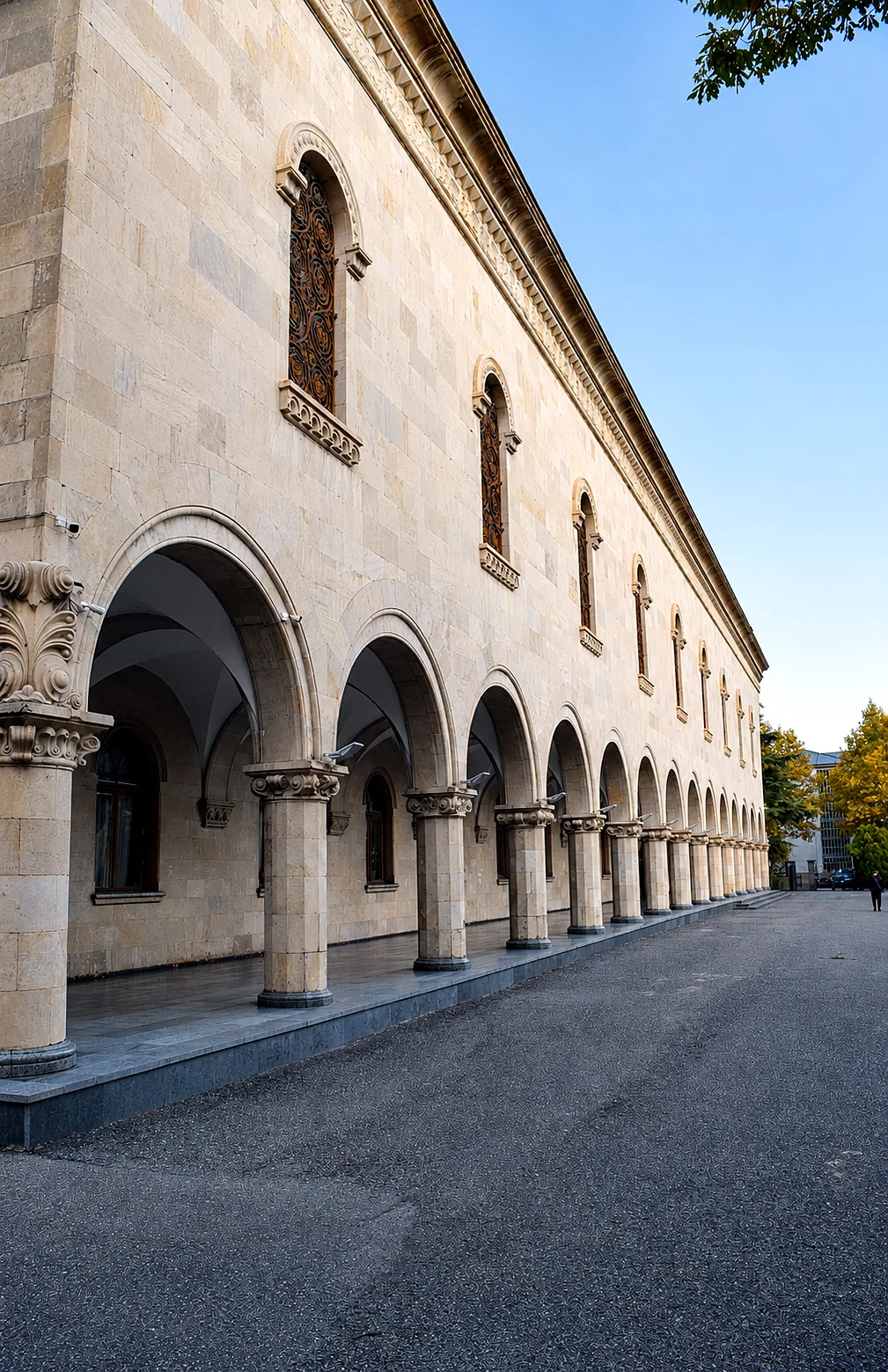
There's an irony in the dates worth knowing. The birthplace house became a memorial museum in 1937, during Stalin's lifetime and at the height of his cult — but the main museum building opened only in 1957, four years after his death in 1953, and a year after Nikita Khrushchev's 1956 "Secret Speech" had begun denouncing Stalin elsewhere in the USSR. Built in his hometown just as Stalin statues were coming down across the Soviet Union, it can be read partly as a conciliatory gesture toward strong local Georgian feeling — which makes the building itself part of the story it tells.
The birthplace house. The small brick-and-timber house where Stalin was born — two tiny rooms, the family's quarters and the father's cobbler workshop, the home of a family at the bottom of the economic ladder in late-19th-century Georgia — stands in the grounds, enclosed within the grand neoclassical pavilion built over it in 1937. The contrast between the scale of the origin and the scale of the power later exercised is one of the quietly striking things about the complex; the temple-like shelter over the humble house is the transformation of a biographical fact into an object of political devotion, made architectural.
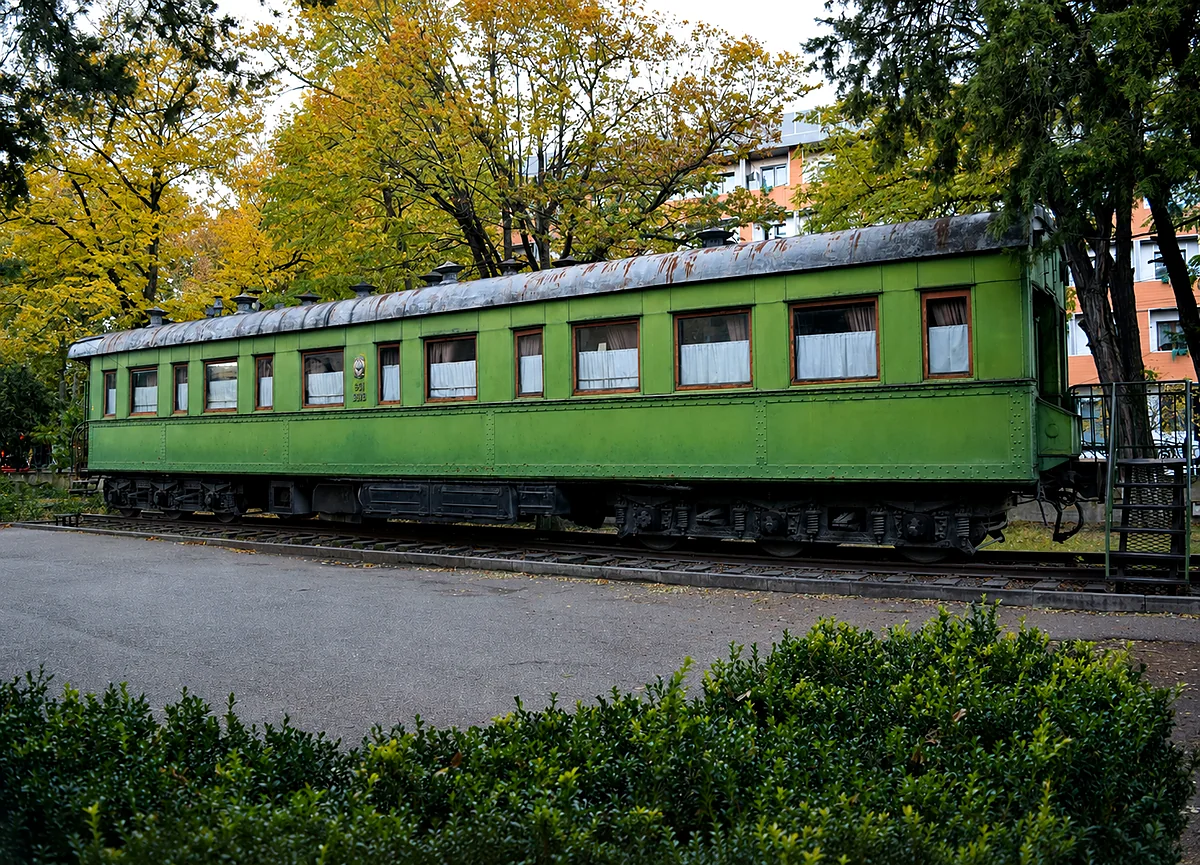
The railway carriage. Stalin's personal carriage stands in the grounds and is part of the standard visit. It's heavily armored — the metal cladding and reinforced windows reflecting the security anxieties of a man with no shortage of enemies — and fitted inside for extended travel in controlled isolation (he used it to reach the Yalta, Tehran, and Potsdam conferences). The pairing of domestic detail with military engineering gives the carriage a quality of revealing paradox the formal halls don't reach: Stalin slept, worked, and moved across the territory he controlled in a vehicle built to keep him mobile and safe at once.
Visiting with context
The museum rewards preparation. A little prior reading on Stalin's full history — the purges, the famine, the camps that the exhibition won't cover — gives you the baseline to read the galleries critically (Simon Sebag Montefiore's Young Stalin and Stalin: The Court of the Red Tsar, or Timothy Snyder's Bloodlands, are good starting points). Be aware that the museum's own guides are sometimes long-serving staff whose interpretation reflects the traditional reverential approach, so independent critical engagement is worthwhile; a guide willing to address the silences as well as the content adds a great deal. For the other side of the story, the Museum of Soviet Occupation in Tbilisi (within the Georgian National Museum) gives the critical, victim-centered account of the Soviet and Stalin years that Gori does not — a natural counterweight if you're spending time in the capital.
The debates within Georgia about what to do with the museum — add critical context, rename it, recast it as a "Museum of Soviet Occupation," or close it — have run since independence without resolution. The central-square Stalin statue was removed in 2010; a 2012 Gori council vote stopped a planned change of content; the reform proposals have repeatedly stalled against strong local feeling. Those unresolved debates are themselves part of the museum's present meaning, and a live example of how post-Soviet societies reckon with difficult histories.
Getting there and visiting
- Location: Stalin Avenue, central Gori, Shida Kartli, Georgia.
- Getting there: Gori is about 85 km west of Tbilisi, an easy day trip; the museum is in the city center. Many operators offer guided Gori day trips (often with Uplistsikhe, and sometimes Mtskheta) that include the museum.
- Admission: Paid entry; the ticket covers the main building, birthplace house, and railway carriage.
- Duration / nearby: Allow around 90 minutes to two hours for the complex. Combine with Gori Fortress, the Giorgi Tatulashvili ceramics studio, and nearby Uplistsikhe and Ateni Sioni for a full Shida Kartli day.
Caucasus Travel FAQ
It's a museum complex in central Gori, in the Shida Kartli region of Georgia, dedicated to Joseph Stalin, who was born in the town in 1878. It has three parts: a grand 1957 exhibition building, the modest house where Stalin was born (preserved under a 1937 neoclassical pavilion), and his personal armored railway carriage. The exhibition presents Stalin's life in the celebratory style of its Soviet origins and largely omits the atrocities of his rule, which makes the museum itself a striking, near-unchanged artifact of Soviet commemorative culture. It's Gori's main attraction.
The birthplace house was turned into a memorial museum in 1937, during Stalin's lifetime. The main museum building, however, opened in 1957 — four years after Stalin's death and a year after Khrushchev's 1956 "Secret Speech" had begun denouncing him elsewhere in the USSR. So the shrine in his hometown was completed just as Stalin statues were being removed across the Soviet Union, which is part of what makes the building itself historically interesting: it reflects strong local Georgian feeling about a native son even as official policy was turning against his cult.
Largely no — and this is the key thing to know before visiting. The main exhibition presents Stalin in a celebratory, hagiographic light and essentially leaves out the Great Terror, the Gulag, the famine caused by forced collectivization, and the mass deportations as a coherent historical account. After the 2008 war a small, easily missed "Hall of Repressions" was added, with brief acknowledgement of the purges and some victims, but it doesn't change the overwhelmingly reverential main narrative. The museum is best understood as a document of how a regime shaped memory; for the critical, victim-centered account, the Museum of Soviet Occupation in Tbilisi is the counterweight.
Yes — but for what it is rather than what it claims to be. Few museums anywhere preserve their original Soviet-era presentation so completely, so moving through it is itself an encounter with Stalin-era memorial culture, and the armored railway carriage and the humble birth house are genuinely striking. It rewards visitors who come prepared, with some prior knowledge of Stalin's full history and a critical frame; a guide willing to address the museum's silences adds a lot. Allow about 90 minutes to two hours.
The museum is on Stalin Avenue in central Gori, about 85 km west of Tbilisi — an easy day trip, and many operators run guided Gori day trips that include it. It pairs naturally with Gori's other sights — the hilltop fortress and the Giorgi Tatulashvili ceramics studio — and with nearby Uplistsikhe (the rock-hewn cave town) and Ateni Sioni church, for a full Shida Kartli day; some itineraries combine Gori with Mtskheta on the Tbilisi side. (Opening hours, ticket price, and contact details are best confirmed before you travel, as they vary.)