
Gori Fortress: The Citadel That Gave the City Its Name
Gori Fortress crowns the steep rocky hill that rises straight out of the center of the city — the hill that gives Gori its name, from the Georgian gora, "hill," a plain word for a dramatic elevation that dominates the city in every direction and is visible from the main roads approaching from both east and west. In the Shida Kartli region of Georgia (the country in the South Caucasus), it has been the defining landmark of Gori far longer than the city's better-known association with Stalin: fortified since at least the early medieval period, rebuilt by successive Georgian kings, and left after a 1920 earthquake as the atmospheric, unrestored ruin you climb today. The reward is one of the best viewpoints in central Georgia — the whole Mtkvari valley and the Caucasus foothills spread out below — reached by a short walk from the streets at its base.
What is Gori Fortress?
Gori Fortress (Goris-Tsikhe) is a hilltop citadel in the center of Gori, the main city of the Shida Kartli region in central Georgia. It sits on the steep rocky hill that gives the city its name and has been in use since at least the 7th century, guarding the Mtkvari valley and the east–west route across Georgia. The fortress took much of its present form under the 17th-century king Rostom and was thoroughly rebuilt by King Erekle II in 1774; its best-preserved part is the western "Tskhra-kara" ("Nine-gated") section. Badly damaged by a 1920 earthquake, it stands today as an open, unrestored ruin — free to visit at any time — and offers sweeping views over the city, the valley, and the foothills. At its base stands the striking Memorial of Georgian Warrior Heroes.
History
The hill's strategic value is obvious — it commands the Mtkvari valley and the corridor linking eastern and western Georgia — and it has drawn defensive use for a very long time; archaeological evidence points to an urban community here in classical antiquity, and the fortress was in use by at least the 7th century. Its exact origins are hard to date precisely, but successive Georgian rulers recognized the site's importance as a control point on the main east–west route and built it up over the centuries into the citadel whose walls and towers survive today.
Its present form is largely the work of two kings. In the 1630s, King Rostom of Kartli rebuilt and garrisoned the fortress (he even asked the Italian missionary Cristoforo Castelli, then living in Gori, to draw it — Castelli's ~1642 illustration survives as a valuable historical record). Then, in 1774, King Erekle II thoroughly repaired and rebuilt it, reportedly using 16th-century depictions as a guide. After the Russian annexation of Georgia in 1801 the fortress was held for a time by a Russian grenadier battalion, but its military importance faded through the 19th century and the fortifications fell out of use.
The decisive blow came in 1920, when a major earthquake struck the region, collapsing much of the walls and towers (and devastating the town below, which was largely rebuilt in the Soviet period). The walls still stand to considerable height along much of the circuit, and the towers are identifiable even where the masonry has partly fallen, but the fortress reads clearly as an unrestored ruin rather than a maintained monument — which is much of its atmosphere.
The fortress and what to see
The fortress is an oval citadel of cobblestone and hewn stone, its walls reaching up to around ten meters in places. The best-preserved section is the western Tskhra-kara — "the Nine-gated" — adjoined by supplementary walls on the south and east; a later arched gate sits in the middle of the south wall. Inside, the interior is an open plateau of rough ground, with the lower courses and foundations of internal structures visible as low stone outlines — including the ruins of a small church in the southeastern section. The fortress also had a tunnel to draw water from a reservoir (now disused) and was once ringed by a moat.
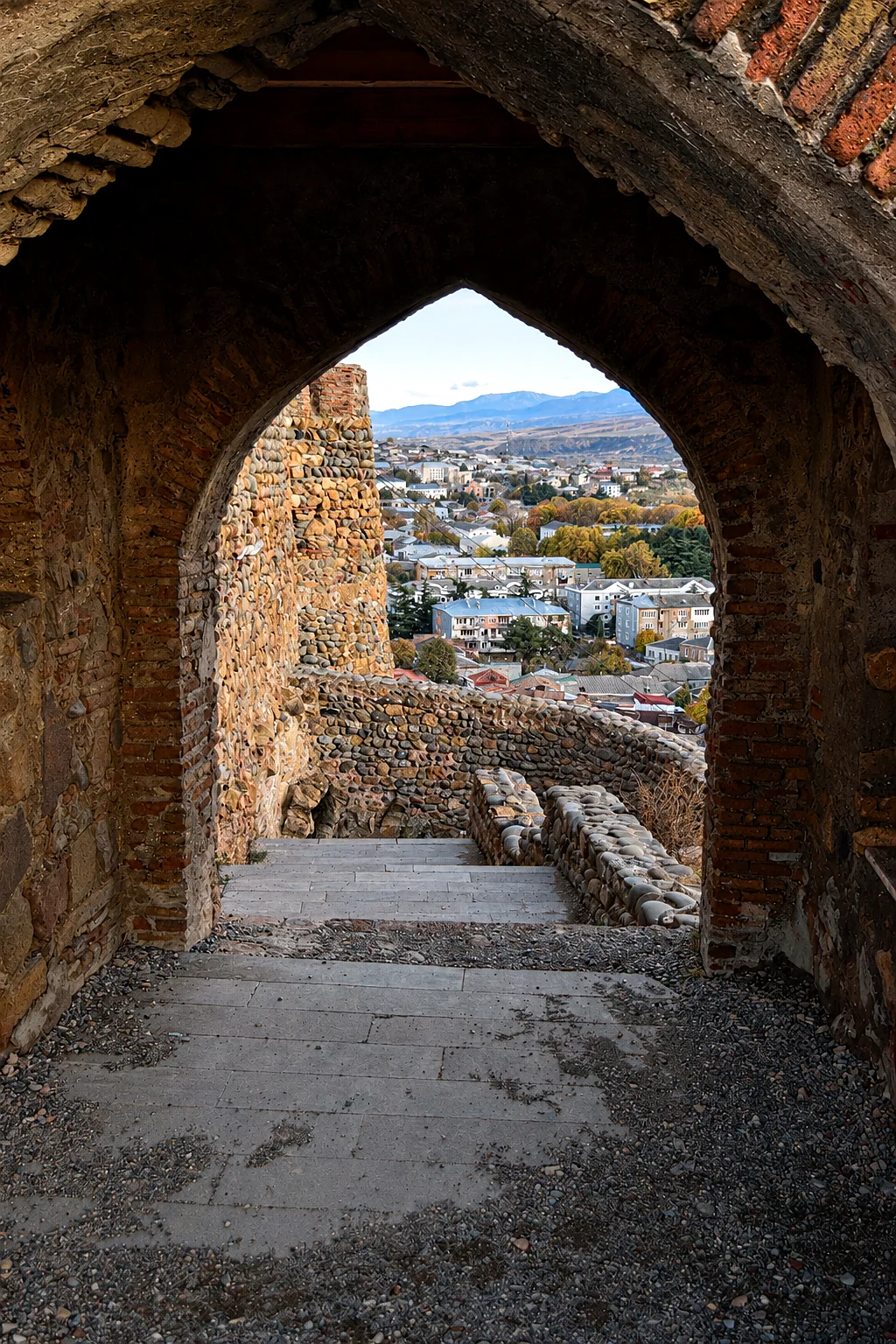
Walking the interior needs some attention to the uneven surface but no real effort, and the absence of reconstruction means you examine the ruins as found rather than as interpreted — the quality of the original masonry (the stone-cutting, the coursing, the bonding at corners) visible in the standing sections, reflecting the skill that medieval and early-modern Georgian royal patronage brought to a key strategic site. The hilltop is exposed and often windy in any season, which gives the place a bracing, austere openness that enclosed sites lack.
The Memorial of Georgian Warrior Heroes
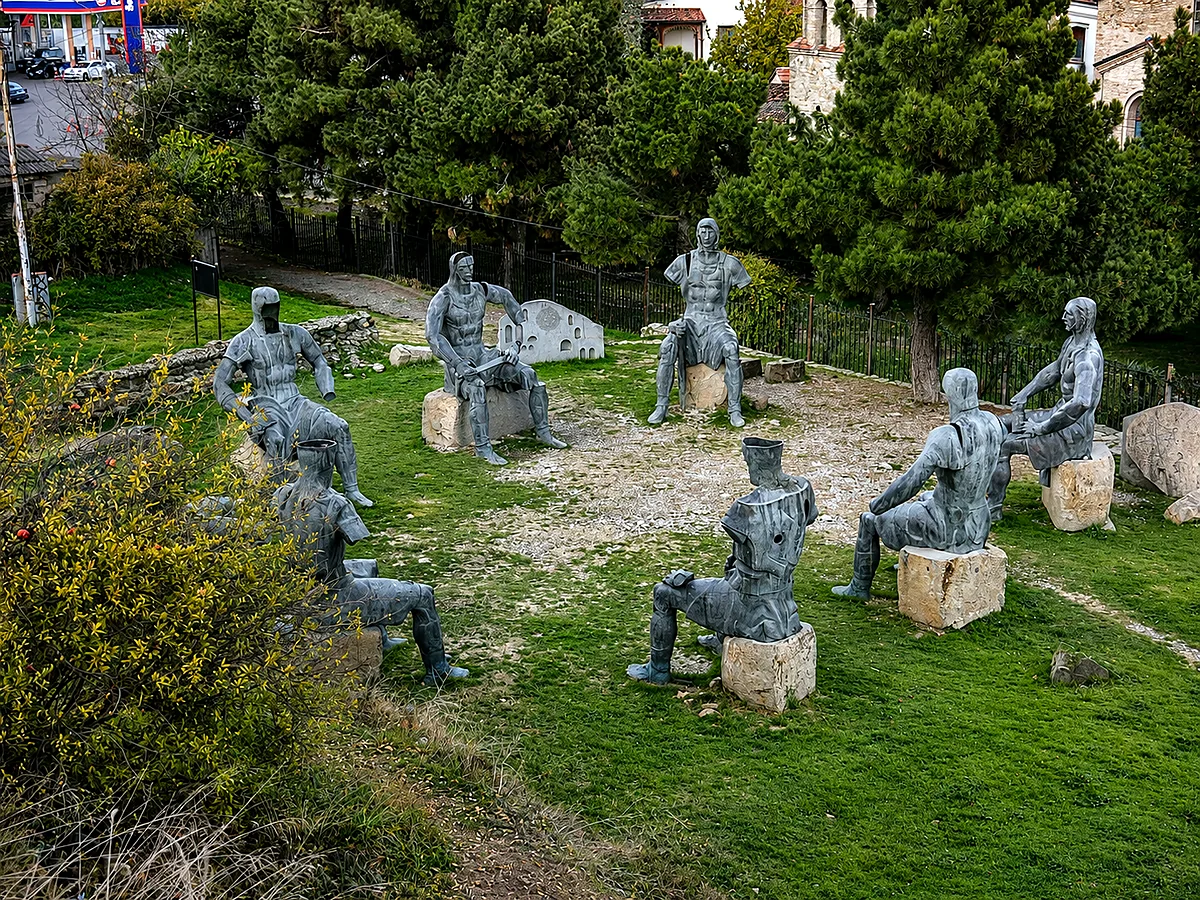
At the foot of the fortress hill stands one of the most striking sights in Gori: the Memorial of Georgian Warrior Heroes, a group of large, seated warrior figures sculpted by Giorgi Ochiauri in 1981–85 and moved here in 2009. The ring of monumental, weathered-bronze warriors at the base of the citadel makes a powerful image against the fortress hill above, and it's well worth seeing on the way up or down.
The ascent and the views
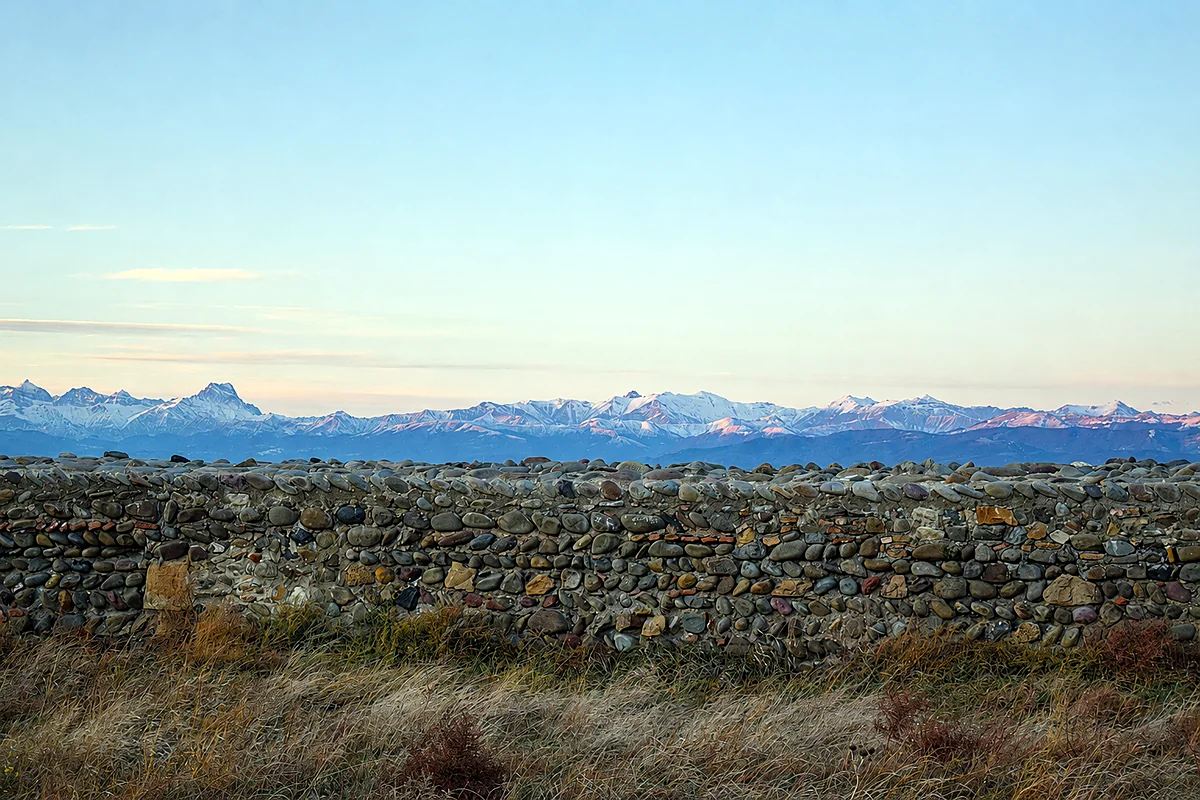
The path up from the streets at the base is short — about 15–20 minutes of steady walking — and the climb is the heart of the experience, the city falling away and the panorama widening with each meter gained. From the walls, the view opens over the full spread of Gori in the Mtkvari valley: the river to the south, the agricultural plains of Shida Kartli reaching out in every direction, the Stalin Museum and the city streets below, and the Caucasus foothills rising to the north. Moving around the surviving wall circuit gives different compositions — north toward the foothills and the mountains beyond, east where the valley narrows toward the gorge and the pale cliff of Uplistsikhe is faintly visible in the distance, and west where the valley opens toward the Kartli plains and the Surami range that divides eastern from western Georgia. In clear weather the light over the valley is excellent all day, with early morning and late afternoon the most photogenic.
Getting there and visiting
- Location: The fortress hill in central Gori, Shida Kartli, Georgia; the path begins from the streets at its base, and the hill is visible from most of the city.
- Getting there: A short, clear, well-trodden walk up from the city center (about 15–20 minutes); manageable for most people with reasonable mobility. Gori is about 85 km west of Tbilisi, an easy day trip.
- Hours / admission: Open at all times; free. There are no facilities on the hill, and the visit is self-guided.
- Practical: The hilltop surface is uneven and loose in places — footwear with grip helps for exploring beyond the main path — and it's exposed and windy, so dress for it.
- Combine with: The Stalin Museum and the Memorial of Georgian Warrior Heroes in Gori itself, the Giorgi Tatulashvili ceramics studio, and nearby Uplistsikhe and Ateni Sioni — a full Shida Kartli day.
Caucasus Travel FAQ
Gori Fortress (Goris-Tsikhe) is a hilltop citadel in the center of Gori, the main city of the Shida Kartli region in central Georgia. It stands on the steep rocky hill that gives the city its name (from the Georgian gora, "hill") and has guarded the Mtkvari valley and the east–west route across Georgia since at least the 7th century. It took much of its present form under King Rostom in the 17th century and King Erekle II in 1774, was badly damaged by a 1920 earthquake, and today is an open, unrestored ruin — free to visit — with sweeping views over the city and valley.
Its exact origins are hard to date, but the fortress was in use by at least the 7th century, and archaeological evidence points to an urban community on the site even earlier, in classical antiquity. What you see today, though, mostly reflects later rebuilding: the citadel was substantially reconstructed by King Rostom of Kartli in the 1630s and thoroughly rebuilt by King Erekle II in 1774. A major earthquake in 1920 then collapsed much of it, leaving the atmospheric ruin that stands today.
The fortress is an oval citadel of cobblestone and hewn stone, with walls up to about ten meters high. Its best-preserved part is the western "Tskhra-kara" ("Nine-gated") section. Inside are the ruins of a small church and the low foundations of other structures, and the fortress once had a water tunnel and a surrounding moat. The main reward is the view — a sweeping panorama over Gori, the Mtkvari valley, and the Caucasus foothills. At the foot of the hill stands the striking Memorial of Georgian Warrior Heroes, a ring of monumental seated warrior sculptures well worth seeing.
Yes, it's free and open at all times. The path up from the city center is clear and well trodden, and the climb takes about 15–20 minutes of steady walking — manageable for most people with reasonable mobility. The hilltop surface is uneven and loose in places, so footwear with grip helps, and it's exposed and windy, so dress accordingly. There are no facilities on the hill, and the visit is self-guided.
Plenty. The fortress pairs naturally with the Joseph Stalin Museum and the Memorial of Georgian Warrior Heroes in the city, and with the Giorgi Tatulashvili ceramics studio. Just outside Gori are two major sights: Uplistsikhe, the ancient rock-hewn cave town a short drive east, and the 7th-century Ateni Sioni church to the south. Together they make a full and varied Shida Kartli day — citadel, museum, cave town, and medieval church — easily done from Gori or as a day trip from Tbilisi (about 85 km east).