
Gori
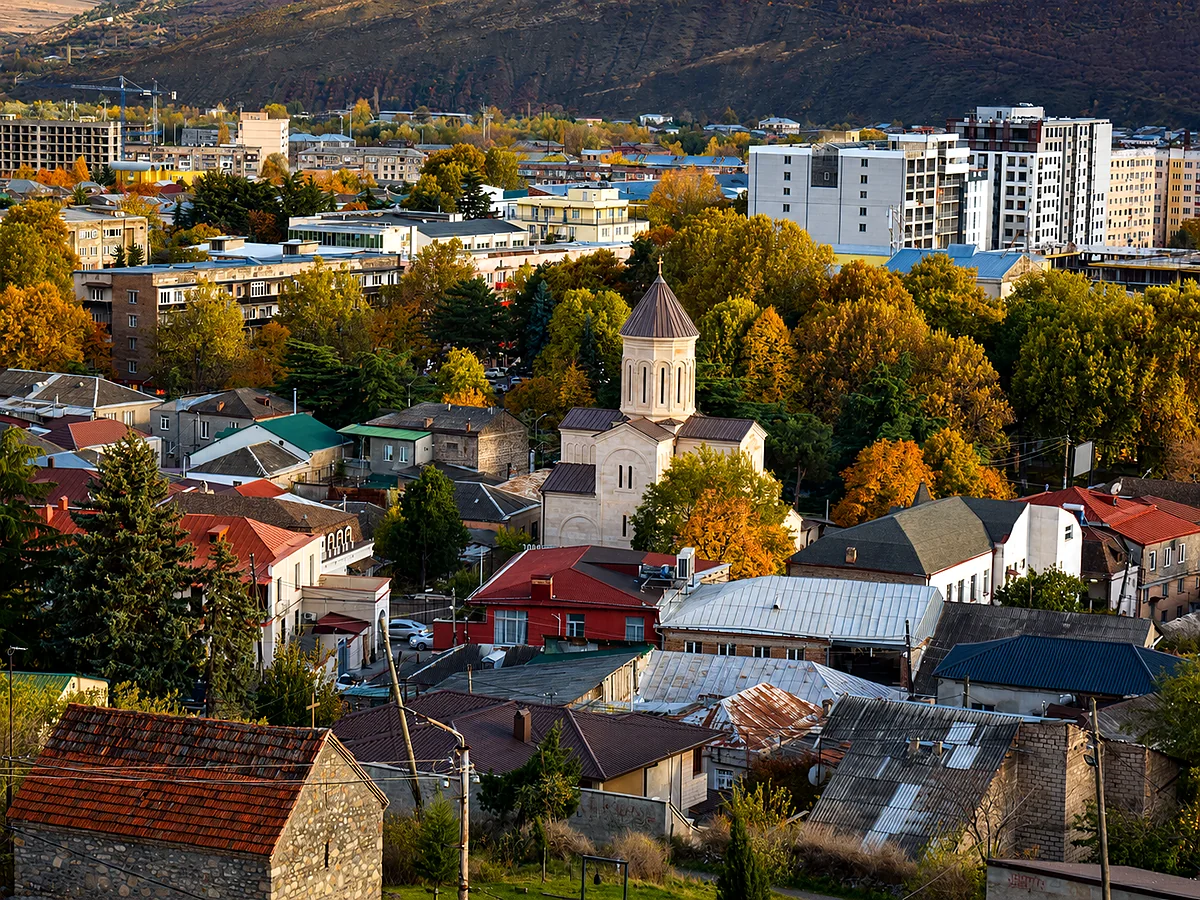
Gori is a city of around 42,000 people in the Shida Kartli region of central Georgia — the country in the South Caucasus — in the broad valley of the Mtkvari River about 85 kilometers west of Tbilisi. Its position has defined its whole history: it sits on the main east-west corridor through Georgia, where the road and railway between Tbilisi and the Black Sea pass through a natural bottleneck between the Greater Caucasus foothills to the north and the Trialeti range to the south. That geography made Gori strategically important across many centuries.
For most international visitors, Gori registers first as the birthplace of Joseph Stalin, and the museum dedicated to him draws the largest number of people. But the city offers more than that single association. Within a short radius are one of the most significant pre-Christian archaeological sites in the South Caucasus, a medieval fortress overlooking the valley, and a landscape linking the central plains to the northern mountains. Gori works well as a half-day or full-day stop between Tbilisi and western Georgia, and for travelers interested in ancient history or the 20th century it deserves more.
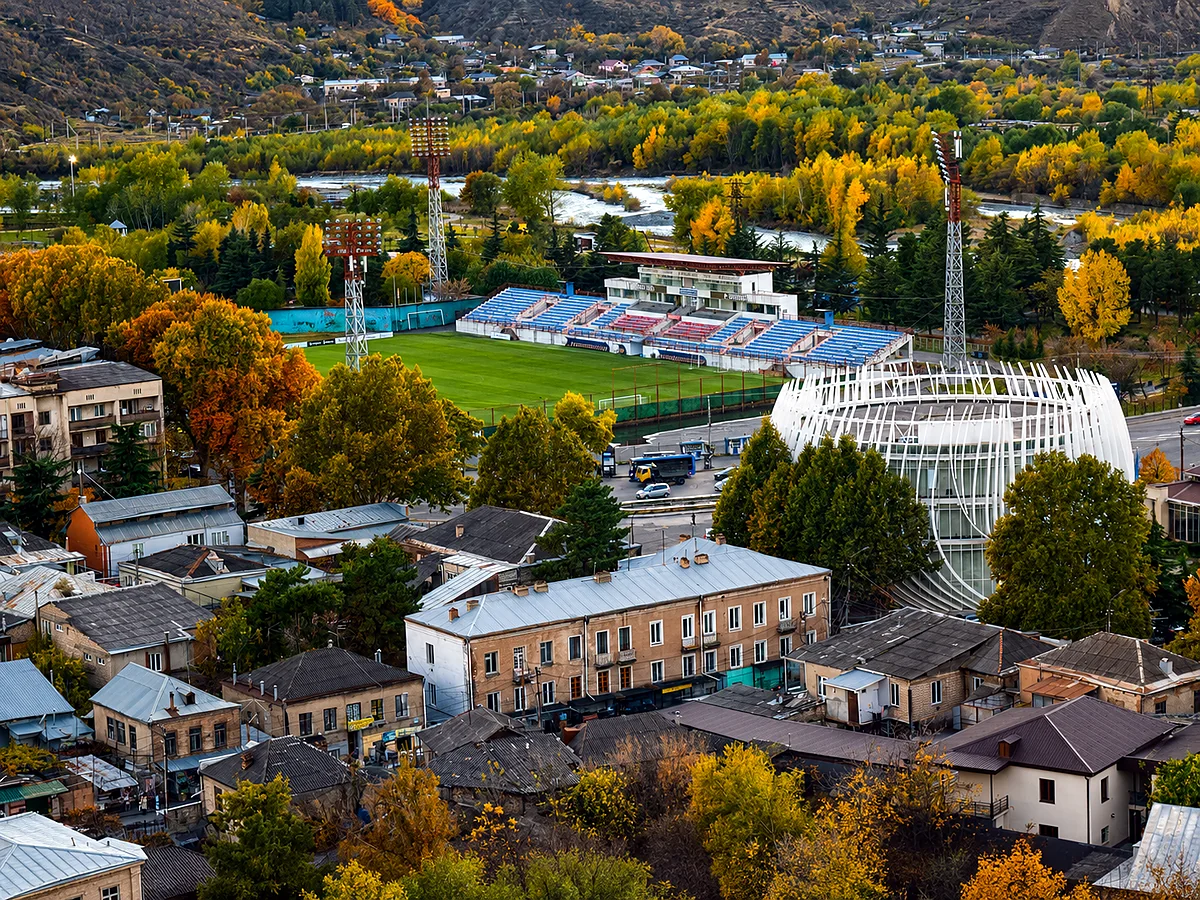
Why visit Gori?
The main reasons to visit Gori are three sites close together: the Joseph Stalin Museum, the cave town of Uplistsikhe 15 kilometers east, and the medieval Gori Fortress above the city. Together they cover the 20th century, the pre-Christian Iron Age, and the medieval period in a single easy day from Tbilisi. It suits travelers interested in history of almost any era. One honest note up front: the Stalin Museum is a Soviet-era shrine that doesn't address his crimes, so it's best understood as a historical artifact in itself rather than a balanced account — more on that below.
The Joseph Stalin Museum
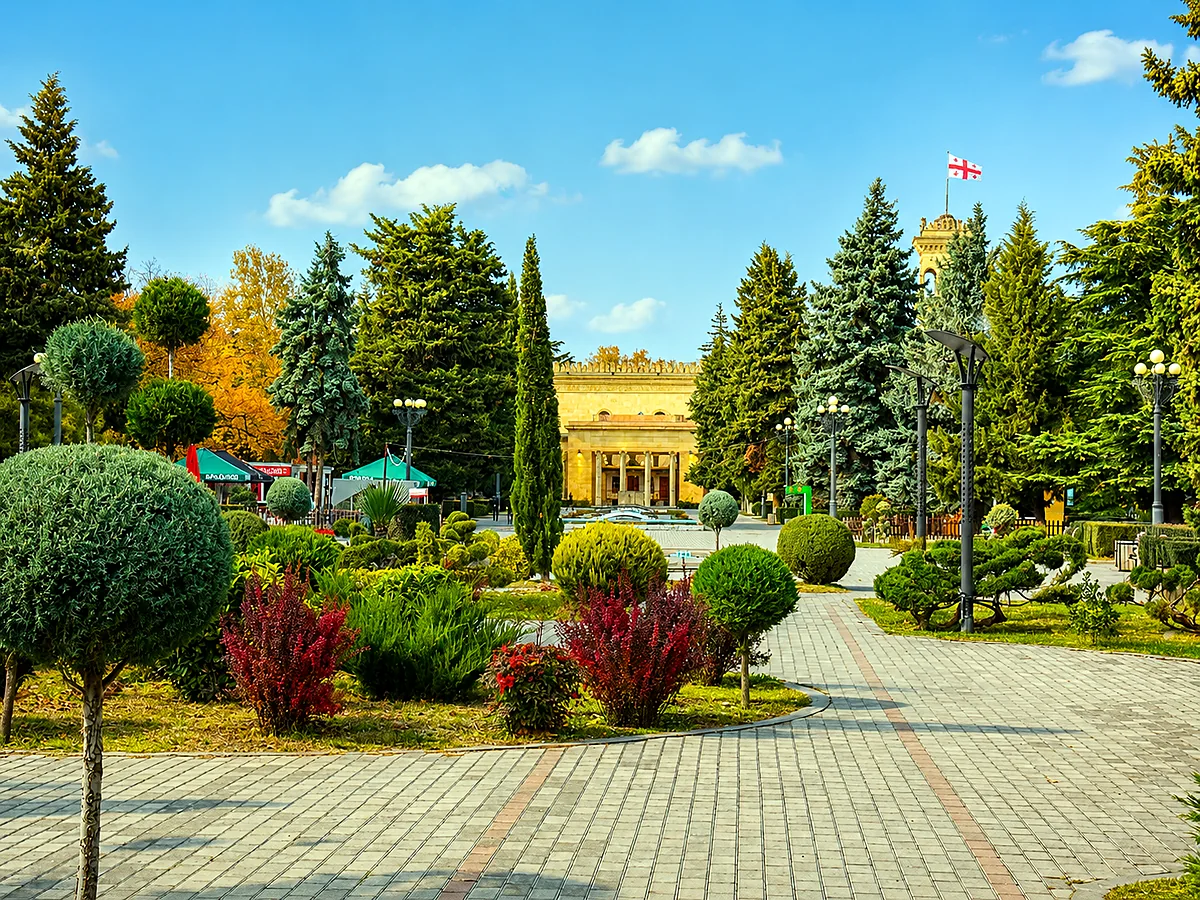
The Joseph Stalin Museum is the most visited and most debated site in Gori, and seeing it honestly means being clear about what it is. The complex was established during Stalin's lifetime, in the 1950s, and reflects the Soviet approach to his memory: reverential, carefully curated, and entirely uncritical. The main building is a substantial Stalinist-baroque structure built to communicate official importance. In front of it stands the modest brick house where Stalin was born, now enclosed in a purpose-built neoclassical shelter. In the grounds sits his personal armored railway carriage, used for long-distance travel.
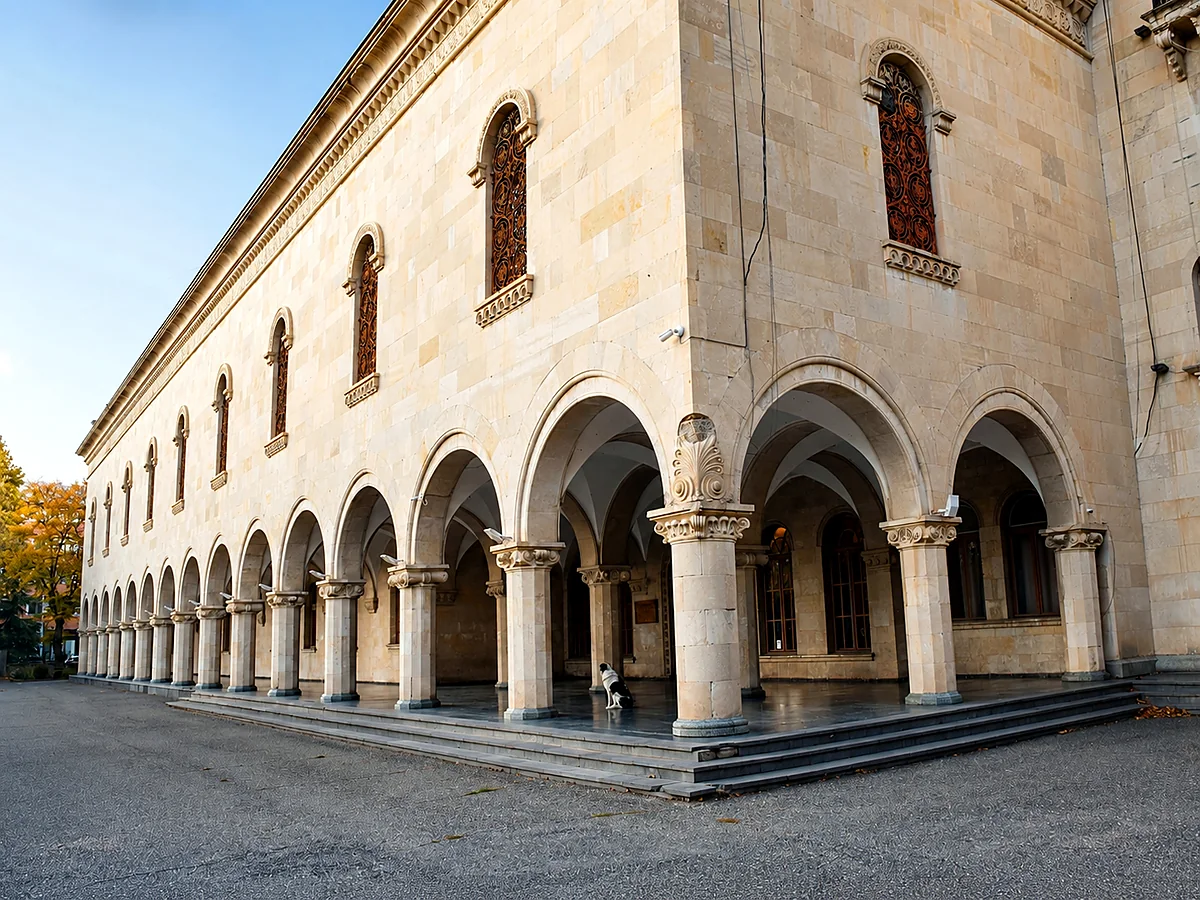
Inside, the exhibition presents his life through photographs, personal effects, documents, and gifts from foreign leaders — the standard vocabulary of Soviet hagiography. What it does not do, in any systematic way, is address the terror, the purges, forced collectivization, the Gulag, or the millions of deaths Stalin's rule caused. That absence is itself historically significant: the museum functions as a primary-source document of how Soviet power built and maintained the cult of Stalin, rather than an objective account of his life.
That makes it an uncomfortable but genuinely interesting visit. It's worth seeing not despite its one-sidedness but partly because of it — as an artifact of a kind of historical memory that has largely disappeared elsewhere but survives here intact. The ongoing debates in Georgia about whether and how to reform the museum are themselves part of what makes Gori historically significant.
Uplistsikhe cave town
Fifteen kilometers east of Gori, carved into a sandstone cliff above the north bank of the Mtkvari, Uplistsikhe is one of the oldest and most remarkable archaeological sites in Georgia. The name means roughly "fortress of the lord," referring to a pre-Christian deity rather than the Christian God — a clue to its antiquity and its religious importance before Christianity became dominant in Georgia in the 4th century.
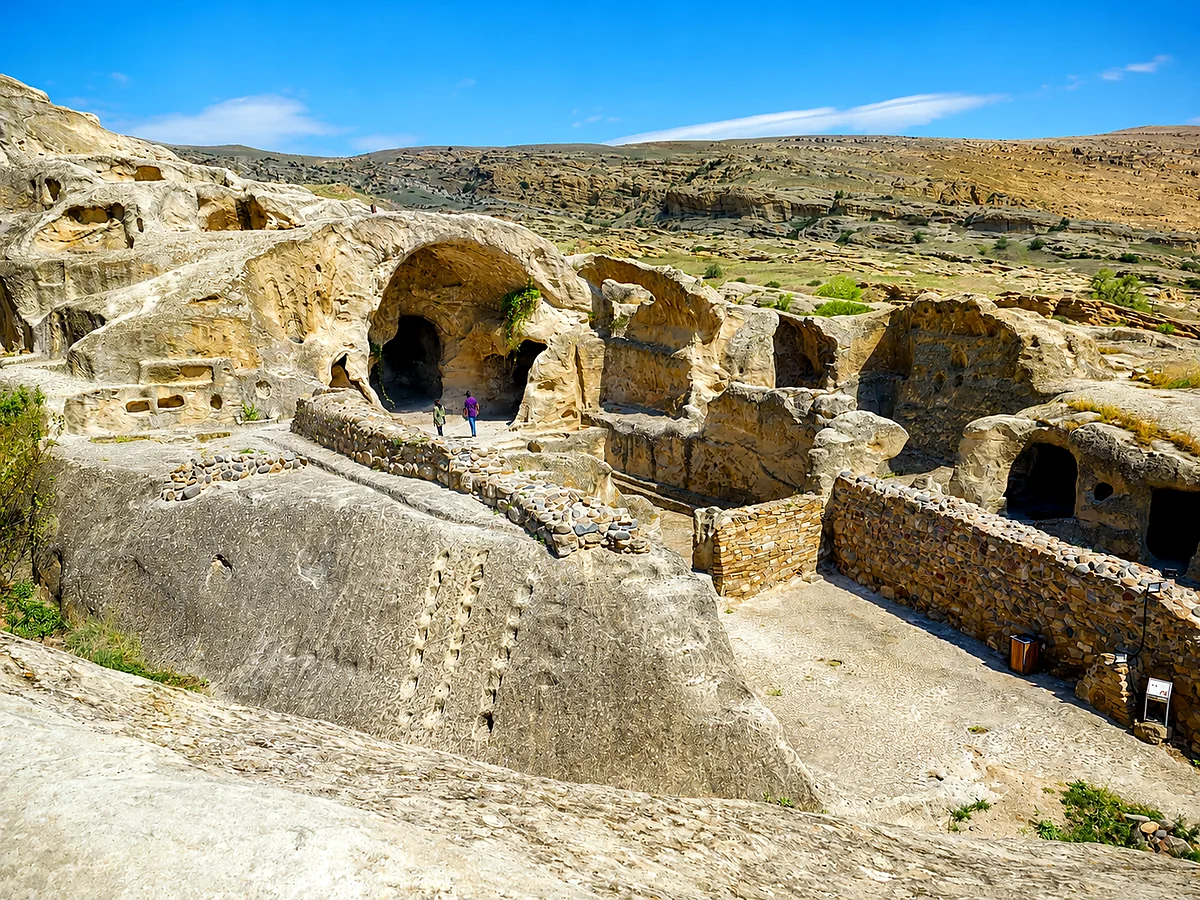
The settlement was established in the early Iron Age, around the first millennium BC, and stayed occupied into the early medieval period, making it one of the longest continuously inhabited sites in the country. At its peak, probably in late antiquity and the early medieval period, it may have housed several thousand people in rooms, streets, tunnels, and open spaces cut directly into the rock. The stone keeps the forms of the original spaces with striking clarity: rooms with carved stone shelves, a large hall whose carved ceiling mimics timber beams in stone, what appears to be a theater or assembly space, storage chambers, water channels, and tunnels connecting different levels.
Uplistsikhe was an important religious center in the pre-Christian period, and some carved spaces are interpreted as temples tied to indigenous Georgian religious practice. After Christianity became the state religion, the old buildings were adapted or replaced — a small 9th-century basilica now stands at the highest point, built partly from materials salvaged from the earlier structures. This overlap of religious traditions in one site is among Uplistsikhe's most interesting features.
Walking the site takes one to two hours depending on how thoroughly you explore. The rock-cut paths connect the levels and pass through tunnels that are genuinely dark and narrow in places, so wear shoes with grip and be ready for uneven footing. The views over the Mtkvari valley and toward Gori Fortress in the distance are excellent. The site is exposed and largely shadeless, which matters in summer when the pale sandstone radiates heat — go in the morning. A small museum at the entrance gives context and is worth seeing before you walk the settlement.
Gori Fortress
Gori Fortress sits on its volcanic rocky hill directly above the city center — the gora, the Georgian word for hill, that gives the city its name — visible from most of the surrounding area and across the valley. The current remains are mostly medieval, though the site was fortified significantly earlier; the most substantial surviving elements date to the 16th and 17th centuries. An earthquake in 1920 damaged the fortress badly and it was never fully restored, so what you see is an atmospheric ruin rather than an intact fortification.
The walls and towers that remain convey the scale of the original, and the elevated position gives wide views over the city, the Mtkvari valley, and the surrounding plains. On clear days the Greater Caucasus peaks are visible to the north, and the contrast between the ruined medieval walls and the mountain horizon is one of the more striking views in this part of Georgia. Access is straightforward, by a path from the city center or by road to the base of the walls. The site is unfenced and freely accessible, with no facilities, so the visit is simply walking the walls and reading the landscape below.
How to get to Gori
Gori is one of the most easily reached cities from Tbilisi — about an hour's drive on the main highway. Marshrutkas (minibuses) run frequently from Tbilisi's Didube station, and regular trains connect the two cities, with Gori's railway station right in the center, which makes arrival by train especially convenient. From Gori, Uplistsikhe is reached by taxi or by a marshrutka running along the main road toward Tbilisi, with the site visible from the road.
Best time to visit Gori
Gori can be visited comfortably any time of year. Spring and autumn offer the most pleasant conditions for the outdoor sites — the fortress and Uplistsikhe in particular — with moderate temperatures and good visibility across the valley. In summer, visit Uplistsikhe in the morning before the exposed sandstone heats up. The city is compact enough that weather is rarely a limiting factor for the museum and the fortress, both of which can be done in a few hours in any conditions.
History and the 2008 war
The area around Gori has been inhabited since the Bronze Age, and the rocky hill at its center has held some form of fortification for most of recorded history. Gori's medieval form was developed under King David IV, David the Builder, in the early 12th century, as part of consolidating Georgian royal power and rebuilding after centuries of Seljuk devastation. Its position on the main east-west route made it a repeated target during later invasions; Persian and Ottoman forces both held it at various points, and the fortress changed hands many times. The Russian Empire took the Kartli-Kakheti kingdom in 1801, and Gori became a regional center of Shida Kartli, gaining new public buildings, a more regular urban plan, and the railway in the 19th century.
The 20th century left its own mark. Stalin's birth here in 1878 — the son of a cobbler and a domestic servant, in a modest house that still stands — became central to the city's Soviet-era identity. More recently, Gori sits close to South Ossetia, and in August 2008 Russian forces advanced to and briefly occupied the city during the war between Georgia and Russia over the breakaway region. The occupation lasted only a few days, but the war displaced tens of thousands of people and left villages in the immediate area destroyed or abandoned. The conflict remains part of the lived memory of Gori's residents — worth being aware of as a visitor, even though it doesn't directly affect a visit to the city today.
Caucasus Travel FAQ
Gori is best known as the birthplace of Joseph Stalin and home to the museum dedicated to him. It's also the base for the Uplistsikhe cave town, one of Georgia's oldest archaeological sites, and has a medieval hilltop fortress overlooking the city.
Yes, but understand what it is. Established in the 1950s, it's a Soviet-era shrine that celebrates Stalin without addressing the purges, the Gulag, or the millions of deaths under his rule. It's worth seeing as a historical artifact of the cult of personality rather than a balanced account, and the birth house and his armored railway carriage are on site.
Uplistsikhe is an ancient cave town carved into a sandstone cliff 15 km east of Gori, established in the early Iron Age (around the first millennium BC). It contains rock-cut rooms, streets, tunnels, a hall with a carved stone ceiling, and a 9th-century church, and was an important pre-Christian religious center. Allow one to two hours.
About an hour by road. Marshrutkas run frequently from Tbilisi's Didube station, and regular trains connect the two cities, with Gori's station in the center. From Gori, Uplistsikhe is reached by taxi or a marshrutka along the Tbilisi road.
Any time of year works. Spring and autumn are best for the outdoor sites, with moderate temperatures and clear valley views. In summer, visit Uplistsikhe in the morning before the exposed sandstone heats up.