
Katskhi Pillar: Georgia's Church on a Rock Column
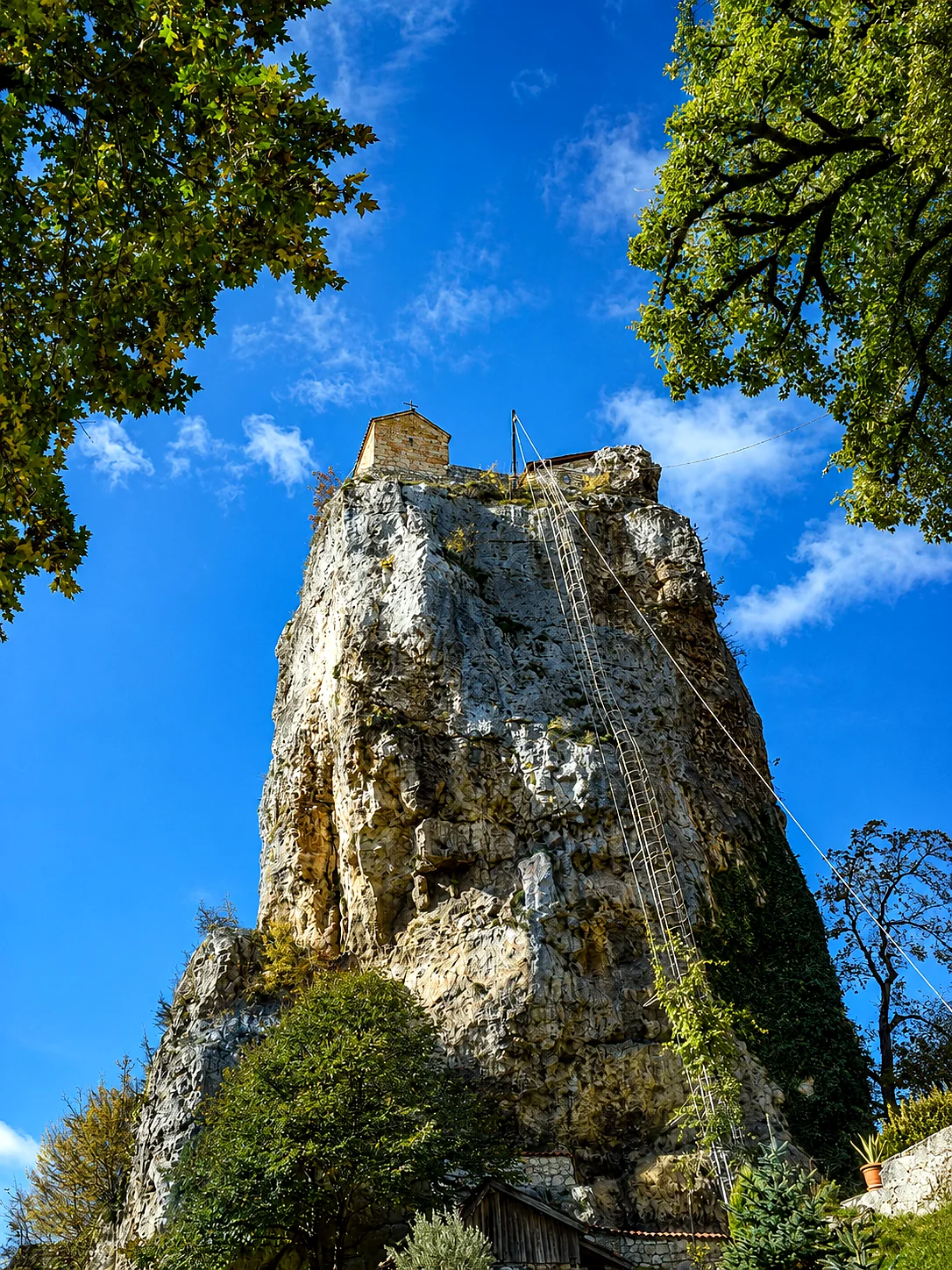
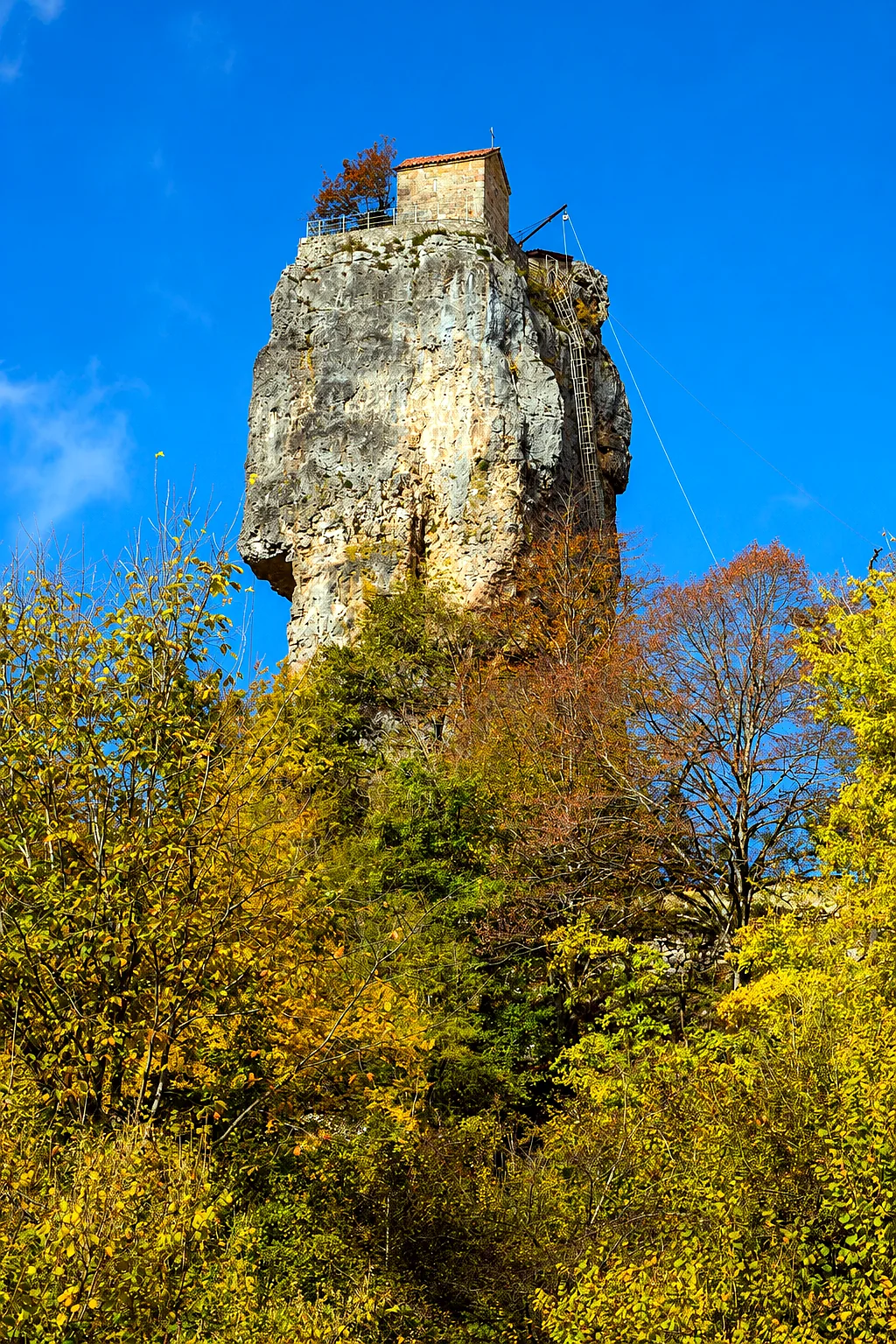
The Katskhi Pillar rises from the floor of a forested valley in the Imereti highlands of Georgia — the country in the South Caucasus — about 5–10 kilometers from Chiatura. It's a natural limestone monolith standing around 40 meters above the surrounding terrain on sheer vertical faces that rise from its base with no gradual slope or accessible approach. At its summit, on a flat area of only a few hundred square meters, sit a small medieval church and the remains of a hermitage — a monastic site on a platform of rock effectively inaccessible without climbing equipment. The combination of the extraordinary geological form and the centuries of religious life conducted at its top makes Katskhi one of the most genuinely singular sites in Georgia, a country not short of remarkable religious monuments.
What is the Katskhi Pillar?
The Katskhi Pillar is a roughly 40-meter natural limestone column near Katskhi village in the Imereti region of western Georgia, topped by a small medieval church and the remains of a hermitage. It's a famous example of the ancient Christian "stylite" tradition, in which ascetics lived atop pillars in isolation. Abandoned for centuries, the church on top was rediscovered by climbers in 1944, and the monastic life was revived in the 1990s by the monk Maxime Qavtaradze, who lived at the summit until 2015. Today only monks may ascend; visitors experience it from the ground, where it's a striking and contemplative sight, about 5–10 km from Chiatura and ~50 km from Kutaisi.
The pillar and its mystery
The pillar is composed of the limestone that underlies much of the Imereti plateau, carved by erosion into its isolated form over geological time. Its sides are essentially vertical and in places slightly overhanging, smooth enough that the rock presents no natural climbing route for ordinary ascent. How the medieval monks who built the structures at the summit managed the construction — raising stone, timber, and other materials to a platform 40 meters up a sheer face — is a question the visible evidence doesn't fully answer, and it adds to the site's sense of mystery. (Local legend even held that the summit was once connected by a long iron chain to the Katskhi church in the valley below.)
A stylite tradition
Katskhi belongs to the tradition of stylitism — the early Christian ascetic practice, named for St. Simeon Stylites, in which monks lived atop columns or pillars in deliberate isolation to draw closer to God. The pillar was known to local communities throughout the medieval period and appears in Georgian historical sources, but its inaccessibility meant the structures at the summit remained largely unexamined until a documented modern ascent.
In July 1944, an expedition led by the mountaineer Alexander Japaridze and the writer Levan Gotua, with the architect Vakhtang Tsintsadze studying the ruins, made the first documented ascent in modern times. They found the remains of a church, a wine cellar carved into the rock, hermit cells, a crypt, and a curtain wall — physical evidence of sustained habitation — along with the bones of the last ascetic who had lived there centuries before. The church at the top is dedicated to Maximus the Confessor, the 7th-century monk and theologian. Architectural and archaeological study (with systematic research from 1999 and digs in 2006) has dated the church structure to roughly the 9th–10th century, with ascetic use of the site possibly reaching back earlier; the monastery was abandoned around the late medieval period, likely amid the invasions and disruptions of the 15th–16th centuries.
The modern revival — and Maxime Qavtaradze
The site's modern fame is tied to one man. In 1993, a Georgian Orthodox monk named Maxime Qavtaradze took up residence at the summit and revived the stylite tradition at Katskhi; in 1995 a new church was built on the rock, and the ruined structures were restored with the help of locals and Georgia's cultural-heritage authorities. Living in relative isolation above the valley — famously sleeping at first in an old refrigerator for shelter before a cottage was built — and descending only occasionally to pray with and counsel the community at the monastery below, Qavtaradze drew worldwide attention through a series of photographs and reports in the early 2010s, and made Katskhi one of the most extraordinary inhabited religious sites in the world.
Importantly, that chapter has closed: Qavtaradze came down from the pillar for good in 2015, and no one lives at the summit now. Monks from the monastery at the base still make the demanding climb to pray at the top, but the era of a permanent resident hermit on the rock has ended.
Visiting — from the ground
Be clear on one point before planning a visit: you cannot go up the pillar. By order of the Georgian Orthodox Patriarch, only monks may ascend to the summit church — visitors (and even local residents) are not permitted to the top, both to protect the structures and to preserve the site's sanctity. The metal ladder and route up are for the monastic community only, so a visit is, by design, a ground-level experience.
That experience is primarily visual and contemplative rather than exploratory, and the site's impact rests on the single sustained impression the pillar makes rather than on what can be discovered by moving through it. The path from the parking area to the base takes about fifteen minutes through the forested valley, and the pillar grows more imposing as you approach. Seen from directly below, with the vertical faces rising to the church silhouetted against the sky, it has a quality of sheer physical assertion that photographs convey poorly and that direct presence registers fully — and if you're lucky, you may glimpse a monk making the nerve-jangling ascent on the ladder.
At the base stand a newly built church (of Simeon Stylites), the monastery, and the ruins of an old wall and belfry, with a place of prayer for visitors; the area is maintained with the care of an active religious site. The valley setting — forested slopes, the limestone karst landscape — adds to the atmosphere, and the general quiet of the Imereti highlands here means visits outside peak summer are often genuinely peaceful. Modest, respectful dress and conduct are appropriate at this active religious site.
Getting there
The Katskhi Pillar is about 5–10 kilometers from Chiatura and around 50 kilometers from Kutaisi, with the drive from Kutaisi taking roughly one to one and a half hours. The road from Chiatura passes through the industrial and forested landscape of the Kvirila valley before entering the narrower Katskhi terrain. It's most often visited together with Chiatura and its Soviet-era cable cars, the two forming a natural full-day itinerary in the western Imereti highlands; organized tours and private transfers from Kutaisi frequently cover both in sequence (and sometimes add the Mghvimevi Monastery).
Practical information
- Location: Near Katskhi village, Chiatura district, Imereti region, western Georgia (about 5–10 km from Chiatura, ~50 km from Kutaisi).
- Getting there: By car, private transfer, or organized tour from Kutaisi (~1–1.5 hours), almost always combined with Chiatura.
- Access: Ground level only — the summit is closed to visitors (monks only) by order of the Patriarch. Don't plan on climbing it.
- Hours/Admission: The ground-level site is accessible during daylight hours; free. No fixed hours; early morning and late afternoon give the best light.
- Etiquette: Active religious site — dress and behave respectfully.
Caucasus Travel FAQ
The Katskhi Pillar is a roughly 40-meter natural limestone column near Katskhi village in the Imereti region of western Georgia, topped by a small medieval church and the remains of a hermitage. It's a famous example of the ancient Christian "stylite" tradition, in which ascetics lived atop pillars in isolation. Abandoned for centuries, it was rediscovered by climbers in 1944, and monastic life was revived in the 1990s. It's one of the most singular religious sites in Georgia and a popular pairing with the nearby Chiatura cable cars.
That's Maxime Qavtaradze, a Georgian Orthodox monk who revived the stylite tradition at Katskhi from 1993, building a new church on the rock in 1995 and living at the summit in relative isolation — famously sleeping at first in an old refrigerator before a cottage was built. He became known worldwide through photographs and reports in the early 2010s. Importantly, he came down from the pillar for good in 2015, so no one lives at the summit today, though monks from the monastery below still climb up to pray.
No. By order of the Georgian Orthodox Patriarch, only monks may ascend to the summit church — visitors are not allowed up (this also protects the old structures and preserves the site's sanctity). The metal ladder is for the monastic community only. A visit to Katskhi is a ground-level experience: you view and photograph the pillar from below, where its sheer scale is genuinely striking, and you may catch sight of a monk making the climb.
The church structure at the top is generally dated to around the 9th–10th century, based on architectural study and archaeological work (systematic research began in 1999, with excavations in 2006). Ascetic use of the pillar may reach back earlier. The church is dedicated to Maximus the Confessor, a 7th-century monk and theologian. When climbers first reached the top in 1944, they found the ruins along with the bones of the last ascetic who had lived there centuries before.
It's about 5–10 km from Chiatura and around 50 km (1–1.5 hours) from Kutaisi, usually visited by car, private transfer, or organized tour — most commonly combined with Chiatura's Soviet-era cable cars as a full-day trip from Kutaisi. From the parking area it's a roughly 15-minute walk through the forested valley to the base. The visit is short and contemplative: you take in the pillar from below (it's far more impressive in person than in photos), with a small church and monastery at the base. It's an active religious site, so dress and behave respectfully.