
Mghvimevi Monastery: A Cliffside Cave Monastery near Chiatura
Mghvimevi Monastery is built into a limestone cliff above the Kvirila River valley a short distance from Chiatura, in Georgia, the country in the South Caucasus, its structures occupying the space between the rock wall above and the steep valley below in a way that blurs the line between built and geological architecture. The name comes from the Georgian word for "cave" (mghvime), and the description fits: the complex incorporates natural caves as functional spaces, with the churches and living quarters growing from and around the rock rather than standing apart from it. It's one of the more visually distinctive monastic sites in western Georgia, and its relative obscurity — it draws a fraction of the visitors that Gelati or Motsameta do — gives it a genuine quietness the region's more celebrated monuments rarely have.
What is Mghvimevi Monastery?
Mghvimevi Monastery is a 13th-century Georgian Orthodox monastery partly carved into a limestone cliff in the Kvirila valley at the edge of Chiatura, in the Imereti region of western Georgia. Its name means "cave," and it's reached by a long, narrow cliffside path and a rock-cut tunnel leading to a large natural cave around which the monastery is built. Its highlights are a 13th-century two-nave basilica with richly carved exterior ornament, the dramatic cave setting (which holds prehistoric archaeological finds), and the views over the Chiatura valley. It's an active nunnery and is listed among Georgia's Cultural Monuments of National Significance. It's most often visited with Chiatura and the Katskhi Pillar on a day trip from Kutaisi.
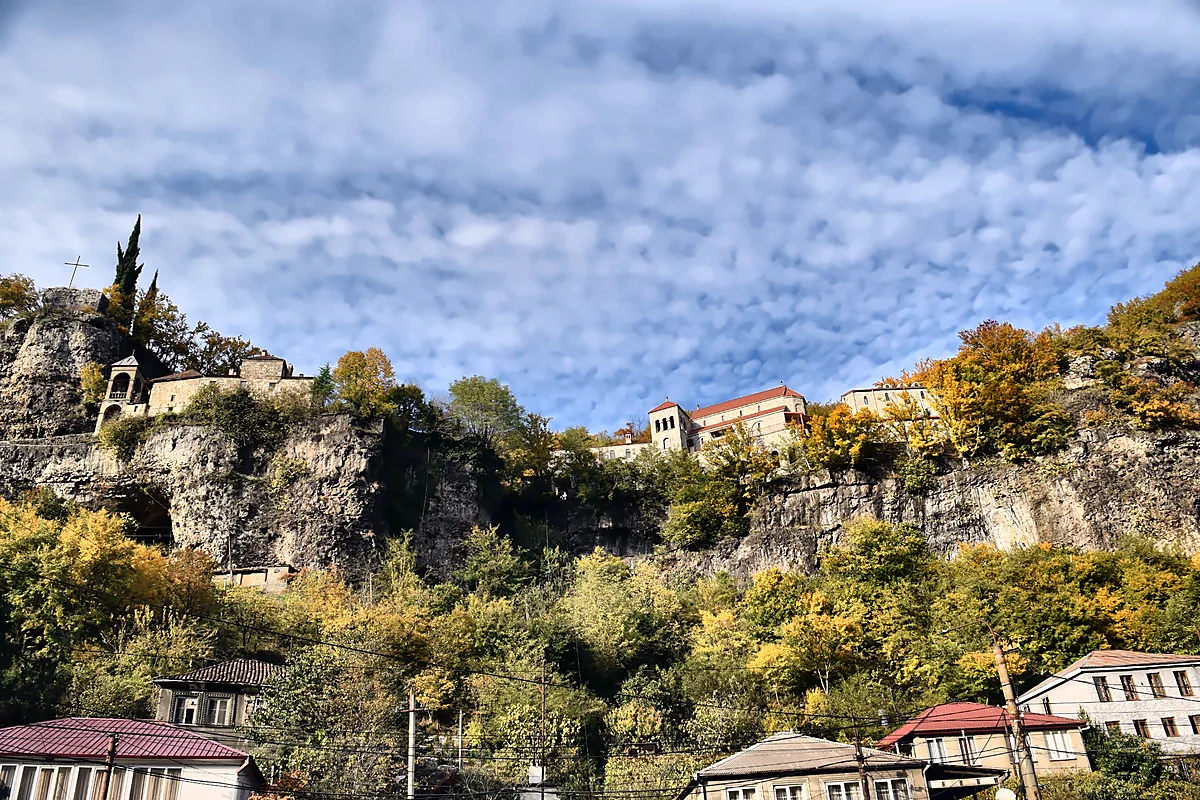
History and the cave setting
The monastery dates to the 13th century, founded in the latter half of that century — a period that spanned the end of the Georgian "golden age" and the onset of the Mongol invasions. The choice of site reflects the consistent preference of Georgian monastic founders for places combining natural defensibility, visual drama, and separation from the world: the cliff face gives isolation without inaccessibility, the valley is visible from the terraces below, and the rock above provides both shelter and the sense of divine proximity that cliff and cave monasteries have expressed across many religious traditions.
The natural cave at the heart of the complex has a deep human history of its own: archaeological work has recovered Upper Paleolithic material here — flint and obsidian tools, and animal remains — and, by tradition (recorded by the 18th-century scholar Prince Vakhushti), the surrounding caves served as wartime refuges. So the site layers prehistoric, medieval, and living religious use in a single dramatic location.
The complex
Mghvimevi is reached by a long, narrow staircase and path that climbs the cliff from the valley, leading into a tunnel cut horizontally into the rock — an entrance easy to miss from below — which opens into the large natural cave around which the monastery is arranged. The ascent isn't demanding (roughly fifteen to twenty minutes at a comfortable pace), but it gives arrival a real sense of transition from the ordinary landscape below to the enclosed, elevated world of the monastery.
The architectural centerpiece is the 13th-century two-nave basilica, built against the cliff with the natural rock forming part of its rear wall and ceiling — the two naves separated by an arcade on a massive central pillar, the apses faceted on the outside. (Sources vary on the church's dedication, citing both the Nativity of the Mother of God and the Savior.) Its real distinction is the exterior stone carving: the facades are richly ornamented with carved window surrounds, monumental crosses, interlaced rhombus patterns, and decorative cornices — among the finer examples of ornamental architectural sculpture in the region, and the feature the monastery is most admired for. Inside are fragments of fresco and a fully painted 18th-century wooden iconostasis depicting the Savior and the Twelve Apostles; an ornamented 11th-century carved west door was moved to the Georgian National Museum in Tbilisi for safekeeping. There's also a smaller hall church (its ceiling and west wall formed by the natural rock) and a bell tower.
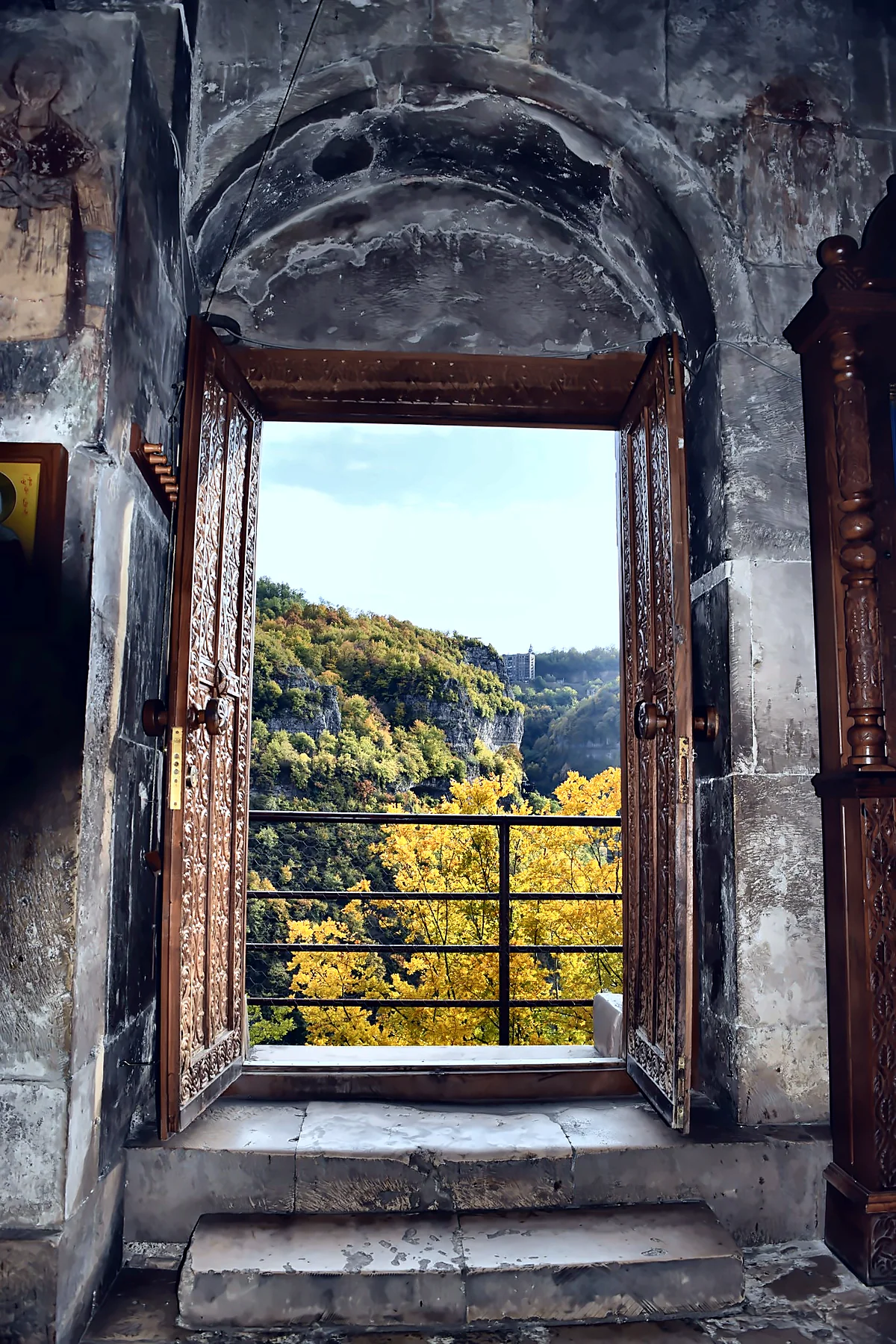
The cave sections — the natural chambers incorporated into the monastic space as worship areas, storage, and the structural basis for the built churches — give a direct sense of how the monastery's founders treated the site's geology as a resource rather than an obstacle; services are still held in the main cave on major feasts.
An active nunnery
Mghvimevi is an active women's monastery (a nunnery), with a small community of nuns in residence who maintain the religious life of the complex and care for its buildings and grounds (the monastery was revived in recent years). This living use shapes the atmosphere strongly: it's not a preserved historical monument but a working institution, and the presence of the community gives the visit a dimension of genuine contemporary monastic life that purely archaeological sites can't offer. Visitors are expected to behave with the respect appropriate to an active place of worship — dress modestly, observe the usual courtesies, and be mindful around the nuns and during services.
The setting
The views from the monastery terraces over the Kvirila valley are part of what makes a visit rewarding beyond the religious and architectural interest. The valley here has the characteristic industrial-natural character of the Chiatura area — the mining town in the middle distance, the forested valley walls rising on both sides, the river on the valley floor — and the cliff-face perspective gives a good sense of the topography that makes Chiatura such an unusual urban environment. The contrast between the tranquility of the monastery terrace and the Soviet-industrial landscape below is one of the more arresting visual juxtapositions at any single site in the Imereti highlands.
Combining with Chiatura
Mghvimevi is most naturally visited with Chiatura and the Katskhi Pillar on a full-day excursion from Kutaisi through the distinctive landscapes of the western Imereti highlands. The three offer complementary experiences — the Soviet-industrial atmosphere and cable-car network of Chiatura, the extraordinary church-topped monolith of the Katskhi Pillar, and the medieval cave monastery of Mghvimevi — that together give a fuller picture of the region than any single site. Many organized tours and private transfers from Kutaisi cover all three in sequence.
Practical information
- Location: Mghvimevi village, at the eastern edge of Chiatura, Chiatura Municipality, Imereti region, western Georgia (about 70–75 km / ~1.5 hours northeast of Kutaisi).
- Getting there: By car, private transfer, or organized tour from Kutaisi, almost always combined with Chiatura and the Katskhi Pillar; reached on foot by a steep cliffside staircase, path, and rock-cut tunnel from below.
- Hours/Admission: Open daily during daylight hours; free. Active nunnery — access may be limited during services.
- Dress code: Modest dress required; women should cover their heads, shoulders and knees covered (wraps sometimes available). Be respectful of the resident community.
- Note: The approach involves stairs and a tunnel and is not step-free; reasonable mobility is needed.
Caucasus Travel FAQ
It's a 13th-century Georgian Orthodox monastery partly carved into a limestone cliff in the Kvirila valley at the edge of Chiatura, in the Imereti region of western Georgia. Its name means "cave," and it's built around a large natural cave reached by a narrow cliffside path and a rock-cut tunnel. Its highlights are a 13th-century two-nave basilica with richly carved exterior stonework, the dramatic cave setting (which holds prehistoric finds), and the valley views. It's an active nunnery and a listed national cultural monument.
Because the complex is built into and around natural caves in the cliff face — the name comes from the Georgian word for "cave" (mghvime). The natural rock forms parts of the churches' walls and ceilings, and the main cave around which the monastery is arranged is itself archaeologically significant, with Upper Paleolithic finds. Services are still held in the cave on major feast days. The integration of built stonework with the living rock is exactly what makes the site so distinctive.
The main church is a 13th-century two-nave basilica, and its standout feature is the richly carved exterior — ornate window surrounds, crosses, and interlaced patterns, among the finer architectural carving in the region. Inside are fresco fragments and an 18th-century painted wooden iconostasis. There's also a smaller hall church (partly formed by the natural rock), a bell tower, and the cave itself. The views over the Chiatura valley from the cliffside terraces are a highlight in their own right.
It's at the eastern edge of Chiatura, about 70–75 km (roughly 1.5 hours) from Kutaisi in the Imereti region. Most visitors come by car, private transfer, or organized tour, almost always combined with Chiatura's cable cars and the Katskhi Pillar as a full day from Kutaisi. From below, the monastery is reached on foot by a steep, narrow cliffside staircase and a tunnel cut into the rock — a short but distinctive climb, so reasonable mobility is needed.
Yes — it's an active nunnery that receives respectful visitors, free of charge, generally during daylight hours (access may be limited during services). Dress modestly: women should cover their heads, and shoulders and knees should be covered. Be mindful that nuns live and worship here, so keep noise down and be considerate, especially during prayers. The approach involves stairs and a tunnel and isn't step-free, so it's worth being prepared for the short climb.