
Vardzia: Queen Tamar's Cave City in the Mtkvari Gorge
Vardzia is carved into the cliffs of Erusheti Mountain above the Mtkvari River gorge in southern Georgia — the country in the South Caucasus — about 70 kilometers southwest of Akhaltsikhe. The scale of what was excavated here in the 12th century remains extraordinary even by the standards of the most ambitious medieval projects anywhere in the world: hundreds of rooms stacked across the cliff face — cave churches, living quarters, a throne room, wine cellars, a pharmacy, storage chambers, stables, and the tunnels and stairways linking them into a functioning city — all cut directly from the volcanic rock during the reigns of King George III and his daughter, Queen Tamar. Vardzia was not built in the usual sense. It was removed from the mountain, chamber by chamber, leaving a honeycomb of inhabited space that is at once a feat of engineering, a religious monument, a royal stronghold, and a defensive refuge. Moving through it today — chamber to chamber through narrow tunnels, out onto carved terraces above the gorge — produces a steady sense of wonder at the human effort its making required. It is one of the defining sights of Georgia.
What is Vardzia?
Vardzia is a vast 12th-century cave monastery and rock-cut city in the Mtkvari gorge of Samtskhe-Javakheti, southern Georgia, about 70 km from Akhaltsikhe. Begun around 1156 under King George III and expanded into a monastic-fortified city by his daughter Queen Tamar at the height of Georgia's Golden Age, it was originally a largely hidden stronghold dug deep into the cliff. A catastrophic earthquake in 1283 sheared away the outer rock face, exposing the interior and creating the dramatic open honeycomb of cave mouths seen today. At its heart is the rock-cut Church of the Dormition, with celebrated 12th-century frescoes including a famous contemporary portrait of Queen Tamar and her father. Still home to a small monastic community, on Georgia's UNESCO Tentative List, it's among the country's most important and spectacular historical sites — and the anchor of the southern Mtkvari-gorge circuit with Khertvisi and Tmogvi.
History and the Golden Age
Work at Vardzia began under King George III around 1156, and the site was greatly expanded and transformed under his daughter Tamar (r. 1184–1213), whose reign marks the peak of medieval Georgian power and culture. Tamar's kingdom stretched across the South Caucasus, kept diplomatic ties from Byzantium to the Crusader states, and produced the greatest works of Georgian medieval literature and art. Scholars trace several building phases here: George III laid out the site and the first dwellings; the Church of the Dormition was carved and painted around 1184–1186; a major expansion through about 1203 (around the Battle of Basian) added many more dwellings along with the defenses, water supply, and irrigation; and a final phase of rebuilding followed the 1283 earthquake. Vardzia was a flagship project of the era — at once a spiritual center, a royal stronghold, a repository for sacred objects and manuscripts, and a refuge capable of sheltering a population during invasion.
At its height the complex was enormous. Figures vary considerably between sources — counts of the rooms at its peak range from around 3,000 to (in some accounts) several thousand more, spread across roughly thirteen levels of cliff — but all agree it was a true underground city, home to a community of several hundred monks plus the administrative and military functions it served. A sophisticated water system, with channels cut through the rock to carry spring water to every level, supported that population, and the wine cellars in the lower levels — their buried qvevri still visible in the rock floor — served the monastery's substantial winemaking.
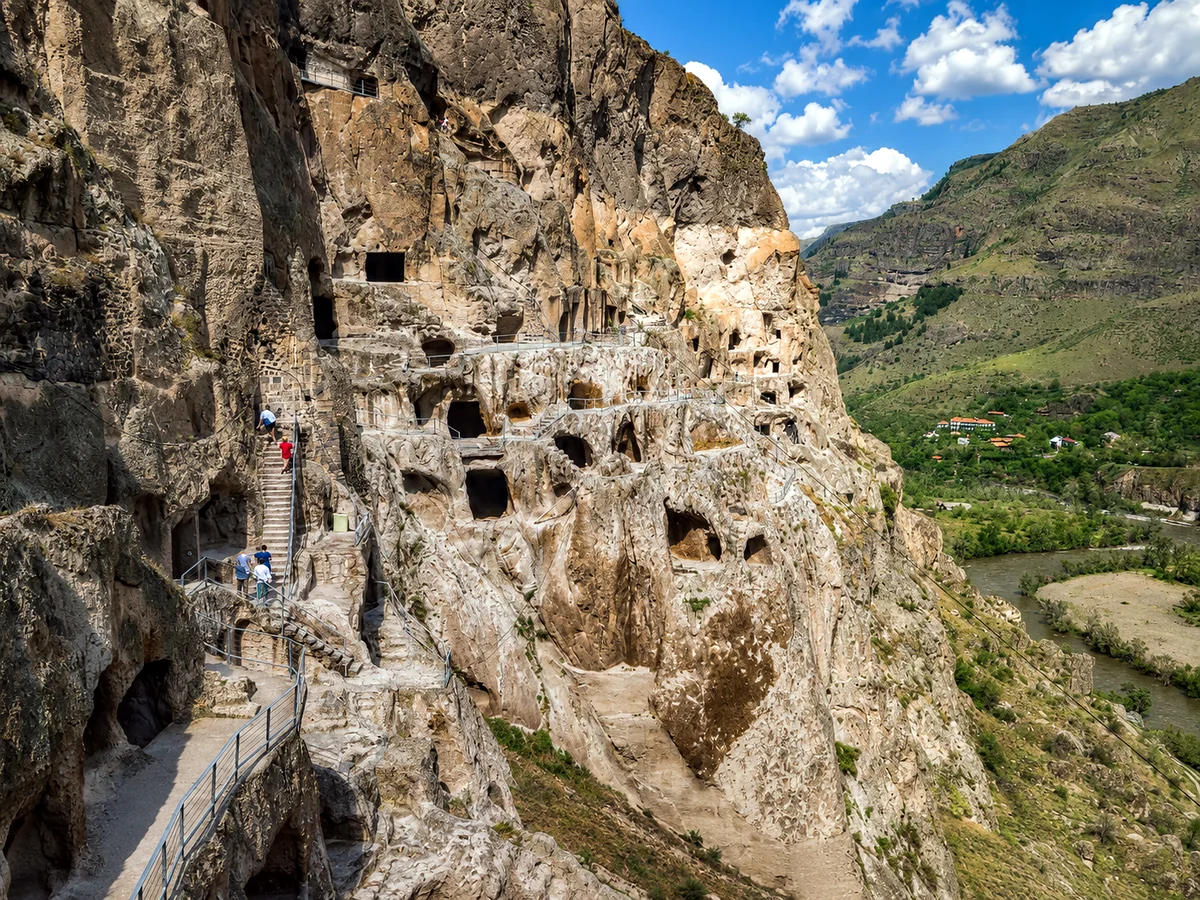
The event that transformed Vardzia from a concealed city into the open honeycomb of today came in 1283, when a major earthquake struck the Mtkvari gorge and sheared away the outer section of the cliff. The collapse destroyed and exposed roughly two-thirds of the rooms that had been hidden within the mountain, turning a largely invisible subterranean complex into the dramatically visible cliff-face installation of open cave mouths that defines the site. This is one of the most striking things to understand about Vardzia: the famous facade — stacked rows of cave openings across the full height and width of the cliff — is the unintended result of geological disaster, not the original design. The complex was built to be hidden, not to be seen. (The prominent bell tower at the entrance was added after the earthquake.) Today only a few hundred of the original rooms survive and are accessible.
Vardzia suffered further: in 1551 a Persian campaign under Shah Tahmasp reached the site, and the monastery was largely abandoned thereafter. A small monastic community was re-established in the modern period and remains active today.
The Church of the Dormition
The spiritual and artistic center of Vardzia is the main cave church, dedicated to the Dormition of the Virgin, carved and decorated in the 1180s and still the primary place of worship for the monastic community. Its interior — a rock-cut hall with a barrel-vaulted ceiling rising some nine meters — preserves fresco painting of exceptional quality and historical importance, made when the Georgian painting tradition was at its Golden Age peak; UNESCO has described the murals as of crucial significance to the development of medieval Georgian mural painting.
The frescoes cover the walls and ceiling in the comprehensive program of Georgian medieval sacred art — saints and apostles, scenes from the life of Christ, the compositions of the liturgical calendar. Their most celebrated image is on the north wall: a portrait of Queen Tamar together with her father, King George III, the founders, each shown holding a model of the church — one of the few surviving contemporary (lifetime) portraits of Tamar, and notably one in which she appears as a young, unmarried woman without the customary royal headdress. Beneath her is the inscription "God grant her a long life." The survival of these paintings across more than eight centuries, in a church exposed to the elements since the 1283 earthquake, is itself remarkable. Behind the church, reached through a tunnel, is the natural spring known as the "Tears of Tamar," still flowing with fresh water.
A small monastic community maintains the church and conducts services today, continuing a religious life that reaches back to the 12th-century foundation. The church remains an active place of worship, and visitors should behave with the respect due a functioning sacred space.
The cave complex
Moving through Vardzia is a continual shift between enclosed and open space. The internal tunnels — low passages cut through the rock, connecting chambers and levels — require ducking in places and pass through darkness between the lit chambers; then the open terraces and cave mouths facing the gorge bring sudden expansions of space and light, with views down to the Mtkvari and across the dry rocky valley to the mountains beyond. The wine cellars in the lower levels, the qvevri hollows still in the floor, convey the monastery's self-sufficiency directly, and the carved niches, stone furniture, refectory, pharmacy, and water channels build a picture of organized life within the mountain that the cave mouths seen from outside can't fully convey.
The marked walking route follows a sequence of tunnels, terraces, and stone staircases through the main accessible areas, taking roughly one and a half to two hours at a comfortable pace. Some sections cross uneven or worn stone, and the tunnels demand attention to head clearance, so footwear with good grip is essential. Parts of the site involve real climbing and tight spaces; it's not well suited to those with limited mobility or significant claustrophobia.
The landscape
The Mtkvari gorge at Vardzia is unlike almost anywhere else in Georgia. The river has cut deep into the volcanic rock of the Javakheti highlands, and the canyon walls rise steeply in terrain that is dry, exposed, and geologically dramatic — a sharp contrast with the forested mountains of northern Georgia or the subtropical Adjaran coast. The palette is ochre, brown, and grey: warm volcanic stone, pale valley dust, the occasional dark green of riverside vegetation. The light is at its best in the morning and late afternoon, when the low sun rakes across the cliff faces and gives the site a visual intensity that flat, overcast light mutes but never quite erases. The approach from Akhaltsikhe down the deepening gorge — the cave mouths revealed gradually across the cliff as the road rounds a bend — is one of the best arrivals at any Georgian site.
Getting there and visiting
- Location: Vardzia village, Aspindza municipality, Samtskhe-Javakheti, southern Georgia — about 70 km southwest of Akhaltsikhe.
- Getting there: About 70 km (1.5–2 hours) from Akhaltsikhe or Borjomi, and roughly 230 km (4–5 hours) from Tbilisi by car. Marshrutkas run from Akhaltsikhe toward Vardzia, but on a limited schedule — check current times locally. Many visitors come on an organized tour from Tbilisi or use Akhaltsikhe as a base; private transport gives the most flexibility.
- Hours / admission: Open daily (typically late morning to evening, varying by season); paid entry at the site.
- Dress: Modest clothing required for the church — shoulders and knees covered; head coverings for women (wraps are often available).
- Time needed: Allow about 2 hours on site; sturdy, grippy footwear essential.
- Best time: Spring through autumn; accessible year-round, but winter road conditions can be difficult and the exposed cliff site is uncomfortable in heavy rain or snow.
- Combine with: Khertvisi Fortress (on the road in, ~11 km north) and Tmogvi Fortress (just north), Vanis Kvabebi (another cave monastery nearby), and the wider region that Akhaltsikhe anchors — Rabati, Sapara, Abastumani, Borjomi.
Caucasus Travel FAQ
Vardzia is a vast 12th-century cave monastery and rock-cut city carved into the cliffs of Erusheti Mountain above the Mtkvari River gorge, in the Samtskhe-Javakheti region of southern Georgia, about 70 km from Akhaltsikhe. Begun around 1156 under King George III and expanded into a monastic-fortified city by his daughter Queen Tamar during Georgia's Golden Age, it held hundreds of rock-cut rooms — churches, living quarters, wine cellars, a pharmacy, a throne room — linked by tunnels and stairways. It's one of Georgia's most important and spectacular historical sites, still home to a small monastic community, and the anchor of the southern Mtkvari-gorge circuit with Khertvisi and Tmogvi.
It was begun around 1156 by King George III, who laid out the site and the first cave dwellings, and was transformed into a great monastic and fortified city by his daughter, Queen Tamar (reigned 1184–1213), at the height of medieval Georgia's power. The Church of the Dormition was carved and painted in the 1180s, and major expansion of the dwellings, defenses, and water system continued to around 1203. Tamar is so closely tied to the site that Vardzia is often thought of as "her" cave city.
This is one of the most interesting things about it. Vardzia was originally built to be largely hidden — a stronghold dug deep into the cliff, its rooms concealed within the mountain. In 1283 a major earthquake sheared away the outer face of the cliff, destroying and exposing roughly two-thirds of the rooms and turning a hidden subterranean city into the dramatic open honeycomb of cave mouths visible today. So the famous facade of stacked cave openings is actually the unintended result of a geological disaster, not the original design. A later Persian raid in 1551 left the monastery largely abandoned, though a small community is active again today. Only a few hundred of the original rooms survive.
Yes. The Church of the Dormition, the spiritual and artistic heart of Vardzia, preserves 12th-century frescoes of exceptional quality — UNESCO has called them crucial to the development of medieval Georgian mural painting. The most famous is on the north wall: a portrait of Queen Tamar together with her father, King George III, the founders, each holding a model of the church. It's one of the very few contemporary (lifetime) portraits of Tamar, and notably shows her as a young, unmarried woman without the usual royal headdress, with the inscription "God grant her a long life" beneath her. Behind the church a spring known as the "Tears of Tamar" still flows.
Vardzia is about 70 km (1.5–2 hours) from Akhaltsikhe or Borjomi and roughly 230 km (4–5 hours) from Tbilisi; most visitors drive, take a tour, or use Akhaltsikhe as a base (marshrutkas run but on a limited schedule). Allow about two hours to walk the marked route through the tunnels, terraces, and staircases — it involves climbing, uneven stone, and some tight, dark passages, so wear sturdy footwear with good grip, and note it's not ideal for those with limited mobility or significant claustrophobia. The church is an active place of worship, so dress modestly (shoulders and knees covered; head coverings for women). Spring through autumn is best. It pairs naturally with Khertvisi and Tmogvi fortresses in the same gorge.