
Akhaltsikhe
Akhaltsikhe is a small city in southern Georgia — the country in the South Caucasus — in the Samtskhe-Javakheti region, at around 1,000 meters above sea level. About 45,000 people live here, in the valley of the Potskhovi River below steep hills. For most travelers it works two ways at once: a base for the cave city of Vardzia and the mineral-water town of Borjomi, and a worthwhile stop in its own right for Rabati Castle. The name means "new fortress" in Georgian, though the settlement is anything but new.
Planning your visit? See our full guide to things to do in Akhaltsikhe for specifics, timings, and local tips.
Why visit Akhaltsikhe?
The main reason to visit Akhaltsikhe is Rabati Castle, a large hilltop fortress complex that holds a mosque, an Orthodox church, a synagogue, and a museum within one set of walls — a physical record of the city's mixed Georgian, Ottoman, and Russian history. The second reason is location: Akhaltsikhe is the natural base for Vardzia (about 55 km southwest), Khertvisi Fortress (about 40 km south), and Borjomi (about 50 km north). The city itself is quiet and compact; most people use it as a hub rather than a destination for several days.
Rabati Castle
Rabati Castle is the reason most travelers stop in Akhaltsikhe. The fortified complex occupies a hilltop above the city center and has existed in some form since at least the 9th century, but what you see today comes mostly from a large restoration completed in 2012.
Inside the walls, the lower Rabati quarter holds a restored mosque with a slender minaret, a Georgian Orthodox church, a synagogue, a caravanserai, and a museum. The upper fortress contains the remains of the medieval citadel and gives wide views over the city and valley. Having Christian and Islamic buildings inside one complex reflects the city's Ottoman period, when different religious communities lived in the same urban space.
The 2012 restoration is worth being honest about. It went well beyond conserving what survived and added significant new construction in a historical style, and architects and historians still debate where restoration ends and reconstruction begins. If you want untouched medieval ruins, Rabati isn't that — large parts are effectively new. What it does well is give a clear, walkable framework for understanding the city's layered past, and the on-site museum has a well-presented collection from the Samtskhe-Javakheti region spanning prehistoric to Ottoman times.
Entry to the lower complex is free; the upper fortress and museum have a modest admission fee. The complex is lit at night, and the illuminated minaret and church tower are visible across much of the city after dark.
The city beyond the castle
Away from Rabati, Akhaltsikhe is an unhurried provincial city you can walk in an hour or two. The main street through the lower town has the usual small shops, bakeries, and cafés, and a number of 19th-century Russian imperial-era buildings survive in mixed condition, giving these streets a different texture from the castle hill.
The local market, busiest in the mornings, is a good place to find regional honey, churchkhela (a sweet made from grape must and walnuts strung on a thread), dried herbs, and local dairy. Samtskhe-Javakheti food carries both Georgian and Armenian influence, so it tastes a little different from what you'll have eaten in Tbilisi — worth noticing if you've been traveling a while.
Day trips from Akhaltsikhe
For many travelers, Akhaltsikhe's real value is as a base for the surrounding region, which holds some of the most significant historical sites in Georgia.
Vardzia cave monastery
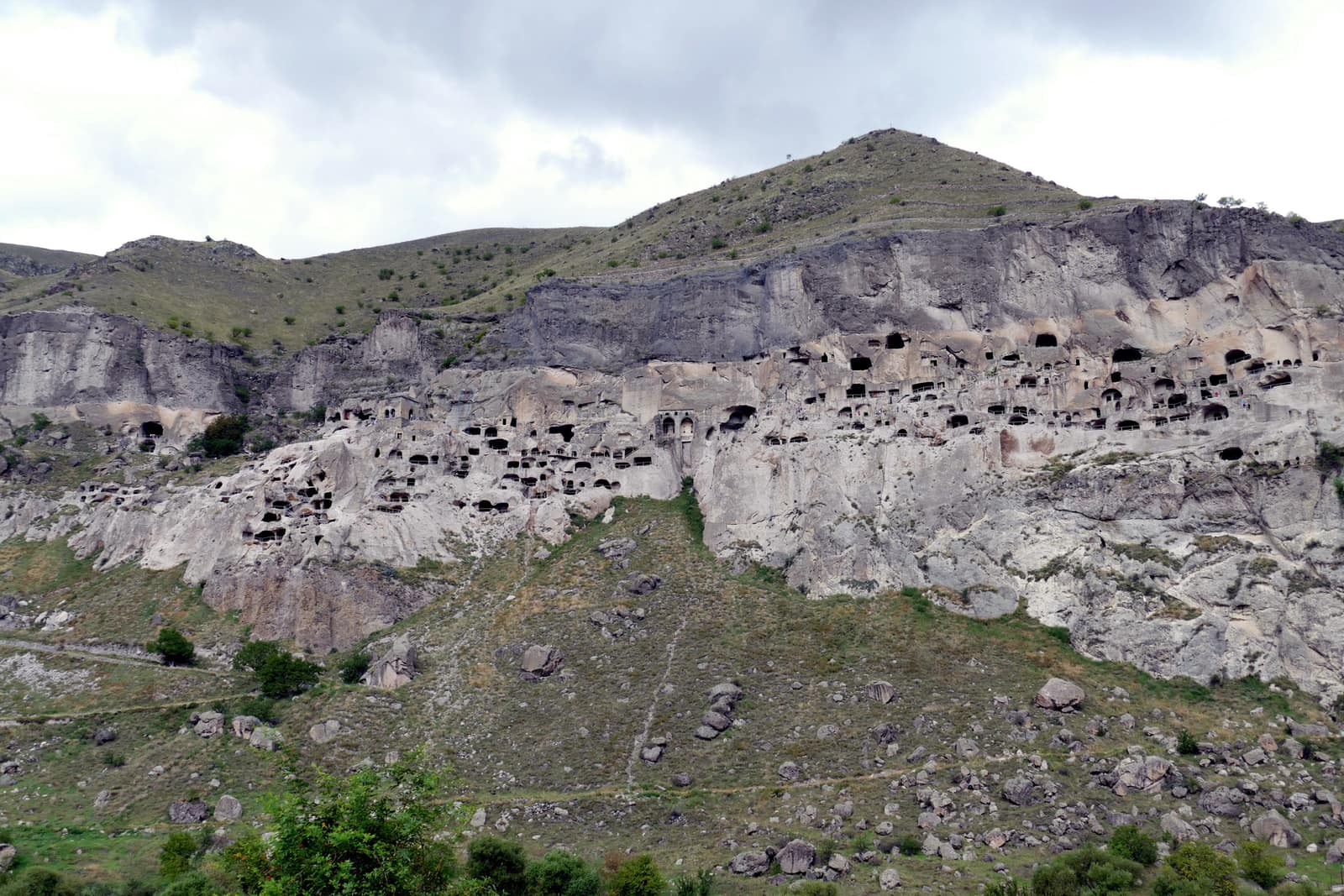
Vardzia is the standout, about 55 km southwest of Akhaltsikhe. It is a vast cave monastery cut into the cliffs of the Mtkvari River gorge in the 12th century, mainly under Queen Tamar. At its height it held more than 3,000 rooms across thirteen levels of cliff face, including a church, a throne room, a pharmacy, and quarters for hundreds of monks. A major earthquake in 1283 collapsed the outer wall of rock, exposing roughly two-thirds of the rooms and creating the honeycomb face you see now. A small community of monks still lives and worships at the site, and several cave chapels keep their original 12th-century frescoes, well preserved for their age. Plan at least a half day, including travel. Wear proper shoes — the visit involves climbing steps and narrow passages cut into rock.
Khertvisi Fortress
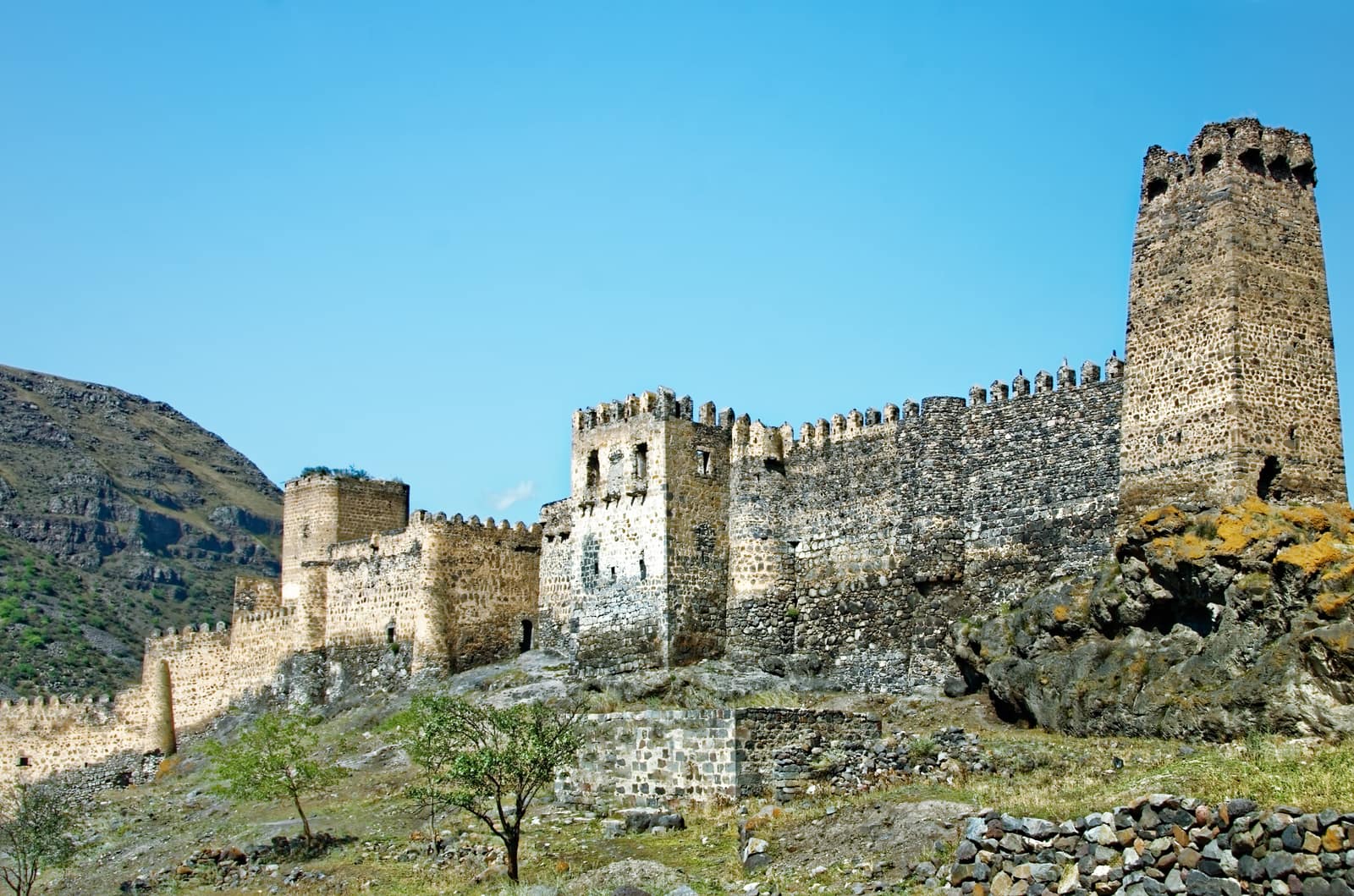
Khertvisi Fortress sits about 40 km south of Akhaltsikhe, above the meeting of the Mtkvari and Paravani rivers, and is one of the oldest fortifications in Georgia — its origins reach back to around the 2nd century BC, though most of the standing structure is medieval. It's on the road to Vardzia, so it slots in naturally as a short stop rather than a separate trip.
Borjomi and Borjomi-Kharagauli National Park
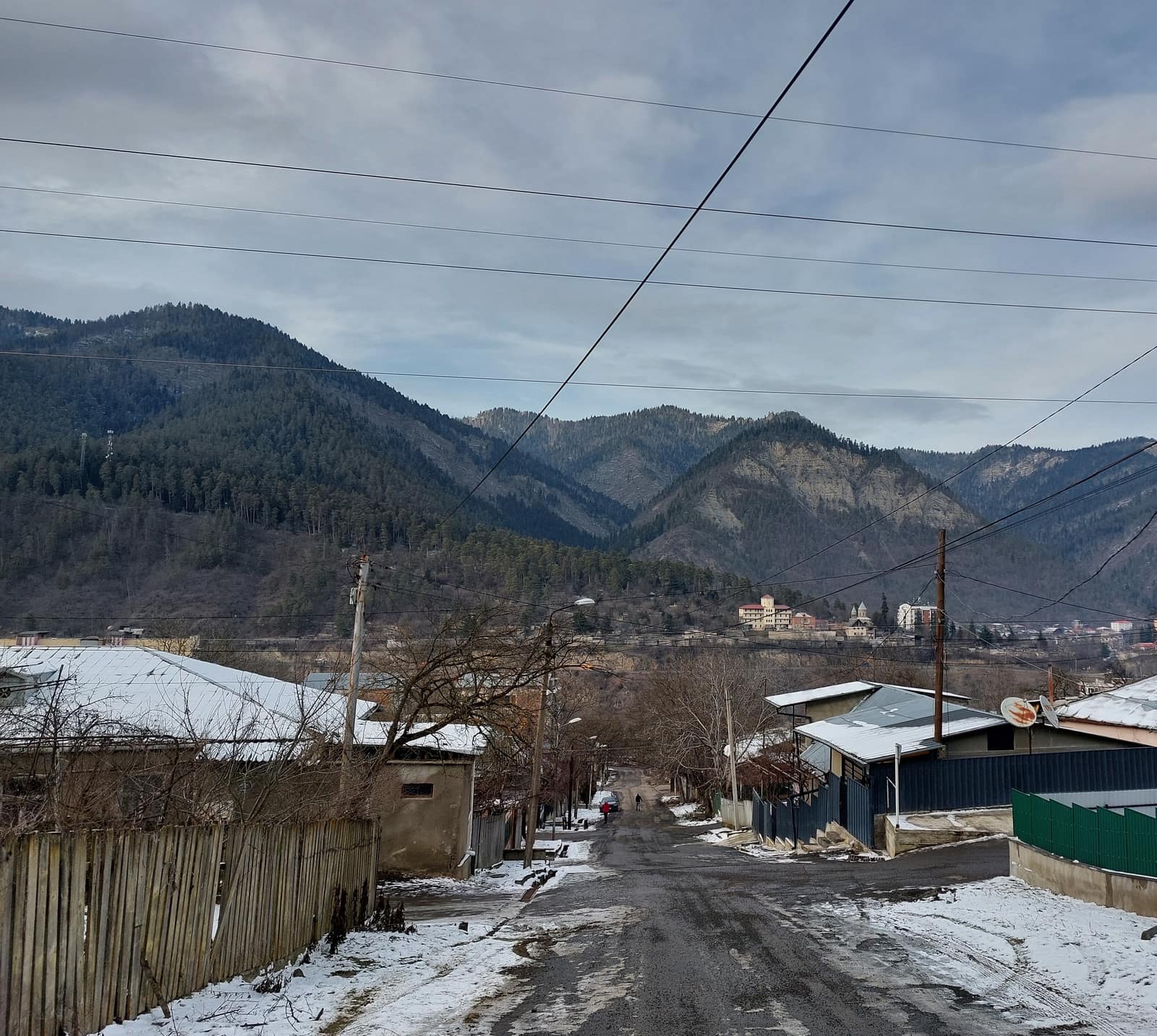
Borjomi is about 50 km north of Akhaltsikhe and is best known for its mineral water, bottled and exported for well over a century. The town sits in a deep, forested gorge on the Mtkvari, with a central park where you can fill a bottle straight from the spring — though the water is warm and strongly mineral, and not everyone likes it. Several grand buildings survive from the Russian imperial and Soviet resort era in varying repair. The surrounding Borjomi-Kharagauli National Park is one of the largest protected forests in the Caucasus, with trails from short walks to multi-day routes.
How to get to Akhaltsikhe
Akhaltsikhe is connected to Tbilisi by regular marshrutka (minibus), with the trip taking roughly three to three and a half hours depending on traffic and road conditions. The route passes through Borjomi, so it's easy to break the journey there. There's no convenient direct train: a rail line exists but reaches Tbilisi only by a much longer route.
Once you're in the region, reaching Vardzia and the other outlying sites is most practical by private car or an organized tour. Public transport to the more remote spots is limited and infrequent, and trying to reach Vardzia and back by marshrutka in a day is tight — this is the main reason many travelers use a driver or a tour for this corner of Georgia.
Best time to visit Akhaltsikhe
Akhaltsikhe sits higher than Tbilisi, so it runs cooler — noticeably so in winter, when temperatures regularly drop below freezing and snow is common. Summers are warm but rarely as hot as the capital, which makes May through October the comfortable window. Spring and early summer bring green hillsides and good conditions for both the castle and the surrounding sites. Vardzia is open year-round but can be cold and icy underfoot in winter, so check conditions before a winter visit.
A brief history of Akhaltsikhe
Akhaltsikhe's history as a notable settlement begins in the 9th century, when it was the seat of the Jakeli dynasty, rulers of the Samtskhe principality. It grew into one of southern Georgia's more important towns through the medieval period. After the unified Georgian kingdom fragmented in the 15th century, Samtskhe drifted under Ottoman influence, and by 1625 Akhaltsikhe was firmly under Ottoman control for nearly two centuries.
Under the Ottomans the city was known as Ahıska and served as the administrative center of the Childir Eyalet, a province covering much of today's southern Georgia and northeastern Turkey. The Ottomans built mosques and a caravanserai and expanded the fortress that still dominates the city. Its population mixed Georgians, Armenians, Turks, and Jews, and it worked as a regional trading hub. Russian forces took the city in 1828 during the Russo-Turkish War, and it joined the Russian Empire under the 1829 Treaty of Adrianople. Russian rule changed both the population and the architecture — much of the Muslim population left or was expelled — and the city stayed within the Russian Empire and then the Soviet Union until Georgian independence in 1991. That sequence — medieval Georgian, Ottoman, Russian imperial, Soviet — is still visible across the city and is what makes Akhaltsikhe one of the more historically layered places in Georgia.
Frequently Asked Questions
Yes, with one caveat: a 2012 restoration added significant new construction, so it isn't an untouched medieval ruin. It's impressive in scale, easy to walk, and the on-site museum gives good regional context. The lower complex is free; the upper fortress and museum charge a modest fee.
Vardzia is about 55 km southwest of Akhaltsikhe, roughly an hour by car, passing Khertvisi Fortress on the way. Allow at least a half day for the visit including travel.
May through October. Akhaltsikhe sits higher than Tbilisi and runs cooler, with cold, often snowy winters. Spring and early summer are especially good for the castle and the surrounding sites.