
Things to Do in Samtskhe-Javakheti: Vardzia, Rabati, and Borjomi
Samtskhe-Javakheti, in southern Georgia — the country in the South Caucasus — is one of the most varied regions in the country, combining historical landmarks, forests, fortresses, and high volcanic plateaus within a single southern tier not far from Tbilisi. It's a region where every stop feels different: cave monasteries, a restored hilltop fortress, a forested spa town, and the spare, lake-dotted Javakheti highlands. Here are the things most worth doing.
What are the best things to do in Samtskhe-Javakheti?
The highlights are the spectacular Vardzia cave monastery; the restored Rabati fortress in Akhaltsikhe; the spa town and forests of Borjomi; and the high volcanic plateau of Javakheti with its lakes, including Lake Paravani. Add the ancient Khertvisi Fortress on the road to Vardzia and the region's mix of Georgian, Armenian, and Ottoman heritage. It's a region best given several days, ideally combining history in the north with the remote landscapes of the south.
Explore the Vardzia cave monastery
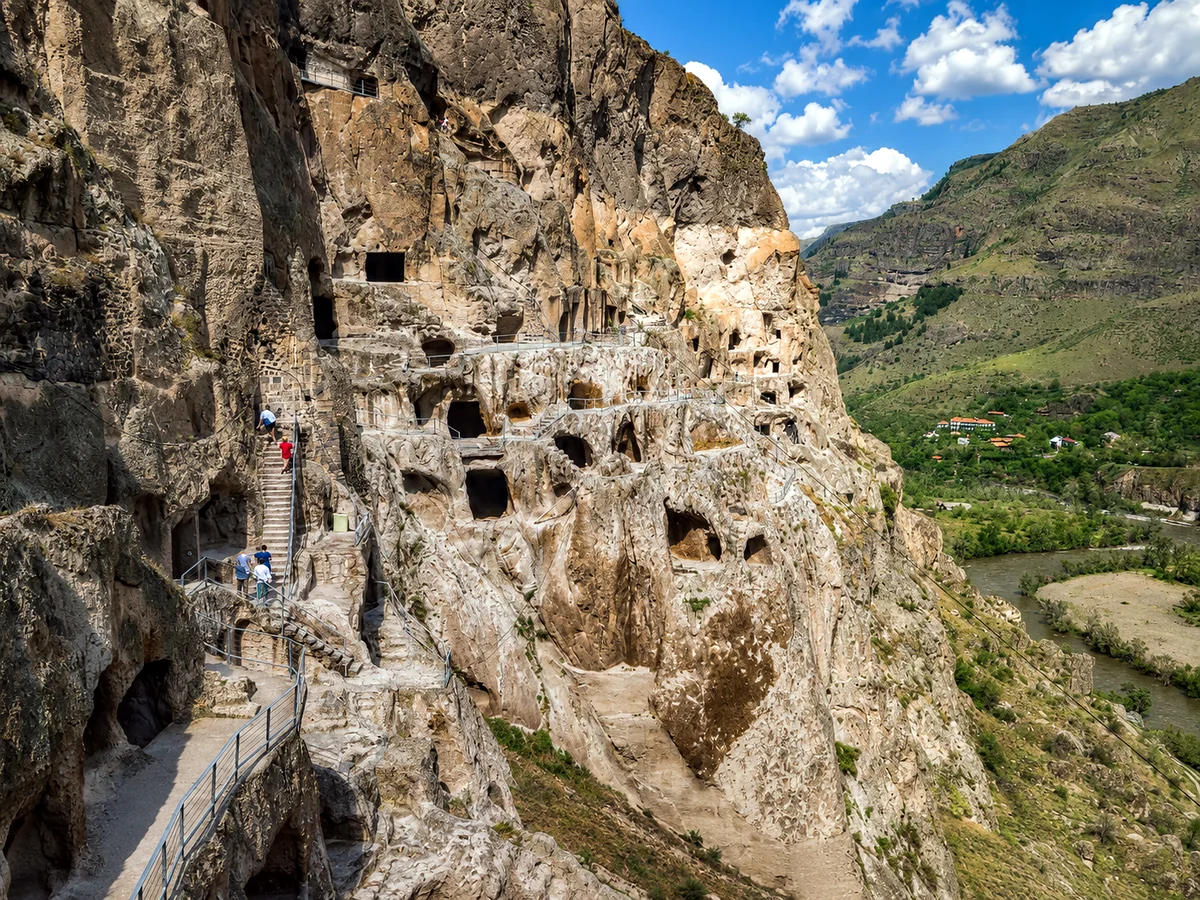
Vardzia is the region's signature site and one of the great monuments of Georgia: a 12th-century cave monastery carved into a cliff above the Mtkvari River, built under King George III and expanded by Queen Tamar. At its peak it held around 3,000 rooms across thirteen levels; a 1283 earthquake collapsed the cliff's outer face and exposed the caves, giving it the honeycomb appearance you see today. Visiting means walking through interconnected cave rooms, tunnels, and stairways, seeing the main Church of the Dormition with its remarkable 12th-century frescoes — including a famous portrait of Queen Tamar — and taking in the views over the Mtkvari valley below. It remains an active monastery with a small resident community, and as a place of worship it's appreciated if you dress modestly (a scarf is useful for entering the church). One of the highlights of any trip to Georgia.
Visit Rabati fortress in Akhaltsikhe
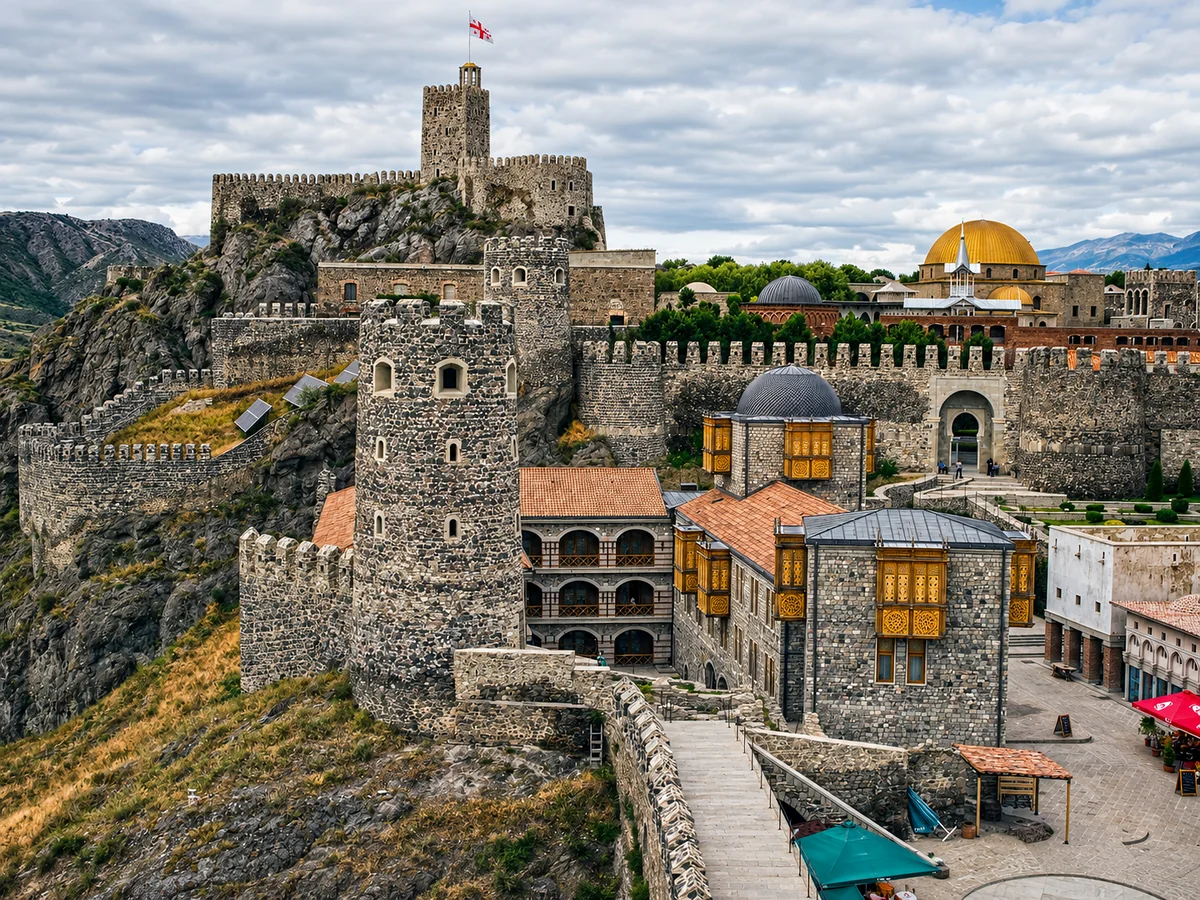
The Rabati fortress, on a hilltop above Akhaltsikhe, is one of the most distinctive architectural sites in the country — a complex that layers a medieval Georgian citadel, an Ottoman mosque with a minaret, a Georgian Orthodox church, a caravanserai, and a synagogue within one set of walls, reflecting the town's mixed history. A major restoration completed in 2012 rebuilt much of it, so it's polished and visitor-friendly, with museums, towers, and courtyards to explore. Worth knowing: the reconstruction was heavy, and how much is original versus rebuilt is debated — some find it impressive, others a little theme-park — so it's best approached as a vivid introduction to the region's layered past rather than an untouched ruin. Akhaltsikhe also makes the natural base for Vardzia and Khertvisi.
Relax in Borjomi and explore the forests
At the northern end of the region, Borjomi is a complete change of pace — a 19th-century spa town famous for its mineral water, set in a deep forested gorge. You can taste the naturally carbonated water at the source in the central park, walk the forest trails, and use the town as the gateway to the Borjomi-Kharagauli National Park, one of the largest protected forest areas in the Caucasus and the region's best-developed base for hiking. This is the part of Samtskhe-Javakheti to slow down in. (Borjomi has its own detailed guide in this series.)
Discover the Javakheti plateau and its lakes
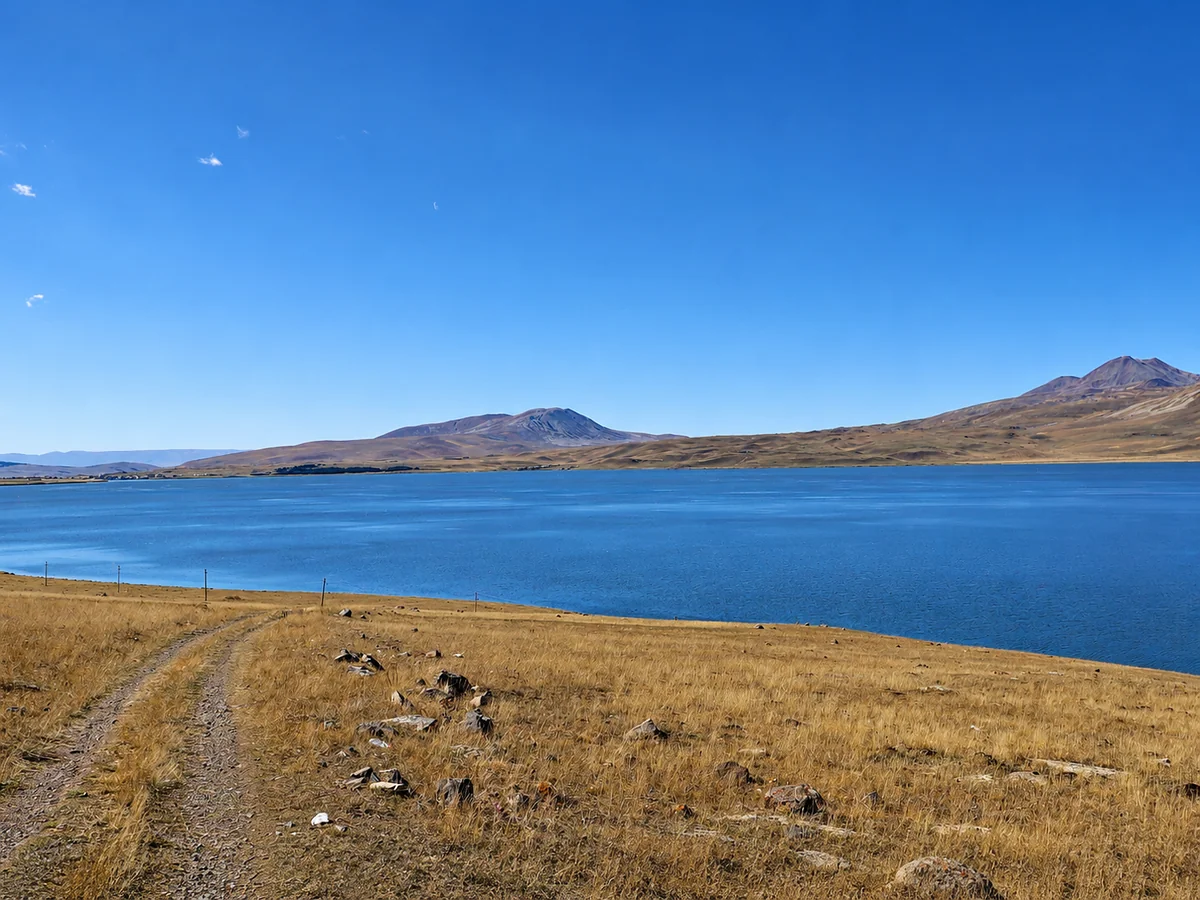
The southern half of the region is a different world: a high volcanic plateau between 1,700 and 2,500 meters, all open grassland, basalt outcrops, and big skies, scattered with volcanic lakes. The largest, Lake Paravani, is the biggest lake in Georgia, sitting at around 2,073 meters. The landscape is spare and windswept — unlike anywhere else in Georgia — and the towns of Akhalkalaki and Ninotsminda are predominantly Armenian-speaking, giving the area a distinct cultural feel. It's also an important zone for migratory and breeding waterbirds. This is remote, off-circuit travel: rewarding for its emptiness and its lakes, best in summer, and most practical with your own vehicle.
Stop at Khertvisi Fortress
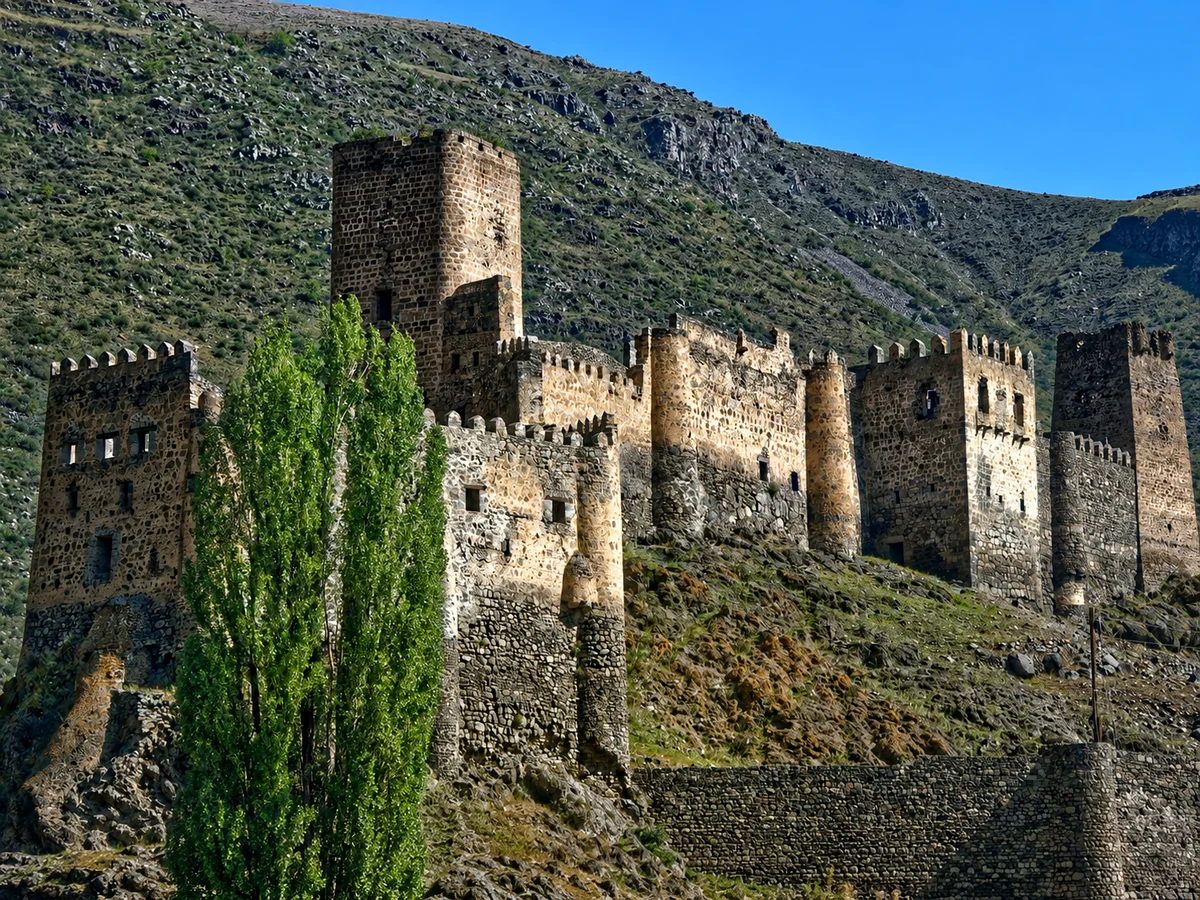
On the road between Akhaltsikhe and Vardzia, Khertvisi Fortress is among the oldest fortifications in Georgia, with origins attributed to the 2nd century BC and standing walls largely from the medieval period. It occupies a dramatic triangular promontory at the confluence of the Mtkvari and Paravani rivers, the walls dropping to the water on two sides — a striking, strategically chosen site that's right beside the road and combines naturally with a Vardzia visit.
Seek out lesser-known cave sites
Vardzia isn't the only rock-cut site in this valley. A few kilometers from it, Vanis Kvabebi (the Vani Caves) is an older, smaller 8th-century cave monastery — a maze of tunnels across multiple levels with a defensive wall from 1204 and two churches — far quieter and more rugged than Vardzia. Smaller cave churches and hermit cells are also scattered through the Mtkvari gorge between Khertvisi and Vardzia, evidence of the same tradition of rock-cut religious life. One important caveat: Vanis Kvabebi has reportedly been closed to visitors in recent years because of rockfall risk, so check its current status before planning to go in.
Experience the region's cultural diversity
Samtskhe-Javakheti has a long history of cultural interaction, and you feel it as you travel. The architecture shifts between Georgian, Ottoman, and Armenian influences; the south, near the Armenian and Turkish borders, has a markedly different character from the Georgian heartland; and the mix of communities, traditions, and religious buildings adds real depth to a trip here. It's one of the region's quieter rewards, threaded through everything else.
Drive the scenic routes
Much of the experience is the road itself. Travelling through Samtskhe-Javakheti takes you from forested gorges through river valleys to open plateau, the landscape changing character as you go, with viewpoints and historical stops along the way. The Akhaltsikhe–Vardzia road through the deepening Mtkvari gorge is especially rewarding, and a car gives the freedom to stop where the scenery and the sites invite it.
Combine history and nature over several days
The region's real advantage is variety: within a relatively short area you can visit an ancient cave city, explore medieval fortresses, walk in a national park, and cross a remote volcanic plateau. Because the sites are spread out, it's best given several days. A natural structure is to start with Borjomi and its forests, spend a day on Akhaltsikhe and Rabati, devote a day to Vardzia and the Mtkvari gorge (with Khertvisi on the way), and — with extra time — add the Javakheti plateau and its lakes. A car or a private tour makes the dispersed sites far easier to link together.
Why Samtskhe-Javakheti is worth exploring
Few regions in Georgia offer this range: a marquee monument in Vardzia, a one-of-a-kind fortress at Rabati, forest and mineral water at Borjomi, and the remote, high landscapes of Javakheti. It rewards both a focused history-and-nature route and a slower multi-day exploration, and it consistently surprises travelers who expect a single character and find instead something layered and varied — one of the strongest additions to a Georgia itinerary for anyone wanting to go beyond the obvious.
Caucasus Travel FAQ
Explore the Vardzia cave monastery, visit the Rabati fortress in Akhaltsikhe, relax in Borjomi and walk in the Borjomi-Kharagauli National Park, and cross the high Javakheti plateau with its lakes, including Lake Paravani. The ancient Khertvisi Fortress on the road to Vardzia is an easy add-on. The region rewards several days combining history and nature.
Very much — it's one of Georgia's great monuments. The 12th-century cave monastery, carved into a cliff above the Mtkvari and built under Queen Tamar, has interconnected cave rooms, tunnels, and a main church with famous 12th-century frescoes, including a portrait of Queen Tamar. It's still an active monastery, so modest dress is appreciated, and the views over the river valley are superb.
Rabati, above Akhaltsikhe, is one of Georgia's most distinctive sites — a hilltop complex layering a Georgian citadel, an Ottoman mosque, a church, a caravanserai, and a synagogue. A 2012 restoration rebuilt much of it, so it's polished and easy to explore; the heavy reconstruction is debated, so it's best seen as a vivid introduction to the region's mixed history rather than an untouched ruin.
The Javakheti plateau is a remote, high volcanic landscape (1,700–2,500 m) of open grassland and lakes, including Lake Paravani, the largest in Georgia. It's a place for scenic driving, lake views, birdwatching, and experiencing the predominantly Armenian towns of Akhalkalaki and Ninotsminda. It's far off the main circuit, best in summer, and most practical with your own vehicle.
It's best over several days, as the sites are spread out. A common structure is Borjomi and its forests, then Akhaltsikhe and Rabati, then Vardzia and the Mtkvari gorge (with Khertvisi on the way), plus an optional day for the Javakheti plateau and lakes. A car or private tour makes linking the dispersed sites much easier.