
Imereti, Georgia: Kutaisi, Gelati Monastery, and the Caves of the Karst
Imereti is the central region of western Georgia — the country in the South Caucasus — occupying the broad valley of the Rioni River and its tributaries between the Likhi range to the east (the low watershed ridge that has historically divided western from eastern Georgia) and the mountainous borders of Racha and Svaneti to the north. It is the most populous region in western Georgia and one of the most historically significant in the country, with a recorded history reaching back to the ancient Kingdom of Colchis and a medieval legacy that includes some of the finest ecclesiastical architecture and most important intellectual institutions Georgia ever produced. Kutaisi, the regional center, is one of the oldest continuously inhabited cities in the Caucasus; the caves, canyons, and forested landscapes around it are among the most visited natural sites in the country; and the wine tradition of Imereti — quieter and less internationally promoted than Kakheti's — represents a genuinely distinct approach to Georgian winemaking that deserves more attention than it usually gets.
What is Imereti known for?
Imereti is best known for Kutaisi (one of the oldest cities in the Caucasus and a major low-cost flight hub), the medieval Gelati Monastery and the Bagrati Cathedral above the city, and the karst landscape of caves and canyons — Prometheus Cave, and the Okatse and Martvili canyons. It's also home to the faded Soviet spa town of Tskaltubo, the Sataplia reserve with its dinosaur footprints, and a distinctive western-Georgian wine tradition built on grapes like Tsolikouri and Tsitska. Compact and well connected, it packs heritage, nature, and wine into a small area.
What makes Imereti useful for travelers
Beyond the quality of what it contains, Imereti's real advantage is accessibility and compactness. The main sites sit within a relatively small area, connected by roads that are good by Georgian standards, and anchored by an international airport that has made Kutaisi one of the most convenient entry points into Georgia from Europe. A traveler with a week here can cover medieval monasteries, underground cave systems, dramatic river canyons, Soviet-era spa ruins, traditional wineries, and a functioning provincial city with real character — without spending excessive time in transit.
Geography and landscape
The Rioni River is the geographical spine of Imereti, rising in the Greater Caucasus to the north and flowing west across the region before continuing through Samegrelo to the Black Sea. The valley broadens considerably through central Imereti, creating the relatively flat agricultural land around Kutaisi that gives the region its character as a productive farming area as well as a historically significant one. The hills framing the valley on both sides — densely forested, cut by smaller river gorges, and underlain by the karst limestone responsible for the region's caves and canyons — rise to greater heights toward the northern and eastern margins.
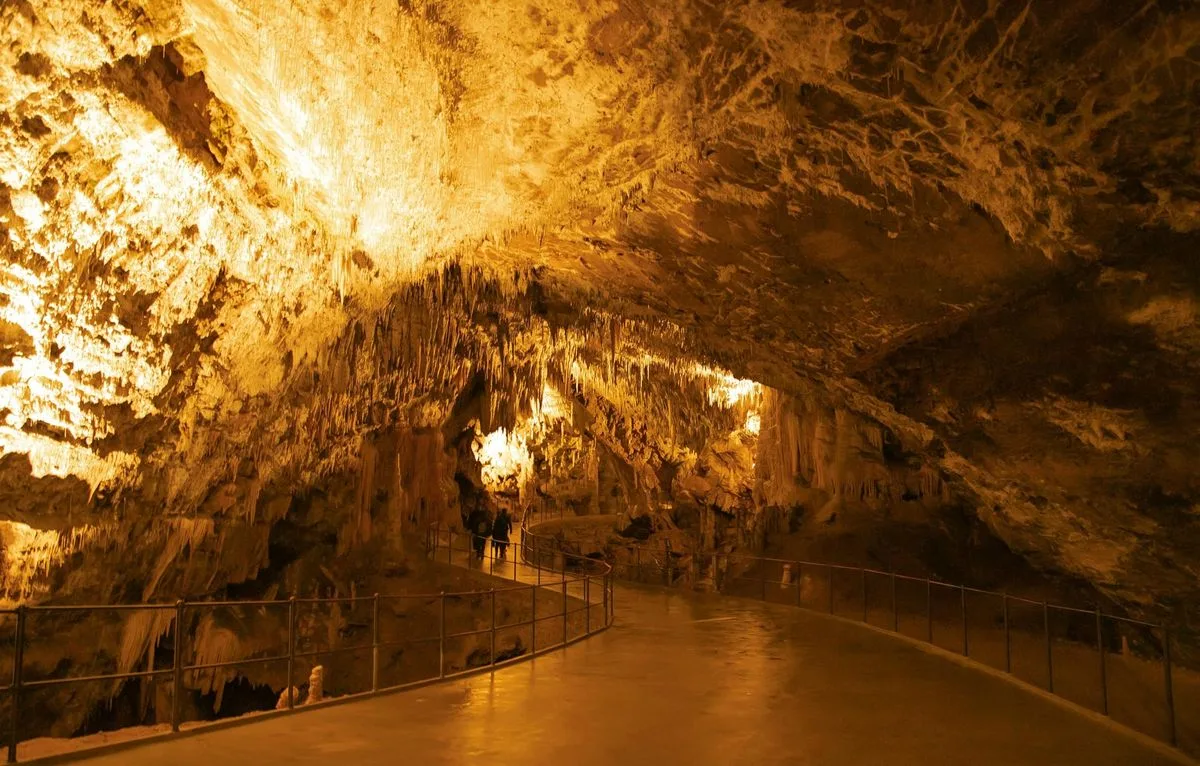
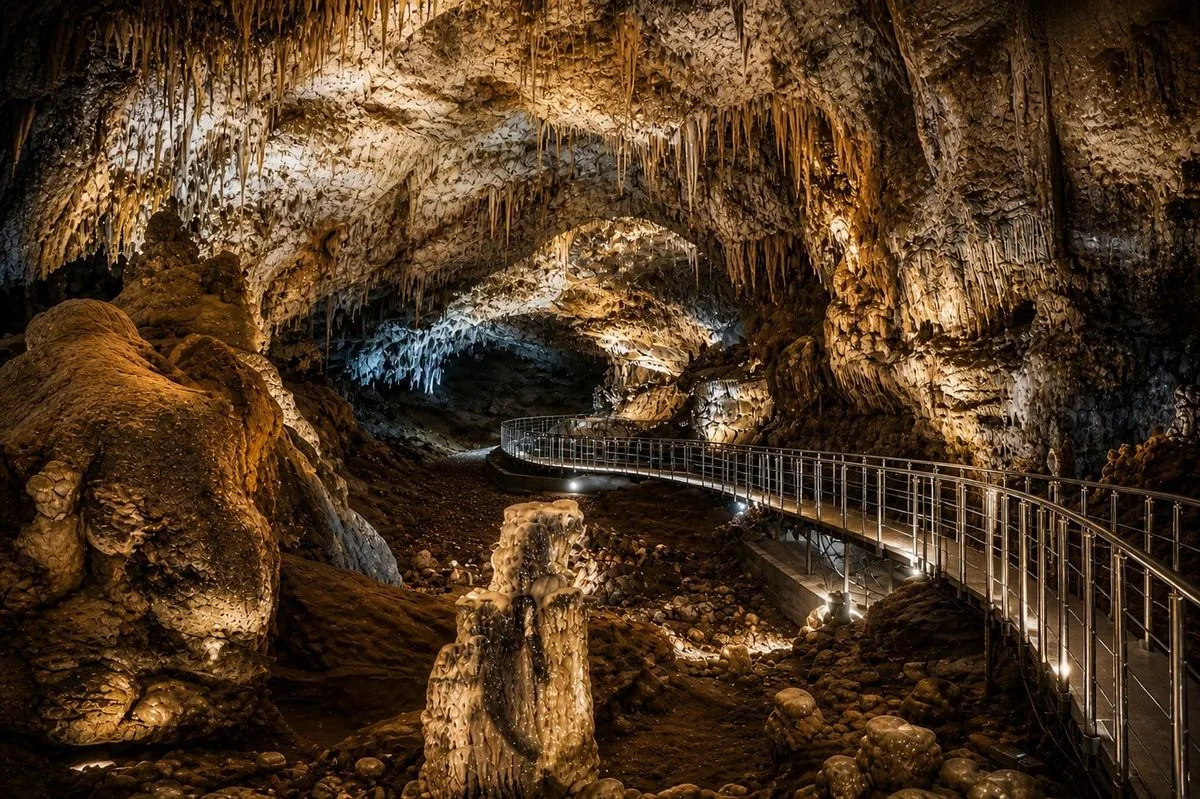
The karst geology deserves particular attention, since it explains much of Imereti's natural appeal. Limestone landscapes develop characteristic underground drainage, and millennia of water percolating through soluble rock have produced the cave systems, gorges, and canyons that make western Georgia one of the most remarkable karst environments in the Caucasus. Prometheus Cave near Tskaltubo, the Okatse and Martvili canyons, and numerous smaller caves and sinkholes are all expressions of the same process — and the results (turquoise rivers in sheer limestone walls, underground chambers of extraordinary scale, stalactite formations representing millions of years of slow mineral deposition) give Imereti a natural dimension that complements its historical and cultural assets.
History
Imereti's history is long and layered. Its most ancient layer is Colchian: modern Imereti falls within the heartland of ancient Colchis, the kingdom of the eastern Black Sea coast that appears in Greek sources from the first millennium BC and occupies a central place in the myth of the Argonauts and the Golden Fleece. How far that mythology maps onto actual events remains debated, but the archaeological evidence of sophisticated Bronze and Iron Age cultures in the Rioni valley is substantial, and the metalworking traditions of ancient Colchis — gold and bronze objects of considerable refinement — are represented in museum collections throughout Georgia.
The medieval period left the most visible legacy. Kutaisi served as the capital of the unified Georgian kingdom under the Bagrationi dynasty in the 10th and 11th centuries, and the building of the Bagrati Cathedral and, shortly afterward, the Gelati Monastery gave physical form to a kingdom at the height of its power and cultural confidence. After the capital moved to Tbilisi, Imereti continued as a significant cultural and religious region, and Gelati in particular developed into one of the most important intellectual institutions in medieval Georgia, its academy functioning alongside Ikalto in Kakheti as a center of theological and philosophical scholarship.
The fragmentation of the unified kingdom in the 15th century produced the Kingdom of Imereti as a distinct political entity, which maintained a complicated existence — alternately autonomous, contested, and under Ottoman pressure — until Russian annexation in 1810. The 19th century brought the standard reorganization of Russian imperial administration, and the region developed through the late imperial and Soviet periods as an agricultural and light-industrial area centered on Kutaisi, which kept a degree of economic and cultural significance throughout.
Kutaisi
Kutaisi merits its own guide — and has one — but its role within Imereti is the essential starting point for the region. As the third-largest city in Georgia and the historical capital of the west, it provides the infrastructure, transport connections, and concentration of cultural institutions that make it the natural base for regional exploration. Its own sites — the Bagrati Cathedral on its hill above the Rioni, the central market, the riverside promenade, and the fabric of a working Georgian provincial city — are worth a day before moving out to the surrounding region.
The city's centrality is reinforced by the airport. Kutaisi International Airport, about 25 kilometers from the center, handles a growing number of routes from European cities, predominantly low-cost carriers, and has transformed access to western Georgia over the past decade. Arriving in Imereti directly from abroad, without transiting Tbilisi, is now a straightforward option that meaningfully changes the calculus of western Georgia as a destination. (Kutaisi has its own detailed guide in this series.)
Gelati Monastery
Nine kilometers northeast of Kutaisi, on a forested hillside above a tributary of the Rioni, Gelati is the most important medieval monument in Imereti and one of the most significant historical sites in Georgia. Founded in 1106 by King David the Builder as both a religious complex and an academy of learning, it was conceived on a scale and with an intellectual ambition that placed it among the leading institutions of the medieval Georgian world. David himself is buried here, beneath the threshold of the main gate — a deliberate act of humility that remains one of the most discussed gestures in Georgian royal history.
The main Cathedral of the Virgin contains the finest surviving medieval mosaics in Georgia, including a 12th-century apse mosaic of the Virgin and Child that represents a high point of Georgian medieval art. The frescoes covering the walls span multiple centuries of production, and reading the layers — earlier work surviving in fragments, later additions filling the gaps, the whole a visual record of the monastery's long history — rewards careful attention. The monastery is active, with a resident community, and the hillside setting gives it a contemplative quality that the more heavily visited sites in Tbilisi and Mtskheta sometimes lack. Gelati is a UNESCO World Heritage Site in its own right — a designation that reflects a significance extending well beyond Georgia's national heritage.
Bagrati Cathedral
The Bagrati Cathedral, built between 1003 and 1008 under King Bagrat III as a physical expression of the newly unified Georgian kingdom, stands on Ukimerioni Hill above Kutaisi with views over the Rioni valley. Its history since construction has been complicated: Ottoman forces destroyed much of it with gunpowder in 1691, and the ruins stood for three centuries before a controversial reconstruction, completed in 2012, rebuilt the dome and portions of the walls. That reconstruction had a notable consequence — Bagrati and Gelati had been jointly inscribed on the UNESCO World Heritage List in 1994, but in 2017 the World Heritage Committee removed Bagrati Cathedral from the listing entirely, judging that the reconstruction had compromised its authenticity and integrity, while retaining Gelati as a standalone World Heritage Site. The debate around the restoration reflects broader questions about conservation philosophy that the site embodies in unusually direct form. Whatever position one takes, the cathedral and its hilltop setting remain impressive, and the views from the grounds over Kutaisi and the Rioni valley are among the best in the city.
Prometheus Cave
About 20 kilometers northwest of Kutaisi near the town of Tskaltubo, Prometheus Cave is the most visited and most thoroughly organized natural attraction in Imereti. The system runs through a series of chambers of varying scale and character, containing stalactite and stalagmite formations developed over millions of years in the karst limestone. A lit walkway guides visitors through the main sequence, and a short boat section on an underground river makes a memorable finale. The largest chambers are genuinely impressive in scale, and the cave holds a constant temperature of around 14°C regardless of the season outside — welcome in summer, when the contrast with the heat above is particularly pleasant. The visit takes roughly an hour and a half to two hours and suits visitors of all ages and fitness levels.
Okatse and Martvili canyons
The two main canyon systems accessible from Kutaisi offer different but complementary takes on the karst landscape. Okatse Canyon, about 40 kilometers from the city, is a narrow, dramatically walled gorge reached via a cantilevered walkway suspended above the canyon edge, giving vertiginous views straight down to the river far below; it ends at a platform over the most dramatic section, and the combination of sheer walls, drop, and distant water rewards the relatively straightforward approach.
Martvili Canyon, about 55 kilometers northwest of Kutaisi in the Samegrelo border area, is wider and more classically scenic — the Abasha River running through limestone walls of exceptional color, with optional boat rides through the narrower sections where overhanging walls and turquoise water create a striking effect. The two are frequently combined in a single day trip from Kutaisi, one in the morning and the other in the afternoon, with a drive between them through the characteristic mixed agricultural and forested landscape of western Georgia. (Martvili also features in the Samegrelo guide in this series, as it sits on the regional boundary.)
Sataplia Nature Reserve
A few kilometers from the Kutaisi city limits, Sataplia preserves a small area of relict Colchic forest — the subtropical forest type that once covered much of the western Caucasus lowlands — alongside Cretaceous-period dinosaur footprints preserved in the limestone surface, a small cave, and a glass-floored observation platform with views over the Rioni valley and the city. The footprints, discovered in the 1930s, include tracks of both herbivorous and carnivorous dinosaurs and add one of the more unusual historical layers to a region already rich in them. The reserve works well as a two-to-three-hour excursion — accessible and varied without being demanding, and particularly good for visitors with children.
Tskaltubo
The spa town of Tskaltubo, about 12 kilometers from Kutaisi, has its own guide in this series, but its place within Imereti deserves mention. The combination of natural thermal mineral springs, a remarkable concentration of grand Soviet-era sanatorium buildings in various states of decay and partial revival, and easy proximity to Prometheus Cave makes it one of the more unusual and historically layered stops in the region. For travelers interested in 20th-century history, Soviet architecture, or simply destinations that operate at a different register from the standard heritage-and-nature circuit, it offers a genuinely distinctive experience within easy reach of Kutaisi. (Tskaltubo has its own detailed guide in this series.)
Imeretian wine
Imereti has its own winemaking tradition — older, more geographically extensive, and more stylistically distinctive than its modest international profile suggests. The main grape varieties — Tsolikouri, Tsitska, and Krakhuna for whites; Otskhanuri Sapere and Dzelshavi for reds — are indigenous to western Georgia and produce wines quite different in character from the Kakhetian varieties that dominate the international conversation about Georgian wine. Imeretian whites made by the traditional qvevri method, with partial skin contact typically shorter than the full extended maceration used in Kakheti, produce amber wines of moderate depth and freshness — more approachable for palates new to skin-contact wines than the intensely tannic full-maceration Kakhetian styles, while still carrying the complexity the qvevri method provides.
Most Imeretian wine is made in small family operations spread across villages throughout the region. These producers rarely have organized visitor infrastructure — a visit typically means a prior introduction through a guesthouse or local contact, then sitting in a cellar or courtyard while the host opens successive vessels and explains each. The informality and directness of these encounters is much of their appeal, and for travelers whose main interest in Georgia is the wine culture, Imereti alongside Kakheti gives a complete picture of the country's winemaking rather than just one half of it.
Getting around
Imereti's compactness is a genuine practical advantage. The distances from Kutaisi to the main sites are all manageable as day trips: Gelati about 20 minutes by road, Prometheus Cave around 30 minutes, Okatse Canyon about an hour, Martvili Canyon an hour and fifteen minutes, Sataplia under 15 minutes. A car gives the most flexibility, especially for reaching smaller wineries and villages off the main routes, but organized day tours from Kutaisi cover the major natural and historical sites efficiently for those without their own transport. Marshrutkas connect Kutaisi with Tbilisi, Batumi, and other cities, and the train network is an alternative for longer intercity journeys.
When to visit
Spring (April through June) is generally the most rewarding season — the Rioni valley is at its greenest, the canyon rivers run full from snowmelt and spring rain, the cave is particularly pleasant as its cool interior contrasts with the warming exterior, and visitor numbers are below the summer peak. Summer is warm and the landscapes fully productive, with the canyons and cave manageable in the heat given the shade and water involved, though July and August bring the largest crowds to the main sites and advance planning matters more. Autumn (September through October) offers excellent conditions for wine-related visits — the Imeretian harvest, while less celebrated than the Kakhetian Rtveli, is active and rewarding — alongside pleasant temperatures and the changing colors of the forested hillsides. Winter is mild at valley elevation and the cave and indoor sites are accessible year-round, though some smaller family wineries and rural guesthouses run reduced schedules outside the main season.
Caucasus Travel FAQ
Imereti is the central region of western Georgia, in the Rioni valley around Kutaisi. It's known for Kutaisi (one of the oldest cities in the Caucasus, with an international airport), the medieval Gelati Monastery and the Bagrati Cathedral, and a karst landscape of caves and canyons — Prometheus Cave and the Okatse and Martvili canyons. It also has the Soviet spa town of Tskaltubo and a distinctive western-Georgian wine tradition.
Yes — it's the most important medieval monument in Imereti and a UNESCO World Heritage Site. Founded in 1106 by King David the Builder as a monastery and academy, it holds the finest surviving medieval mosaics in Georgia, including a 12th-century apse mosaic of the Virgin and Child, along with centuries of frescoes. David the Builder is buried beneath the main gate. It's nine kilometers from Kutaisi and still an active monastery.
No. Bagrati Cathedral, built 1003–1008 under King Bagrat III, was jointly inscribed with Gelati in 1994, but in 2017 UNESCO removed it from the World Heritage List because its 2012 reconstruction was judged to compromise its authenticity. Gelati was retained as a standalone site. Bagrati is still well worth visiting — its hilltop setting above Kutaisi offers some of the best views in the city — but it no longer carries World Heritage status.
Prometheus Cave, about 20 km from Kutaisi near Tskaltubo, is Imereti's most popular and best-organized natural attraction. A lit walkway leads through a sequence of large karst chambers full of stalactite and stalagmite formations, ending with a short boat ride on an underground river. It stays around 14°C year-round, and the visit takes about 1.5–2 hours. It suits all ages and fitness levels.
Yes — both are easy day trips and are often combined into one. Okatse (about 40 km) is a narrow gorge with a cantilevered walkway giving dizzying views down to the river; Martvili (about 55 km, on the Samegrelo border) is a wider, scenic canyon with turquoise water and optional boat rides. A car or an organized tour from Kutaisi covers both comfortably in a day.