
Kutaisi
Kutaisi is the principal city of western Georgia — the country in the South Caucasus — and the historical center of the Imereti region, set in the valley of the Rioni River at around 125 meters above sea level. With about 125,000 people it's Georgia's third largest city after Tbilisi and Batumi, and by a wide margin the most historically significant urban center in the western half of the country. Its origins reach back at least to the early first millennium BC, when it was a major center of the ancient Kingdom of Colchis — the land of Greek myth where Jason and the Argonauts sought the Golden Fleece. Whether or not that myth maps onto real events, the antiquity of settlement here is well established, and Kutaisi has been continuously inhabited and important for longer than almost any other city in Georgia.
The city today feels like a large provincial center rather than a metropolis — unhurried, genuinely Georgian in its daily rhythms, and far less reshaped by the rapid development and international tourism that have transformed Tbilisi and Batumi. The Rioni divides it roughly in half, with bridges linking the two banks and the main commercial and historic areas on both sides. The streets mix 19th-century townhouses, Soviet residential blocks, and the occasional grander public building, and the hills above carry the medieval monuments that are Kutaisi's main claim to distinction.
Why visit Kutaisi?
The main reasons to visit Kutaisi are two UNESCO World Heritage medieval sites — the hilltop Bagrati Cathedral and the Gelati Monastery — and the city's role as the best base for the natural attractions of western Georgia: Prometheus Cave, Martvili and Okatse canyons, and the eerie abandoned spa town of Tskaltubo. It also has a distinct Imeretian food culture and a lively student-city atmosphere. It suits travelers who want medieval history and outdoor day trips in one place, and it's increasingly easy to reach thanks to Kutaisi International Airport's low-cost European flights.
Gelati Monastery
Nine kilometers northeast of Kutaisi, on a forested hillside above a tributary of the Rioni, the Gelati Monastery is one of the most important medieval sites in Georgia and, for many visitors, the single most rewarding destination in the Kutaisi area. Founded in 1106 by King David the Builder, Gelati was conceived as both a religious center and an intellectual institution — an academy where Georgian scholars studied theology, philosophy, and the natural sciences. David described it in his will as a "second Jerusalem" for Georgia, and the scale and quality of what was built matched that ambition.
The main Cathedral of the Virgin, completed during David's reign, is large and beautifully proportioned, and its interior holds some of the finest surviving medieval mosaics and frescoes in Georgia. The 12th-century apse mosaic of the Virgin and Child is particularly well preserved and ranks among the high points of Georgian medieval art, with frescoes from multiple periods layered across the walls in a palimpsest that rewards careful looking. The sophistication of the work reflects the intellectual seriousness of the institution that commissioned it.
David the Builder is buried at Gelati, his grave marked by a stone slab set into the threshold of the main gate, positioned so that everyone entering steps over it. The placement — a king choosing to be literally walked upon — has been read as an act of humility, though its meaning within 12th-century Georgian royal piety is more complex than that simple reading. Several other Georgian kings and important figures are buried in the complex. The monastery is still active, with a monastic community in residence, and the grounds include a secondary church of St. George and the Church of St. Nicholas alongside the main cathedral. Gelati was inscribed as a UNESCO World Heritage Site, alongside Bagrati Cathedral, in 1994. As an active monastery, modest dress is expected.
Bagrati Cathedral
The Bagrati Cathedral stands on Ukimerioni Hill above the city center, visible from much of Kutaisi and commanding a panoramic view over the Rioni valley. It was built between roughly 1003 and 1008 under King Bagrat III and was among the most ambitious religious projects in medieval Georgia — a large cross-in-square church with a high drum and dome, built to express the aspirations of a newly unified kingdom. It was inscribed as a UNESCO World Heritage Site in 1994.
The cathedral's later history was difficult. Ottoman forces blew up the structure with gunpowder in 1691, collapsing the dome and leaving it a ruin for three centuries — and the atmospheric quality of those ruins drew considerable admiration. A controversial reconstruction completed in 2012 rebuilt the dome and sections of the walls using modern materials and techniques, which led UNESCO to place the site on its List of World Heritage in Danger over concerns about the authenticity of the intervention. UNESCO removed it from the danger list in 2024 after subsequent work, but the debate — sensitive conservation versus an inappropriate reconstruction that damaged the site's integrity — continues among architects, historians, and conservation specialists. Whatever view you take, the cathedral and its hilltop setting remain impressive, and the views over Kutaisi and the Rioni valley are among the best in the city.
The city center and the Rioni
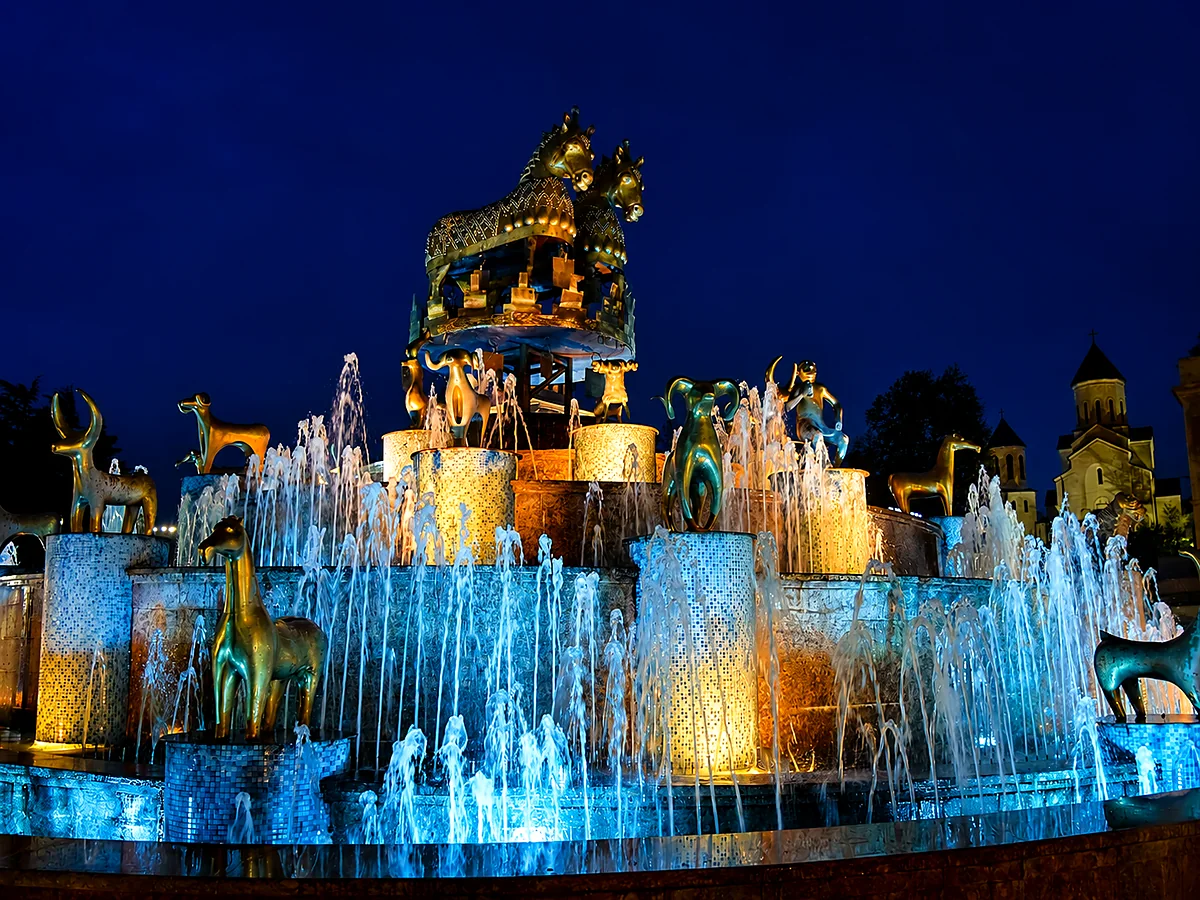
Kutaisi's center is a manageable, pleasant area to explore on foot, built around the main squares and the streets between the river and the lower slopes. The White Bridge, a pedestrian bridge over the Rioni, connects the two banks at a central point and gives views up and down the river that are especially good in late-afternoon light.
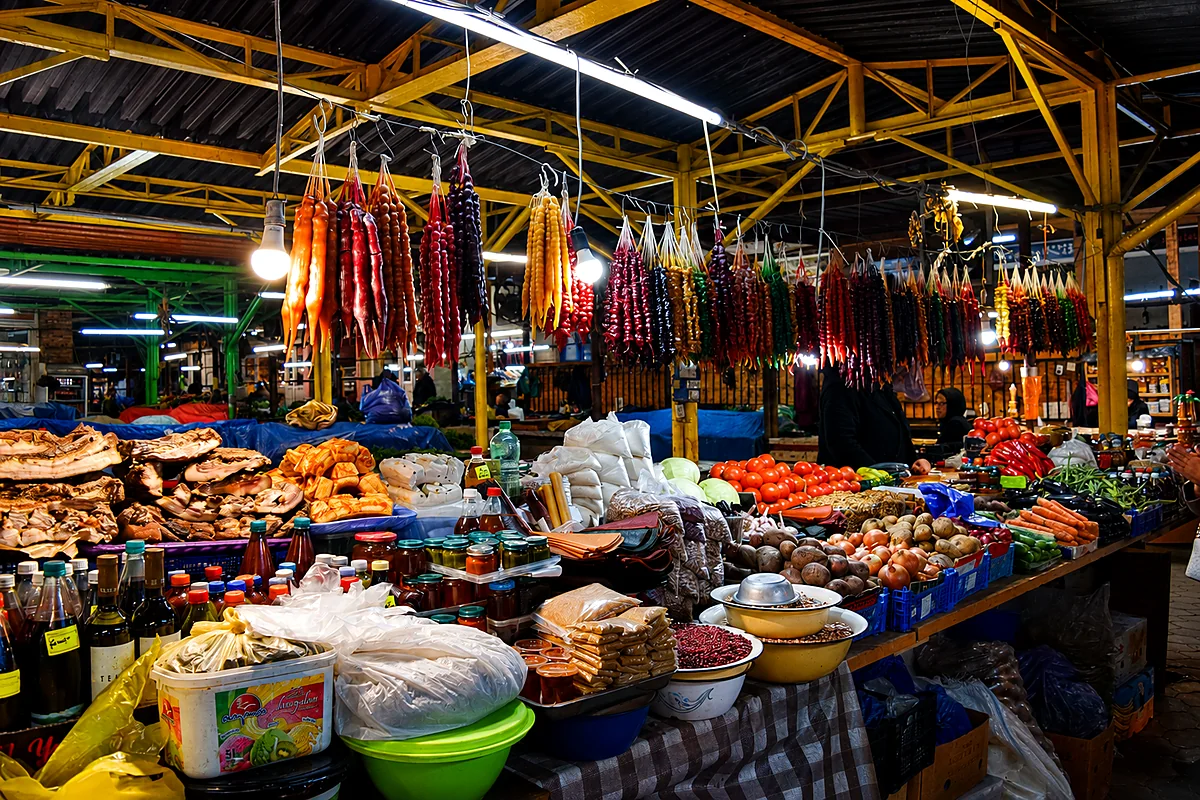
The central market, busiest in the morning, is one of the better places to sense the city's everyday economic life, with seasonal produce, dairy, spices, churchkhela, local honey, and the pickled and preserved vegetables that are staples of Georgian home cooking. The cheese section is worth particular attention — Imeretian cheese, a fresh, mildly salty cow's-milk variety, is the defining ingredient of the region's most famous dish and is made by small dairies across the surrounding countryside. Kutaisi also has a significant student population from its several universities, which gives the center a youthful energy unusual for a provincial city of its size, with cafés, small restaurants, and bars concentrated in the central streets and along the riverbank, lively in good weather without Tbilisi's tourist density.
Imeretian cuisine
The Imereti region has a culinary identity distinct enough to merit specific attention, and the most fundamental difference is the cheese. Imeretian cheese — imeruli kveli — is a fresh, semi-soft, lightly salted cheese with a clean, milky flavor, quite different from the stronger, saltier sulguni used elsewhere in Georgia. It's the cheese in Imeretian khachapuri, the round, flat version of the famous cheese bread that originated here and remains the definitive local variety, distinguished from the Adjarian boat-shaped version by its closed form and subtler, fresher filling.
Beyond khachapuri, Imeretian cooking leans heavily on walnuts — ground into sauces and stuffings across dishes from cold vegetable preparations to filled pastries — and fresh herbs, particularly coriander, used in quantities some visitors find startling. Badrijani nigvzit (thin fried eggplant rolled around a garlicky walnut paste) is one of the most universally liked dishes in the Georgian repertoire and appears on virtually every table. Pkhali — finely chopped cooked vegetables mixed with walnut paste and shaped into small balls — is another reliable regional preparation that varies by the base vegetable.
Natural sites and day trips around Kutaisi
The area around Kutaisi has a concentration of natural attractions that makes the city an unusually good base for combining cultural and outdoor itineraries.
Prometheus Cave, about 20 kilometers northwest near Tskaltubo, is the most accessible and most visited cave in Georgia. It runs for several kilometers through chambers of varied stalactite and stalagmite formations, with a lit walkway through the main sequence and a short boat section on an underground river. Well organized with reliable infrastructure, it's worth two to three hours.
Martvili Canyon, about 55 kilometers northwest, is a gorge cut through limestone by the Abasha River, with steep walls above water of exceptional turquoise clarity. You can walk the path above the canyon or take a short boat ride through the narrower sections, where the overhanging walls and the water color are genuinely striking. Okatse Canyon, about 40 kilometers from Kutaisi, is narrower and more dramatically walled, reached via an elevated walkway cantilevered over the canyon edge with vertiginous views to the river below. The two canyons are frequently combined into a single day trip, one in the morning and the other in the afternoon.
Sataplia Nature Reserve, a few kilometers from the city limits, preserves a small area of relict Colchic forest — the subtropical forest that once covered much of the western Caucasus lowlands — along with dinosaur footprints set in limestone, a small cave, and views over the city. It's shorter and less dramatic than the larger sites but works well as an afternoon excursion.
Tskaltubo
The town of Tskaltubo, about 12 kilometers from Kutaisi, is one of the more unusual destinations in western Georgia. In the Soviet period it was developed as a major spa and sanatorium complex around natural radon and carbon-dioxide mineral baths that flow at a constant 33–35°C. At its peak Tskaltubo had dozens of large sanatorium buildings for Soviet citizens sent for treatment and recuperation, and Stalin used a dedicated facility here. The collapse of the Soviet Union ended the system abruptly, and many of the grand neoclassical and Stalinist-baroque buildings have stood empty and deteriorating since the early 1990s, some occupied for decades by people displaced by the Abkhazian conflict. That combination of grand decaying architecture, occupied ruins, and partially functioning spa facilities makes Tskaltubo haunting and visually striking, and it draws photographers and urban-exploration enthusiasts. One important note: some buildings are derelict and others are people's homes, so visits should be made with care and respect for residents, and some structures are unsafe to enter.
How to get to Kutaisi
Kutaisi International Airport handles a growing number of international routes, including low-cost flights from several European cities, which has significantly increased the city's accessibility; it's about 25 kilometers from the center. By road from Tbilisi, the journey takes about three hours along the main east-west highway. Regular marshrutkas (minibuses) connect Kutaisi with Tbilisi, Batumi, and other major cities, and trains run to both Tbilisi and Batumi, with the Batumi journey taking roughly two hours through the Rioni valley.
Best time to visit Kutaisi
Kutaisi and Imereti have a relatively mild climate, tempered by the nearby Black Sea and wetter than eastern Georgia for most of the year. Spring (April–June) is generally the best season — green landscape, comfortable temperatures, and the natural sites at their most photogenic. Summer is warm and can be humid, but the region stays green through July and August, and the caves and canyons are enjoyable regardless of the heat. Autumn offers pleasant temperatures and good conditions for outdoor exploration through October. Winter is mild at city elevation, with occasional snow on the surrounding hills, and the cave and canyon sites remain accessible year-round.
History
Kutaisi's documented history as a significant political center begins in the medieval period, when it was the capital of the Kingdom of Abkhazia and later of a unified Georgian state. The city reached its greatest prominence in the 10th and 11th centuries, when the Bagrationi dynasty consolidated control over the fragmented Georgian kingdoms and made Kutaisi the seat of royal power. King Bagrat III, who completed the unification of most of the Georgian kingdoms under one crown around 1008, chose Kutaisi as his capital and commissioned the Bagrati Cathedral as a physical expression of that unity. His successor David IV — David the Builder — moved the capital to Tbilisi after recapturing it from the Seljuk Turks in 1122, but Kutaisi remained the center of western Georgia and an important royal and religious center through the medieval period.
The city was sacked by the Mongols in the 13th century and by Ottoman forces multiple times after, and Imereti spent long periods as a vassal or target of Ottoman expansion before being absorbed into the Russian Empire in 1810. The 19th century brought the administrative and architectural changes typical of Russian imperial rule — new public buildings, a more regular urban plan, and the railway to Tbilisi and Batumi that reintegrated Kutaisi into the regional economy. The city briefly hosted the Georgian parliament in the 2000s, when a decentralization initiative moved the legislature here from Tbilisi, though it has since returned to the capital.
Caucasus Travel FAQ
Kutaisi is western Georgia's historic center, known for two UNESCO World Heritage medieval sites — the Gelati Monastery and Bagrati Cathedral — and as the best base for the region's natural attractions: Prometheus Cave, Martvili and Okatse canyons, and the abandoned Soviet spa town of Tskaltubo. It also has a distinct Imeretian food culture.
Yes — for many visitors it's the highlight of the Kutaisi area. Founded in 1106 by David the Builder as a monastery and academy, it holds some of the finest medieval mosaics and frescoes in Georgia, including a well-preserved 12th-century apse mosaic, and David the Builder is buried at the gate. It's a UNESCO World Heritage Site and still an active monastery.
Prometheus Cave (about 20 km), Martvili Canyon (about 55 km) and Okatse Canyon (about 40 km, often combined in one day), the Sataplia Nature Reserve near the city, and the abandoned spa town of Tskaltubo (about 12 km). Gelati and Bagrati are the main cultural sites.
Spring (April–June) is generally best, with green landscapes and comfortable temperatures. Summer is warm and humid but the region stays green and the caves and canyons are enjoyable; autumn is pleasant through October. The cave and canyon sites are accessible year-round.