
Prometheus Cave: Georgia's Largest Show Cave near Kutaisi
Prometheus Cave is the largest and most visited cave system in Georgia, the country in the South Caucasus, near the village of Kumistavi in the Imereti region (Tskaltubo Municipality), about 20 kilometers northwest of Kutaisi. It takes its name from the mythological figure of Greek — and Georgian — tradition: Prometheus, who stole fire from the gods and was chained in the Caucasus mountains as punishment, a reference that fits the extraordinary subterranean world the cave contains. Beneath this section of the Imereti karst plateau lies one of the most remarkable underground landscapes in the Caucasus: a sequence of chambers connected by passages carved over millions of years by water moving through soluble limestone, and decorated throughout by stalactites, stalagmites, flowstones, and cave pearls — geological time made visible. Explored and mapped systematically from the 1980s, it has since been developed with visitor infrastructure that makes it accessible to a wide range of people without diminishing the underground environment's strangeness and beauty.
What is Prometheus Cave?
Prometheus Cave (also called Kumistavi Cave) is the largest and best-developed show cave in Georgia, near Kumistavi village in Tskaltubo Municipality, in the Imereti region of western Georgia, about 20 km from Kutaisi. A walking route of roughly one to one-and-a-half kilometers leads through six grand chambers full of stalactites, stalagmites, and other formations, lit with colored lighting, ending at an underground river where an optional boat ride is offered. The cave stays at a constant 14°C year-round. It's one of the most popular day trips from Kutaisi, often combined with the nearby Sataplia Nature Reserve, the Tskaltubo spa town, and the Okatse/Martvili canyons.
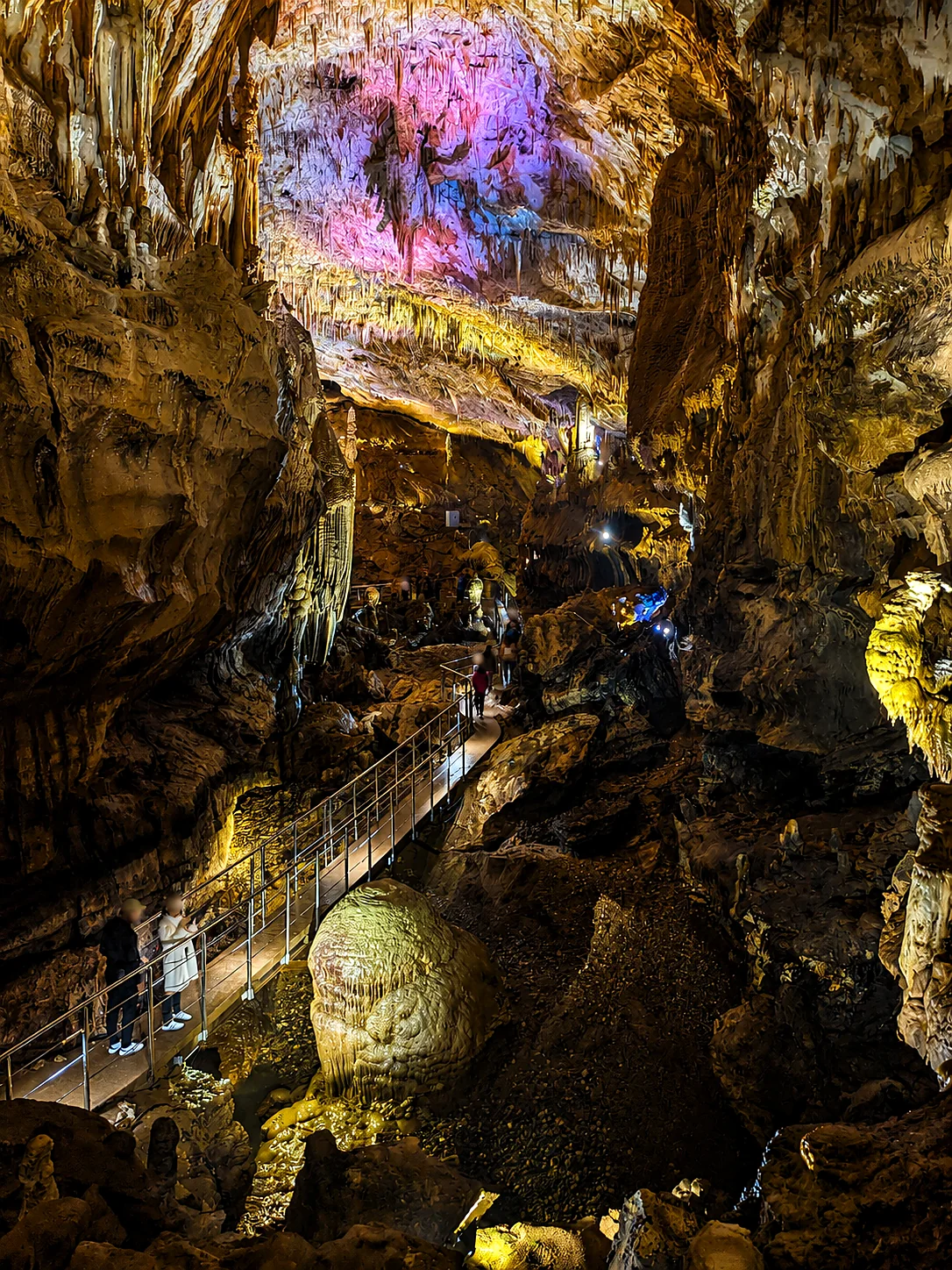
A name from myth — Greek and Georgian
The cave's name links it to Prometheus, the Titan of Greek myth who stole fire for humankind and was chained to a Caucasus peak (often associated with nearby Mount Khvamli) as punishment, an eagle tearing at his liver. Georgia has its own parallel hero in Amirani, the chained Caucasian rebel of Georgian mythology — so the name reaches into both traditions. The connection runs deeper into local legend too: the cave's six visitor halls carry names drawn from the Colchis myths — among them Argonauts, Kolkheti (Colchis), and Medea — tying this underground world to the Golden Fleece story that Kutaisi, as ancient Colchis, wears as part of its identity.
Geology and formation
The limestone plateau of Imereti is among the most extensively karstified landscapes in Georgia, shaped over tens of millions of years by the dissolution of soluble rock by slightly acidic groundwater. As rainwater percolates through soil and rock it absorbs carbon dioxide and turns weakly acidic, gradually dissolving the limestone's calcium carbonate along fractures and bedding planes to create the channels, passages, and chambers that define karst cave systems. Prometheus is one of the more spectacular results of this process in the region — a multi-chambered system extending for several kilometers (the cave developed roughly 60–70 million years ago in the Sataplia–Tskaltubo karst massif), with chambers reaching heights of around 20 meters or more and a sense of interior space that genuinely surprises first-time cave visitors.
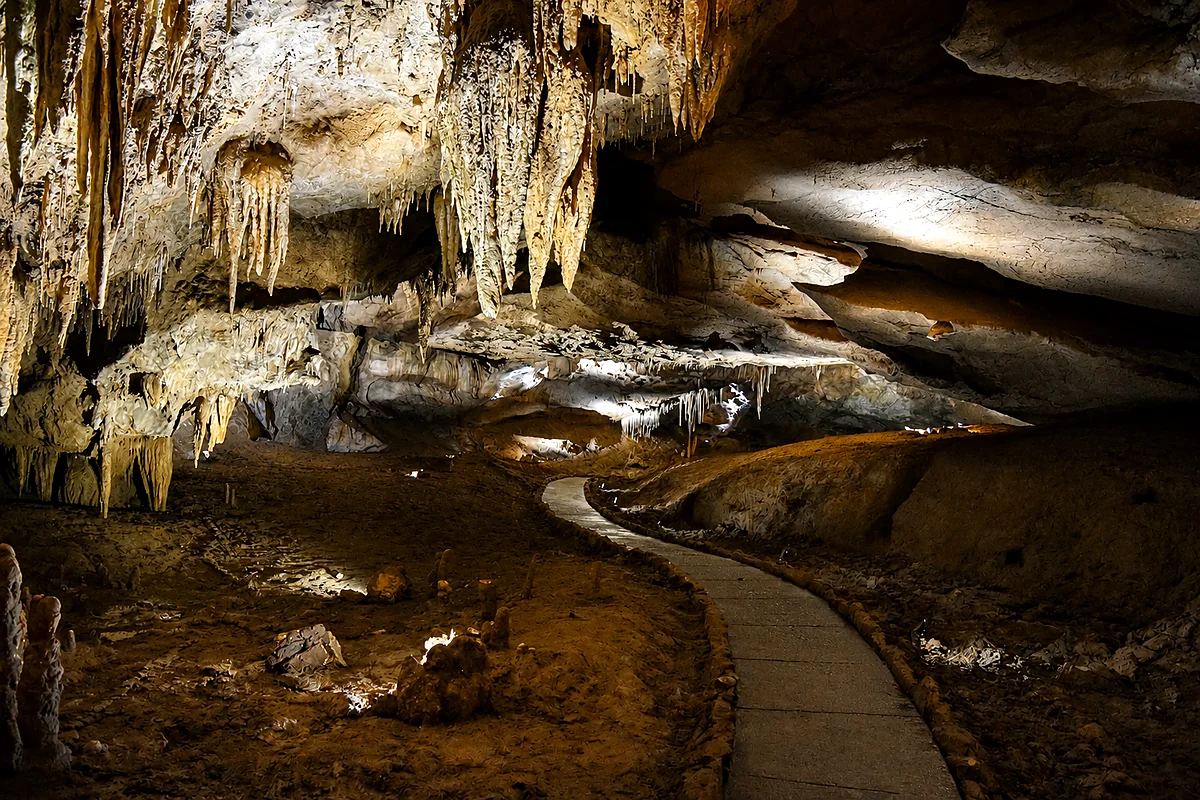
The formations are the product of the reverse process: calcium carbonate dissolved in groundwater being redeposited as the water drips, flows, or seeps through the cave, building the characteristic shapes of speleothem — the collective term for cave mineral deposits — at rates of millimeters per century. Stalactites hang from the ceiling where water drips from a fixed point; stalagmites build on the floor where the drips land; where the two meet they form columns. Flowstones coat sloping surfaces where water runs in a thin film. Cave pearls form in shallow pools where dripping water agitates a carbonate nucleus over thousands of years. All of these appear throughout Prometheus, from delicate translucent stalactites a few centimeters long to massive columns several meters across that have been growing since before recorded human history.
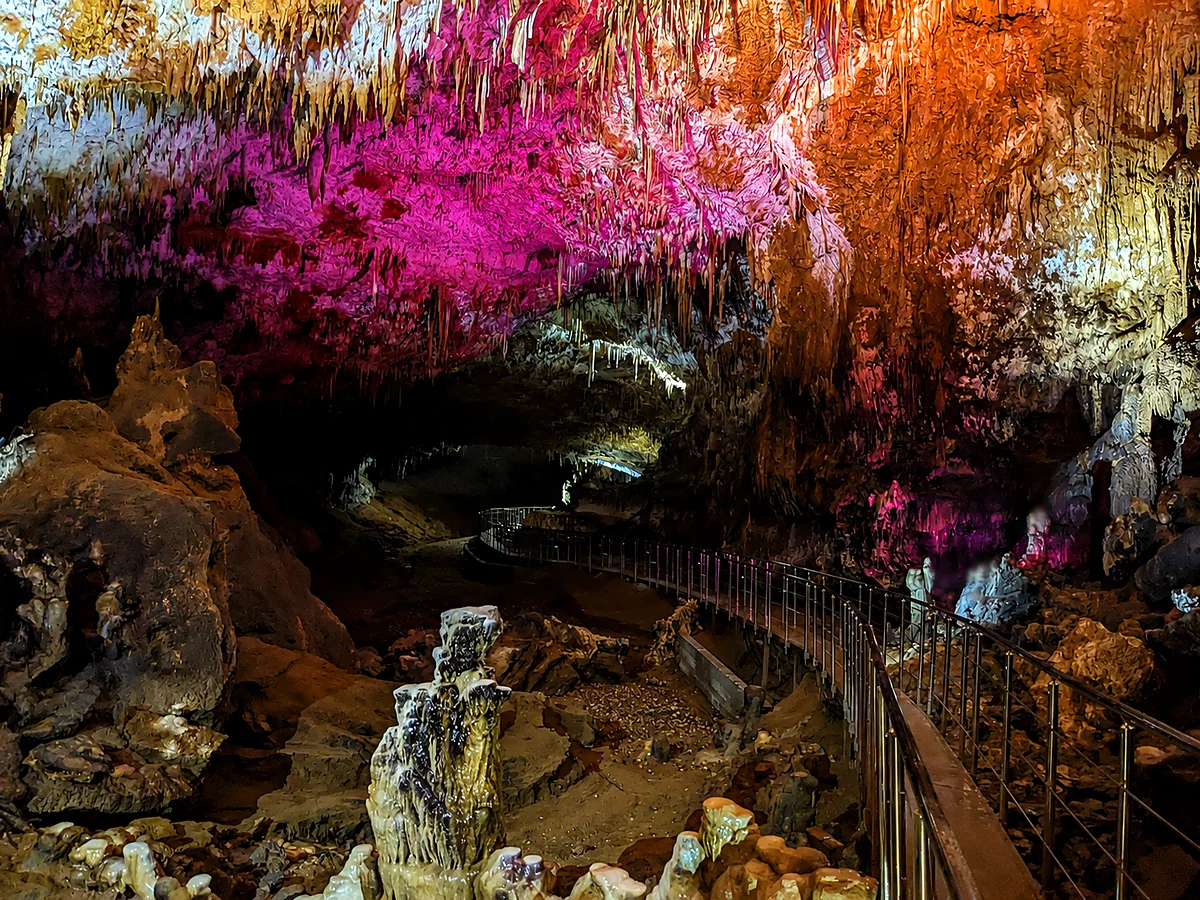
The color of the formations varies with the mineral impurities in the groundwater that deposited them: pure calcite is white or translucent; iron oxides give yellows, oranges, and reds; manganese produces darker tones. This variety of natural color is one of the cave's most striking characteristics — and one the installed lighting (added, with soft background music, in the late 2000s) exploits with considerable theatrical effect.
The visit
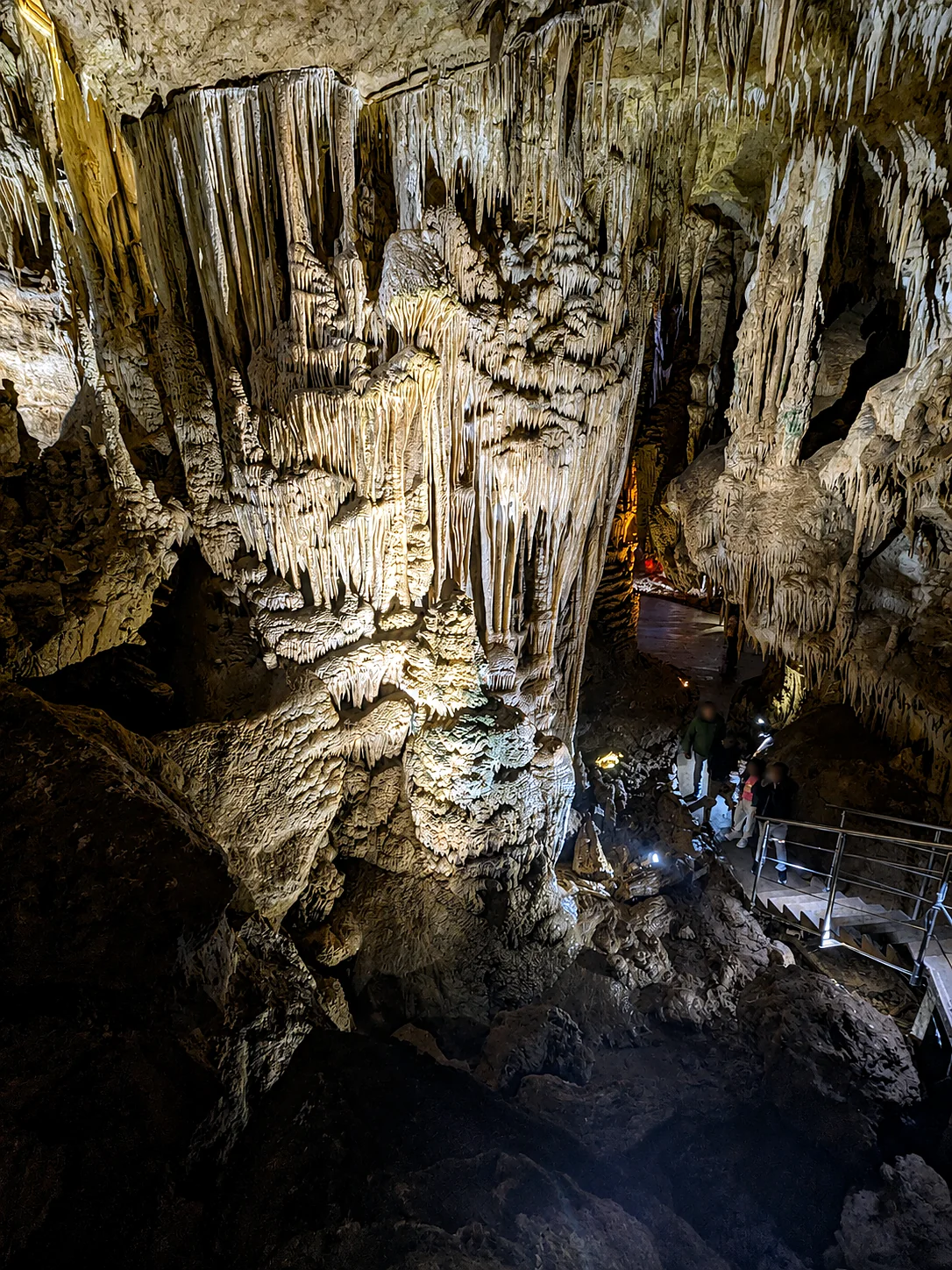
The visitor route covers roughly one to one-and-a-half kilometers of the cave across six main chambers, each with its own character and concentration of formations, in about an hour at the guided pace. The first chambers establish the scale — ceilings rising well above the walkway, the formations building in density as you go, and the temperature dropping immediately to the cave's constant 14°C. That stable underground temperature, year-round regardless of the season outside, is one of the most practically relevant facts for visitors: cool enough to want a light layer in summer (when the contrast with the heat outside is sharpest) and considerably warmer than a cold winter day.
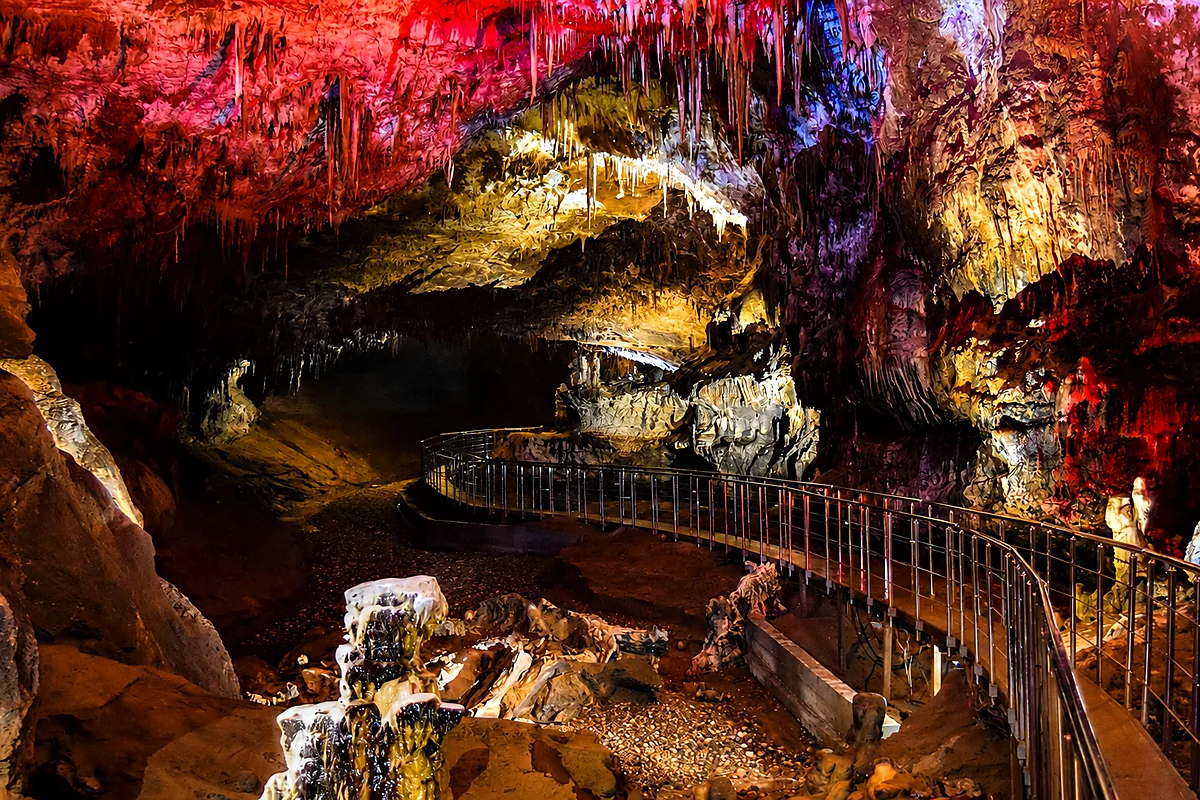
The lighting illuminates the formations from various angles with colored light, designed to maximize visual impact. Opinion on show-cave lighting varies — some find colored illumination theatrical to the point of artificiality, others feel it enhances the drama — but the effect here is well calibrated, and the sections where the lighting is used most sparingly, letting the natural colors and textures speak, are often the most impressive; the scale of the larger chambers in particular reads best when the lighting gives a clear sense of ceiling height and depth rather than fragmenting the space into color-bathed sections. The acoustics are another quietly memorable dimension — the way sound behaves in the enclosed stone, the echoes in the larger halls, the particular silence in the passages between chambers when the guide pauses — contributing to the sense of an environment that runs by different physical rules from the surface.
The final section reaches the underground river (the Kumistavi), a genuine subterranean watercourse flowing through the lower level before emerging further down the karst slope — still slowly dissolving and reshaping the rock, the active agent of the cave's ongoing development. The optional boat ride here covers a short stretch (a few hundred meters, adding roughly fifteen minutes) through a passage where the walls narrow and the ceiling lowers, a perspective the walking route can't give — and, for many visitors, the single most memorable moment: dark water, close stone, the sound of the river, and the formations caught in the boat's light.
Practical information
- Location: Near Kumistavi village, Tskaltubo Municipality, Imereti region, western Georgia — about 20 km (≈20–40 min) northwest of Kutaisi.
- Getting there: By taxi or private transfer from Kutaisi (the simplest), or marshrutka via Tskaltubo; commonly combined with the Sataplia Nature Reserve, the Tskaltubo spa town, or the Okatse/Martvili canyons as a day trip.
- Tours: Visited only on guided tours, departing at regular intervals, with geology/formation commentary; offered in multiple languages depending on demand.
- Boat ride: Separately ticketed, subject to river water levels (which vary with seasonal rainfall) — check availability on arrival and buy the combined ticket if it's running; it adds a lot for little extra time.
- Temperature: Constant ~14°C — bring a light jacket or layer in any season (especially summer).
- Footwear: Grippy shoes advisable, as the walkway can be damp; paths are well maintained and fine for ordinary fitness (some steps).
- Facilities: Café, ticket office, and parking at the entrance area; well organized for high visitor numbers.
- When to visit: Year-round (the constant temperature makes it weather-independent). Spring/autumn are most comfortable for combining with other sites; summer gives a refreshing hot-to-cool contrast but is busiest (July–August) — go early or late on peak days; winter is quietest.
Caucasus Travel FAQ
Prometheus Cave (also called Kumistavi Cave) is the largest and most-visited show cave in Georgia, near Kumistavi village in Tskaltubo Municipality, in the Imereti region of western Georgia, about 20 km from Kutaisi. A walking route of roughly 1–1.5 km leads through six grand chambers filled with stalactites, stalagmites, and other formations, lit with colored lighting, and ends at an underground river with an optional boat ride. It stays at a constant 14°C year-round and is one of the most popular day trips from Kutaisi.
It's named for Prometheus, the Titan of Greek myth who stole fire for humanity and was chained to a peak in the Caucasus (associated with nearby Mount Khvamli) as punishment. Georgia has its own version of the myth in the hero Amirani, also chained in the Caucasus, so the name spans both traditions. Fittingly, the cave's six visitor halls carry names from the Colchis legends — including Argonauts, Kolkheti (Colchis), and Medea — connecting it to the Golden Fleece story tied to Kutaisi as ancient Colchis.
The guided walking route runs about 1–1.5 km through six large chambers, taking roughly an hour, with ceilings well overhead and dense formations — stalactites, stalagmites, columns, flowstones, and cave pearls — lit with colored lighting. At the end, an optional boat ride (a few hundred meters, about 15 extra minutes) takes you along the underground Kumistavi River, which for many is the highlight. The cave is a steady 14°C throughout.
If it's running, yes — most visitors find the short underground-river boat ride the most memorable part, and it adds little time for a lot of atmosphere. However, it's separately ticketed and depends on the river's water level, which varies with seasonal rainfall, so it isn't guaranteed. Check availability when you arrive and buy the combined ticket if the boat is operating.
It's about 20 km northwest of Kutaisi, roughly 20–40 minutes by road — easiest by taxi or private transfer, or by marshrutka via the Tskaltubo spa town. It's commonly combined with the Sataplia Nature Reserve, Tskaltubo, or the Okatse/Martvili canyons. It's worthwhile year-round because the temperature is constant (a refreshing contrast in summer, cosy in winter); it's busiest in July–August, so going early or late in the day then gives a quieter visit. Bring a light layer for the 14°C interior.