
Borjomi Central Park: The Spa Heart of Georgia's Mineral-Water Town
Borjomi Central Park runs along the Borjomula River where it joins the Mtkvari (Kura), spreading across both banks through mature trees, riverside paths, and the spa-town infrastructure that has been accumulating since the mid-19th century, when Borjomi first became one of the most fashionable health resorts in the Caucasus. It is the social and recreational heart of the town — the place where the famous Borjomi mineral spring can be tasted straight from the source — and the natural gateway between the settled town and the vast forested expanse of the Borjomi-Kharagauli National Park that begins just beyond the park's upper end. Borjomi sits in a green river gorge at about 850 m, and the park's mix of river sound, tree canopy, and cool mountain air gives it a genuinely restorative quality.
What is Borjomi Central Park?
Borjomi Central Park is the historic spa park in the center of Borjomi, a mineral-water resort town in the Samtskhe-Javakheti region of southern Georgia. Laid out in 1850 along the Borjomula River, it's where visitors can drink the celebrated Borjomi mineral water free from the natural spring, stroll riverside promenades under mature trees, ride a seasonal cable car for views over the gorge, and — a short walk upstream — reach the open-air Borjomi sulfur pools. It's also the gateway to the Borjomi-Kharagauli National Park, one of the largest protected forests in the Caucasus. Cool, green, and unhurried, it's the centerpiece of any visit to Borjomi.
A 19th-century spa resort
The park was created in 1850, when Count Mikhail Vorontsov, the Russian viceroy of the Caucasus, developed Borjomi's springs into a resort and laid out a mineral-water park — the origin of today's Central Park. Borjomi grew fashionable over the following decades, and it was the patronage of the Romanovs that sealed its fame: Grand Duke Mikhail Romanov (brother of Tsar Alexander II) took a particular liking to the place, built the first industrial bottling factory here in 1894, and his family built the Likani Palace (1892–95) just west of town as a summer residence. The formal park design — riverside promenades, bridges, organized planting — reflects the 19th-century European spa aesthetic, and despite the changes of the Soviet decades, the park keeps the character of a place built for leisurely, therapeutic recreation rather than active tourism. The pace within it is correspondingly unhurried.
The mineral spring
The natural Borjomi mineral spring in the park is the site's defining feature and the literal source of one of the most widely distributed Georgian products in history — bottled here since 1854 and famous across the Russian Empire and the Soviet world. The water emerges naturally warm (Borjomi's volcanic source water rises at around 37–41°C, having risen too fast from deep underground to cool) — noticeably warm to the touch — and is strongly carbonated and mineralized, its composition rich in sodium bicarbonate and trace elements of volcanic origin, giving it the distinctive salty-sour taste for which it's both celebrated and, by some, merely endured.
Drinking from the spring is free, and most visitors feel compelled to try it. The warm, intensely mineral, faintly sulfurous water that comes from the tap is quite unlike the chilled, commercially fizzed version sold everywhere across Georgia and the former Soviet world, and first-timers' reactions range from instant enthusiasm to polite endurance. A tap structure lets visitors fill their own bottles, and many do — for the novelty of drinking from the source rather than from a branded bottle. The water has a long therapeutic reputation: from the imperial and Soviet periods, Borjomi was promoted as a medical spa, with the water traditionally taken for digestive and related complaints. That balneological tradition is part of the town's identity and history; how seriously to take the health claims is a personal matter, but the spring is worth experiencing as the source of the famous water regardless.
The park
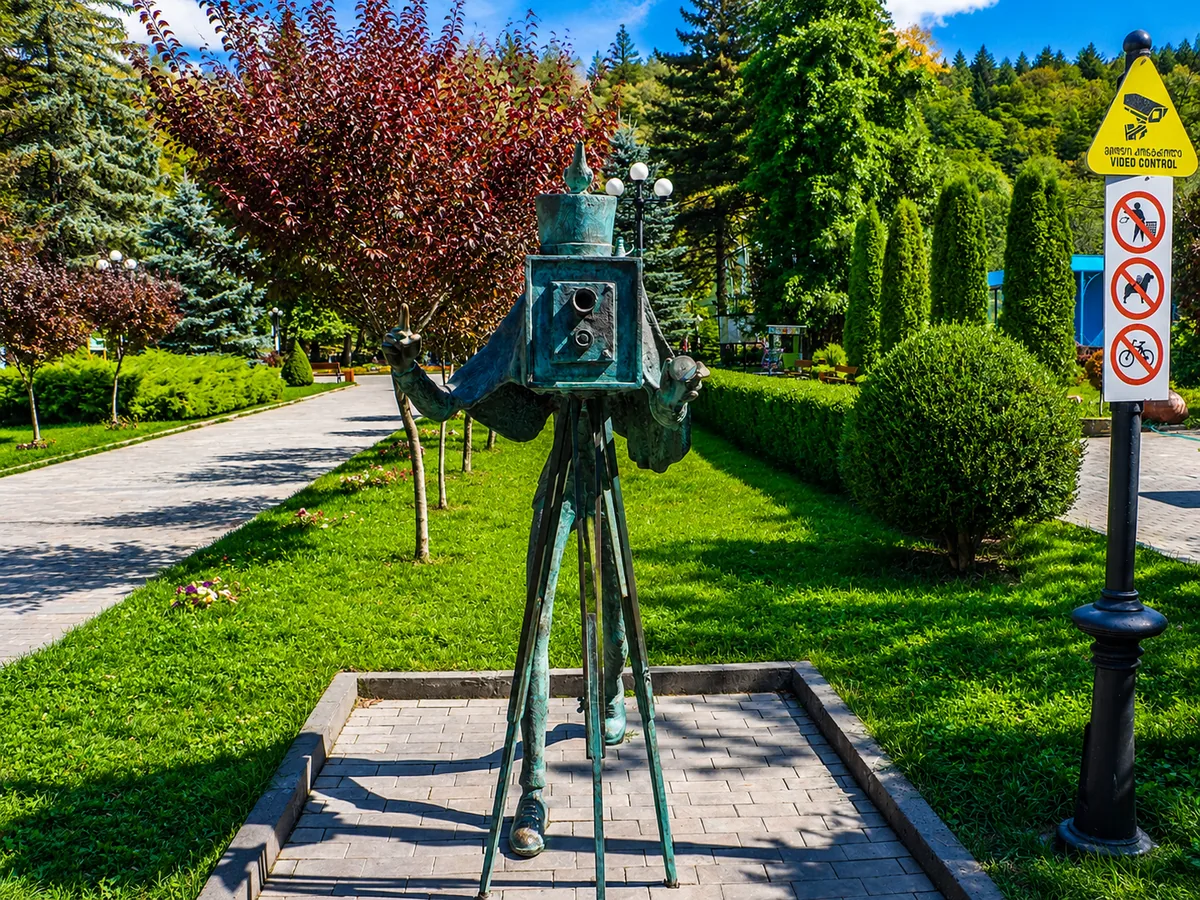
The walking paths run along both banks of the Borjomula, with bridges linking the two sides and paths continuing upstream through progressively denser forest as the gorge narrows toward the national park. The lower sections, nearest the town center, hold the most activity — the spring, café terraces, family recreation areas, fairground attractions, and the cable car station. Further upstream the paths quieten and the forest closes in, and the transition from managed park to the wilder national-park terrain happens gradually rather than at a sharp line.
The cable car ascends from the park to a hilltop above Borjomi (where there's a Ferris wheel and viewpoint), giving the best elevated view of the town and the surrounding gorge — the forested slopes rising on both sides and the buildings of Borjomi compressed into the narrow valley floor. It's a modest installation by the standards of Georgia's mountain cable cars, and it runs mainly in the warmer season, but the short ride is worth it for the orientation it gives over a gorge whose enclosed character is hard to grasp from street level.
About 3 km upstream through the park, reached by a pleasant forest walk along the river, are the Borjomi Sulfur Pools — open-air warm thermal pools (water around the low-to-high 20s–30s °C), fed by a natural sulfur spring, originally arranged in the Romanov era (the "Tsars' baths") and restored in the mid-2000s. They're a popular outing, though worth approaching with modest expectations: the setting is lovely, but the infrastructure is basic. (Bring a towel; facilities are limited.)
The park is at its best in spring, when the trees leaf out and the Borjomula runs high with snowmelt, and in autumn, when the deciduous trees among the conifers turn. Summer brings the most visitors and the liveliest atmosphere, with families from across Georgia coming to escape the lowland heat — the forest shade keeps the gorge noticeably cooler than the surrounding region even in July and August, one of Borjomi's most reliable practical attractions for domestic visitors.
Gateway to the national park
The Borjomi-Kharagauli National Park — one of the largest protected forest areas in the Caucasus, and part of a Europe-class wilderness — begins where the managed park ends, and trails from the upper reaches of the Central Park lead into its territory. The national park's visitor center, near the boundary, provides trail maps and current conditions and can arrange guides for longer routes. Short half-day walks from the park's upper edge give a taste of the national park's forest character without committing to the long multi-day traverses that cross the full protected area.
Getting there and visiting
- Location: Center of Borjomi town, Samtskhe-Javakheti, southern Georgia (~850 m elevation); the park entrance is in the town center, walkable from most accommodation. Borjomi is about 2–2.5 hours from Tbilisi by road or rail.
- Hours: Daily, early morning to late evening; the mineral spring is accessible during park hours. (The cable car and some attractions run mainly in the warmer months.)
- Admission: A small entry fee at the main gate; the cable car and sulfur pools are charged separately.
- Best time: Spring and autumn for the gorge at its loveliest; summer for the liveliest atmosphere and the coolest escape from the heat.
- Combine with: The Borjomi-Kharagauli National Park, the Likani (Romanov) Palace, the Borjomi Local Lore Museum, and the wider region — Bakuriani (the ski resort up the valley, reachable by the historic narrow-gauge railway and the Eiffel-built bridge near Tsagveri), and further afield Akhaltsikhe (Rabati), Abastumani, and Vardzia.
Caucasus Travel FAQ
Borjomi Central Park is the historic spa park in the center of Borjomi, a mineral-water resort town in the Samtskhe-Javakheti region of southern Georgia. Laid out in 1850 along the Borjomula River, it's where visitors can drink the famous Borjomi mineral water free from its natural spring, walk riverside promenades under mature trees, ride a seasonal cable car for views over the gorge, and — a short walk upstream — reach the open-air Borjomi sulfur pools. It's also the gateway to the Borjomi-Kharagauli National Park. Cool, green, and unhurried, it's the centerpiece of any visit to Borjomi.
Yes — there's a public spring in the park where you can drink the famous Borjomi mineral water free and fill your own bottles. Straight from the source it's quite different from the chilled, fizzy bottled version sold everywhere: it emerges naturally warm (Borjomi's volcanic source water rises at around 37–41°C), strongly carbonated, intensely mineral, and faintly sulfurous, with a salty-sour taste that first-timers either love or politely endure. The water has been bottled here since 1854 and was famous across the Russian Empire and the Soviet Union; tasting it at the spring is one of the essential Borjomi experiences.
Borjomi has a long reputation as a medical-spa water — from the imperial and Soviet eras it was promoted for digestive and related complaints, and "taking the waters" was the whole point of the resort. That balneological tradition is a genuine part of the town's history and identity. How much weight to give the specific health claims is a personal matter, and it's not a substitute for medical advice; but the spring is well worth experiencing as the source of one of the most famous mineral waters in the world.
Plenty. Beyond tasting the water, you can stroll the riverside paths and bridges, relax at the café terraces, and ride the cable car up to a hilltop viewpoint and Ferris wheel for the best overview of the gorge (it runs mainly in the warmer months). About 3 km upstream, a forest walk along the river leads to the Borjomi Sulfur Pools — open-air warm thermal pools dating from the Romanov era and restored in the 2000s (lovely setting, but basic facilities). And the park's upper end is the gateway into the Borjomi-Kharagauli National Park for forest hikes.
Borjomi is in southern Georgia, about 2–2.5 hours from Tbilisi by road or by the scenic train, and the park is right in the town center, walkable from most accommodation. Spring and autumn are loveliest in the gorge — high water and fresh leaf in spring, turning colors in autumn — while summer is busiest and liveliest, popular with Georgian families escaping the lowland heat (the forested gorge stays noticeably cooler than the surrounding region even in July and August). It pairs well with the Likani Romanov Palace, Bakuriani up the valley, and the wider region's sights such as Akhaltsikhe, Abastumani, and Vardzia.