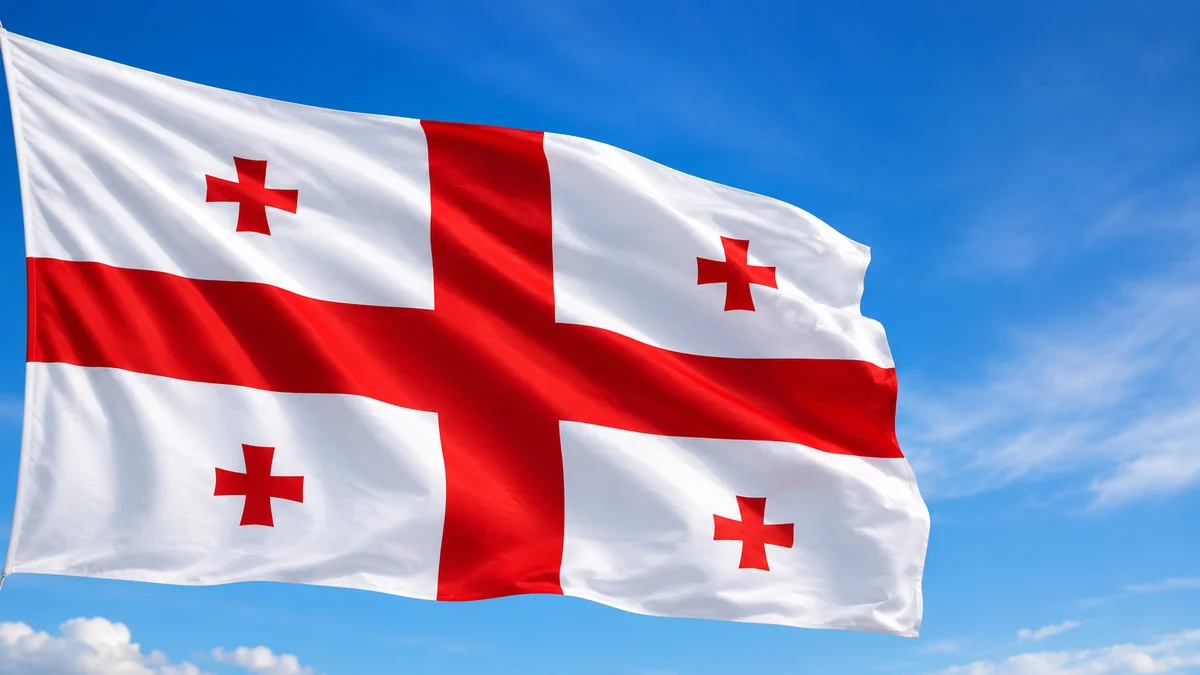
You will see it before you have left the airport: five red crosses on white, one large and four small, hanging at passport control and again over the exit and again from half the balconies on the drive into Tbilisi. It looks like it has flown over this country for a thousand years.
It has, and it hasn't. The design is genuinely medieval — the crosses are old, the symbolism older. But the flag over the airport is younger than the smartphone. It became Georgia's national flag in January 2004, and the path it took to get there runs not through a design committee but through a street revolution, a president who refused to sign, and a Church that wanted its symbol back. The flag that looks like the oldest thing in the country is, as a national flag, one of the newest in Europe.
That gap — between how old it looks and how recently it was raised — is the whole story, and it is a better one than the tourist-board version.
What you are actually looking at
The technical description first, because the design rewards a close look.
A white field. A large red cross running edge to edge, dividing the field into four quarters — this is the Cross of St George, the same red-on-white cross England uses, and for the same reason: St George is the patron saint of both. In each of the four white quarters sits a smaller red cross with arms that narrow at the centre and flare out at the ends.
Those four small crosses are the detail worth knowing. They are Bolnisi crosses — sometimes called Bolnur-Katskhuri crosses — and they are not a generic ornament. The shape is copied from a stone carving on the Bolnisi Sioni, a basilica in southern Georgia built between roughly 478 and 493, during the reign of Vakhtang Gorgasali. That church holds some of the oldest surviving Georgian inscriptions in existence. So the small crosses on the modern flag are a direct quotation from one of the oldest Christian buildings in the country — a fifth-century carving lifted onto a twenty-first-century banner.
The whole arrangement — a large cross with four smaller ones in the quarters — is a form the wider world knows as the Jerusalem cross, the emblem of the Crusader Kingdom of Jerusalem, where the five crosses were read as the five wounds of Christ. On the Georgian flag the same five are usually explained as either the Five Holy Wounds, or as Christ flanked by the four Evangelists. Georgia did not invent the five-cross form. It made a specific, local version of it, in its own ecclesiastical stone.
The medieval flag was real — mostly
Here the honest guide has to slow down, because the deep history is a mix of solid evidence and cherished tradition, and it is worth knowing which is which.
The solid part: a red-on-white Jerusalem cross is shown as the flag of Tbilisi on a 1367 sea chart by the Pizzigano brothers, Venetian cartographers — hard, dated, external evidence that this design was associated with the city in the fourteenth century. An earlier portolan chart by the Mallorcan cartographer Angelino Dulcert, from 1339, is also cited in Georgian scholarship for the country's banner. By the 1300s, in other words, foreigners drawing maps already knew Georgia by something very like this flag.
The traditional part, which you should enjoy without treating as documented fact: the single red St George's cross on white is said to have been used by Vakhtang Gorgasali himself in the fifth century. Queen Tamar — the great monarch of Georgia's golden age, who reigned to 1213 — is held by tradition to have carried a white flag bearing a dark red cross and a star. David IV the Builder is sometimes credited with establishing the red cross as the emblem of a united Georgia. These attributions appear constantly in Georgian sources and rather less constantly in the surviving medieval record. The five-cross form itself is most confidently dated by historians to the fourteenth century, possibly adopted under George V, the king who drove out the Mongols.
So: the flag is medieval. The claim that this exact flag flew over Tamar or Vakhtang is tradition rather than proof. Both things can be true at once, and a country is allowed its traditions — but you will sound better informed if you know where the documentation stops and the beautiful story begins.
Then the flag disappeared. After the medieval kingdom fragmented, its successor states flew their own banners, mostly with animals. When the Russian Empire annexed Georgia in 1801, the old symbols were suppressed. For most of two centuries, the five-cross flag was history, not a flag anyone flew.
The flag Georgia actually flew for most of a century
If you meet an older Georgian who grew up under a different flag, this is the one they mean.
When Georgia won a brief independence as the Democratic Republic of Georgia in 1918, it did not revive the medieval crosses. It commissioned a new flag from the artist Jakob Nikoladze: a cherry-red field with a small canton of black and white stripes in the upper corner. The symbolism was deliberate and secular — cherry red as the Georgian national colour, black for the tragedies of the country's past, white for hope for its future. It is a quietly moving flag, and it lasted only until Soviet forces crushed the republic in 1921.
Through the Soviet decades Georgia flew variations of the red Soviet banner — hammer and sickle, a blue sun, the republic's name in Georgian script. And when independence returned in 1991, Georgia brought back not the crosses but the 1918 cherry-red flag. That, not the five crosses, was the flag of newly independent Georgia through the 1990s. For thirteen years after the Soviet collapse, the flag you now see everywhere was still not the national flag.
How a museum piece became a protest banner
This is the part the tourist brochures skip, and it is the most interesting thing about the flag.
Through the 1990s, vexillologists and the Georgian Orthodox Church pushed to revive the medieval five-cross design. The Church, in particular, wanted it — the Catholicos-Patriarch, the most trusted public figure in the country, backed the restoration. In 1999 Parliament actually passed a bill to make the five-cross flag national. And President Eduard Shevardnadze declined to sign it. The flag stayed unofficial.
So it went to the streets instead. In the early 2000s the main opposition movement — the United National Movement, led by Mikheil Saakashvili — took up the five-cross flag as its banner. It became the symbol of everyone fed up with Shevardnadze: old enough to feel patriotic, Church-endorsed, and pointedly not the flag of the government people wanted gone.
In November 2003, after an election widely seen as rigged, the protests that became the Rose Revolution filled the streets of Tbilisi — and the five-cross flag filled the protests, outnumbering every other banner, including the official cherry-red one. When demonstrators carrying roses walked into Parliament and Shevardnadze resigned, the flag over the crowd was the medieval one. It had become the flag of the revolution before it was the flag of the country.
The formalities followed fast. Saakashvili won the presidency in January 2004. Parliament adopted the five-cross flag on 14 January 2004 — now marked every year as Flag Day — and Saakashvili signed it into law by decree on 25 January. A design that had been a museum reconstruction a decade earlier was suddenly the national flag, carried in on the momentum of a revolution.
Not everyone was glad — and that is worth knowing
Because your best writing, and your best conversations here, come from being honest rather than promotional: the change was not universally loved, and the debate tells you something real about the country.
Some Georgians preferred to keep the 1918 cherry-red flag, precisely because it belonged to Georgia's first democratic republic and to a secular, modern idea of independence rather than a medieval religious one. Others — secular voices, and advocates for Georgia's Muslim, Armenian, and other minority communities — were uneasy that the new national flag was so emphatically Christian, five crosses over a multi-ethnic republic, arriving with the open blessing of the Orthodox Church. The flag that unified the revolution was, to a minority, a flag that spoke over them.
None of this is a reason to admire the flag less. It is a reason to understand it better. A national flag adopted in living memory, by a narrow and pointed political process, still carries the argument that produced it. That is more interesting than a flag nobody ever questioned.
What it means when you see it
Set the debates aside and stand in front of one. The reading most Georgians would give you is straightforward and old: white for purity and peace, red for courage and love of country, the central cross for St George and the central place of Christianity in Georgian statehood, the four Bolnisi crosses for the faith reaching the four corners — quoted, stone for stone, from a church built fifteen centuries ago.
And the fuller meaning is the one the brochures leave out: this is a flag that is genuinely medieval in design and genuinely recent in office, that spent most of the last century boxed away while a cherry-red flag did the work, and that came back not by decree from above but carried through the streets from below. It looks a thousand years old because it is quoting something a thousand years old. It flies today because of something that happened in 2003.
Both of those are true, and knowing both is the difference between seeing a pretty flag and reading it.
Hikasus Travel is based on Vakhtang Gorgasali Street in Old Tbilisi — named for the king whose fifth-century basilica gave the flag its four small crosses. We run hiking and cultural tours across Sakartvelo, where the history is closer to the surface than you'd think.