Type "Georgia" into a search engine and you will mostly get Atlanta. Peaches, Ray Charles, the Braves. Somewhere below the fold, if you are persistent, a country of 3.9 million people wedged between the Caucasus range and the Black Sea — a country that has been called Georgia in English since the Middle Ages, and which has never once called itself that.
Georgians call this place Sakartvelo. Not a poetic alternative or a nationalist flourish; it is simply the name, the only one in Georgian, the one on the constitution and the passports and the sign at the border. Georgia is what the rest of the world decided to call it, for reasons that had very little to do with Georgians and rather a lot to do with a mistake.
It is a good mistake, though. Following it properly takes you through Persian sound changes, a crusader misunderstanding, a legendary son of Noah, and a genuinely strange piece of modern diplomacy in which Georgia lobbied hard for the very name that gets it confused with a US state — and had excellent reasons for doing so.
The story you have probably heard
Ask around Tbilisi and you will be told, pleasantly and confidently, that the country is named after St George.
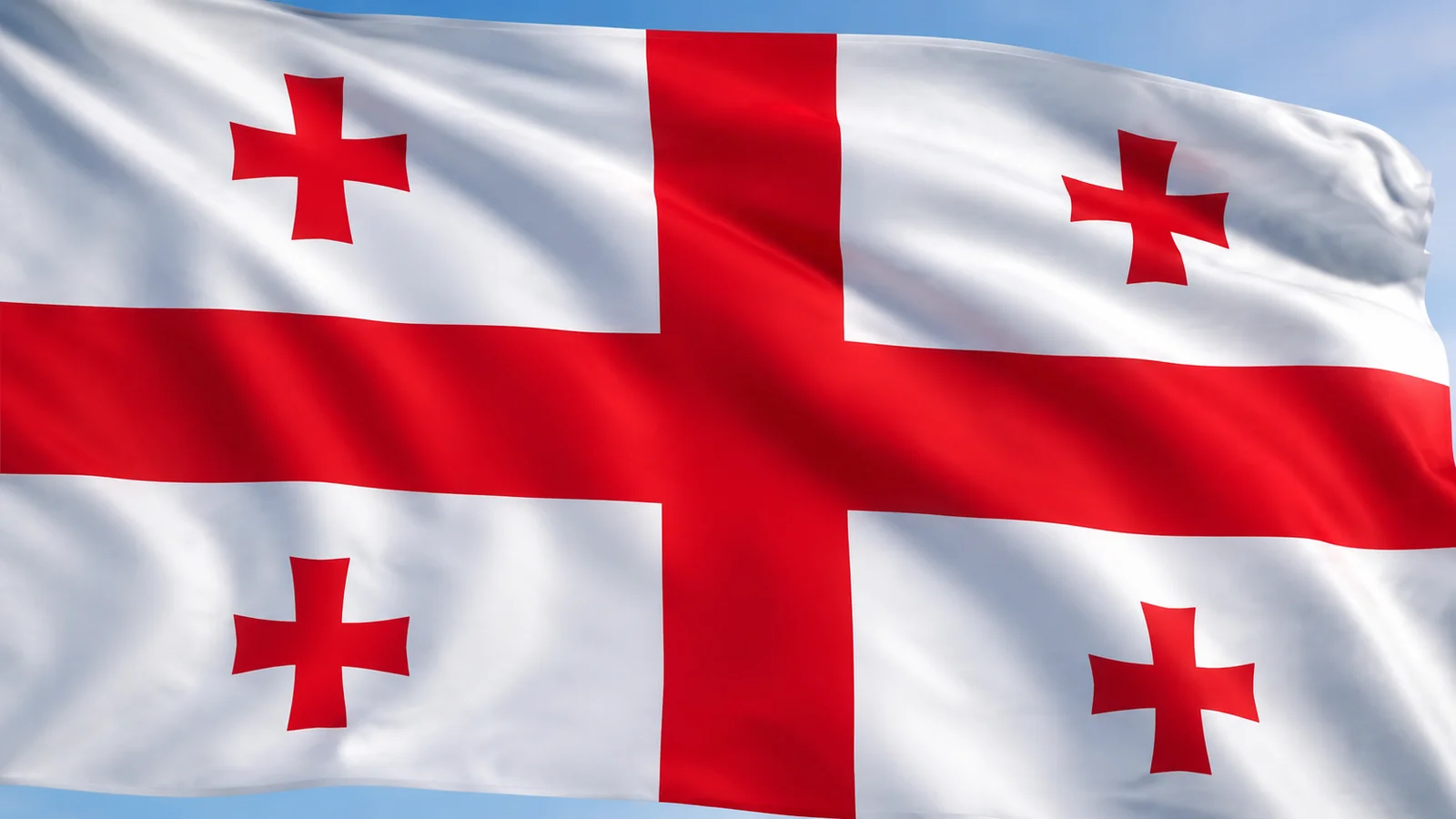
The evidence looks overwhelming. St George is the patron saint of Georgia. There are several hundred churches dedicated to him. His feast is commemorated twice a year rather than the usual once. He is on the flag — the large central cross is his, and the four smaller crosses in the corners make five St George crosses on a single national banner. There is a golden statue of him spearing the dragon standing on a column in the middle of Tbilisi's Freedom Square. If you were designing a country to look like it was named after St George, you would design this one.
It is still a folk etymology. Almost certainly wrong.
The order of events is the problem. The name reached Western Europe before the saint could plausibly have supplied it, and it arrived from a direction — the east — where nobody was thinking about St George at all.
The trail runs through Persia
In Persian, Georgians were gurj (گرج). The country was Gurjistan — the ethnonym plus the ordinary Persian suffix -stan, "land of," the same one doing the work in Afghanistan, Uzbekistan, and a dozen other names. Arabic borrowed it as Jurz or Kurj. Turkish still uses Gürcistan today. Armenian went its own way entirely with Vrastan, which is a separate story.
This is the name that reached Europe. Crusaders and pilgrims in the Holy Land — where Georgian monks had held communities for centuries, which is precisely how the two worlds met — heard something like Gurj or Gurjistan, and rendered it into Latin and the vernaculars as Georgia, and also as Jorgania, Giorginia, and several other attempts that did not survive.
And then they explained it. Here were people called something like gurj, who venerated St George with an intensity unusual even by medieval standards, whose knights rode under his cross. The conclusion was irresistible and completely wrong: this must be the land of St George. Jacques de Vitry, the thirteenth-century bishop and chronicler, offers exactly this explanation. Franz Ferdinand von Troilo repeats it centuries later. It is a tidy story, and tidy stories travel.
What actually happened is that gurj and George sound similar by coincidence, and Europeans reverse-engineered a saint out of a sound. The Persian word has no connection to the Greek name Georgios whatsoever.
So what does gurj mean?
Here the honest answer is: nobody is certain, and you should be suspicious of anyone who tells you otherwise.
The most commonly cited theory derives it from an Old Iranian root meaning wolf — vrkān, "land of wolves," surviving in the region name Gorgan and in modern Persian gorg. The Kartvelian v shifting to g within the Iranian family is a regular development rather than a convenient coincidence, which is what makes the theory attractive.
If it is right, there is a detail that will land differently depending on where you are standing while you read this. Vakhtang Gorgasali, the fifth-century king who founded Tbilisi, is known by an epithet built from the same root: gorgasali, from Persian gorg (wolf) and sar (head) — wolf's head, said to describe the helmet he wore into battle. The king who founded the capital and the name the outside world uses for the country may both trace back to the same animal, in the same language, neither of them Georgian.
Our office is on Vakhtang Gorgasali Street. We are not neutral about this theory.
But it is not the only one. Martin Schwartz has proposed a different route, from Parthian gurjig, an ethnic term linked to Virkʿ — the Armenian name for Iberia. And a much older theory, popularised by the French traveller Jean Chardin in the seventeenth century, connected Georgia to the ancient Greek γεωργός, geōrgos, "tiller of the earth," on the grounds that classical writers used a similar word for settled agricultural peoples. It is a lovely idea for a country that has been farming vines for eight thousand years. It is also, most scholars think, another rationalisation after the fact — a second attempt to explain a name whose real origin had already been lost.
The scholarly consensus favours the Persian route. Within that route, the wolf is a strong hypothesis and not a settled fact. That is where the evidence honestly sits.
Sakartvelo: the name from the inside
None of the above has anything to do with what Georgians call their country, which is the more interesting name anyway.
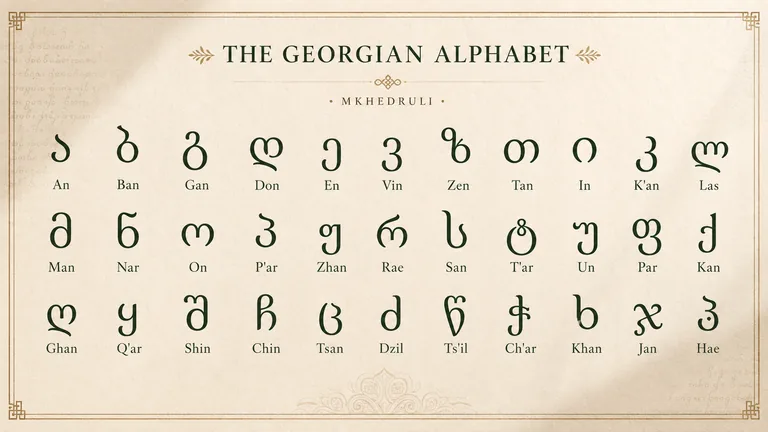
Sakartvelo (საქართველო) breaks apart cleanly once you see the seams: sa- + kartvel + -o. Kartveli is a Georgian person. The circumfix sa-...-o is an ordinary piece of Georgian grammar meaning, roughly, "the place of." Sakartvelo is the place of the Kartvelians. That is the whole construction, and it is the same one you will meet again in Sakartvelo's neighbours: Somkheti for Armenia, Osmaleti for the Ottoman lands.
Kartveli comes in turn from Kartli — the central region around Mtskheta and Tbilisi that became the political nucleus of the country, and which the Greeks and Romans knew as Iberia. Not, to be clear, the Iberia that is Spain and Portugal. The duplication is ancient, unexplained, and has been irritating Georgians for approximately two thousand years, which suggests the Atlanta problem is less novel than it feels.
Western Georgia had its own name and its own kingdom: Colchis, where the Greeks sent Jason after the Golden Fleece. Kartli and Colchis were separate places with separate histories, and the name of the eastern one eventually swallowed both.
There is one popular explanation to set aside. You will hear — sometimes from Georgians, sometimes from guides who should know better — that the name splits as Sak-a-rtvelo and contains rtveli, the word for the grape harvest, making Sakartvelo "the land of the wine harvest." Given the qvevri and the eight thousand years, it is a story everyone wants to be true. It requires cutting the word in the wrong place. The root is kartvel-, and the resemblance to rtveli is an accident. Georgia does not need its name to be about wine. Georgia has the wine.
Kartlos, son of Targamos, grandson of Noah
The Georgians, naturally, have their own founding story for the name, and it is better than the crusaders'.
It appears in Kartlis Tskhovreba — The Life of Kartli, usually called the Georgian Chronicles — the great compilation of Georgian history, in the opening mythological section attributed to the eleventh-century chronicler Leonti Mroveli, working from oral tradition that may be considerably older; the historian Giorgi Melikishvili dated the myth itself to the early eighth century.
The story runs like this. Targamos — the biblical Togarmah, a descendant of Japheth, son of Noah — divided the Caucasus among his eight sons. To Kartlos he gave the land we are standing in. Kartlos came to the confluence of the Mtkvari and the Aragvi, climbed the mountain above it, built his house there, and gave the mountain his own name: Kartli. From that mountain the name spread outward until it covered the whole country. Kartlos's brothers founded the other peoples of the region — Haos the Armenians, Egros the Colchians, Kavkasos the peoples of the North Caucasus, Lekos the Dagestanis.
His son Mtskhetos, described as the mightiest of the brothers, founded Mtskheta at that same confluence — the city that became the capital of Iberia and where Georgia adopted Christianity in the fourth century. The oath sworn at Kartlos's grave was held to be the most binding oath in the country.
It is myth, not history; there is no archaeology behind Kartlos, and the genealogy is a medieval attempt to hook Georgian origins onto the Old Testament in the way most Christian nations were doing at the time. But it tells you something that a bare etymology cannot. The name comes from a person, the person comes from a mountain, and the mountain sits above the confluence of two rivers you can drive to in twenty minutes from Tbilisi. The story is anchored to ground you can stand on. Most national myths are not.
Sakartvelo as the name of a single unified country is younger than the myth. Kartli was one kingdom among several for centuries. The name is attested from around the eighth century, but it becomes the name of the whole state after 1008, when Bagrat III united Kartli and Abkhazia into a single kingdom and the word had, for the first time, an entire country to describe. It has been in the constitution since 1995.
Gruzia, and why the confusion with Atlanta is deliberate
Which brings us to the part that surprises people.
Russian calls Georgia Gruziya — from the same Persian gurj, arriving by a northern route, first appearing in a Russian traveller's account in 1389. Through the Russian Empire and then the Soviet Union, Gruzia spread across the Slavic world and beyond: Bulgarian, Belarusian, Chinese, Hungarian, Slovene, the Baltic states.
Georgia has spent the last two decades asking those countries to stop.
The objection is not linguistic. It is that Gruzia, whatever its Persian origins, arrived everywhere it went by way of Moscow, and carries two centuries of empire with it. As one Georgian lawmaker put it during the campaign, the word is associated with Georgia's being part of the Russian Empire for two hundred years, and its spread was Russia's doing.
It has worked, slowly. Israel dropped Gruzia in 2005. South Korea followed in 2011. Japan changed in 2015. And in 2018 Lithuania went further than anyone had asked and became the first country in the world to adopt the Georgian endonym outright: in Lithuanian, Georgia is now Sakartvelas. Georgia returned the courtesy by dropping the Russian-derived Litva and calling Lithuania Lietuva.
Now hold the two halves of this together. Georgia asked Japan to stop calling it Gruzia and to start calling it Georgia — which is to say, to adopt a name that is a crusader's mistranslation of a Persian word, and which guarantees permanent confusion with a state in the American South. It did this on purpose. Given a choice between a name that misidentifies you and a name that reminds you who used to own you, a country will take the misidentification every time.
The confusion with Atlanta is not an accident of history. It is, in a small way, a decision.
What to do with all this
Practically, not much — nobody will correct you for saying Georgia, because Georgians say it too when speaking English. But two things are worth knowing.
Sakartvelo (sa-kart-VE-lo) is not difficult, and using it once in conversation lands rather better than you would expect. So does knowing that a Georgian person is a Kartveli. As with the language generally, the point is not fluency; it is the demonstration that you understood there was something to learn.
And the second thing is this: the whole story is walkable. Mtskheta sits at Kartlos's confluence, half an hour from the capital. The mountain in the legend is above it. Vakhtang Gorgasali, wolf's head, founded Tbilisi at the hot springs a few streets from where this was written, and the sulphur baths are still running. The Freedom Square St George — the saint who did not name the country but has been quietly credited with it for eight hundred years — is fifteen minutes' walk from the baths.
You can do the etymology on foot in a day. Most countries cannot offer that.
Hikasus Travel is based on Vakhtang Gorgasali Street in Old Tbilisi, a few minutes from the sulphur baths where the city began. We run hiking and cultural tours across Sakartvelo — the country, not the state.