
Jvari Monastery, Mtskheta: The 6th-Century Hilltop Church Above the River Confluence
Jvari Monastery stands on a rocky promontory above the ancient town of Mtskheta, in the country of Georgia in the South Caucasus, at the point where the Aragvi River joins the Mtkvari and the two currents — one clearer, the other darker and more sediment-laden — remain visibly distinct for some distance downstream before fully mixing. The monastery was built in the late 6th and early 7th centuries on a site already considered sacred — the hilltop where St. Nino, the missionary credited with bringing Christianity to Georgia in the early 4th century, is traditionally said to have erected a wooden cross after the conversion of the Iberian kingdom. The name Jvari means simply "cross" in Georgian, and the building that grew up around that original sacred marker became one of the foundational monuments of Georgian Christian architecture — so successfully resolved that it gave its name to a whole church type and influenced Georgian (and Armenian) ecclesiastical design for centuries afterward. It is part of the UNESCO World Heritage Site "Historical Monuments of Mtskheta," inscribed in 1994, and among the most visited religious sites in the country.
What is Jvari Monastery?
Jvari is a 6th–7th-century Georgian Orthodox church on a hilltop above Mtskheta, about 20 km north of Tbilisi, famous for two things: its place in the founding story of Georgian Christianity (St. Nino is said to have raised a wooden cross here in the 4th century — "Jvari" means "cross") and its panoramic view over the confluence of the Mtkvari and Aragvi rivers with the old town below. Architecturally it's the founding example of the "Jvari type" tetraconch church. It's a UNESCO World Heritage Site, free to enter, and usually visited together with Svetitskhoveli Cathedral on a Mtskheta day trip.
History and sacred significance
The Jvari story begins with the wooden cross that St. Nino is said to have erected on this hilltop during or shortly after the conversion of King Mirian III and the Iberian court to Christianity in the 4th century. The precise sequence of events and the exact nature of the original structure belong to hagiographic tradition rather than documented history, but the consistency of the tradition across Georgian sources and the early date of the site's sacred status are well established. A small church (the "Small Church of Jvari") was built beside the cross site in the 6th century, around 545 under Guaram I; the larger main church that made Jvari famous — the "Great Church" — was built over roughly 586/590 to 605 under the Iberian eristavi (duke) Stepanoz, whose dedicatory inscription and relief figures survive in the exterior stonework.
The site's importance in Georgian Christian consciousness comes from this combination of founding narrative and architectural achievement — Jvari is both the place where the physical symbol of Georgian Christianity was first raised and one of the most artistically accomplished early medieval churches in the Caucasus. That double significance gives the monastery a prominence within Georgian religious culture that purely architecturally impressive sites and purely historically significant ones don't individually reach. Remarkably, the Great Church has never been substantially rebuilt and stands largely as it did some fourteen centuries ago.
There's also a well-known literary association: the Romantic poet Mikhail Lermontov opened his narrative poem Mtsyri with an image of the two rivers merging "like two sisters" at the foot of a hill where a monastery stands, and popular tradition has long identified that monastery as Jvari. Lermontov didn't name the site explicitly, and historians debate the firm attribution, but the association is deeply embedded — generations of Georgian and Russian readers have connected the specific view from this hilltop with the poem's opening, and it adds a cultural layer that reinforces Jvari's standing as one of the more emotionally resonant places in the Georgian landscape.
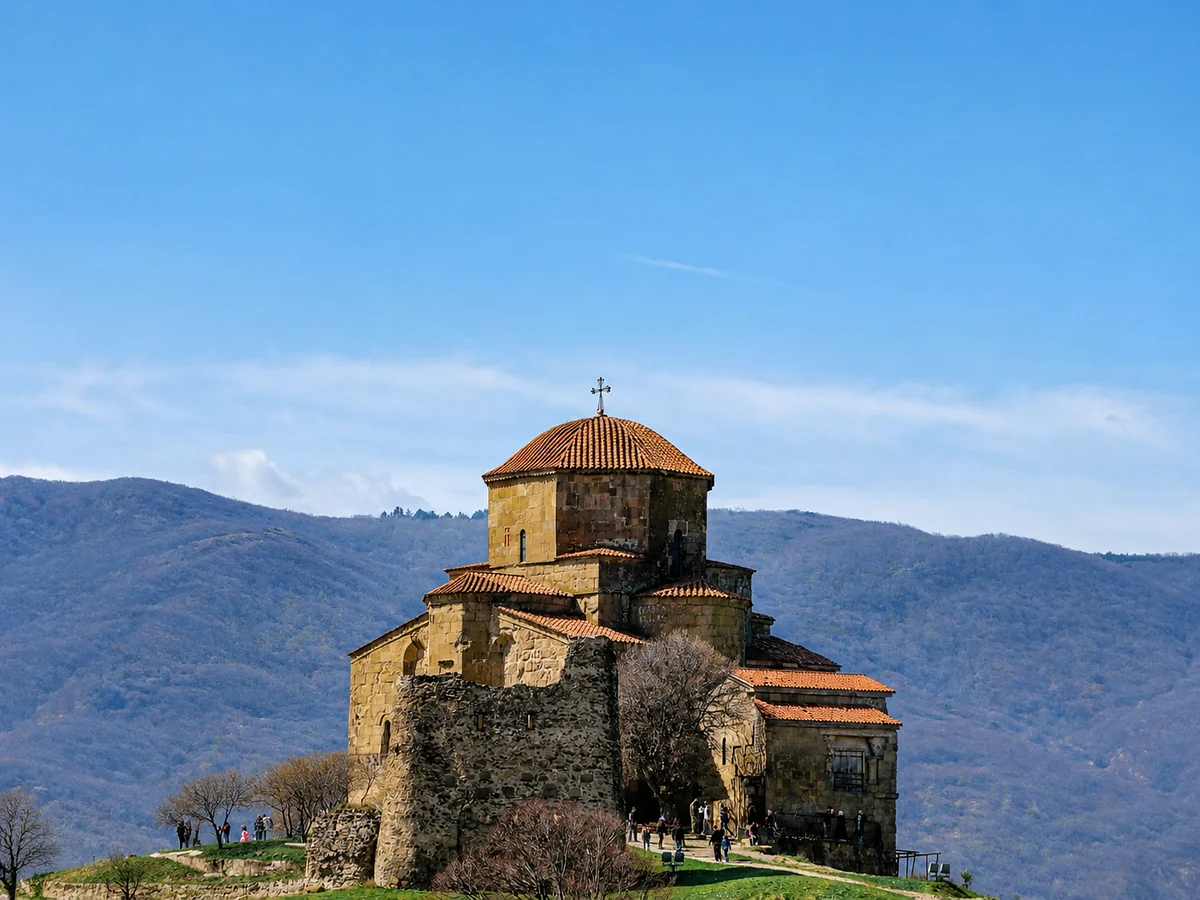
The architecture
Jvari is recognized internationally as one of the most significant examples of early medieval Caucasian Christian architecture and as a foundational building in the specifically Georgian ecclesiastical tradition — so much so that the building type is named the "Jvari type" after it. The church is a tetraconch: a centrally planned building with four semicircular apses arranged around a central domed space, producing a cross-shaped plan when seen from above. This type, adapted from early Christian architectural thinking to the materials and conditions of the South Caucasus, was developed by Georgian builders in the 6th century as one approach to the problem of creating a domed sacred space, and the Jvari church is its most fully resolved expression.
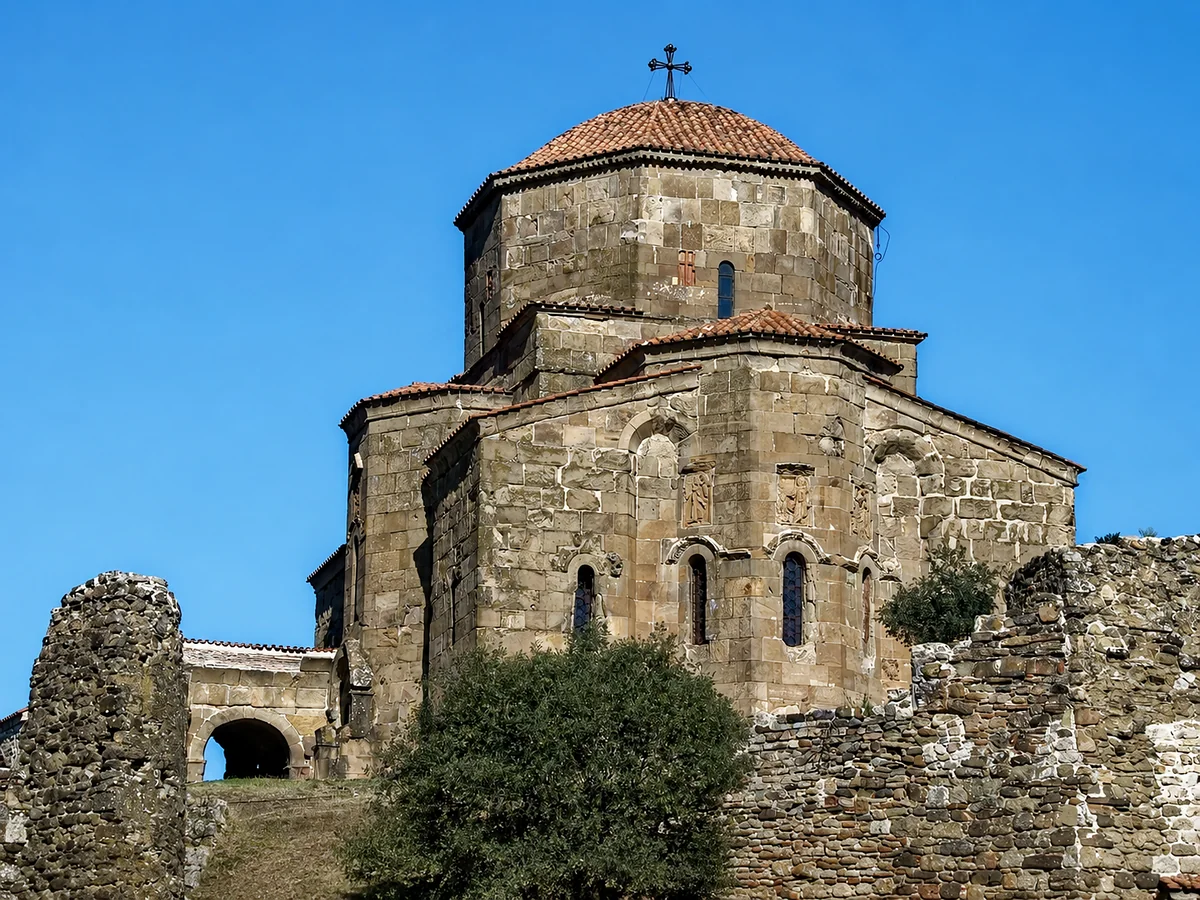
The success of the design lies in the spatial relationship between the central dome and the four apses — the way the hemispherical vault relates to the curved surfaces below it, creating an interior of considerable harmony and calm that the building's relatively modest scale doesn't diminish. The drum carrying the dome is articulated on the exterior with blind arcading and carved relief that gives the building its vertical emphasis and characteristic silhouette, reading clearly from the valley below and from considerable distances across the landscape.
The exterior carving includes relief figures in the tympana of the blind arcades — among them the dedicatory figures of the eristavi who commissioned the church — executed in the flat, hieratic style of 6th–7th-century Caucasian stone carving. Weathered after fourteen centuries of exposure, the reliefs retain enough legibility to identify the figures and read the dedicatory program. The quality of the stone-cutting throughout — the precision of the ashlar courses, the careful dressing of the decorative elements — reflects a workshop of considerable competence working at the height of its capability. The building sits on its rocky summit (around 656 m) as a natural extension of the hill, the harmony between structure and landscape that is characteristic of medieval Georgian architecture at its best.
The view
The panorama from the Jvari hilltop is one of the most reproduced and immediately recognizable Georgian landscape images, and it's one of those relatively rare cases where the reality fully justifies the reputation. Standing at the edge of the hilltop precinct, looking down over the confluence of the Mtkvari and the Aragvi, with the ancient town of Mtskheta on the valley floor below and the broader landscape of central Georgia extending in multiple directions, gives a geographical comprehension of this part of the country that no amount of time at valley level provides. The two rivers meeting below — the color difference between them visible from above and persisting for a considerable distance downstream — is the specific element most photographs emphasize, and in person the effect is, if anything, more striking, because the scale of the landscape and the elevation give the confluence a context a photograph can't fully capture.
The light over the Mtskheta valley changes significantly through the day. Late afternoon — when the sun illuminates the valley from the west and the shadows lengthen across the farmland and the rooftops of the old town — is generally the most rewarding for the view and for photography, while early morning, with the valley floor still in shade and the upper walls of the monastery catching the first light, has a different but equally striking quality. The hilltop is exposed and can be windy and cold, especially off-season.
The visit
The monastery is reached from Mtskheta by road — a short drive up the hill — or by a more demanding uphill walk of about thirty minutes from the town below. The road approach is the standard option for most visitors, often by taxi from Mtskheta (sometimes arranged with a wait), and the combination of Jvari and its view with a visit to the Svetitskhoveli Cathedral in the town below makes a half-day covering the two most significant monuments of one of the most historically important sites in Georgia. Entry to the precinct and church is free, and a thorough visit — the architecture, the exterior carvings, the views — takes roughly thirty to forty-five minutes, longer for those who want to sit with the panorama and examine the building closely. Modest dress is required for entry into the church, and the active religious use of the building should be respected.
Caucasus Travel FAQ
Jvari is a 6th–7th-century Georgian Orthodox church on a hilltop above Mtskheta, about 20 km north of Tbilisi. Its name means "cross," after the wooden cross St. Nino is said to have raised here in the 4th century. It's famous both as a foundational monument of Georgian architecture (the "Jvari type" tetraconch church is named after it) and for its sweeping view over the confluence of the Mtkvari and Aragvi rivers. It's a UNESCO World Heritage Site, part of the "Historical Monuments of Mtskheta."
Two reasons. First, its place in Georgian Christianity: the hilltop is where St. Nino is said to have erected a cross after the kingdom's conversion in the 4th century. Second, its architecture and setting: the church (built around 590–605) is the founding example of the tetraconch "Jvari type," influential across the Caucasus, and it sits on a clifftop with one of Georgia's most famous views — the two rivers meeting below, their different colors visible from above.
It's a short drive up the hill from Mtskheta (about 20 km / 30 minutes from Tbilisi), usually by car or taxi — taxis from Mtskheta often wait while you visit. There's also a steeper uphill walk of about thirty minutes from the town. Most visitors combine Jvari with Svetitskhoveli Cathedral in Mtskheta below for a half-day. Entry is free; modest dress is required as it's an active church.
From the hilltop you look down over the meeting of the Mtkvari and Aragvi rivers, with the old town of Mtskheta on the valley floor and central Georgia stretching out beyond. The two rivers' differing colors stay visible for some way downstream — the detail most photos emphasize. Late afternoon light is especially good. The view is among the most recognizable in Georgia and is popularly linked to the opening of Lermontov's poem Mtsyri.
Yes — they're the two halves of the Mtskheta UNESCO site and are almost always done together. Jvari gives you the hilltop architecture and the famous river-confluence panorama; Svetitskhoveli, in the town below, is Georgia's grand "Mother Cathedral" and the burial site of Christ's robe by tradition. Add the in-town Samtavro Monastery and the secluded Shio-Mgvime, and Mtskheta easily fills a half- to full-day.