
Svetitskhoveli Cathedral, Mtskheta: Georgia's Mother Cathedral and the Robe of Christ
Svetitskhoveli Cathedral stands at the center of the ancient town of Mtskheta — the former capital of the Kingdom of Iberia and the spiritual heart of Georgian Christianity — in the country of Georgia in the South Caucasus, where it has held its position, literally and symbolically, for the better part of a thousand years. The current structure was built between 1010 and 1029 under the Catholicos Melkisedek I, during the reign of King George I, but the sacred site it occupies is far older, with earlier churches here dating to the 4th century, when Christianity first became the state religion of Iberia. It is the largest medieval church in Georgia, one of the most architecturally ambitious religious buildings in the entire Caucasus, and the site most intimately bound to the founding narrative of Georgian Christianity. Together with the nearby Jvari Monastery and Samtavro, it forms the core of the UNESCO World Heritage Site "Historical Monuments of Mtskheta," inscribed in 1994.
What is Svetitskhoveli Cathedral?
Svetitskhoveli is the most important cathedral in Georgia — the "Mother Cathedral" of the Georgian Orthodox Church — in the ancient capital of Mtskheta, about 20 km north of Tbilisi. The present 11th-century building (1010–1029) is Georgia's largest medieval church, built on a 4th-century site where, by tradition, the robe of Christ is buried. Its name means "life-giving pillar," after a miraculous column in its founding legend. Georgian kings were crowned and buried here, and it's a UNESCO World Heritage Site. It's an active cathedral; entry is free and modest dress is required.
The name and the sacred legend
The name Svetitskhoveli translates as "life-giving pillar" — referring not to an architectural pillar but to a miraculous column central to the founding legend of the site and to its extraordinary sacred status. The legend, preserved in Georgian hagiographic sources and deeply embedded in the national religious consciousness, runs as follows: a Mtskhetan Jew named Elias was present at the crucifixion of Christ in Jerusalem and brought the robe of Christ back to Mtskheta. His sister Sidonia took the robe and died holding it, and was buried with it in her hands. A cedar tree grew from her grave, and when St. Nino instructed that the tree be cut for timber for the first Christian church on the site, seven pillars were cut from it; six were installed, but the seventh rose into the air of its own accord and descended only after St. Nino prayed through the night, after which it was found to have healing properties and to flow with a life-giving liquid. This miraculous pillar — the Svetitskhoveli — became the spiritual heart of the cathedral and the source of its name, and the buried robe of Christ made Mtskheta one of the holiest places in the world for Georgian Orthodox Christians.
The theological and devotional weight of this legend is hard to overstate in the context of Georgian Christianity. The robe of Christ — one of the most sacred relics in Christian tradition — buried at the very site of the first Georgian church, and the miraculous column produced from that same ground, gave Svetitskhoveli a sacred status among the most important Christian pilgrimage sites in the world for the Georgian church and people; it has been described as a "second Jerusalem." Kings were crowned here and royal burials took place within its walls, and the cathedral served as the seat of the Catholicos — the head of the Georgian Orthodox Church — through much of the medieval period. This concentration of royal, religious, and sacred-historical significance in a single building is what gives Svetitskhoveli its particular weight in Georgian culture, beyond what purely architectural admiration accounts for.
The architecture
The cathedral built in the early 11th century — by the architect Arsukidze, whose name is preserved in tradition — is a large cross-in-square church with a tall drum and dome, constructed from carefully dressed golden sandstone that gives the building its warm, honey-colored tone. The scale is deliberately monumental, the largest medieval church in Georgia, built to express the ambitions of a royal patron and a church hierarchy at the height of their political and religious confidence. The proportions are carefully considered: the relationship between the massive stone walls, the vertical emphasis of the drum and dome, and the horizontal spread of the crossing arms achieves a balance that makes the cathedral feel commanding and harmonious rather than simply large.
The exterior decoration is restrained by the standards of Georgia's most ornate medieval churches — the Nikortsminda Cathedral offers a more densely carved facade — but the carved details that do appear are of high quality, particularly the blind arcading that articulates the wall surfaces and the carved decoration around the windows and portals. The facades read as surfaces of considered architectural composition rather than canvases for ornamental elaboration, giving the building a formal clarity appropriate for a structure of this scale and institutional importance.
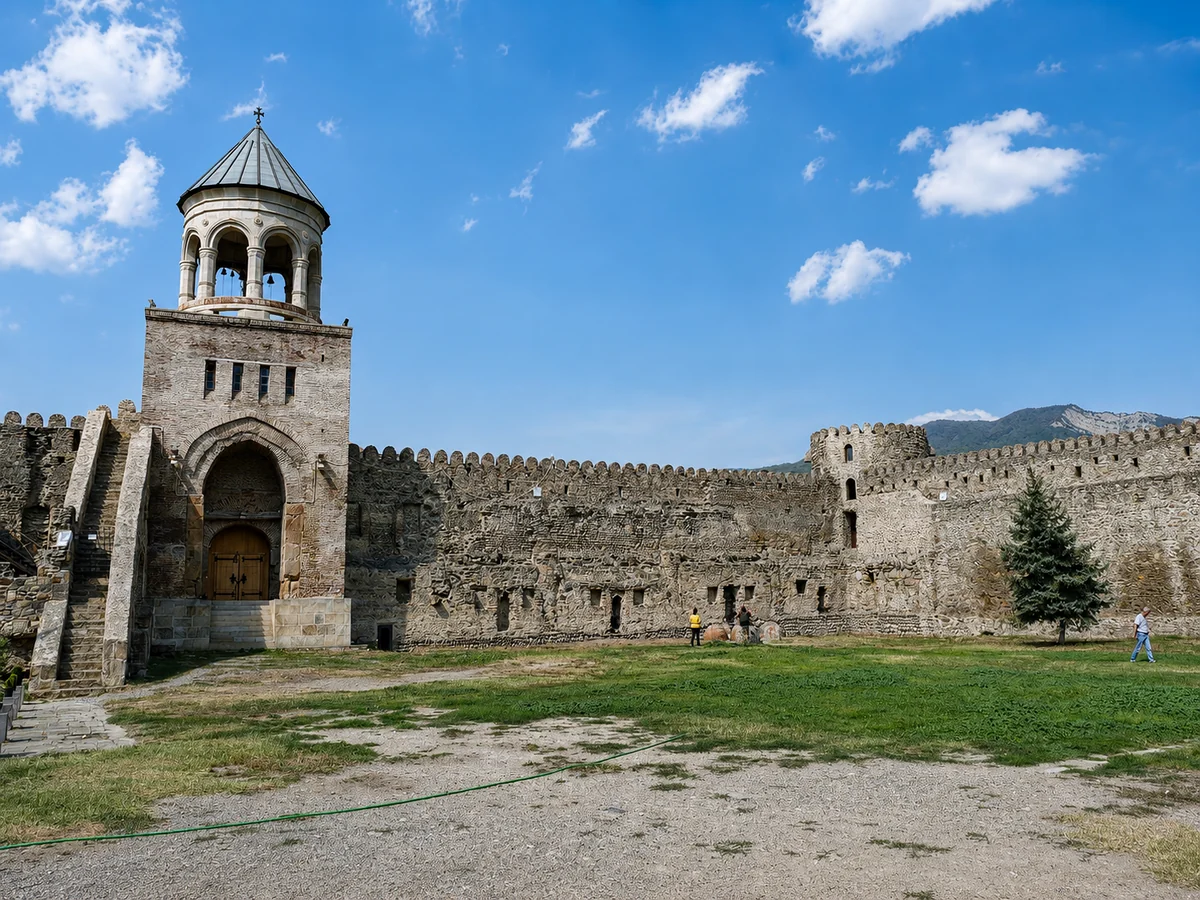
The fortified wall surrounding the precinct, with its corner towers and massive gateways, was built under King Erekle II in the late 18th century, during a period of repeated military pressure on the region, and gives the complex a self-contained, almost military character from outside. Passing through the main gateway into the precinct, with the full facade of the cathedral suddenly visible across the open courtyard, is one of the more effective architectural arrival sequences in Georgian heritage — the transition from the enclosed gateway to the open space giving the cathedral's scale its proper context.
The interior
The interior of Svetitskhoveli is imposing in the way that large medieval churches of genuine quality consistently are — the scale of the space, the quality of the stone, and the layered historical additions combining to communicate both architectural ambition and sacred continuity. The massive stone pillars carrying the crossing vault define the main space and give the cathedral its characteristic rhythm of solid and void, and the drum above the crossing admits light in a way that animates the stone surfaces below and gives the central space a vertical luminosity the side aisles don't share.
Frescoes from multiple periods cover sections of the interior walls — the 11th-century original decoration surviving in fragmentary form alongside later additions that extended the pictorial program across subsequent centuries (including a striking medieval Last Judgment scene). The quality of what survives from the medieval period is considerable, and the later additions, of varying quality, give the interior the palimpsest character of a building continuously used and renewed across a thousand years. The carved stone canopy marking the site of the holy pillar is the focal point of the cathedral's devotional life — an ornate baldachin enclosing the spot of the original miraculous column. Within the cathedral there is also a small stone structure built into the south side that is a symbolic copy of the Chapel of the Holy Sepulchre in Jerusalem, raised to mark Svetitskhoveli's status as a holy site second only to Jerusalem.
The royal tombs within the cathedral — including members of the Bagrationi dynasty whose patronage shaped medieval Georgia — add a dynastic dimension to the sacred and architectural interest and give the building a historical depth few religious monuments anywhere can match. The cathedral remains fully active, with regular services, and the presence of the worshipping community gives the space a living quality that purely heritage-focused visits can't access in the same way.
The precinct and setting
The walled precinct contains additional structures of interest — the remains of earlier buildings visible in foundations and lower courses, a smaller church within the walls, and the Catholicos's quarters — giving the enclosed area a complexity that rewards exploration beyond the main building. The grounds are well maintained and provide space to step back and read the cathedral's exterior from the distances that reveal its proportions most clearly.
Mtskheta itself, visible from the precinct walls and immediately accessible on foot, completes the context — the ancient streets, surviving traditional houses, the local market, and the atmosphere of a small Georgian town that retains the consciousness of its extraordinary historical importance without having become a purely touristic environment. Svetitskhoveli in the town center and Jvari on the hill above cover the two most significant monuments of the site and give the full UNESCO World Heritage experience that Mtskheta represents; Samtavro Monastery, a few minutes' walk away, completes the in-town religious heritage.
Getting there and practical information
Mtskheta is about 20 kilometers north of Tbilisi, reachable in around thirty minutes by road. Marshrutkas run frequently from Tbilisi's Didube station, and the town sits on the route north toward Gudauri and Stepantsminda along the Georgian Military Highway. The cathedral is central in Mtskheta and easily found on foot from wherever transport drops you. Entry to the cathedral and precinct is free. A thorough visit to the interior and exterior takes roughly thirty to sixty minutes, with the precinct and the surrounding town comfortably extending the full Mtskheta experience to a half-day (and easily a full day with Jvari and Samtavro). Modest dress — covered shoulders and knees — is required for entry, and head coverings for women are expected within the active religious space.
Caucasus Travel FAQ
Svetitskhoveli is the "Mother Cathedral" of the Georgian Orthodox Church, in the ancient capital of Mtskheta, about 20 km north of Tbilisi. The present building (1010–1029) is Georgia's largest medieval church, standing on a 4th-century site where, by tradition, the robe of Christ is buried. Its name means "life-giving pillar," after a miraculous column in its founding legend, and it's part of the "Historical Monuments of Mtskheta" UNESCO World Heritage Site.
It's the holiest cathedral in Georgia and a place where the country's Christian, royal, and national history converge. By tradition the robe of Christ is buried beneath it, making Mtskheta a "second Jerusalem" for Georgian Orthodoxy; Georgian kings were crowned and buried here; and it was the seat of the Catholicos through much of the medieval period. That concentration of sacred and historical significance gives it a weight beyond its architecture.
By tradition, a Mtskhetan Jew named Elias brought Christ's robe back from Jerusalem; his sister Sidonia died holding it and was buried with it, and a cedar grew from her grave. When St. Nino had the tree cut for the first church, one of the pillars rose into the air on its own and descended only after she prayed all night — then flowed with a healing, "life-giving" liquid. That pillar gives the cathedral its name, Svetitskhoveli.
Mtskheta is about 20 km north of Tbilisi, roughly thirty minutes by road. Marshrutkas run frequently from Tbilisi's Didube station, and many visitors come on a Mtskheta day tour. The cathedral is in the center of town and easy to find on foot. Entry is free; modest dress (covered shoulders and knees, headscarf for women) is required as it's an active cathedral.
Plenty — Mtskheta is compact and packed with significance. A short walk away is Samtavro Monastery (tombs of the first Christian kings and St. Gabriel's grave); on the hill above town is the 6th-century Jvari Monastery, the other half of the UNESCO site, with sweeping views over the river confluence; and a short drive out is the secluded Shio-Mgvime cave monastery. Together they make an easy half- to full-day.