
Alphabetic Tower, Batumi: The DNA-Helix Monument to the Georgian Alphabet
The Alphabetic Tower rises from the Batumi waterfront in Adjara, on Georgia's Black Sea coast — the country in the South Caucasus — in a form that's immediately distinctive: a double-helix structure about 130 meters tall, its twin spiraling arms twisting upward in a shape that references the DNA double helix while carrying the 33 letters of the Georgian alphabet along its exterior. It was completed in 2011 as part of the intensive development of Batumi's seafront during the city's modernization decade, and it has since become one of the most recognizable elements of the skyline, visible from the boulevard, from the sea, and from the hills above the city.
What is the Alphabetic Tower?
The Alphabetic Tower is a 130-meter landmark on the Batumi seafront, built in 2011 and designed by Spanish architect Alberto Domingo Cabo. Two steel bands spiral upward in the shape of a DNA double helix, carrying the 33 letters of the Georgian alphabet — each about 4 meters tall — so the structure reads as a monument to the Georgian written language. The concept: language is the "genetic code" of a nation. At the top is an observation deck and a revolving panoramic restaurant, reached by lift, with views over Batumi, the Black Sea, and the Adjara mountains. The exterior is free and lit in shifting colors at night; the observation deck is ticketed.
A monument to the alphabet
Choosing the Georgian alphabet as the subject of a major public monument is entirely in keeping with the value Georgian culture places on its written language. The Georgian script is one of a small number of writing systems in the world considered a genuine original invention rather than a derivative of an earlier alphabet, and it has been in continuous use since at least the 5th century AD. The script exists in three historical forms, of which the modern Mkhedruli — used in everyday writing — developed through the medieval period, and the continuity of this written tradition across some fifteen centuries is a real source of national pride. (Georgia's living scripts are recognized on UNESCO's list of Intangible Cultural Heritage.) The Alphabetic Tower translates that cultural significance into architectural terms, making the script itself the decorative program of a structure visible from across the city — the designer's idea being that a language is the genetic code of a people, hence the DNA form.
The structure
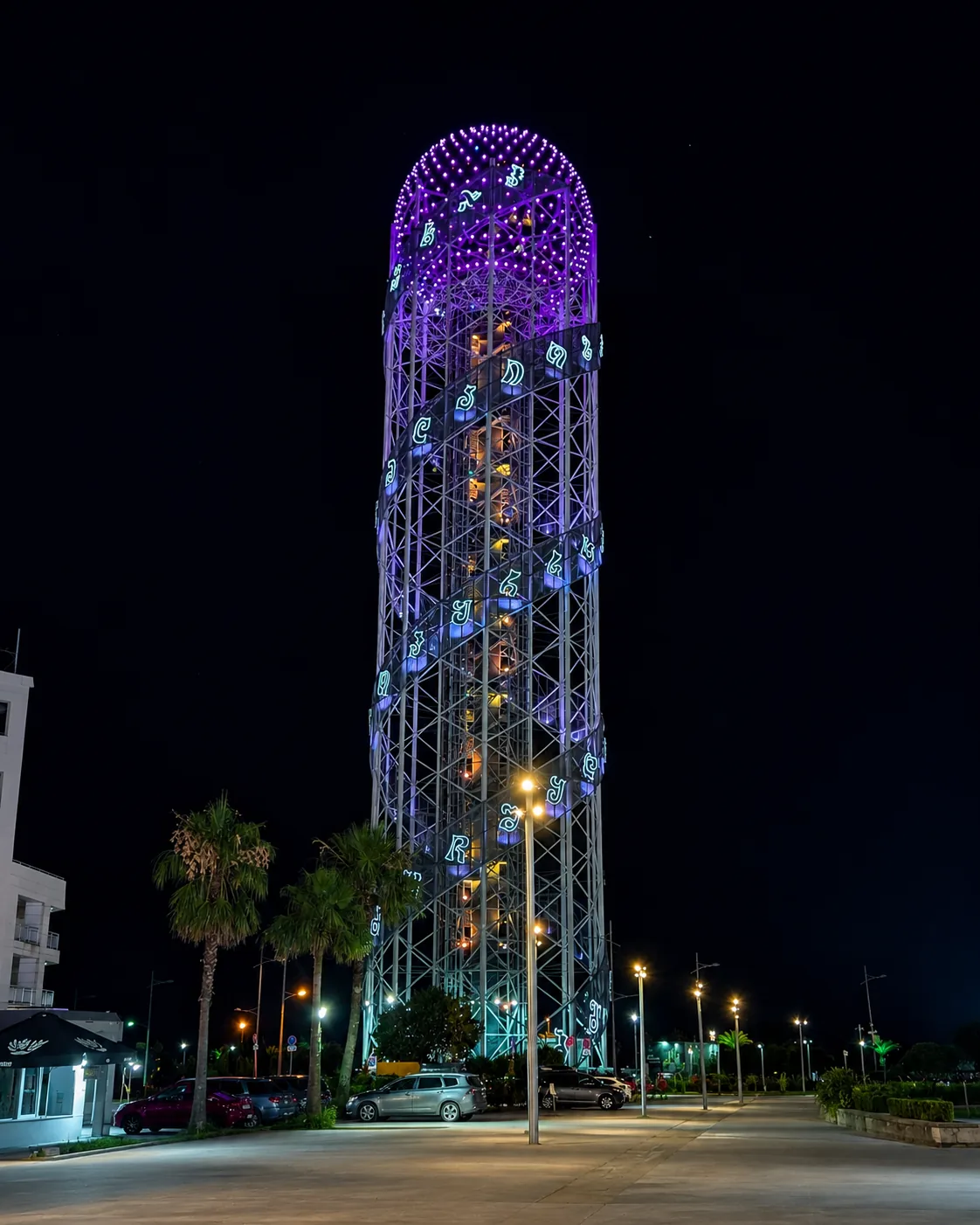
The tower's double-helix form is structurally interesting beyond its symbolic content. Two intertwining steel bands rise from a shared base, holding the 33 aluminium letters (each about 4 meters tall) along the spiraling surfaces at intervals that let each character be read from the ground, and lead up to the crowning sphere that contains the upper levels. The composition is unmistakably contemporary — a building that makes no reference to Georgia's medieval or imperial architectural heritage and instead positions itself as a statement about modern Georgia's relationship to its own culture, using the tools of contemporary architecture to celebrate something ancient. It was designed by the Spanish architect Alberto Domingo Cabo (with the firm CMD Ingenieros), built from 2010, and completed at a cost of around $65 million.
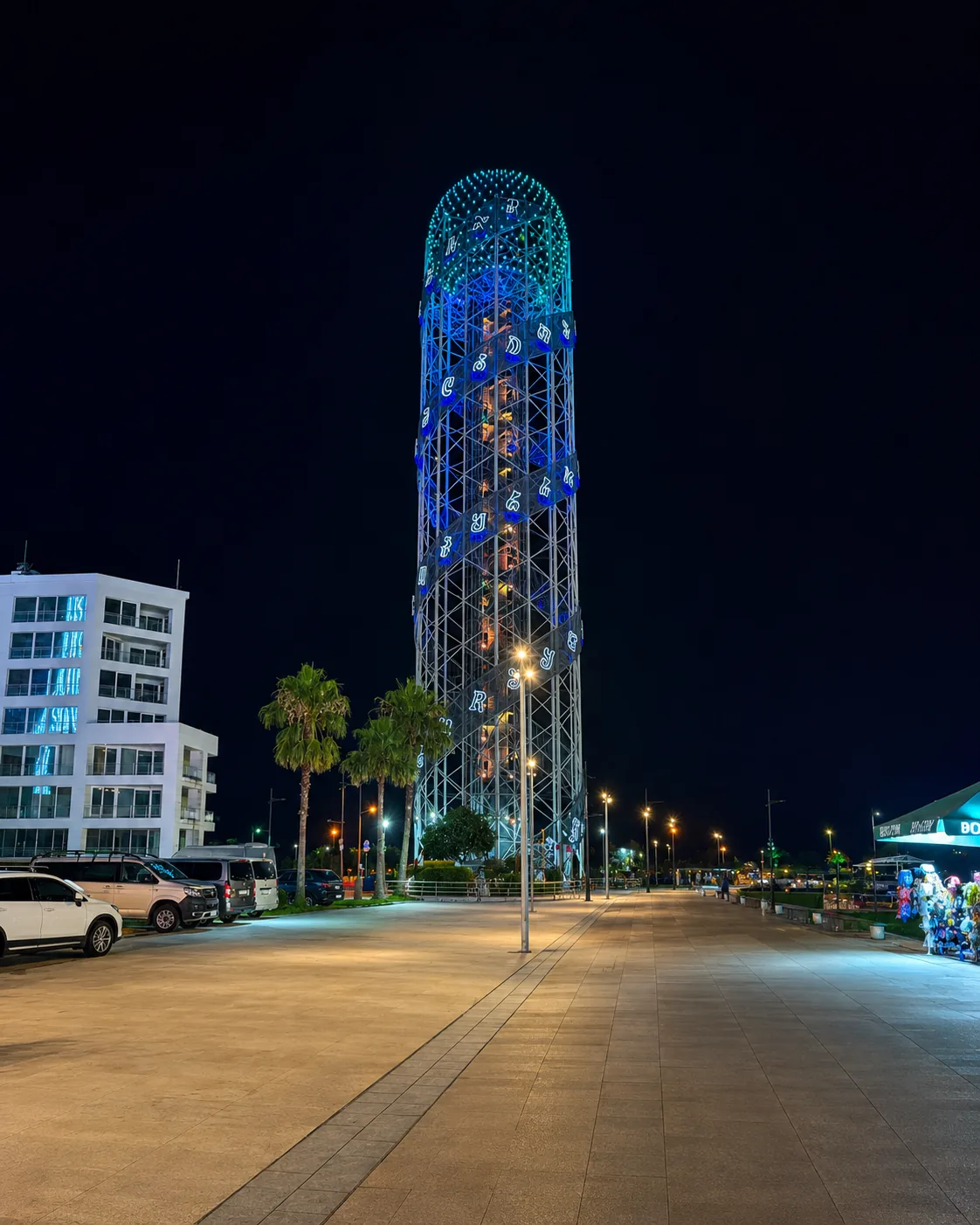
The illumination system that lights the tower after dark is one of its most effective features. The structure is lit in shifting colors that change through the evening, and the combination of the lit letters, the spiral form, and the reflection on the Black Sea behind it makes the tower one of the more photographed night subjects on the Batumi waterfront. The effect is strongest viewed from enough distance to take in the full height — from the boulevard looking north, or from the beach looking inland — rather than from directly below.
The observation level and restaurant
The crowning sphere contains an observation deck with an open terrace and a revolving panoramic restaurant (it rotates a full 360 degrees over about an hour), reached by lift within the structure. The views take in Batumi, the Black Sea coastline, and the Adjara highlands to the east. The observation deck is ticketed (a modest fee, around 20 GEL at the time of writing), and the tower is generally open from late morning to around midnight, though hours and the restaurant's operation can vary seasonally — worth checking current times if you're visiting specifically for a meal or the deck.
Even for visitors who don't go up, the tower exterior and its waterfront position make a worthwhile stop on any walk along the Batumi boulevard. The concentration of modern landmarks in the immediate vicinity — the Ali & Nino statue a short distance away, the Ferris wheel alongside, the fountains of the surrounding Miracle Park, and the port area to the north — makes this stretch of the seafront the densest single kilometer of contemporary public art and architecture in Georgia.
Practical information
- Location: Batumi seafront / boulevard, in the Miracle Park area, Batumi, Adjara.
- Hours: The exterior is visible and accessible at all times. The observation deck and restaurant generally run from late morning to around midnight, but hours vary seasonally — check current times before a dedicated visit.
- Admission: Exterior and ground level free; observation deck ticketed (modest fee).
- Best time: After dark for the illuminated letters and color-shifting lights; daytime for the clearest panoramic views from the top.
- Combine with: The Ali & Nino statue, the Ferris wheel and Miracle Park, and a walk along the Batumi boulevard.
Caucasus Travel FAQ
It's a 130-meter landmark on the Batumi seafront, built in 2011, shaped like a DNA double helix. Two spiraling steel bands carry the 33 letters of the Georgian alphabet — each about 4 meters tall — making the tower a monument to the Georgian written language, on the idea that language is the "genetic code" of a nation. It has an observation deck and a revolving restaurant at the top, and it's one of Batumi's signature modern sights.
The double-helix form is a deliberate metaphor: the Spanish architect, Alberto Domingo Cabo, conceived the tower around the idea that a language is the genetic code of a people. So the structure that usually represents biological inheritance — the DNA helix — instead carries the letters of the Georgian alphabet, linking the script to the identity and continuity of the Georgian nation.
Yes — a lift inside the structure leads to an observation deck with an open terrace and a revolving panoramic restaurant near the top, with views over Batumi, the Black Sea, and the Adjara mountains. The observation deck is ticketed (a modest fee). Opening hours and the restaurant's operation vary seasonally, so it's worth checking current times before visiting specifically to go up or dine.
The Georgian script is one of a small number of writing systems considered an original invention rather than a derivative of an older alphabet, and it has been in continuous use since at least the 5th century AD. It has three historical forms — the everyday modern script is Mkhedruli — and Georgia's living alphabets are recognized on UNESCO's Intangible Cultural Heritage list. That deep pride in the written language is exactly what the tower celebrates.
After dark is the most striking, when the tower is lit in shifting colors and the illuminated letters reflect off the Black Sea — it's one of the most photographed night sights on the Batumi waterfront. For the views from the top, daytime is clearest. The exterior is free to admire at any hour, and it's easily combined with the nearby Ali & Nino statue and a walk along the boulevard.