
Samegrelo, Georgia: Megrelian Culture, Martvili Canyon, and the Gateway to Svaneti
Samegrelo is a region in western Georgia — the country in the South Caucasus — occupying the lowland and foothill terrain between the Black Sea coast to the west, the Enguri River to the north (which separates it from Abkhazia), and the rising slopes of the Greater Caucasus that lead up to Svaneti. Its administrative center is Zugdidi, a city of around 75,000 that serves as the region's practical and cultural hub. Samegrelo isn't a region that announces itself with a single dramatic landmark. Its appeal is more diffuse and gradual: a landscape of exceptional greenness and fertility, a distinct cultural and linguistic identity, a history centered on the Dadiani dynasty that ruled here for centuries, and its position as the main gateway to Svaneti, which means most visitors to the high Caucasus pass through it — though fewer stop long enough to understand what the region offers on its own terms.
What is Samegrelo known for?
Samegrelo is best known as the gateway to Svaneti, the distinct culture and language of the Megrelian people, and the Dadiani dynasty whose Zugdidi palace holds one of Napoleon's death masks. Its standout natural site is Martvili Canyon, with its turquoise river and boat rides, and it's home to the vast Enguri Dam and the ancient fortress city of Nokalakevi. It's also celebrated for Megrelian cuisine — among the richest and spiciest in Georgia — and its prized sulguni cheese.
The Megrelians and their language
The people of Samegrelo call themselves Megrelians — Megreli in their own language — and they speak Megrelian, a South Caucasian language related to but distinct from Georgian and mutually unintelligible with it in spoken form. Like Svan in the neighboring mountains, Megrelian is one of the older languages of the Caucasus, preserving features of the ancient Colchic world that once dominated the eastern Black Sea coastal zone. It's spoken as a first language by most of the region's population, with Georgian used in education, official contexts, and communication with the rest of the country.
This linguistic distinctiveness is part of a broader cultural identity that sets Samegrelo apart. Megrelian traditions, music, food, and social customs have their own character, and regional pride in this identity is genuine and pervasive. Travelers who engage with local people here, rather than simply passing through, tend to find a culture that is warm and hospitable in the distinctly Georgian way but also clearly particular to this corner of the country.
History and the Dadiani dynasty
Samegrelo's political history is inseparable from the Dadiani family, the noble dynasty that governed the region as the Principality of Samegrelo (Mingrelia) from the 16th century until Russian annexation in the mid-19th century. The Dadiani princes held a degree of autonomy through the shifting pressures of Ottoman, Persian, and Russian imperial competition, and at points formed marriage ties with European royalty — most famously the marriage of Princess Salome Dadiani to Achille Murat, a great-nephew of Napoleon Bonaparte (a grandson of Napoleon's sister Caroline Bonaparte and Marshal Joachim Murat), in 1868. That connection brought a number of Napoleonic relics to Samegrelo and left them in the family's possession.
The Dadiani Palace in Zugdidi, the family's principal residence in the later years of the principality, is now one of the more interesting regional museums in Georgia. Its collection reflects the family's unusual position at the meeting point of Caucasian, Ottoman, and European influences: medieval Georgian religious objects and manuscripts, family belongings across several generations, diplomatic gifts, and — most unexpectedly — items connected to Napoleon, including one of the small number of bronze death masks of the emperor, acquired through the Murat marriage. The palace stands in a botanical garden established by the Dadiani princes, one of the oldest in Georgia, whose collection of exotic trees and plants, accumulated over more than a century, gives the grounds a pleasantly overgrown, faintly faded grandeur.
Zugdidi itself is quiet by Georgian standards, its broad streets and Soviet-era residential blocks giving it a somewhat sleepy character that belies its importance as a regional center. The city was significantly affected by the wave of internally displaced people from Abkhazia after the 1992–93 war, and the presence of this community — many of whom have now lived in Zugdidi for over thirty years without being able to return home — is part of the social and political reality of the city and the wider region. (Zugdidi has its own detailed guide in this series.)
Landscape and climate
Samegrelo is among the wettest and most consistently green regions in Georgia, receiving substantial rainfall year-round as moist Black Sea air is forced upward by the Caucasus foothills. The result is dense mixed forest, lush farmland, and a general fertility that contrasts sharply with the drier, more open terrain of eastern Georgia. The air carries a dampness and softness that visitors from the east notice immediately, and the vegetation — towering chestnut and oak forests, dense undergrowth, climbing plants covering abandoned structures — has an almost subtropical exuberance in the warmer months.
The rivers are central to the landscape. The Enguri, the Rioni, the Tskhenistskali, and numerous smaller tributaries drain the Caucasus slopes and cut through the lowlands in gorges and valleys that shape the region's geography and create some of its most striking natural sites. The rivers run fast and cold, fed by glacier melt and mountain rainfall, their turbid grey-green color — from suspended glacial sediment — characteristic of the fast-flowing Caucasus streams.
Martvili Canyon
The most visited natural site in Samegrelo is Martvili Canyon, about 55 kilometers northeast of Zugdidi in the foothills above the lowland plain. The canyon is cut by the Abasha River through limestone formations, creating a gorge of real visual drama — vertical walls of pale rock dropping to a river of intense turquoise, the color produced by the limestone geology and the water's mineral content. A walking path along the rim gives views down into the gorge, and short boat rides through the narrower sections offer a closer perspective on the rock walls and the water.
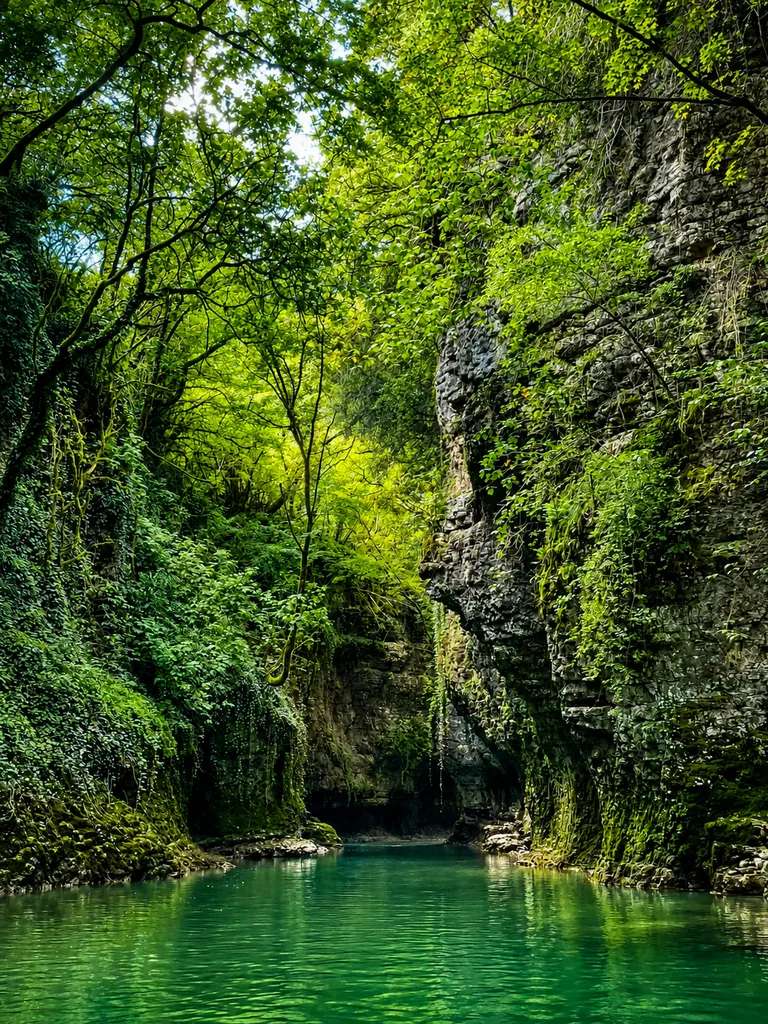
The canyon is well organized for visitors, with a maintained path, boat service, and basic facilities at the entrance, and is typically combined with Okatse Canyon further east as a natural full-day excursion. Martvili town itself is close by, with a medieval monastery on a hillside above the surrounding farmland — a well-preserved complex with wide views across the lowland plain toward the Black Sea horizon. (Martvili has its own detailed guide in this series.)
The road to Svaneti
The single most important practical role Samegrelo plays in Georgian travel is as the gateway to Svaneti. The main road connecting the rest of Georgia to Mestia runs north from Zugdidi up the Enguri valley, climbing through the gorge that separates the lowland Samegrelo basin from the high mountain world above. The journey from Zugdidi to Mestia takes about three hours and is one of the more dramatic road trips in Georgia — the transformation from the flat, green farmland around Zugdidi, through the narrow, steep-walled Enguri gorge, to the high Svan valleys above is complete and rapid, covering in a few hours a vertical and visual range that would take days on foot.
The Enguri Hydroelectric Dam, encountered early in the climb from Zugdidi, is one of the highest concrete arch dams in the world, its structure rising about 271 meters above the gorge floor and impounding a large reservoir whose deep blue-green water fills the valley for several kilometers behind it. The scale of the structure against the gorge walls is impressive, and the viewpoint from the road above gives a sense of the engineering involved. It has been operational since 1978 (with construction completed later) and remains a major source of Georgia's electricity. One geopolitical note worth knowing: the dam sits in Georgian-controlled territory, but the power station is partly located in Abkhazia, and its output has long been shared across the boundary — a quiet reminder of the region's unresolved situation.
Nokalakevi
About 50 kilometers southwest of Zugdidi, near the town of Senaki, the archaeological site of Nokalakevi preserves the ruins of what was once one of the most important fortified cities in western Georgia. Known in ancient sources as Archaeopolis, it was a major urban center of the Colchic and later Lazic kingdoms, occupied from at least the 5th century BC through the medieval period, with the ruins of its defensive walls, towers, and internal structures spread across a considerable area on the bank of the Tekhuri River. It was the scene of significant military operations during the Byzantine–Persian wars of the 6th century AD, when it served as a key Byzantine stronghold in the struggle for control of the eastern Black Sea region.
Nokalakevi is less visited than Georgia's more accessible historical sites but rewards the detour for travelers interested in the ancient and early medieval history of the western Caucasus. The ruins are substantial and the setting, on a river bend below forested hills, is attractive. Archaeological work here has run for decades and produced finds spanning the full chronological range of occupation.
Megrelian cuisine
Megrelian cuisine is one of the most distinctive regional food traditions in Georgia, with a well-deserved reputation for intensity. Where other Georgian regional cuisines moderate their use of adjika — the pungent paste of hot peppers, garlic, and spices fundamental to Georgian cooking — Megrelian cooking uses it generously. The result is food that is richer, hotter, and more assertively flavored than the pan-Georgian norm.
The Megrelian version of khachapuri uses a double layer of cheese, both inside the dough and melted across the top, for a more intense dairy richness than other regional variants. Kharcho, a soup of beef, rice, walnuts, and a quantity of spice that varies by cook but is never mild, is one of the most famous Megrelian dishes and has spread throughout Georgian cooking. Gebzhalia is a fresh-cheese preparation particular to the region, served in a warm sauce of mint and cream that cools the fiercer flavors elsewhere in the meal. Elarji, a thick porridge of cornmeal and sulguni cheese pulled into long elastic threads, is a Megrelian staple that is simultaneously simple and deeply satisfying. The sulguni of Samegrelo — a lightly brined, semi-firm cheese with a layered, slightly elastic texture — is considered by many the finest in Georgia, and appears throughout the regional cuisine: fresh, smoked, fried, melted, or simply eaten with bread.
Getting there and around
Zugdidi is connected to Tbilisi by both road and rail, the train taking about five hours through the Rioni valley and the lowland plains of western Georgia, and the road journey around four hours. From Zugdidi, marshrutkas and shared taxis run to the main towns and villages, and the road north to Mestia departs from the city center. A car gives the most flexibility for the natural sites and the smaller villages off the main routes. Martvili Canyon and Okatse Canyon are most practically visited by car or as part of an organized tour from Zugdidi or Kutaisi.
When to visit
Samegrelo is a year-round destination in the sense that the lowland climate rarely becomes truly extreme, but the most rewarding seasons are spring and early summer — when the landscape is at its greenest and the rivers running high from snowmelt — and autumn, when the forests take on color and temperatures ease from the summer humidity. July and August can be genuinely hot and humid in the lowlands, though the canyon sites and forested areas stay pleasant. Winter is mild and rarely snowy at lower elevations, and the region is quieter than at any other time — an advantage for those who prefer to travel without crowds, though some smaller natural sites may have reduced facilities outside the main season.
Caucasus Travel FAQ
Samegrelo is a green, fertile region in western Georgia, between the Black Sea, the Enguri River (which borders Abkhazia), and the foothills leading up to Svaneti, with Zugdidi as its center. It's known for the distinct Megrelian language and culture, the Dadiani dynasty and its Zugdidi palace, Martvili Canyon, the Enguri Dam, and a famously rich, spicy regional cuisine.
The main sight is the Dadiani Palace, the former residence of the princes of Samegrelo, now a museum holding medieval Georgian religious objects, the family's belongings, and — most unexpectedly — one of Napoleon's death masks, acquired through the marriage of Princess Salome Dadiani to Napoleon's great-nephew Achille Murat. The palace sits in one of Georgia's oldest botanical gardens.
Yes. Martvili Canyon, about 55 km from Zugdidi, is a dramatic limestone gorge with vivid turquoise water, a rim walking path, and short boat rides through the narrow sections. It's well set up for visitors and is usually combined with the nearby Okatse Canyon as a full-day trip from Zugdidi or Kutaisi.
Because the main road to Mestia and Upper Svaneti runs north from Zugdidi up the Enguri valley — there's no other practical route. The roughly three-hour drive climbs from green lowlands through the Enguri gorge (passing the huge Enguri Dam) to the high Svan valleys, one of the most dramatic road journeys in Georgia.
It's among the richest and spiciest in Georgia, using the hot-pepper-and-garlic paste adjika generously. Signature dishes include the double-cheese Megrelian khachapuri, kharcho (a spiced beef, rice, and walnut soup), gebzhalia (cheese in mint-and-cream sauce), and elarji (cornmeal-and-sulguni porridge). The region's sulguni cheese is considered by many the best in Georgia.