
Things to Do in Mtskheta-Mtianeti: Mtskheta, the Military Highway, and Kazbegi
Mtskheta-Mtianeti, directly north of Tbilisi in Georgia — the country in the South Caucasus — is one of the most complete regions in the country, combining religious heritage, a famous scenic drive, and high Caucasus landscapes in a compact, easy-to-reach area. For first-time visitors it's close to essential: it runs from the UNESCO-listed monuments of the ancient capital up the Georgian Military Highway to the dramatic peaks around Mount Kazbek, packing some of Georgia's most memorable experiences into a single corridor. Here are the things most worth doing.
What are the best things to do in Mtskheta-Mtianeti?
The highlights are visiting Mtskheta's UNESCO monuments (Svetitskhoveli Cathedral and Jvari Monastery); driving the Georgian Military Highway with its viewpoints; stopping at Ananuri fortress above its turquoise reservoir; skiing or hiking at Gudauri; and reaching Stepantsminda (Kazbegi) for the iconic Gergeti Trinity Church beneath Mount Kazbek. The Russia-Georgia Friendship Monument and the remote Truso valley round out the route. Much of it can be done as a day trip from Tbilisi, though the mountains reward longer.
Visit Mtskheta, the spiritual capital
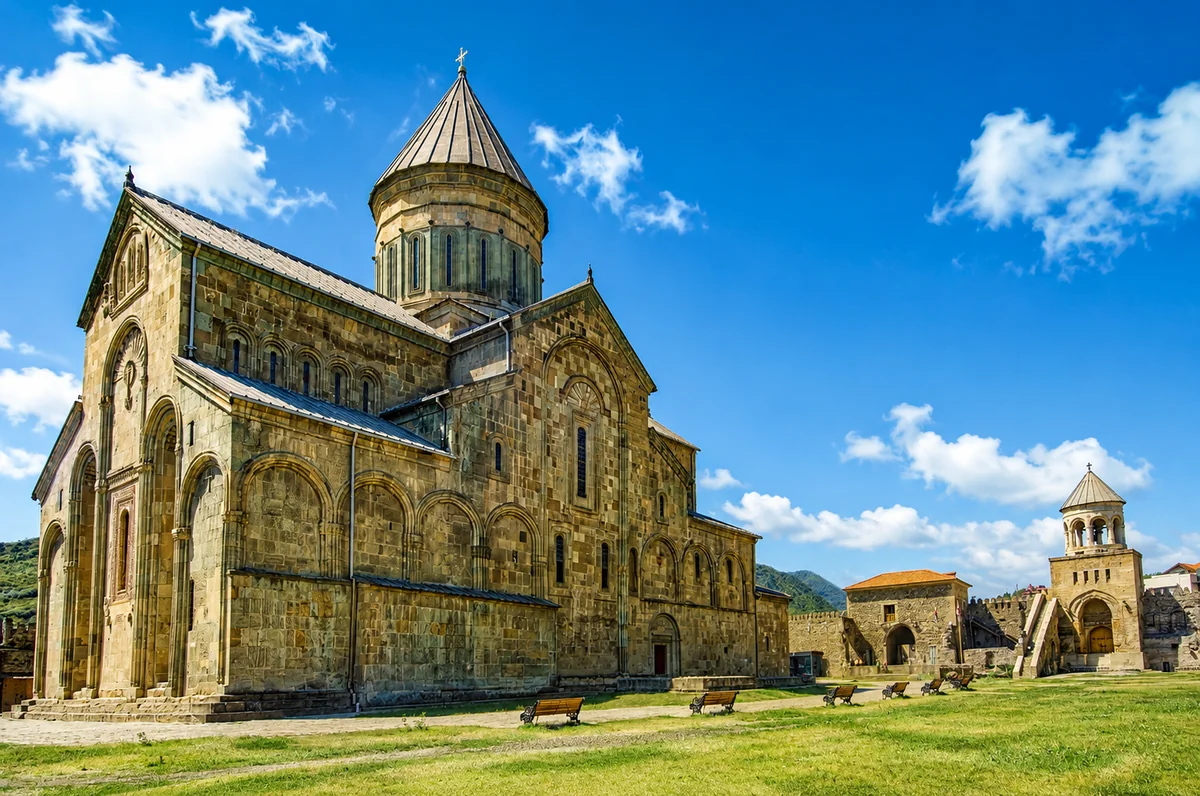
Start in Mtskheta, one of the oldest cities in Georgia and the spiritual center of the Georgian Orthodox Church. The two essential sites are the Svetitskhoveli Cathedral — the great 11th-century cathedral (built 1010–1029) at the heart of the old town, said to hold the burial place of Christ's robe, which makes it one of the most sacred sites in Georgian Orthodoxy — and the Jvari Monastery, the late-6th/early-7th-century church on the cliff above, one of the earliest examples of the Georgian cross-in-square plan. From the Jvari terrace the view over the confluence of the Aragvi and Mtkvari rivers, with Svetitskhoveli below in the town, is among the most celebrated panoramas in the country. Both are UNESCO World Heritage Sites; both are active churches, so modest dress is required (covered shoulders and legs, and a headscarf for women). Just 20 minutes from Tbilisi, Mtskheta is the natural starting point for the region. (It has its own detailed guide in this series.)
Drive the Georgian Military Highway
The Georgian Military Highway is one of the great scenic drives of the Caucasus, and travelling it is an experience in itself. Running north from the Mtskheta junction up the Aragvi valley to the Russian border, it climbs through landscapes that change character with the altitude — forested gorges, the turquoise Zhinvali Reservoir, open sub-alpine slopes, the high Jvari Pass, and finally the sheer-walled Dariali Gorge. There are viewpoints and photo stops the whole way, and the route ties together most of the region's highlights, so much of a trip here is really about the road and what you stop for along it.
Stop at Ananuri fortress
Ananuri, on the highway above the Zhinvali Reservoir, is one of the most photographed sites in Georgia — but it rewards more than a quick photo. The 17th-century fortress complex has two churches within its walls (the larger, the 1689 Church of the Assumption, carries fine carved-stone ornament), plus defensive towers and walls that give a clear sense of a Georgian feudal stronghold. The setting, with the medieval stonework above the turquoise water and forested hills, is the defining image; the views from the upper walls are excellent in clear weather. Worth an hour rather than ten minutes.
Gudauri: mountains and adventure
Gudauri, at around 2,200 meters, is Georgia's main high-altitude mountain resort. In winter it's the country's premier ski and snowboard destination, with open, above-treeline terrain; in summer it's a base for paragliding (the flights over the valley are a signature Gudauri experience), hiking, and mountain walks. The wide-open alpine setting and the easy access from the highway make it a key stop on any mountain itinerary. (Gudauri has its own detailed guide in this series.)
Kazbegi and the Gergeti Trinity Church
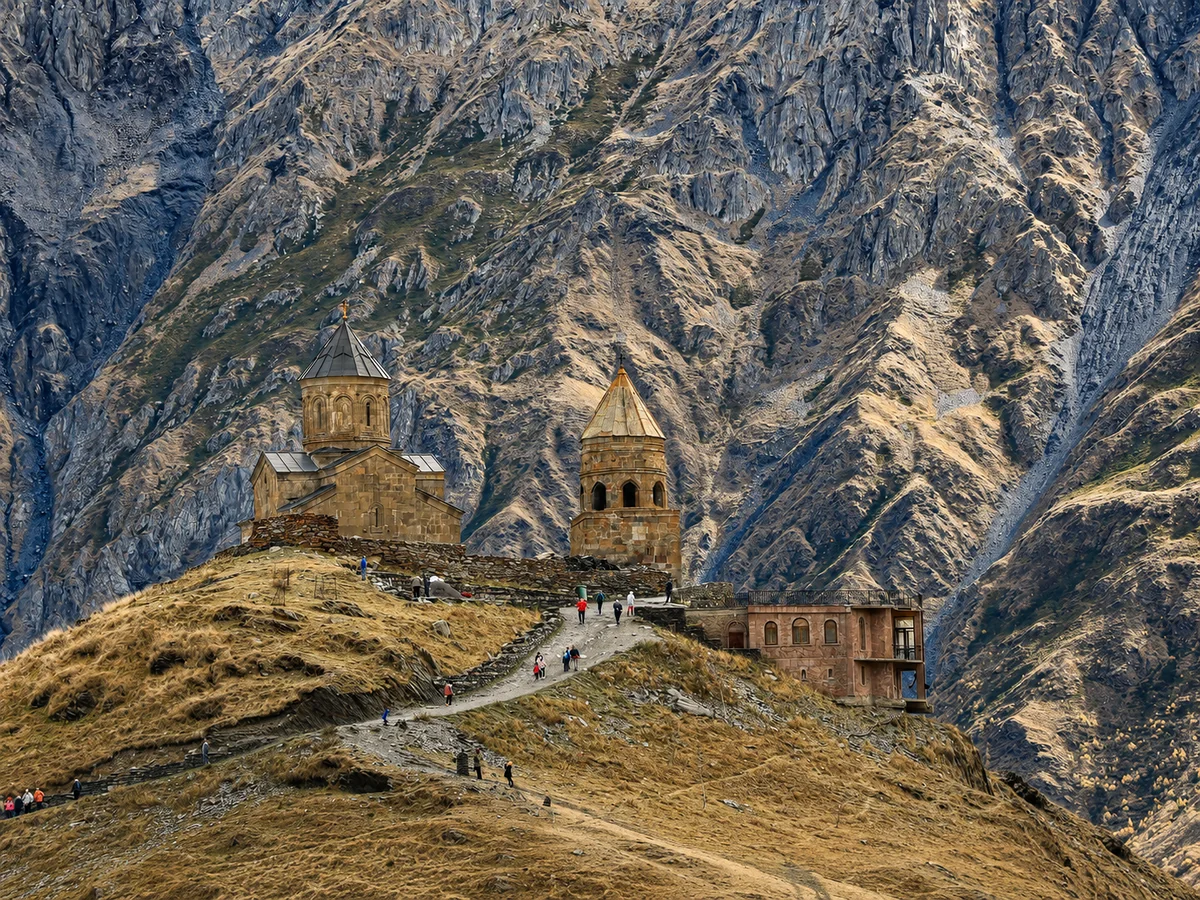
Stepantsminda — still widely called Kazbegi — is the gateway to the high Caucasus, and its great highlight is the Gergeti Trinity Church: a 14th-century church standing alone at 2,170 meters on a ridge above the town, with Mount Kazbek (5,054 meters) rising behind it. The image of the church against the snow-capped peak is one of the most iconic in Georgia. You can reach it on foot from Stepantsminda (a steep but straightforward walk of a couple of hours) or by 4x4 taxi from the village. It's an active church, so modest dress and a headscarf for women are required. (Stepantsminda/Kazbegi has its own detailed guide.)
Hike in the Kazbegi area
The Kazbegi district is one of the best places in Georgia for mountain walking. Beyond the popular trail up to Gergeti Trinity Church, there are walks to waterfalls and viewpoints and full-day hikes into the surrounding valleys — including the longer trek toward the Gergeti glacier for experienced, well-prepared walkers. The high terrain is most reliable for hiking in summer (July and August), and the scenery is consistently spectacular. For the longer and higher routes, good preparation and, in places, local guidance are sensible.
See the Russia-Georgia Friendship Monument
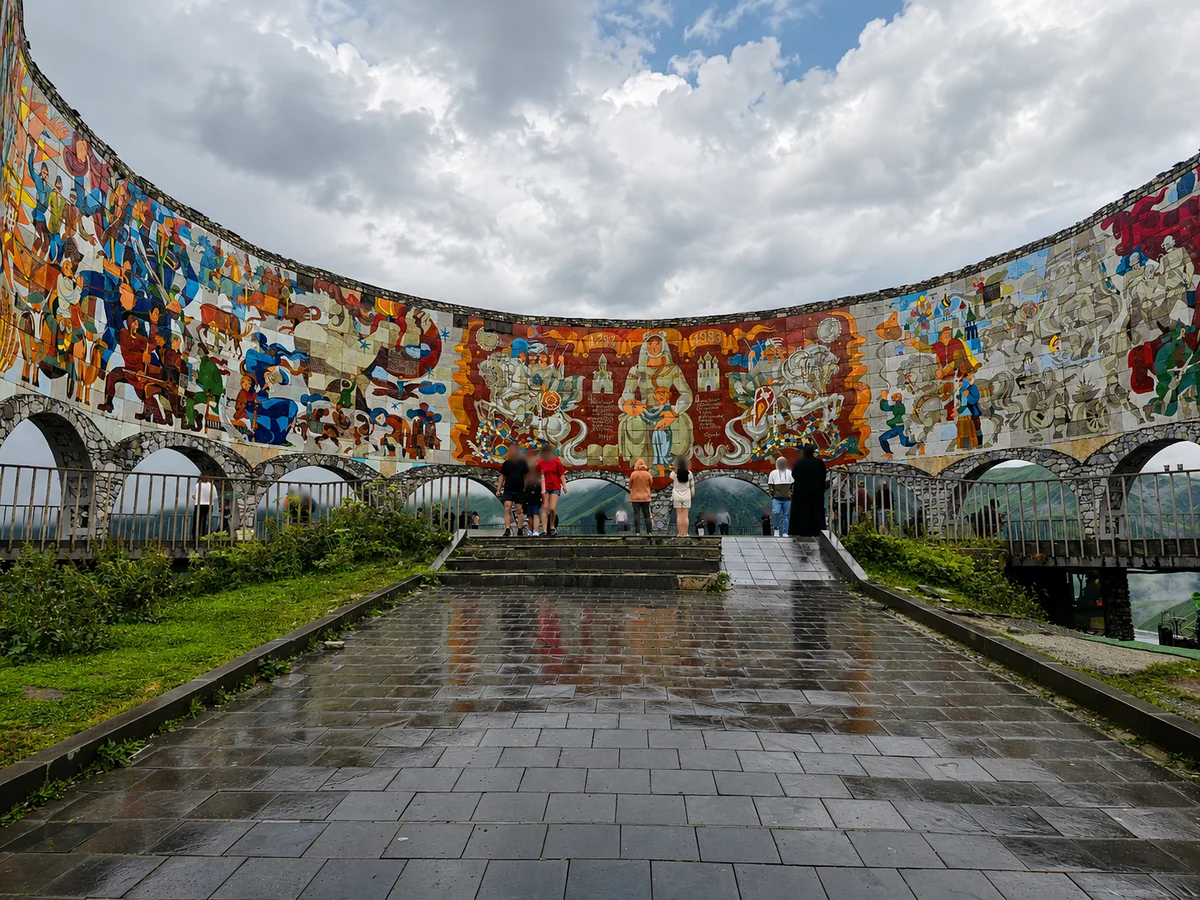
Near Gudauri, the Russia-Georgia Friendship Monument is one of the best panoramic stops on the highway. It's a large circular structure decorated with colorful mosaic murals, built in the Soviet era (1983, marking the 200th anniversary of the Treaty of Georgievsk), perched on the edge above a deep mountain valley. The murals are striking, but the real draw is the view out over the Devil's Valley and the surrounding peaks — a near-mandatory photo stop on the drive north.
Explore the Truso Valley
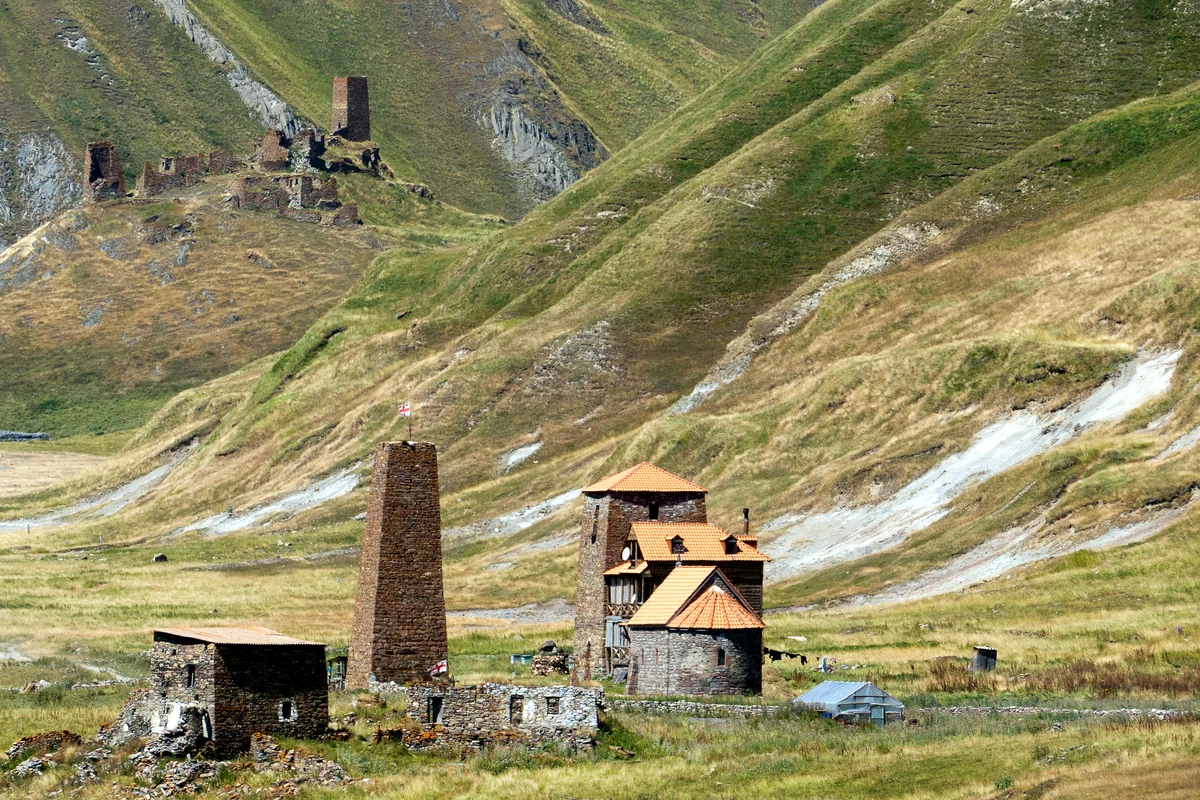
For something quieter and more off the beaten path, the Truso valley, branching west from the highway near Kazbegi, is a rewarding detour. It's known for its travertine mineral springs and the rust-and-ochre colors they stain the ground, along with abandoned villages, medieval ruins, and defensive towers, all in a peaceful, remote setting. It sees far fewer visitors than the Gergeti church and suits travelers looking for a more solitary mountain experience.
Make the most of the route
One of the best things about Mtskheta-Mtianeti is how much sits along a single road. The landscape changes dramatically as you climb, there are frequent reasons to stop, and you can reach several major highlights in one day. How you do it depends on your time: a day trip from Tbilisi can cover Mtskheta, Ananuri, and Gudauri; a long day can extend to Kazbegi and the Gergeti church; and a multi-day trip lets you add real hiking, the Truso valley, and a slower pace in the mountains. Marshrutkas run the highway from Tbilisi's Didube station, but a car or private transfer gives far more freedom to stop along the way.
Why Mtskheta-Mtianeti is essential
Few regions pack in as much as this one: UNESCO heritage at Mtskheta, one of the most scenic drives in the country, the high mountain landscape around Kazbek, and year-round activity from summer hiking to winter skiing at Gudauri. Easy to reach and endlessly photogenic, it's one of the most essential regions in any Georgia itinerary — and the natural first journey north for most visitors.
Caucasus Travel FAQ
Visit Mtskheta's UNESCO monuments (Svetitskhoveli Cathedral and Jvari Monastery), drive the Georgian Military Highway, stop at Ananuri fortress above its turquoise reservoir, ski or hike at Gudauri, and reach Stepantsminda (Kazbegi) for the Gergeti Trinity Church beneath Mount Kazbek. The Friendship Monument and the Truso valley are excellent additional stops.
Yes — at least in part. A day trip can comfortably cover Mtskheta, Ananuri, and Gudauri; a long day can stretch to Kazbegi and the Gergeti church (about three hours each way). To do real hiking or the Truso valley, or to enjoy the mountains at a relaxed pace, plan an overnight in Gudauri or Stepantsminda.
Gergeti Trinity Church is a 14th-century church standing alone at 2,170 meters above Stepantsminda, with Mount Kazbek behind it — one of Georgia's most iconic views. You can hike up from the village (a steep walk of roughly two hours) or take a 4x4 taxi. It's an active church, so modest dress and a headscarf for women are required.
Both. Gudauri is Georgia's main ski resort in winter (December–March), but in summer it's a fine base for paragliding over the valley, hiking, and mountain walks, with wide alpine views. Its position on the Military Highway makes it an easy stop year-round.
It's a large circular Soviet-era monument near Gudauri (built in 1983), decorated with colorful mosaic murals and perched on the edge above a deep mountain valley. It's one of the best panoramic photo stops on the Georgian Military Highway, with sweeping views over the surrounding peaks.