
Gremi: The Citadel of Kakheti's Lost Royal Capital
The Gremi Archangels' Complex stands on a hill above the Alazani valley in eastern Kakheti, in Georgia — the country in the South Caucasus — roughly between Telavi and Kvareli, its tower and church visible from the main road and from far across the vineyards below. It is what remains of Gremi, once the capital of the Kingdom of Kakheti in the 16th and early 17th centuries — a city of genuine urban scale and commercial weight whose destruction by the Persian Shah Abbas I in the 1610s ended its life as a functioning capital and left the hilltop citadel as the most visible surviving evidence of a significant Georgian royal center. The complex is compact and the visit fairly brief, but the architectural quality of the church and tower, the historical depth of the site, and the panoramic views over the Alazani valley make it one of the more rewarding stops in the Kakheti wine region for travelers whose interests reach beyond the vineyard circuit.
What is the Gremi Archangels' Complex?
Gremi is a 16th-century royal citadel and church in the Kakheti region of eastern Georgia — the surviving heart of what was once the capital of the Kingdom of Kakheti. Founded by King Levan of Kakheti, its centerpiece is the Church of the Archangels Michael and Gabriel, built in 1565 and frescoed by 1577, alongside a three-story tower-palace that now houses a small museum. The wider city around it was destroyed by Shah Abbas I of Persia in the 1610s, after which the Kakhetian capital moved to Telavi. Set on a hill above the Alazani valley between Telavi and Kvareli, the complex is known for its preserved frescoes, its museum, and one of the best valley panoramas in Kakheti.
Gremi as a capital
Understanding what Gremi was requires picturing what surrounded it before its destruction. The hilltop structures that survive — the church, the tower, and remnants of walls — were not the whole of Gremi but the citadel of a larger city that spread across the hillside below. At its 16th-century peak Gremi was a substantial urban settlement, a lively trading town on the Silk Road routes connecting the Caucasus with Persia and the broader Middle East, with a population that included Georgian, Armenian, and foreign merchant communities. The city had bazaars, caravanserais, baths, and the full infrastructure of a royal capital — none of which survives above ground today, though archaeological investigation (the town covered roughly 40 hectares, in three main parts: the church complex, the royal residence, and the commercial quarter) has traced the outlines of the lower town across the hillside.
The Kingdom of Kakheti reached a degree of stability and commercial prosperity under King Levan (who reigned 1520–1574) that allowed this investment in Gremi, and the construction of the Church of the Archangels and the citadel reflected both the resources available and the ambition of a kingdom that saw itself as a legitimate heir to the medieval Georgian royal tradition. The dedication to the Archangels was not arbitrary — the Archangels Michael and Gabriel held particular significance in Georgian Orthodox tradition as protectors of the kingdom and its rulers, so a royal church dedicated to them carried political as well as religious meaning.
Gremi's destruction came with the campaign of Shah Abbas I of Persia in the 1610s (commonly dated 1615), part of an assault that devastated much of Kakheti and is held to have killed or enslaved a large part of the region's population. The city was burned and its people dispersed, and the capital function that had given the settlement its reason for existence effectively ended; within a few decades the Kakhetian kings transferred their seat to Telavi. The hilltop structures survived in damaged form — the tower and church walls robust enough to outlast the more perishable urban fabric below — and the site remained known and visited across the following centuries even as the lower city disappeared into the hillside vegetation. (It was in the aftermath of this period of Persian pressure that the Kakhetian queen Ketevan was put to death by Shah Abbas for refusing to renounce Christianity — a figure still commemorated in the region, with a portrait near the road below the citadel.)
The Church of the Archangels
The Church of the Archangels, built in 1565 under King Levan and frescoed by 1577, is the architectural centerpiece and one of the better-preserved 16th-century Georgian religious buildings in Kakheti. It's a domed, cruciform church of moderate scale, built chiefly of stone, its design marrying traditional Georgian masonry with a local interpretation of contemporary Iranian (Persian) architectural taste — a drum and dome rising above the central crossing, a façade in arched sections, and restrained ornament appropriate to a royal foundation. King Levan is buried inside.
The interior is well preserved and retains original frescoes of considerable quality across much of the wall surface, executed with the confident technique of court-patronized painting. The program is the standard one for Georgian Orthodox churches of the period — scenes from the life of Christ, saints and church fathers, the Deesis in the apse — and includes a portrait of King Levan holding a model of the church, the kind of donor image that ties the building directly to its royal founder. The frescoes have survived better than many contemporary examples in Kakheti, partly because of the building's structural soundness and partly because the site's relative remoteness spared it the human interventions that have damaged medieval painting in more accessible places. The combination of the architecture and the surviving decoration gives the interior a completeness that lets you understand the building as it was meant to function, rather than as a fragment.
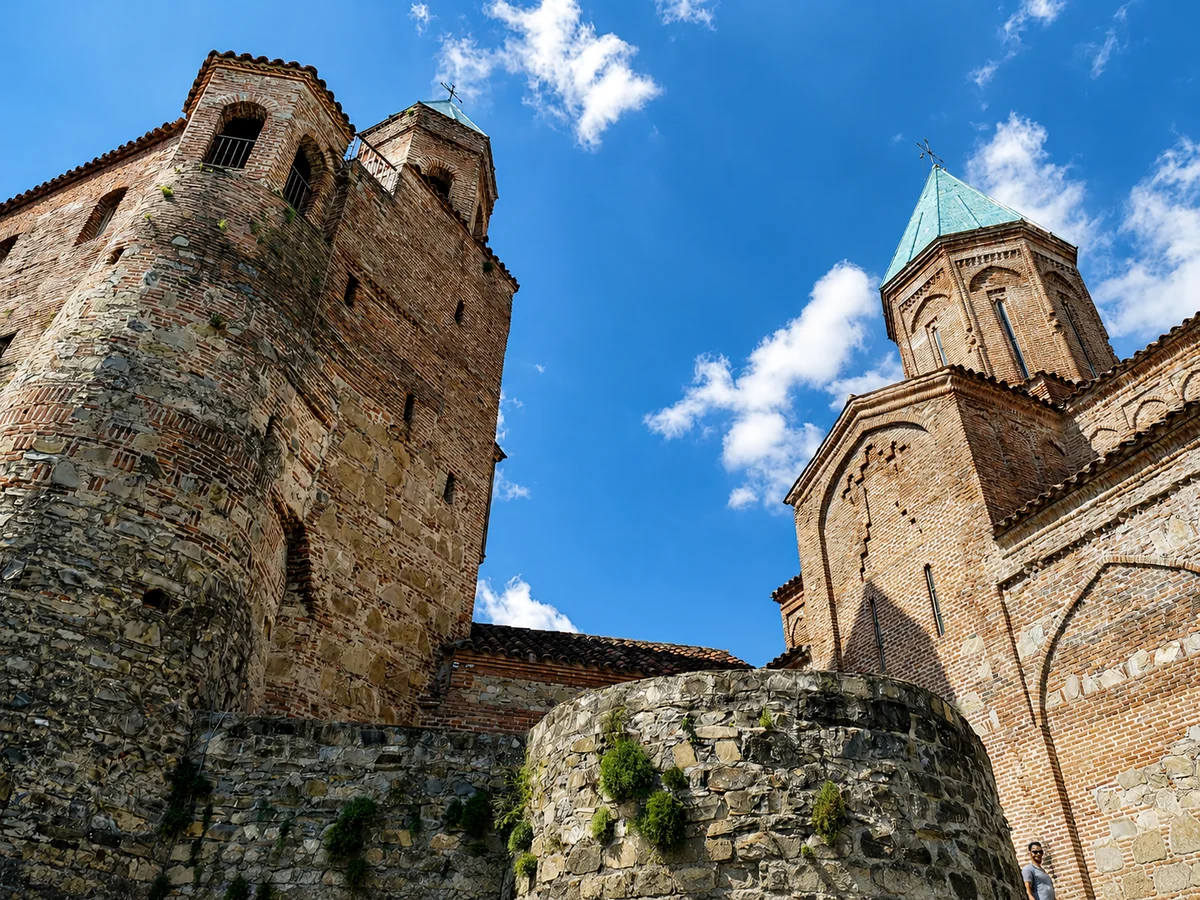
The tower and the museum
The tower-palace attached to the complex serves several roles in the visit. As architecture it embodies the military reality of a 16th-century Georgian royal citadel — a period when the threat of Persian and Ottoman action made defensive capability a necessary companion to any significant political or religious foundation. The tower is substantial, its walls thick, built to withstand assault and serve as a refuge of last resort.
As an experience it offers two things the church cannot. The first is the climb — an interior staircase ascends through the levels to the upper sections and the most elevated viewpoint at the site. The second is the museum housed in the tower's interior, presenting artifacts from Gremi and the broader Kakheti region from the period of the city's life — ceramics, metalwork, a 16th-century cannon, architectural fragments, and documentary and explanatory material that flesh out the archaeological record of the lost lower town. The collection is modest but well presented, and engaging with it before or after the church gives the architecture a historical context that makes it far more legible.
The views
The panorama from the Gremi hilltop is one of the site's defining qualities and a reason it rewards the visit independently of its history. The Alazani valley spreads out below in its full width — the flat floor covered in vineyards and orchards, the Alazani River in the middle distance, the forested Caucasus foothills rising beyond toward the northern horizon, and the snow-capped peaks of the Greater Caucasus visible on clear days. This is one of the most comprehensive single views of the Kakheti landscape from any accessible point in the region, and it gives the valley's geography — the relationship between the agricultural floor, the drainage, and the mountain backdrop that shapes the conditions for the region's wine production — an immediate visual clarity that time at valley level can't provide.
From the tower roof, raised above the church and vegetation, the panorama extends further and the contours of the lower town can be read below — the humps and irregularities in the ground that mark the collapsed, overgrown remains of the 16th-century city, visible as a landscape feature once you know what you're looking at. Reading the buried urban fabric from above gives the site an archaeological dimension the standing buildings alone don't fully convey.
In the late afternoon, when the sun lights the valley from the west and the shadows of the foothills reach across the middle distance, the view takes on the warm, golden quality of Kakhetian light at its most characteristic — the same light that falls on the vineyards at harvest. Timing a visit to catch it is easy with any Kakheti itinerary that includes Gremi as an afternoon stop between Telavi and Kvareli.
Getting there and visiting
The complex is on the main road between Telavi and Kvareli, roughly 20–25 km east of Telavi, and is visible from the road as you pass — the tower on the hilltop is a clear landmark, so finding it needs nothing beyond turning off and following the short approach to the entrance. A thorough visit — the church interior, the tower climb, the museum — takes about thirty to forty-five minutes, though time on the tower roof and the hilltop grounds taking in the views can comfortably extend that. The entrance fee covers the tower and museum; the church and courtyard grounds are generally accessible on the same ticket. Gremi is quiet relative to the main Kakheti circuit — fewer visitors than Telavi, Sighnaghi, or Alaverdi — which gives it an unhurried quality the busier sites can't guarantee. (Note that parts of the wider complex have at times been under renovation, so some secondary structures may be closed.)
Practical information
- Location: On the Telavi–Kvareli road, ~20–25 km east of Telavi, Kakheti region, eastern Georgia (about 115 km east of Tbilisi).
- Getting there: Private car, taxi, or organized Kakheti tour; Kvareli-bound marshrutkas from Telavi pass directly in front of the site. Visible from the road — a clear hilltop landmark.
- Hours / Admission: The church and grounds are generally accessible; the tower and museum are ticketed.
- Time needed: About 30–45 minutes, longer with the views.
- Best time: Late afternoon for the golden valley light; autumn for the harvest landscape.
- Good to know: It's an active sacred site as well as a monument — modest dress is appropriate at the church. Some secondary structures may be closed for renovation.
Caucasus Travel FAQ
Gremi is a 16th-century royal citadel and church in the Kakheti region of eastern Georgia — the surviving core of what was once the capital of the Kingdom of Kakheti. Founded by King Levan of Kakheti, its centerpiece is the Church of the Archangels Michael and Gabriel, built in 1565 and frescoed by 1577, with a three-story tower-palace that now holds a small museum. The wider city was destroyed by Shah Abbas I of Persia in the 1610s, after which the Kakhetian capital moved to Telavi. It sits on a hill above the Alazani valley between Telavi and Kvareli.
For roughly two centuries Gremi was the capital of the Kingdom of Kakheti and a thriving Silk Road trading town, with merchant communities, bazaars, caravanserais, and baths spread across the hillside below the citadel. That all ended with the campaign of Shah Abbas I of Persia (commonly dated 1615), which devastated Kakheti, burned the city, and dispersed its people; within decades the kings moved their seat to Telavi. What survives today is the hilltop citadel — the church and tower — while the lower town lies buried and overgrown, its outline traced by archaeologists.
Three things: the Church of the Archangels (1565), well preserved and decorated with original 1577 frescoes, including a portrait of King Levan holding a model of the church (Levan is buried inside); the tower-palace, which you can climb for the best viewpoint and which houses a small museum of artifacts from the site and region (ceramics, metalwork, a 16th-century cannon, explanatory panels); and the panorama — one of the widest, clearest views of the Alazani valley and the Greater Caucasus available anywhere in Kakheti.
It's on the main Telavi–Kvareli road, about 20–25 km east of Telavi (roughly 115 km from Tbilisi), reached by car, taxi, or organized Kakheti tour — Kvareli-bound marshrutkas from Telavi also pass right in front of it, and the hilltop tower is an obvious landmark from the road. A thorough visit (church, tower, museum) takes about 30–45 minutes, longer if you linger over the views. The church and grounds are generally accessible; the tower and museum are ticketed.
Late afternoon is ideal — the western light turns the Alazani valley golden, the same light that defines the Kakheti wine landscape at harvest. Autumn adds the harvest and the changing colors. Gremi is also notably quieter than Telavi, Sighnaghi, or Alaverdi, so it tends to feel unhurried whenever you go. It works well as an afternoon stop on a Kakheti route between Telavi and Kvareli.