
Kvemo Kartli, Georgia: Dmanisi, Bolnisi, and the Diamond Bridge
Kvemo Kartli — “Lower Kartli” — is the southernmost region of Georgia's historical core (Georgia being the country in the South Caucasus), occupying the broad valleys and rolling uplands between Tbilisi to the north and the Armenian and Azerbaijani borders to the south. It's one of the most ethnically diverse regions in the country, home to ethnic Georgians, Azerbaijanis, Armenians, and the traces of a German colonial presence that lasted from the early 19th century until the Second World War. That diversity shows in the landscape — Orthodox churches, mosques, and Armenian khachkars appear within short distances of each other — and gives the region a cultural texture quite different from the more homogeneous east and west of Georgia. It's also among the least-visited regions by international travelers, so those who do explore it find a directness and authenticity the more developed circuits rarely offer.
What is Kvemo Kartli known for?
Kvemo Kartli is best known for Dmanisi, where 1.8-million-year-old hominin fossils represent the oldest evidence of early humans outside Africa; the 5th-century Bolnisi Sioni Cathedral, which holds some of the oldest known inscriptions in the Georgian alphabet; and the Dashbashi (Tsalka) Canyon with its dramatic glass “Diamond Bridge.” It's also Georgia's most ethnically diverse region and the site of the ancient Bronze Age Trialeti culture. Easy to reach from Tbilisi, it rewards travelers interested in deep history and quieter, less-touristed landscapes.
The region sits at modest elevation by Georgian standards — valley floors lie between roughly 300 and 600 meters — and the terrain has a spaciousness that contrasts with both the forested mountains of the north and the enclosed river valleys of the west. The climate is warm and relatively dry, the farmland productive, and the countryside unhurried and functional, reflecting a region whose economy has always rested on farming and trade.
A region of extraordinary historical depth
The claim that a single region holds the oldest evidence of early humans outside Africa is a large one, and Kvemo Kartli makes it with full archaeological justification. The site at Dmanisi, about 90 kilometers southwest of Tbilisi, has produced hominin fossils and stone tools dating to roughly 1.8 million years ago — the oldest evidence of human ancestors outside Africa yet found. The implications for understanding early human dispersal are profound: the Dmanisi hominins were small-brained and technologically simple, yet had reached the southern Caucasus from Africa far earlier than the previous scientific consensus thought possible. Dmanisi has its own detailed guide in this series, but its presence here is the single most important fact about the region's significance.
Alongside that prehistoric layer, Kvemo Kartli holds evidence of continuous occupation through the Bronze Age, Iron Age, classical period, and the full span of medieval Georgian history. The region was part of the ancient Kingdom of Kartli and later a frontier zone between Georgian, Armenian, Persian, and Ottoman spheres — a position that brought repeated conflict but also steady commercial activity along the trade routes crossing the southern Caucasus between the Mediterranean world and Central Asia.
Cultural diversity and the communities of the region
Kvemo Kartli's ethnic composition is more complex than almost any other region in Georgia, and much of its character comes from that. The Azerbaijani community, concentrated in the southeastern districts near the Azerbaijani border, is the largest ethnic minority in Georgia, with a presence here that is centuries old — the legacy of the region's long role as a transition zone between the Turkic and Georgian worlds. Their villages, with their mosques and distinct architecture, give the southeast a visual character noticeably different from the Georgian heartland to the north.
The Armenian community, concentrated in the southwestern districts near the Armenian border, adds another layer. Armenian churches and khachkars — carved stone crosses — appear throughout these areas alongside Georgian Orthodox churches, and local markets and daily life reflect the mixing of two closely related but distinct South Caucasian traditions.
The German colonial history, centered on the town of Bolnisi (formerly Katharinenfeld), is covered in detail in the Bolnisi guide. Its physical traces — solid, European-proportioned stone farmhouses and a rational street grid sitting incongruously in a Georgian-Azerbaijani landscape — add one more unexpected layer to an already rich region.
Bolnisi and early Christian heritage
The Bolnisi Sioni Cathedral, a 5th-century basilica built from local green basalt, is the most significant early Christian monument in Kvemo Kartli and one of the most important in Georgia. It contains some of the oldest known inscriptions in the Georgian alphabet — carved around its windows, providing direct evidence of the early development of Georgian writing — and the combination of architectural quality, age, and epigraphic importance makes it essential for anyone interested in the origins of Georgian civilization. It's quiet and rarely crowded, which suits a building of this age.
Bolnisi itself, with its visible German colonial architecture in the ethnically mixed Mashavera valley, gives the cathedral a context as interesting as the building. The town sits in a valley farmed continuously for millennia, and the layering within a few kilometers — pre-Christian settlement, early Christian monumentality, Georgian medieval history, 19th-century European colonialism, Soviet collective farming — makes the Bolnisi area one of the most compact demonstrations of the region's historical density.
Dashbashi (Tsalka) Canyon and the Diamond Bridge
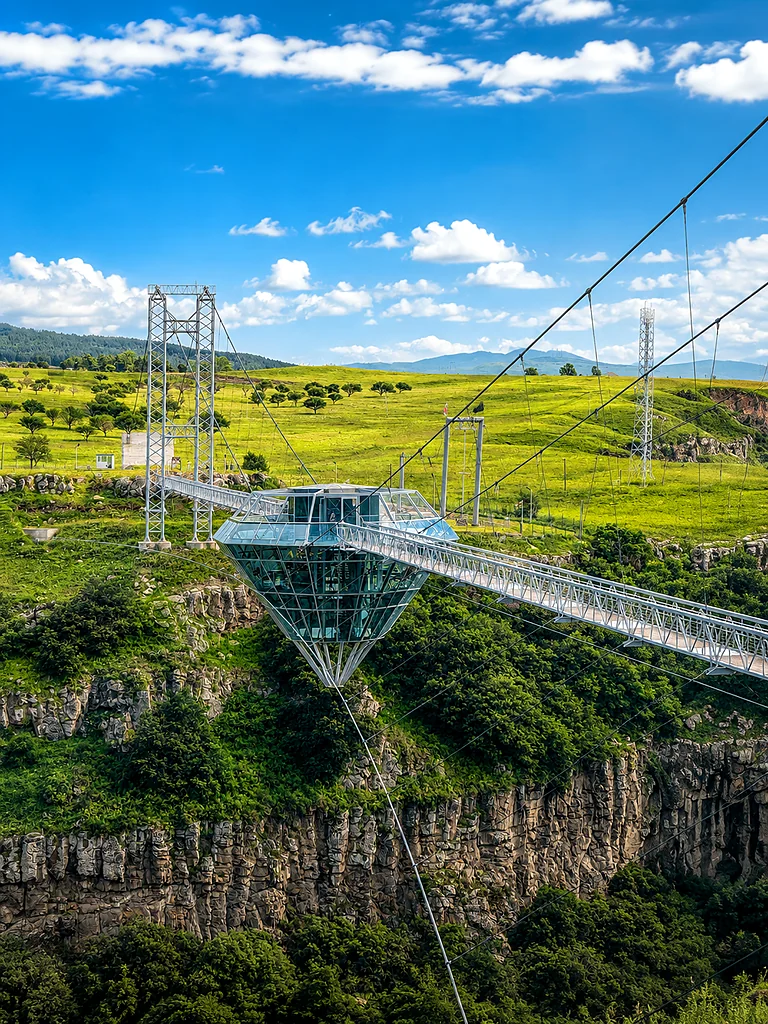
In the western uplands of Kvemo Kartli, near the town of Tsalka, the Khrami River (also called the Ktsia) has cut through a volcanic plateau to form the Dashbashi Canyon — now often called Tsalka Canyon — a gorge of real visual drama that has become one of the most popular natural destinations within easy reach of Tbilisi. The canyon runs around 8 kilometers, its slopes draped in greenery and laced with cascading waterfalls (the “Weeping Wall” is the best known), with the river running far below on a plateau at roughly 1,200–1,500 meters.
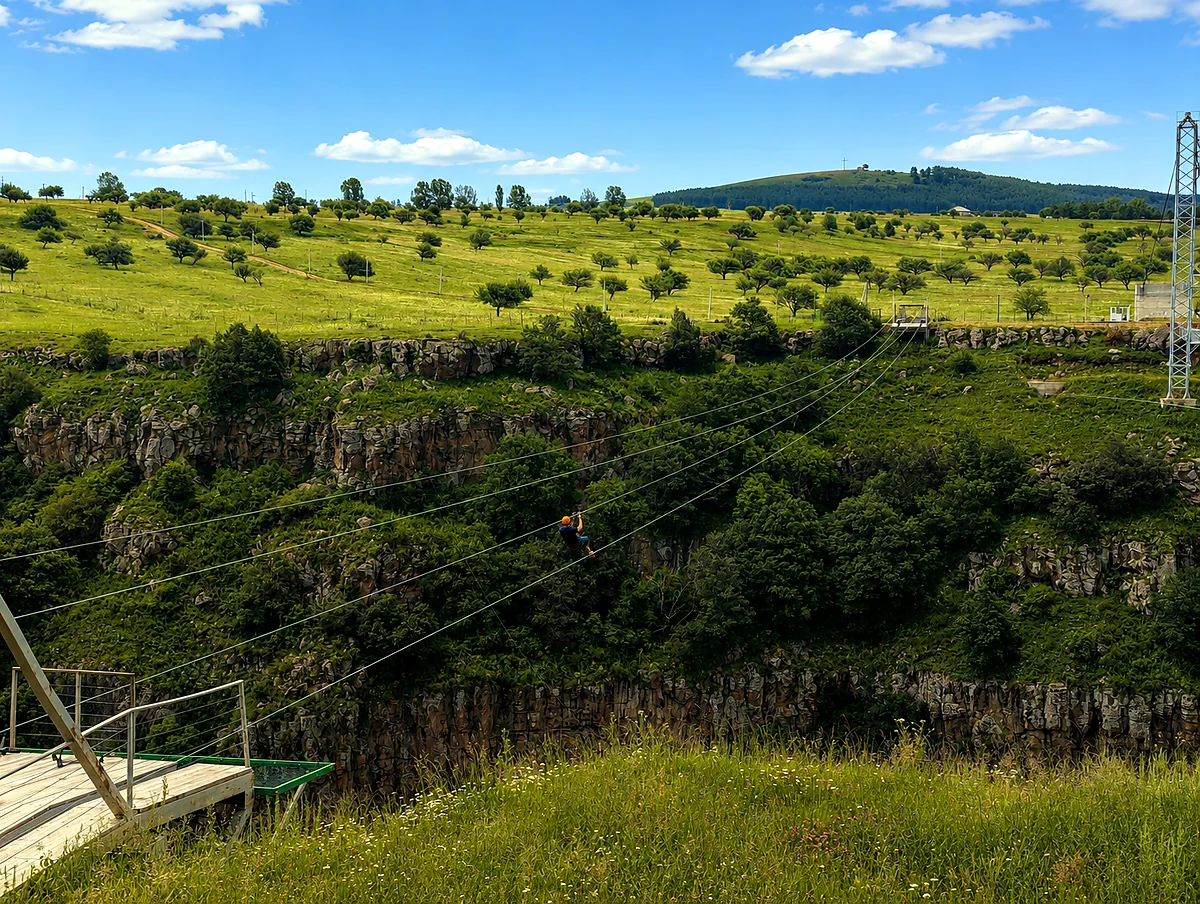
Its headline feature is recent: a 240-meter glass “Diamond Bridge,” opened in 2021, suspended high above the canyon (around 280 meters up) with a diamond-shaped glass café at its center — a vertiginous, much-photographed attraction reached by an easy walking trail of under two kilometers from the visitor center. The development is a private tourism project, so expect an entrance fee and a built-up, commercialized site rather than untouched wilderness — but the canyon, the waterfalls, and the glass bridge together make a genuinely dramatic half-day. It's about 90 to 110 kilometers from Tbilisi (a winding two-hour-ish drive) and can be paired with Dmanisi or Bolnisi for a full day in the region.
Rustavi
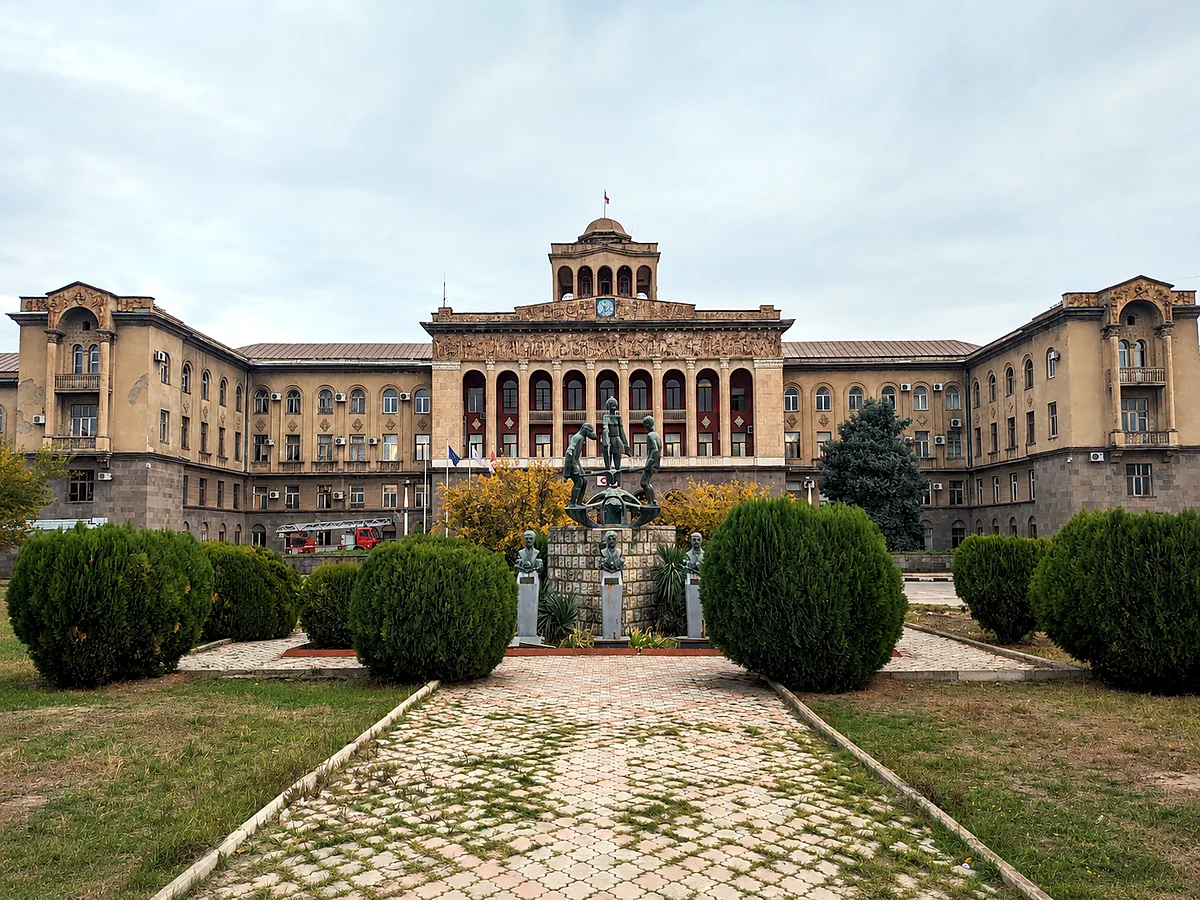
Rustavi, the second-largest city in Georgia (around 120,000 people), sits 25 kilometers southeast of Tbilisi in the Mtkvari valley and is the industrial center of Kvemo Kartli. It's a Soviet creation — built essentially from scratch in the 1940s and 1950s as a planned industrial city around a large metallurgical complex — and its character reflects that origin entirely: wide Soviet boulevards, standard residential blocks, and the infrastructure of heavy industry. The steel plant that gave the city its reason for being has cut production sharply since the Soviet collapse but still operates, and the mix of industrial architecture, planned urbanism, and a large working-class population gives Rustavi a character that is entirely real but quite unlike anything on the standard tourist circuit. Travelers interested in Soviet urban planning or industrial heritage find it worth a stop; most others pass through on the way south. (Rustavi has its own guide in this series.)
The Trialeti plateau and surrounding landscape
The western part of Kvemo Kartli rises toward the Trialeti range, a series of upland plateaus and ridges forming the natural boundary between the Mtkvari basin and the Samtskhe-Javakheti highlands to the south. The Trialeti culture, a Bronze Age civilization that flourished here between roughly 2000 and 1500 BC, produced remarkable goldwork and pottery — now held in the Georgian National Museum in Tbilisi — among the finest prehistoric metalwork found anywhere in the Caucasus. The plateau's archaeological sites aren't extensively developed for visitors, but the landscape itself — open, elevated, with wide views — rewards exploration for those with the inclination and a suitable vehicle.
The Algeti National Park, in the northern part of the region near the boundary with Shida Kartli, protects a forested area of the Trialeti foothills and offers hiking trails and natural scenery within easy reach of Tbilisi. Less visited than Georgia's more famous protected areas, it's a relatively undisturbed forest accessible as a half-day excursion from the capital.
Getting there and around
Kvemo Kartli's proximity to Tbilisi is its biggest practical advantage. Rustavi is reachable by public bus from the capital in under an hour. Bolnisi and the Mashavera valley are accessible by marshrutka from Tbilisi's Isani or Samgori stations, around one to one and a half hours. Dmanisi needs a private car, or a marshrutka to the town followed by a taxi to the archaeological site. Dashbashi (Tsalka) Canyon is most practically reached by car (or an organized day tour). The secondary roads vary considerably in quality, and exploring the more remote ethnic-minority districts in the southeast benefits from a robust vehicle or a local guide. A car gives by far the most flexibility for the region's dispersed sites, and a full day can combine Bolnisi, Dmanisi, and Dashbashi with time for the agricultural landscapes and villages in between.
When to visit
Spring (April–June) is the most rewarding season, when the plateau grasslands are green, the valleys are in active production, and temperatures suit both driving and walking. Dashbashi Canyon is especially good in spring, with the waterfalls running at full volume from snowmelt. Autumn extends the comfortable season through October with clear skies. Summer is warm and can be hot in the open lowlands — visiting the canyon and the exposed Dmanisi site early in the morning is advisable in July and August. Winter is mild at lower elevations and the main sites stay accessible, though the higher plateau roads (toward Tsalka and Trialeti) can be affected by snow and ice in the coldest months, and the canyon waterfalls freeze into ice walls — dramatic in their own right.
Frequently Asked Questions
Kvemo Kartli (“Lower Kartli”) is the southernmost region of central Georgia, between Tbilisi and the Armenian and Azerbaijani borders, with Rustavi as its largest city. It's known for the Dmanisi early-human site (the oldest hominin fossils outside Africa), the 5th-century Bolnisi Sioni Cathedral, the Dashbashi Canyon and its glass Diamond Bridge, and as Georgia's most ethnically diverse region.
Dmanisi, about 90 km southwest of Tbilisi, is where 1.8-million-year-old hominin fossils and stone tools were found — the oldest evidence of human ancestors outside Africa. The discovery reshaped understanding of early human migration, showing that small-brained early humans had reached the Caucasus far earlier than once thought.
Dashbashi Canyon, near Tsalka in western Kvemo Kartli, is an 8-km gorge carved by the Khrami River, with cascading waterfalls and a famous glass “Diamond Bridge” — a 240-meter walkway suspended high above the canyon, with a diamond-shaped glass café at its center, opened in 2021. It's a dramatic, easy half-day trip about two hours from Tbilisi (entrance fee applies).
The Bolnisi Sioni is a 5th-century basilica of green basalt that holds some of the oldest known inscriptions in the Georgian alphabet, carved around its windows — direct evidence of the early development of Georgian writing. It's one of the most significant early Christian monuments in Georgia, and quiet to visit.
Yes — it's very close to the capital. Rustavi is under an hour by bus, Bolnisi about 1–1.5 hours by marshrutka, and the Diamond Bridge roughly two hours by car. With a car, a full day can combine Bolnisi, Dmanisi, and Dashbashi Canyon; the region's sites are dispersed, so driving (or an organized tour) gives the most flexibility.