
Tskaltubo
Tskaltubo is a small spa town in the Imereti region of western Georgia — the country in the South Caucasus — in a gentle, forested valley about 15 kilometers northwest of Kutaisi. Its permanent population is around 8,000, though for much of the Soviet period it hosted far more: at its peak it was one of the most prestigious health resorts in the entire USSR, drawing hundreds of thousands of visitors a year to its mineral baths and grand sanatorium complexes. The Soviet collapse ended that chapter abruptly, and Tskaltubo spent the following decades in suspended animation — the grand buildings empty or partially occupied, the springs still flowing, the infrastructure slowly deteriorating around a population that had lost the economic engine that built the town. What makes it genuinely interesting today is exactly that combination: a mineral-water tradition that predates the Soviet era and continues in various forms, and an extraordinary architectural legacy now much of it in an advanced state of picturesque decay that draws a very different kind of visitor from the health tourists who once filled these buildings.
Why visit Tskaltubo?
The main reason to visit Tskaltubo is its remarkable concentration of decaying Soviet-era sanatoriums — more than twenty grand complexes that have made the town a magnet for photographers and anyone interested in Soviet architecture and 20th-century history. Alongside that, the original mineral baths still operate for those seeking the therapeutic spa experience, and the town is an easy base for Prometheus Cave, the Sataplia Nature Reserve, and nearby Kutaisi. One important and sensitive note: many of the sanatoriums are home to families displaced by the 1990s Abkhazian conflict, and some buildings are derelict and unsafe — so exploring them calls for real care and respect for the residents, not just a camera.
The Soviet sanatoriums
The physical legacy of the Soviet period gives Tskaltubo its most distinctive character. The town holds a remarkable concentration of large Soviet-era sanatorium buildings — more than twenty significant complexes in various states of preservation — spanning a range of styles from the Stalinist neoclassicism of the 1930s and 1940s to the more restrained modernism of the 1950s and 1960s. These were designed to impress as well as function, and the ambition of their architects is visible even through decades of neglect: grand entrance halls with high ceilings and ornate plasterwork, colonnaded facades extending for hundreds of meters, and elaborate mosaic floors from a period when state investment in public buildings was an ideological statement as much as a functional one.
The 1991 Soviet collapse ended the sanatorium system immediately and completely. The state vouchers that had filled these buildings stopped, the administering institutions dissolved, and Tskaltubo lost its reason for being almost overnight. Many sanatoriums were then used as emergency accommodation for people displaced by the Abkhazian conflict of the early 1990s — families who had fled the fighting and for whom the empty buildings were the only available option. Some of those communities have lived there ever since, creating an unusual and humanly complex situation in which the grand Soviet structures serve at once as deteriorating monuments and as the actual homes of families who have spent decades in them. Other buildings stand entirely empty, their interiors returning to ruin as roofs leak, plaster falls, and vegetation pushes through the windows.
For travelers interested in Soviet architecture, 20th-century history, or the aesthetic of decay and memory, this landscape is extraordinary, and walking through or around the complexes gives a visceral sense of the Soviet resort system that no museum could replicate. But this is the point that needs stating plainly: the presence of actual residents means this isn't an abandoned ruin to wander freely. Many buildings are people's homes, some structures are genuinely unsafe, and visits should be made with care, permission where appropriate, and respect — the human reality here is part of what makes the place meaningful, not a backdrop for it.
Several sanatoriums have been or are being renovated for contemporary use, and a small number of functioning spa hotels now operate in the town, offering the mineral baths in a more conventional hospitality setting. The renovation projects are ongoing and uneven, but they reflect a recognition that Tskaltubo's therapeutic tradition and architectural heritage together are a resource worth developing rather than simply mourning.
The mineral baths today
The springs themselves haven't changed, and the therapeutic tradition continues in the facilities that remain operational. The water is unusual — naturally warm, emerging at a constant 33 to 35 degrees Celsius, slightly radioactive, and rich in calcium bicarbonate and carbon dioxide in proportions that early 20th-century balneologists identified as therapeutically significant. The natural temperature means it can be used for bathing without artificial heating, which made it both efficient and medically distinctive within the Soviet system. The characteristic Tskaltubo experience — immersion in the warm mineral water for a prescribed period, typically twenty to thirty minutes — is available at several working facilities, from the more organized spa hotels to smaller local operations. The water's composition is still considered beneficial for circulatory, joint, and skin conditions by practitioners of balneotherapy, and a significant share of today's visitors come specifically for extended therapeutic stays rather than the architecture or natural sites. The two visitor populations — those drawn to the Soviet ruins and those genuinely seeking treatment — coexist in a way that gives this small town an unusual range.
Prometheus Cave
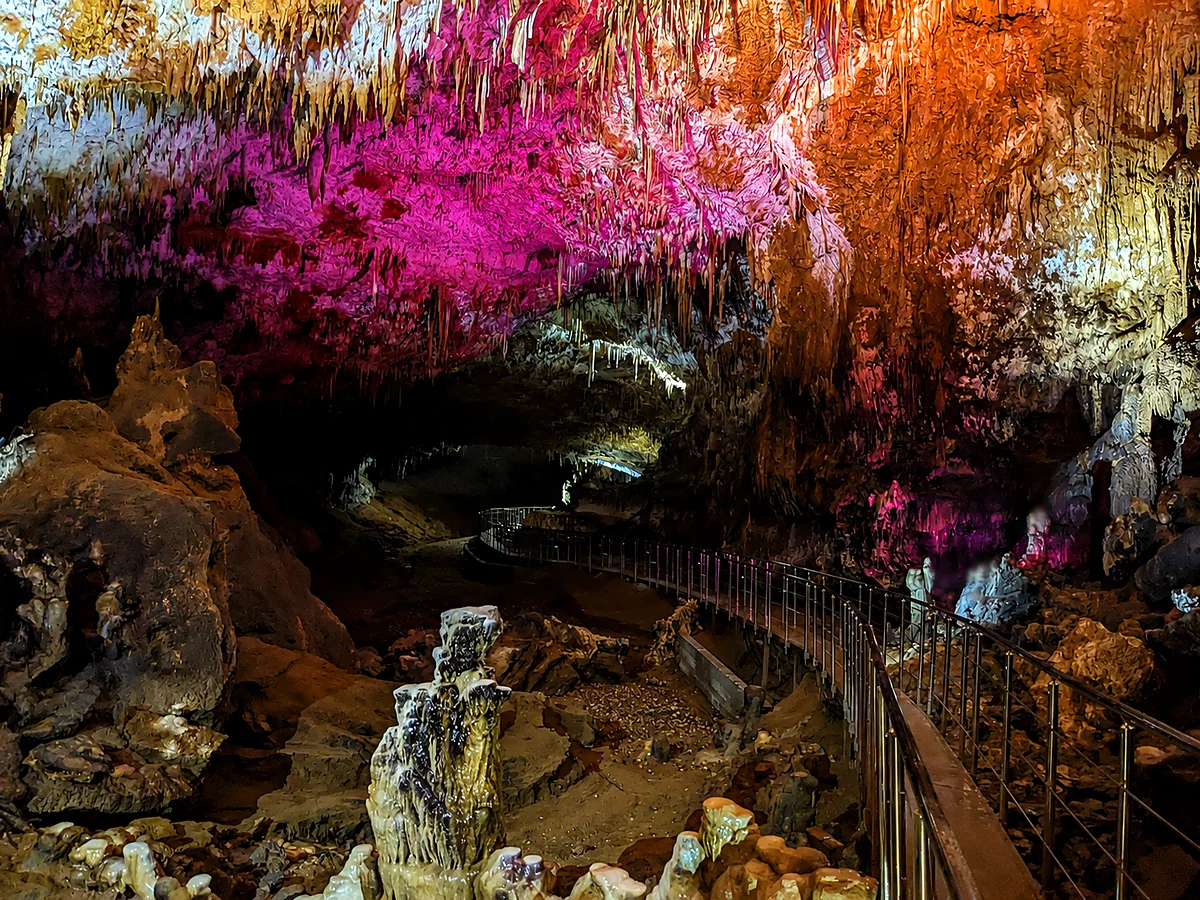
The most visited natural attraction near Tskaltubo is the Prometheus Cave, about five kilometers from the town center near the village of Kumistavi. The cave system runs for several kilometers through chambers of varying size, with stalactite and stalagmite formations developed over millions of years in the karst limestone of this part of Imereti. It was first explored systematically in the 1980s, and the name — referencing the mythological figure chained in the Caucasus — dates from that period.
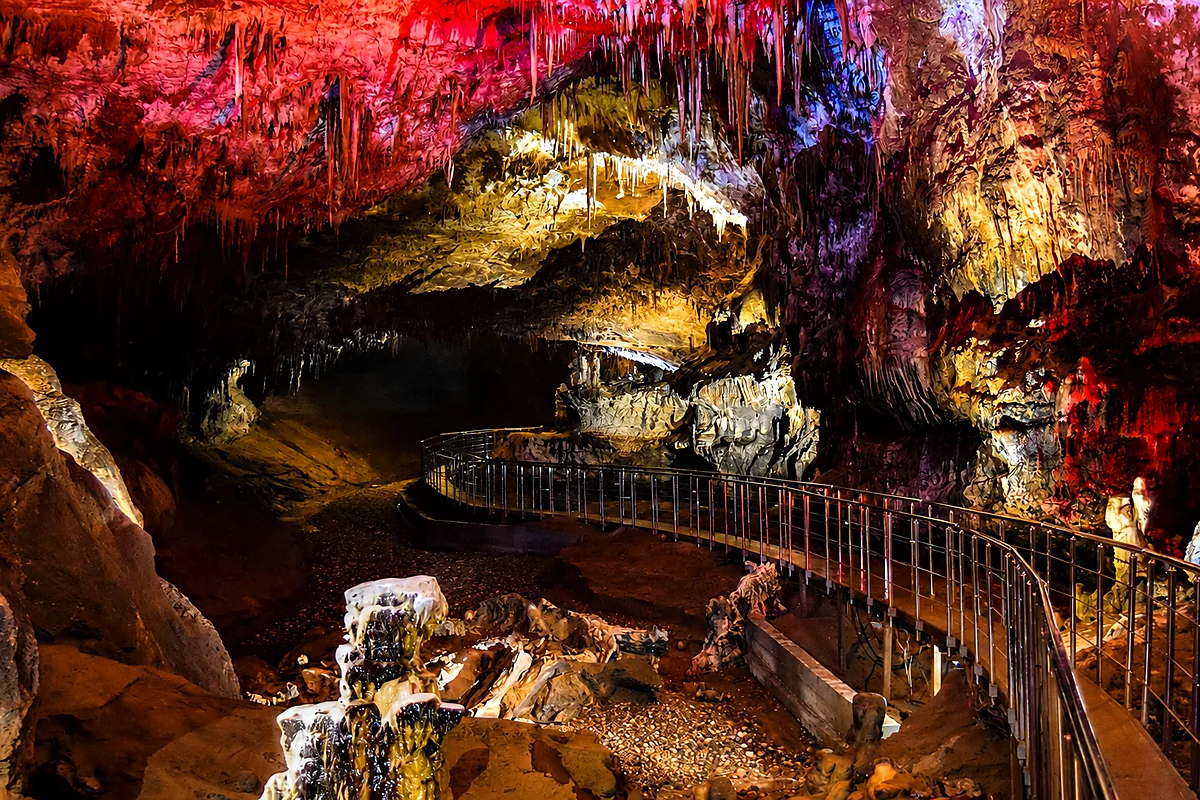
The visitor infrastructure is well organized, with a lit walkway through the main sequence of chambers and a short boat section on an underground river that gives a different perspective and a memorable final stretch. The illumination is inevitably theatrical but does highlight the variety and scale of the formations; the largest chambers are genuinely impressive, and the boat section through the flooded lower passages has an atmosphere the walking sections can't quite match. A visit takes about an hour and a half to two hours, and the cave holds a constant temperature of around 14 degrees Celsius regardless of season — worth knowing when dressing for a summer visit.
Sataplia Nature Reserve
A few kilometers from Kutaisi and easily combined with a Tskaltubo visit, the Sataplia Nature Reserve protects a small but ecologically significant area of Colchic forest — the subtropical forest that once covered much of the western Caucasus lowlands — alongside Cretaceous-period dinosaur footprints preserved in the limestone surface. The footprints, discovered in the 1930s, include tracks of both herbivorous and carnivorous dinosaurs and are protected under a glass shelter. A small cave within the reserve and a glass-floored observation platform over the edge of the forested hill, with views across the Rioni valley and the rooftops of Kutaisi below, complete the main circuit. It works well as a two-hour excursion — accessible, interesting without being exhausting, and well suited to visitors with children.
How to get to Tskaltubo and the surrounding region
Tskaltubo's proximity to Kutaisi makes it easy to combine with the city's major sites — the Bagrati Cathedral, Gelati Monastery, and the central market are all within twenty minutes by car or taxi. Kutaisi International Airport, which handles connections from several European cities, is similarly close, which makes Tskaltubo a practical first or last stop for travelers arriving or leaving through this gateway. The broader western Georgia itinerary — Martvili Canyon, Okatse Canyon, the Racha region — is all within reasonable day-trip distance of a Tskaltubo base, and accommodation ranges from basic guesthouses to the functioning spa hotels, covering a reasonable spread of budgets.
Best time to visit Tskaltubo
Spring and autumn are the most comfortable seasons for combining the outdoor sites — Prometheus Cave, Sataplia, the sanatorium walks — with mild temperatures and pleasant light. The cave holds a constant internal temperature year-round and is worth visiting in any season. Summer is warm and the surrounding forests are fully green, which makes the valley setting especially attractive, though western Georgia's July and August humidity can be considerable. Winter is quiet, mild by Georgian standards, and particularly suited to visitors mainly interested in the therapeutic spa experience — the baths are if anything more appealing in cooler weather, and the reduced visitor numbers give the town a stillness that suits its somewhat melancholy architectural character.
History and the origins of the resort
The thermal springs at Tskaltubo were known to local communities long before any formal development, and Georgian historical sources mention the water's healing properties going back several centuries. Serious development began in the late 19th century under Russian imperial administration, when the springs were scientifically studied and the first organized bathing facilities were built. The transformation into a major destination came in the Soviet period, from the 1920s and accelerating through the 1930s and 1940s. The Soviet approach to health and recreation — organized, ideologically inflected, and delivered through large institutions rather than private enterprise — found an ideal vehicle in Tskaltubo's natural resources, and the construction program was correspondingly ambitious. Stalin himself used a dedicated facility here, which ensured both significant investment and a prestige that filtered down through the Soviet hierarchy. By the 1950s and 1960s, Tskaltubo drew workers from across the Soviet Union, arriving on state-sponsored vouchers for two- or three-week therapeutic stays that combined the mineral baths with rest, medical supervision, and the organized leisure of the sanatorium system.
FAQ Voyage dans le Caucase
Tskaltubo is a spa town in western Georgia famous for two things: its remarkable concentration of grand, now largely abandoned Soviet-era sanatoriums, which draw photographers and architecture enthusiasts, and its naturally warm mineral baths, which still operate for therapeutic stays. It's also close to Prometheus Cave and Kutaisi.
Some, but carefully. Tskaltubo has more than twenty Soviet sanatorium complexes, but many are home to families displaced by the 1990s Abkhazian conflict, and some buildings are unsafe. Visits should be made with respect for residents and permission where appropriate, rather than treating the buildings as empty ruins.
Yes. The naturally warm springs (a constant 33–35°C) still feed working facilities, from organized spa hotels to smaller local operations, and a typical bath lasts twenty to thirty minutes. Many visitors come specifically for extended therapeutic stays, which the water is considered beneficial for circulatory, joint, and skin conditions.
Prometheus Cave (about 5 km away) and the Sataplia Nature Reserve, with its dinosaur footprints, are the main natural sites. Kutaisi, with the Bagrati Cathedral and Gelati Monastery, is about twenty minutes away, and Martvili and Okatse canyons are within day-trip range.
It's about 15 km northwest of Kutaisi, roughly twenty minutes by car or taxi, and Kutaisi International Airport is also close, which makes Tskaltubo a practical first or last stop for travelers using that gateway.