
Lechkhumi, Georgia: Tvishi Wine and the Quiet Northwest
Lechkhumi is a small historical region in northwestern Georgia — the country in the South Caucasus — a zone of forested hills and river valleys between the high mountains of Racha to the north and east and the lowlands of Imereti to the south. It has no separate administrative status today, falling within the Racha-Lechkhumi and Kvemo Svaneti region, and its boundaries are defined more by geographical character and historical tradition than by any current political line. The regional center is Tsageri, a small town of a few thousand on the Tskhenistskali River, and the broader territory is a scatter of villages connected by secondary roads through landscape that grows more forested and more mountainous as you move north toward Racha and Svaneti.
What is Lechkhumi known for?
Lechkhumi is best known for its wine — above all Tvishi, a naturally semi-sweet white made from the Tsolikouri grape, and as the home of Usakhelouri, one of Georgia's rarest and most prized wines. Beyond wine, it's known for its exceptionally green, rainy landscape, the clean Tskhenistskali River, traditional hillside villages like Lailashi, and being one of the least-visited corners of the country. It pairs naturally with neighboring Racha as a combined northwestern-Georgia wine-and-mountain trip.
Lechkhumi is, by most measures, one of the least-visited parts of Georgia. It doesn't appear on standard itineraries, its name is unfamiliar to most international visitors, and tourism infrastructure is minimal. Those are exactly the conditions that make it interesting to a certain kind of traveler — one willing to navigate without the scaffolding of organized tourism, who finds the absence of crowds and the presence of genuine local life more rewarding than well-maintained sites and established visitor facilities. For them, Lechkhumi offers something increasingly hard to find in the parts of Georgia that have been discovered: a landscape and a human environment that function on their own terms.
Geography and landscape
The physical character of Lechkhumi is defined by the Tskhenistskali River — the name means "horse's water" — and its tributaries, which drain the southern slopes of the Racha ridge and flow south to join the Rioni in Imereti. The Tskhenistskali valley runs roughly north–south through the heart of the region, and most Lechkhumi settlements are strung along it or up the side valleys that branch from it. The terrain is hilly rather than dramatically mountainous in the lower sections, with well-watered slopes under mixed deciduous and conifer forest, and becomes more serious in the upper valleys where the ridgelines rise toward the Racha highlands.
The landscape has a softness and greenness — the result of substantial year-round rainfall — that sets it apart from the more austere mountains of Racha and the open agricultural plains of Imereti. Vineyards on many south-facing slopes give the lower valleys a cultivated character that contrasts pleasantly with the wild forest above, producing the visual rhythm characteristic of Lechkhumi: cleared land in the valley bottoms and lower slopes, dense forest rising above, and occasional village clusters among the vines.
Tvishi, Usakhelouri, and the wine tradition
Like Racha to its north, Lechkhumi has a wine identity built around specific indigenous grapes and geographically defined production zones rather than large-scale commercial viticulture. The region's best-known wine is Tvishi, a naturally semi-sweet white made from the Tsolikouri grape in a defined zone on the Rioni valley around the villages of Tvishi and Alpana, in the southern part of Tsageri municipality. The microclimate of this stretch — the slope orientation, the temperature patterns, the way the river moderates humidity through the growing season — gives Tsolikouri a sugar content that, fermented in the traditional way, yields a wine with restrained natural sweetness, fresh acidity, and a floral, finely balanced character quite unlike the better-known semi-sweet reds of Racha and Kakheti. Tvishi holds a Protected Designation of Origin, and it's prized for elegance and precision rather than richness.
Lechkhumi's other great wine is rarer still: Usakhelouri, made from a grape of the same name in the small Zubi-Okureshi zone, is one of the scarcest and most sought-after wines in all of Georgia, produced in tiny quantities and commanding prices to match. The region also grows the red Orbeluri Ojaleshi, centered on the village of Orbeli in the Tskhenistskali valley, among other local varieties that most Georgian wine drinkers outside the region have never encountered. A thorough tasting in Lechkhumi covers a range of whites and reds far beyond Tvishi alone.
Production across the region is small and almost entirely in the hands of local families. There's no large winery infrastructure, no organized tasting rooms, and no visitor trail comparable to the more developed wine areas. Visiting a producer means arriving at a family home, usually through a local introduction or a guesthouse recommendation, and experiencing the wine in the context of Lechkhumi hospitality — a meal, a courtyard, a conversation in whatever common language is available, and a series of glasses from vessels the host chooses based on what they think worth sharing. The intimacy of that kind of encounter is something the organized wine tourism of Kakheti and Racha can't replicate, and for travelers whose interest in Georgian wine extends beyond tasting to understanding how wine is woven into daily life, Lechkhumi is especially rewarding. Because these are family operations, a visit is best arranged in advance through a guesthouse or local contact rather than as a walk-in.
Lailashi and the villages
The village of Lailashi, perched on a hillside above the Tskhenistskali valley with wide views across the surrounding landscape, is one of the more frequently mentioned destinations within Lechkhumi, mainly for the panorama it offers over the forested valley and the ridgelines beyond. The village is small and traditional, with the stone-and-timber domestic architecture typical of this part of western Georgia, and the combination of the elevated position and the landscape below — vineyards on the south-facing slopes, forest above, the river in the valley floor — makes it worth the stop for the view alone. The wider network of villages shares similar characteristics: small, agricultural, tied to the landscape by the vineyards and orchards that are their main economic activity, and genuinely welcoming to the rare visitor who arrives without the mediating apparatus of organized tourism.
Churches and chapels across Lechkhumi's villages reflect a long Christian tradition, and several medieval religious buildings survive in various states of preservation, giving points of architectural and historical interest amid the natural and agricultural landscape. None approaches the significance of Nikortsminda in neighboring Racha, but collectively they give the region a cultural depth beyond its wine and scenery. Tsageri itself, the historical capital of the Lechkhumi principality, has its own church architecture and sits beneath the dramatic Khvamli massif.
Green Lake and natural sites
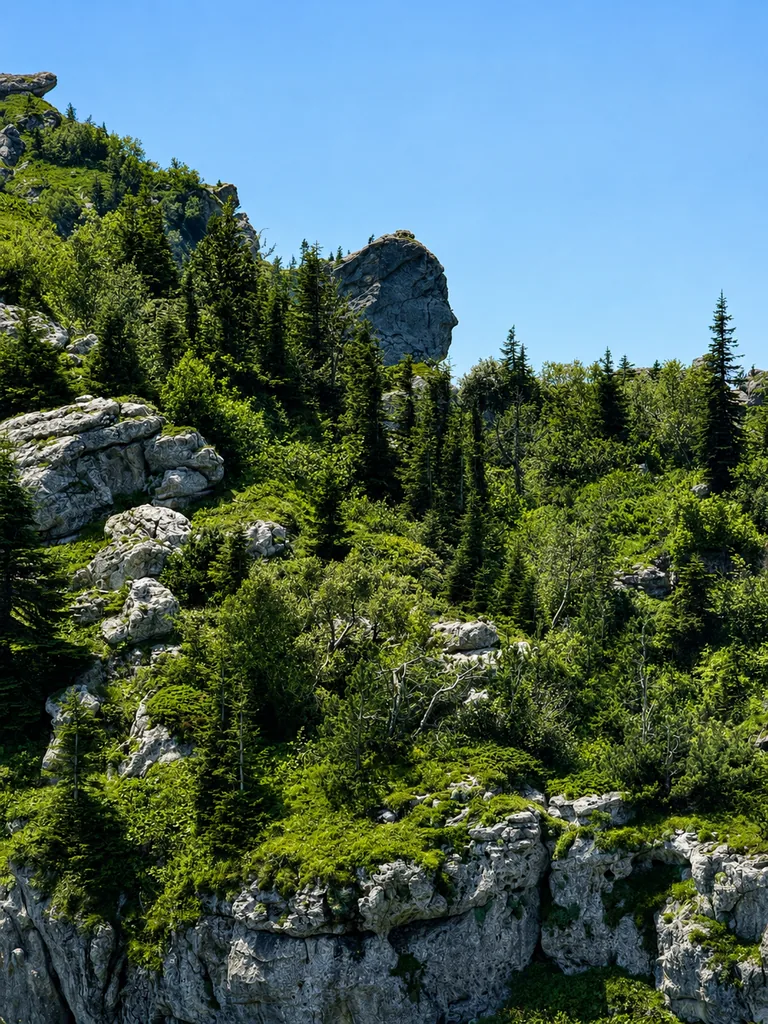
In the forested terrain above the main valley, a number of natural sites reward exploration by those with suitable transport and a willingness to navigate tracks that aren't always signposted or well maintained. The Green Lake — a small natural lake in a forested setting in the hills above the valley, named for the color produced by its water chemistry and the surrounding vegetation — is one of the more visited of these, though even it sees very few visitors by the standards of Georgia's better-known natural sites; it's a popular stop on local wine tours, often for fresh fish by the water. The forested hillsides also hold waterfalls, river gorges, and areas of old-growth forest accessible on foot from the main valley roads, though they require independent navigation and some physical effort.
The Tskhenistskali River itself is one of the cleanest and most pristine in western Georgia, fed by mountain springs and flowing through largely undeveloped terrain for much of its upper length. Fishing — mainly for trout — is a traditional activity along it, and the combination of clear water, forested banks, and the general quiet of the valley gives the riverside a quality of undisturbed natural beauty that is increasingly rare in more accessible parts of Georgia.
Combining Lechkhumi with Racha
Lechkhumi and Racha are geographically adjacent and culturally related, and most practical itineraries treat them as a single combined destination rather than separate trips. The road from Tsageri to Ambrolauri in Racha runs through the Tskhenistskali and Rioni valleys and takes around an hour, and the two regions complement each other naturally — Racha's Khvanchkara and the Nikortsminda Cathedral alongside Lechkhumi's Tvishi, Usakhelouri, and the quieter, more intimate wine-village experience of the Tskhenistskali valley. Three or four days in the combined area covers the main points of both regions while allowing the slower pace the landscapes and wine culture genuinely reward.
The broader route from Kutaisi north through Lechkhumi and Racha — and potentially on toward Lower Svaneti via the Rioni gorge — is one of the more coherent extended journeys through western Georgia, tracing the transition from the historical density of Imereti, through the increasingly remote mountain wine country of the northwestern highlands, toward the high Caucasus.
Getting there and around
Lechkhumi is about two to two and a half hours from Kutaisi by road, the route climbing from the Rioni lowlands into the Tskhenistskali valley. Marshrutkas connect Tsageri to Kutaisi, though the schedule is infrequent and the journey long. From Tbilisi the distance is around 300 kilometers and the drive five to six hours — long enough that the region isn't realistically a day trip from the capital and needs at least an overnight, which most visitors combine with time in Racha. Within the region a car is essential for reaching the wine villages, Lailashi, and the upper-valley natural sites. The secondary roads range from adequate gravel to rougher surfaces needing higher ground clearance, and it's worth checking current conditions locally before venturing far from the main valley road.
When to visit
The practical season runs May through October, with road conditions and weather both becoming less reliable from November. Spring (late April through June) brings the vineyards into leaf and the forests to their fullest green, and the rivers run high from snowmelt. Summer is warm in the valley and comfortable in the higher terrain, and the long days of June and July suit the unhurried exploration the region rewards. Autumn is the most celebrated season in the local wine culture — the Tvishi harvest typically runs through September into October depending on the year — and the combination of harvest activity, autumn forest color, and the quality of the light makes it the most rewarding time to visit. Winter has its own austere character, but access to the upper valleys and wine villages becomes unreliable, and the already limited accommodation runs on reduced schedules outside the main season.
Caucasus Travel FAQ
Lechkhumi is a small historical region in northwestern Georgia, between Racha and Imereti, within the Racha-Lechkhumi and Kvemo Svaneti administrative region, with Tsageri as its center. It's best known for its wine — the semi-sweet white Tvishi and the rare Usakhelouri — and for its green river valleys and very quiet, traditional character.
Tvishi is a naturally semi-sweet white wine made from the Tsolikouri grape in a small Protected Designation of Origin zone on the Rioni valley around the villages of Tvishi and Alpana, in Lechkhumi. Its natural sweetness comes from the grapes and the microclimate, balanced by fresh acidity and floral aromatics — elegant and finely balanced rather than rich.
Usakhelouri is one of Georgia's rarest and most prized wines, made from the grape of the same name in Lechkhumi's small Zubi-Okureshi zone. Produced in very small quantities, it's highly sought after and commands high prices — a real connoisseur's wine and a point of pride for the region.
Yes, but informally. There are no organized tasting rooms or visitor trails; visiting a producer means arriving at a family home, usually arranged through a guesthouse or local contact, and experiencing the wine over a meal in a courtyard. It's one of the most intimate wine experiences in Georgia, best arranged in advance.
It's about 2–2.5 hours by road from Kutaisi, or 5–6 hours (around 300 km) from Tbilisi, so it needs at least an overnight. Most travelers pair it with neighboring Racha — Tsageri to Ambrolauri is about an hour — for a combined northwestern-Georgia wine-and-mountain trip of three to four days.