
Guria, Georgia: Tea Country on the Black Sea
Guria is a small region in western Georgia — the country in the South Caucasus — wedged between the Black Sea coast to the west, the Adjara highlands to the south, Samegrelo to the north, and the Imereti uplands to the east. It's one of the smallest regions in the country by area and one of the least visited by international travelers, which has left it with an unhurried, lived-in quality that its more celebrated neighbors — Batumi to the south, Kutaisi to the east — have partly traded away for tourism infrastructure. The regional center is Ozurgeti, a quiet town of around 20,000 people that serves as the administrative and commercial hub without drawing much attention to itself. Guria's real character is outside the town: the rolling green hills, the tea plantations on the lower slopes, the forested ridges rising toward the Meskheti range, and the stretch of Black Sea coast that forms the region's western edge.
What is Guria known for?
Guria is best known as the birthplace of Georgian tea, with a tea-growing tradition stretching back to the 1840s and a specialty-tea revival now centered here. Beyond tea, the region is known for the magnetic black-sand beaches of the resort town of Ureki, the dramatic cloud-sea views from the Gomi ridge, an exceptionally green and rainy landscape, and a local culture famous within Georgia for sharp wit and humor. It's a quiet, authentic corner of western Georgia, well off the main tourist track.
The climate is among the wettest in Georgia, shaped by the Black Sea and the way the coastal hills trap moisture moving inland. Rain falls throughout the year rather than in a single season, and the result is a landscape of persistent greenness — hills covered in vegetation from valley floor to ridgeline, rivers running full even in summer, and a general sense of land that's fertile in itself rather than only through irrigation and effort. That same climate, which makes ordinary cereal farming difficult, turns out to be ideal for tea — and tea, more than anything, has shaped Guria's agricultural and cultural identity over the past century and a half.
Tea: history and revival
Tea cultivation in Georgia began in the 1840s, with the first experimental plantings made in the Ozurgeti area of Guria on the initiative of Russian imperial agronomists looking to develop a domestic tea industry for the empire. The Guruli hills — acidic soils, high rainfall, mild winters, warm humid summers — proved well suited to Camellia sinensis, and cultivation expanded steadily through the late 19th century. By the Soviet period, Georgian tea (grown mainly in Guria, Adjara, Samegrelo, and Abkhazia) had become one of the major agricultural products of the Caucasus, and the terraced plantations covering the hillsides of western Georgia were a defining feature of the Soviet landscape here.
Soviet production prioritized volume over quality, and the large-scale mechanized harvesting and processing of the collective system produced tea that was functional rather than distinguished. The collapse of the Soviet agricultural system in the early 1990s devastated the industry: the collectives dissolved, the processing infrastructure fell into disrepair, and many plantations were abandoned as the economic model that sustained them disappeared. For two decades Georgian tea retreated from its former prominence, and the hillside plantations of Guria grew over.
The revival underway since the 2010s takes a fundamentally different approach. Rather than rebuilding industrial-scale Soviet production, the new Georgian tea industry is built around small family operations producing specialty teas — hand-picked, carefully processed, often organic — that compete on quality rather than quantity. Guria is at the center of this, with a growing number of small producers whose teas have drawn attention from specialty buyers in Europe, Japan, and North America. The most ambitious are working with traditional Georgian tea varieties that were neglected in the Soviet period in favor of higher-yielding but lower-quality cultivars, and the results have surprised markets used to defining quality tea by an East Asian origin.
Visiting a tea producer in Guria usually means walking the plantation itself — the low, dense bushes covering the hillside, their new growth a brighter green than the mature leaves below — watching or joining the hand-picking, and following the leaf through withering, rolling, oxidation, and drying to the finished tea. Conducted on small family farms rather than in organized visitor facilities, these visits have a directness and genuine engagement with the craft comparable to the best wine visits in Kakheti or Racha. The harvest runs from May through October, with the first spring flush — the young growth after winter dormancy — considered the finest of the year. One practical note: because these are small family farms rather than set-up visitor operations, a tea visit is best arranged in advance rather than as a walk-in.
Gomi Mountain and the sea of clouds
In eastern Guria, where the hills rise toward the Meskheti range that forms the boundary with Adjara and Samtskhe-Javakheti, the Gomi ridge reaches close to 2,000 meters and is known for a weather phenomenon that makes it one of western Georgia's more unusual viewpoints. The humid maritime climate and the ridge's elevation combine to create conditions where a sea of cloud often forms in the valleys below while the ridge stays clear above it — especially around sunrise and sunset, when the temperature difference between warm valley air and the cooler ridge produces a fog layer that fills the landscape below. On the mornings it forms fully, the effect is striking: the forested valleys and the distant Black Sea coast vanish beneath a white surface, and the ridge stands above it as if on an island.
Reaching the Gomi area means a road that climbs steeply from the valley floor and gets rougher as it gains elevation. Simple guesthouses and wooden cottages operate in the warmer months, which is what makes it possible to be on the ridge at dawn when the cloud is most likely. The surrounding terrain offers walking through subalpine meadows and forest, with views north toward the Samegrelo lowlands and the distant Greater Caucasus and south toward the Adjarian highlands on clear days. Worth being honest about: the cloud sea is a weather event, not a guarantee — it forms under the right conditions and not on demand, so an overnight stay improves your odds far more than a day trip.
The Black Sea coast and Ureki
Guria's western edge meets the Black Sea along a stretch of coast that includes the resort town of Ureki, known throughout Georgia for its magnetic black-sand beaches. The dark sand comes from the volcanic and mineral content of the rivers draining the Caucasian highlands, deposited along this section of coast by longshore drift, and its relatively high iron content gives it measurable magnetic properties. A medical tradition grew up around the sands — the claim that exposure benefits various circulatory and musculoskeletal conditions — and has sustained a health-tourism industry in Ureki since the Soviet period, when it was developed as a sanatorium destination.
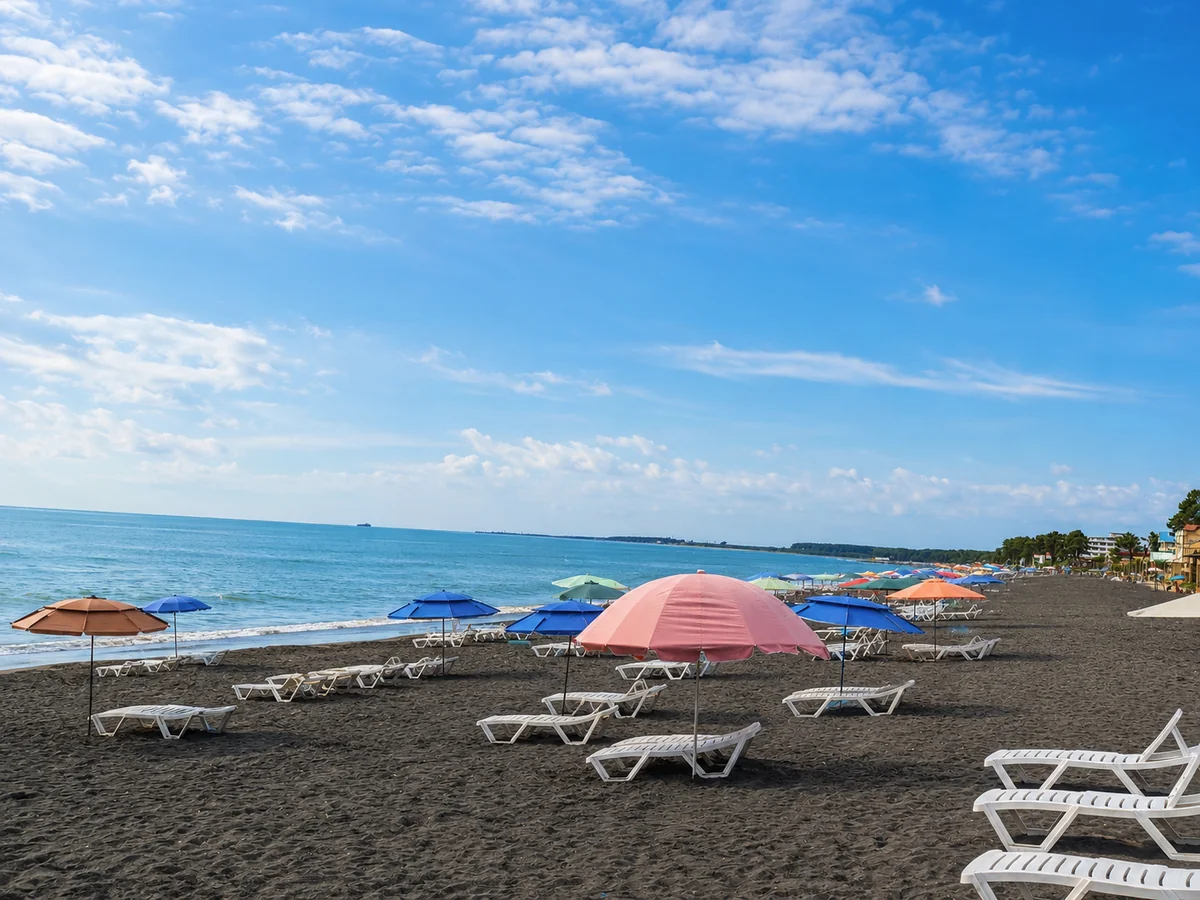
In practice, Ureki is a calm, family-oriented Georgian seaside resort rather than an international beach destination. The water is relatively sheltered and the waves gentle, the resort infrastructure modest but functional and improving, and the crowd is mostly Georgian plus a growing number of visitors from neighboring countries — the summer atmosphere lively and unpretentious. On the famous sand: the magnetic property is real in a mineralogical sense, and the traditional health claims are widely believed locally, but they aren't something we'd present as medically established, so treat the sands as a distinctive feature rather than a treatment. The combination of dark sand, Black Sea water, and the green Gurian hills inland gives Ureki a visual character that sets it apart from the lighter beaches further along the coast.
Lanchkhuti and the central region
The town of Lanchkhuti, between Ozurgeti and the coast, sits in the lower Gurian hills where the steeper tea terrain gives way to flatter farmland approaching the sea. The surrounding villages preserve the traditional domestic architecture of rural Guria — wooden houses on stone foundations with the carved decorative detail characteristic of western Georgian building, set among gardens of fruit trees and tea bushes. The village churches, reflecting several centuries of ecclesiastical building, give points of historical and architectural interest without approaching the significance of the major monuments in neighboring Imereti or Adjara.
Guria also has a distinct cultural personality. Gurians have a long-standing reputation in Georgian cultural lore for a particular sharp wit — a tradition of wordplay, irony, and quick verbal exchange that sets social interaction here apart from the more formal hospitality of eastern Georgia. It's the kind of thing that's hard to verify on a short visit, but it's consistently reported by Georgian travelers who know the region, and it adds a dimension to encounters with local people that goes beyond the universal Georgian warmth.
Rivers and regional boundaries
The Choloki River, flowing west through southern Guria to the Black Sea, marks the historical boundary between Guria and Adjara and has served as a significant administrative and cultural border line through various political configurations. The area around the Choloki crossing carries that boundary-zone history, and the transition from the predominantly Christian Gurian communities to the mixed Christian-Muslim demographic of Adjara becomes gradually apparent as you move south through the lower hills toward Batumi.
The Natanebi River, in the north, similarly marks the boundary with Samegrelo. The forested hills between the two rivers are the heart of Guria — where the tea plantations are densest, the landscape most characteristic, and the regional identity most strongly felt.
Getting there and around
Guria sits on the main Tbilisi–Batumi transport corridor, and its primary towns, Lanchkhuti and Ozurgeti, are served by both the railway and the main highway. The train from Tbilisi to Ozurgeti takes around four hours, and marshrutkas connect the region to both Tbilisi and Batumi with reasonable frequency. Ureki is reachable from Tbilisi by train (there's a station serving the resort) and by marshrutka. Within the region, reaching the tea plantations, the Gomi ridge, and the interior villages needs a car or taxi, as public transport beyond the main towns is limited. The roads through the tea hills are narrow and winding but generally passable in a standard vehicle, though the higher Gomi approaches benefit from better ground clearance.
When to visit
Guria works year-round at the coast and lower elevations, with Ureki functioning mainly as a summer resort from June through September. The tea harvest — May through October — is the most rewarding window for the plantations, with the first flush in May and early June rated the finest by most producers. The landscape is at its greenest in spring and early summer, when the rainfall has saturated the hillsides and the tea bushes are growing actively. Autumn is quieter and pleasant, with mild temperatures and the harvest mood extending from the tea fields into the fruit orchards and the small-scale family winemaking that supplements many Gurian households' income. The Gomi ridge is most rewarding from late spring through early autumn, when the cloud phenomenon is most likely and access to the higher terrain is reliable.
Caucasus Travel FAQ
Guria is a small region in western Georgia, between the Black Sea coast, the Adjara highlands, Samegrelo, and Imereti, with Ozurgeti as its center. It's best known as the birthplace of Georgian tea and home to a specialty-tea revival, the magnetic black-sand beaches of Ureki, and the cloud-sea views of the Gomi ridge.
Yes. Guria is the heart of Georgia's specialty-tea revival, and a number of small family producers welcome visitors to walk the plantation, see the hand-picking, and follow the leaf through processing. Because these are small farms rather than set-up visitor centers, it's best to arrange a visit in advance. The harvest runs May to October, with the spring first flush considered the finest.
Ureki's beaches have dark, iron-rich volcanic sand with measurable magnetic properties, deposited along the coast by the rivers draining the Caucasus. A health-tourism tradition since the Soviet era attributes benefits to the sands; the magnetism is real mineralogically, though the medical claims aren't established. Ureki is a calm, family-friendly summer resort.
Gomi is a ridge in eastern Guria reaching close to 2,000 meters, known for a phenomenon where cloud fills the valleys below while the ridge stays clear above — most often around sunrise and sunset. Staying overnight in a ridge guesthouse gives the best chance of seeing it, since it depends on the right weather and isn't guaranteed.
Guria sits on the main Tbilisi–Batumi corridor. Ozurgeti and Lanchkhuti are served by train (Tbilisi–Ozurgeti is roughly four hours) and by marshrutka from both Tbilisi and Batumi, and Ureki has its own rail stop. To reach the tea farms, Gomi, and the interior villages you'll want a car or taxi, as public transport beyond the towns is limited.