
Adjara, Georgia: Batumi, the Black Sea Coast, and the Mountain Interior
Adjara is an autonomous republic within Georgia — the country in the South Caucasus — occupying the southwestern corner of the country along the eastern shore of the Black Sea, with Turkey forming its southern border along the Arsiani mountain range. It is one of the smallest administrative regions in Georgia by area but one of the most geographically varied: within roughly 80 kilometers from the coastline to the high mountain passes, the landscape moves through subtropical coastal lowlands, dense forested foothills, deep river gorges, tea and citrus plantations, alpine meadows, and bare rocky ridgelines approaching 3,000 meters. That compression of different environments into a compact territory gives Adjara a diversity larger, more uniform regions can't match — and it's the underlying reason the region rewards more time than most visitors initially give it.
Most travelers who visit Adjara come for Batumi, which is reasonable — the city is the most developed, accessible, and internationally recognized destination in the region. But Batumi and Adjara aren't the same thing, and treating them as interchangeable means missing the forested mountain interior, the medieval bridges and waterfalls of the Acharistskali valley, the tea-growing villages of the lower slopes, and a rural cultural landscape that has developed its own particular character through centuries of geography and history.
What is Adjara known for?
Adjara is best known for Batumi — the lively Black Sea resort city with its striking modern skyline — and for the subtropical coast that surrounds it. Inland, it's known for its forested mountain interior: the Makhuntseti waterfall and medieval arch bridges of the Acharistskali valley, the scenic Goderdzi Pass, and tea-growing villages. It has a distinct cultural identity shaped by three centuries of Ottoman rule, including a Muslim community alongside Orthodox Christians, and it's the home of the famous boat-shaped Adjarian khachapuri.
Geography and climate
Adjara's geography divides naturally into two zones. The coastal lowland — narrow in places, wider where the main rivers reach the sea — carries most of the region's population and almost all its urban development. Batumi sits at the northern end of this coastal strip, with the town of Kobuleti further north along the same shoreline. The climate here is among the wettest in the Caucasus — Batumi receives over 2,400 millimeters of rainfall a year, more than almost any other city in Georgia — and the combination of warmth and moisture produces the lush, almost subtropical vegetation that defines the coast. Tea plantations cover the lower hillsides, citrus trees grow in domestic gardens, and the general greenness persists through most of the year in a way that consistently surprises visitors arriving from the drier eastern half of the country.
The mountain zone begins almost immediately behind the coastal strip, the hills rising steeply from the narrow valley floors. The main river valleys — the Acharistskali and its tributaries — cut deeply into the highland terrain and form the main corridors into the interior. The landscape changes rapidly with elevation: subtropical vegetation in the lower valleys gives way to mixed deciduous and conifer forest at middle elevations, then alpine meadow and bare rock above the treeline. The highest points of the Arsiani range along the Turkish border exceed 3,000 meters, and the passes crossing this range historically served as the main routes connecting Adjara with northeastern Turkey and the broader Ottoman world that shaped the region for several centuries.
History and cultural identity
Adjara's cultural identity has been shaped by a historical trajectory significantly different from the rest of Georgia. The region has belonged to the Georgian cultural and political world since antiquity, but its position on the routes connecting the Caucasus with Anatolia made it a repeated object of contest between Georgian kingdoms, Byzantine influence, and later the Ottoman Empire. Ottoman control — which began in the late 16th century and lasted until Russian forces took the region in 1878, following the Russo-Turkish War — lasted roughly three centuries, long enough to leave a lasting cultural and religious impact. A significant portion of the Adjarian population converted to Islam during this period, and the region retains a Muslim community today that gives it a religious character distinct from the predominantly Orthodox Christian rest of Georgia. The coexistence of the two traditions — mosques and Orthodox churches within the same communities, Islamic and Christian festivals observed by different parts of the same population — is one of the more visible expressions of Adjara's particular position.
The Russian annexation of 1878 brought significant demographic and cultural change. New administrative structures, Russian-style urban development in Batumi, and the construction of the Transcaucasian Railway transformed the coastal economy rapidly. The discovery that the Black Sea port of Batumi was ideally positioned for exporting Azerbaijani oil from Baku turned the town from a modest Ottoman coastal settlement into one of the most commercially active ports in the region within a generation. The wealth from that oil trade financed the handsome European-style buildings that still define central Batumi and gave the city a cosmopolitan character it has retained in various forms since.
The Soviet period brought Adjara into the Georgian Soviet Socialist Republic as an autonomous republic — a status it keeps within post-independence Georgia. The post-Soviet decades were complicated by the authoritarian rule of Aslan Abashidze, who governed Adjara as effectively a personal fief from the early 1990s until the Rose Revolution of 2003 and the peaceful resolution that ended his rule in 2004. The years since have seen substantial investment in Batumi's infrastructure and tourism economy, transforming the city from a neglected post-Soviet port into one of the more dynamic and visually distinctive urban environments in the South Caucasus.
The coast
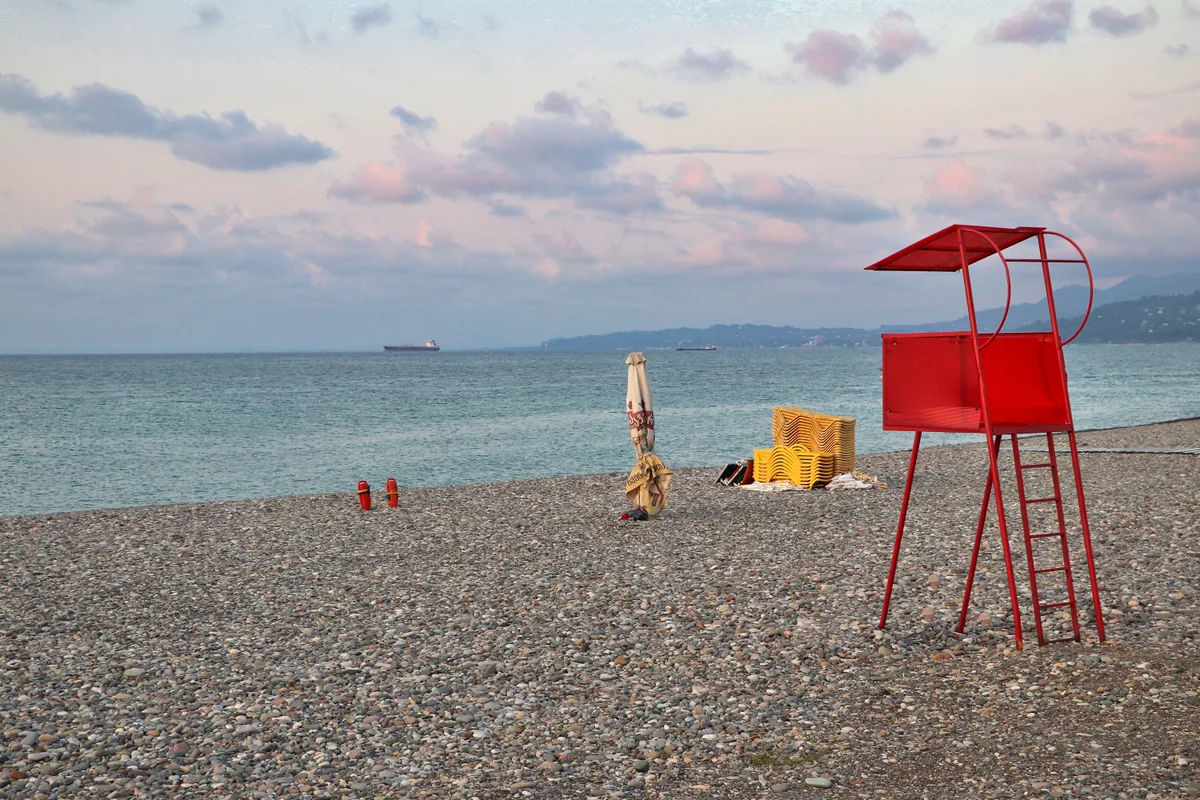
Adjara's Black Sea coastline runs roughly 100 kilometers from the north of the region down to the Turkish border at Sarpi, and its character varies considerably along the way. Batumi's developed northern seafront — high-rise hotels, casino complexes, and the long boulevard running parallel to the shingle beach — represents one extreme: urban, active, and fully oriented toward summer tourism. The coastal town of Kobuleti, about 30 kilometers north of Batumi, has a longer beach and a more relaxed atmosphere, historically the domestic Georgian resort alternative to the more internationalized Batumi. The smaller settlements in between offer varying degrees of quietness and accessibility.
South of Batumi toward the Turkish border, the coastline becomes progressively quieter and less developed. The village of Sarpi, at the border crossing point, has beaches popular with both Georgian and Turkish visitors and a character shaped by its position between the two countries. The Sarpi crossing — the main coastal border between Georgia and Turkey — is open and busy, leading directly into the Turkish province of Artvin, and the cultural and architectural continuities between northeastern Turkey and Adjara are evident to travelers crossing in either direction. (Sarpi has its own border-crossing guide in this series.)
The Black Sea along this coast is generally clean and calm enough for swimming through the summer, though the shingle beaches — characteristic of this stretch and of the Georgian Black Sea shore generally — take some adjustment for visitors used to sandy Mediterranean beaches. Water temperatures peak in August and stay warm enough for comfortable swimming through September.
The mountain interior
The highland interior is the part of Adjara most visitors underestimate and that most rewards the effort of reaching it. The main route into the mountains follows the Acharistskali River valley from Batumi, climbing through a landscape that changes character repeatedly over an hour's drive. The lower valley is warm and lush, the hillsides covered in tea plantations and mixed forest, the road following the river through small settlements. As the valley narrows and the road climbs more steeply, the subtropical vegetation gives way to denser forest and the air cools noticeably.
The Makhuntseti Waterfall, about 35 kilometers from Batumi in the Acharistskali valley, is one of the most visited natural sites in the region — a tall cascade into a forested gorge, genuinely impressive in spring and early summer when snowmelt drives the river at full flow. Immediately adjacent, the Makhuntseti Arch Bridge is a single-span medieval stone bridge of remarkable proportions, preserved in near-complete condition and crossing the river at a height and span that reflect the confidence of its medieval builders (it's commonly associated with the era of Queen Tamar). Similar medieval arch bridges appear at several other points throughout the Adjarian highlands — the Dandalo Bridge and others in the upper valleys — and form one of the most distinctive categories of historical monument in the region, less well known than the churches and fortresses of eastern Georgia but equally impressive in their own right.
Further into the mountains, the Goderdzi Pass at around 2,025 meters connects the Acharistskali valley (via the highland towns of Shuakhevi and Khulo) with the Samtskhe-Javakheti region and the road to Akhaltsikhe — the Trans-Adjara highway. The road over the pass is one of the more scenic drives in southwestern Georgia, crossing open highland terrain with wide views, though parts of it are unpaved and in poor condition, and it can be slow going. The plateau above the pass is used as summer pasture and contains the Goderdzi Ski Resort, which operates in winter and provides access to some of the most remote terrain in Adjara.
The upper valleys hold a number of villages that retain traditional architectural forms and agricultural practices increasingly rare in the more accessible parts of the region. The characteristic Adjarian highland house — built on a hillside, the ground floor used for animals and storage and the living quarters above, oriented to catch light and views across the valley — appears in various states of preservation throughout the interior. The general character of these upper-valley settlements, with their small churches, communal spaces, and working agricultural economy, gives a very different impression of Adjara from the casino hotels of the Batumi seafront.
Adjarian cuisine
Adjarian food shares the foundations of Georgian cooking but carries its own regional character, shaped by the coastal environment, the mountain agricultural tradition, and the Ottoman culinary influences that three centuries of political connection produced. The most internationally recognized Adjarian dish — the Adjarian khachapuri (khachapuri Adjaruli) — is a boat-shaped bread filled with molten cheese, topped with a raw egg and a generous knob of butter that the diner breaks and stirs into the filling at the table. It originated in Adjara and has spread throughout Georgia and well beyond, but the version made here, with the local cheese and the right bread, has a character restaurant imitations elsewhere rarely match.

Seafood features more prominently in the Batumi restaurant scene than in most other Georgian cities, reflecting the coastal location — fresh Black Sea fish, including mullet and sea bass and various local species, appear regularly on menus. The Ottoman culinary connection is subtly present in certain local preparations and sweets, and the herb and spice profile of some Adjarian dishes reflects influences from northeastern Turkey that give the food a flavor dimension not found in the same form elsewhere in Georgia.
The tea grown on the hillsides of lower Adjara — introduced during the Russian imperial period as a deliberate attempt to reduce the empire's dependence on imported tea — is consumed locally and processed in facilities that have operated in various forms since the 19th century. Georgian tea has a modest international profile compared to the wine, but it's part of the agricultural identity of the region and available in forms ranging from basic commercial production to small-scale artisanal processing that yields a considerably more interesting product.
Batumi
Batumi deserves its own guide — and has one — but its role within Adjara is worth noting. The city is the economic, cultural, and logistical center of the entire region, providing the airport, the main transport connections, the most developed accommodation and restaurant infrastructure, and the most concentrated range of urban attractions. For travelers visiting Adjara, Batumi is the natural base, and all of the mountain interior is accessible as day trips or overnight excursions from the city. Batumi to Makhuntseti is under an hour; the Goderdzi Pass road is reachable in around two hours; and the Turkish border at Sarpi is about fifteen minutes by road. That compactness means a week based in Batumi can cover the coastal, urban, and mountain dimensions of Adjara with reasonable thoroughness. (Batumi has its own detailed guide in this series.)
Getting there
Batumi International Airport handles a growing number of international routes, including connections to Istanbul, Tel Aviv, and several European cities, as well as domestic flights to Tbilisi. By road from Tbilisi, the journey takes about four to five hours along the main east-west highway. Regular overnight and daytime trains connect Batumi with Tbilisi, taking five to six hours. Marshrutkas run between Batumi and Tbilisi and the main western Georgian cities. The Turkish border crossing at Sarpi connects Adjara directly with northeastern Turkey, and travelers arriving overland from Turkey enter Georgia through this point.
When to visit
The peak season for the coastal and urban sides of Adjara runs June through September, with July and August the busiest and warmest. The beach is in full use, the boulevard at its most active, and the atmosphere of Batumi in high summer lively to the point of being overwhelming for those who prefer quiet. Spring — particularly May and June — offers pleasant temperatures, the botanical garden and highland landscapes at their most verdant, and far fewer crowds. Autumn extends the comfortable season through October, with the sea warm enough for swimming well into September and the mountain interior taking on the colors of the season. The highland interior is accessible and rewarding from May through October, with the Goderdzi Pass road sometimes affected by snow outside that window. Winter in Batumi is mild at sea level, rarely freezing, and the city is much quieter — while the Goderdzi ski area provides a winter mountain option for those combining coast and snow.
Caucasus Travel FAQ
Adjara is an autonomous republic in the southwestern corner of Georgia, on the Black Sea coast bordering Turkey. It's best known for the resort city of Batumi and the subtropical coast, and inland for its forested mountains — the Makhuntseti waterfall and medieval bridges, the Goderdzi Pass, and tea-growing villages. Shaped by three centuries of Ottoman rule, it has a distinct identity, including a Muslim community alongside Orthodox Christians, and it's the home of Adjarian khachapuri.
Yes — and it's a common thing visitors miss. Behind the coast, the mountain interior up the Acharistskali valley offers the Makhuntseti waterfall and arch bridge, other medieval bridges in the upper valleys, the scenic Goderdzi Pass, tea villages, and traditional highland architecture. It's all reachable as day trips from Batumi, and it gives a completely different impression of the region from the seafront.
It's the famous boat-shaped version of Georgia's cheese bread — an open, boat-shaped loaf filled with molten cheese, topped with a raw egg and butter that you stir into the filling at the table. It originated in Adjara and is now eaten across Georgia and abroad, but the local version, with Adjarian cheese and bread, is the original and the best.
Batumi has an international airport with routes to Istanbul, Tel Aviv, and several European cities, plus domestic flights to Tbilisi. From Tbilisi it's about 4–5 hours by road or 5–6 hours by train. Coming from Turkey, the Sarpi border crossing on the coast leads directly into northeastern Turkey and is the main overland entry point.
June to September is peak season for the beach and Batumi, with July and August busiest and warmest. May–June and September–October are quieter and very pleasant, with the sea still swimmable into September. The mountain interior and the Goderdzi Pass are best from May to October; winter is mild on the coast and quiet, with skiing at Goderdzi for those wanting to combine coast and snow.