Armenia is a small country with a very long memory. It sits in the South Caucasus, between the Black Sea and the Caspian, and it packs into an area smaller than Belgium a capital older than Rome, some of the earliest Christian architecture anywhere, volcanic mountains that rise past 4,000 metres, a high-altitude lake the size of a small sea, and a wine tradition with archaeological evidence going back around 6,000 years. It is also compact enough that most of that can be seen in one trip, without spending your holiday in transit.
This guide is written for people actually planning a trip: when to go, how many days to allow, which places earn their reputation, how to get there and around, what to expect from money, language, food and safety, and how Armenia fits with a visit to neighbouring Georgia. It is the Armenia counterpart to our Ultimate Guide to Traveling to Georgia, and it links onward to our detailed pages on Armenia, its regions, cities and places to visit whenever you want to go deeper.
Why Visit Armenia?
Armenia was the first state to adopt Christianity as its official religion, traditionally dated to 301 AD, and that single fact shaped almost everything you will look at: monasteries on cliff edges and in gorges, churches cut out of solid rock, and thousands of carved cross-stones, the khachkars, that stand in fields and churchyards across the country. Three of these ensembles are on the UNESCO World Heritage List: the Monastery of Geghard and the Upper Azat Valley, the Monasteries of Haghpat and Sanahin, and the Cathedral and Churches of Etchmiadzin together with the archaeological site of Zvartnots.
The landscape is the other half of the appeal. Armenia is a mountain country with an average elevation around 1,800 metres. Its scenery runs from the dry Ararat plain, with Mount Ararat filling the horizon across the border, through red-rock canyons in the south and the beech forests of the north-east to the cold blue expanse of Lake Sevan. Then there is Yerevan: a pink-stone capital of café terraces, wine bars and museums that is far more sociable than most first-time visitors expect.
Add generous hospitality, food built around fresh herbs, grilled meat and paper-thin lavash, and distances short enough that a monastery, a wine cellar and a mountain view can share one day, and you have a destination that rewards a week or more without ever feeling rushed.
Where Is Armenia?
Armenia is a landlocked country in the South Caucasus, in the highlands between Europe and Asia. It borders Georgia to the north, Azerbaijan to the east, Iran to the south and Turkey to the west, and it covers about 29,700 square kilometres. Yerevan, the capital, lies in the south-west of the country on the Ararat plain at roughly 1,000 metres above sea level.
One geographic point is worth settling early because it comes up on every trip. Mount Ararat, the 5,137-metre volcano that appears on Armenian brandy labels, city murals and half the postcards in Yerevan, stands in present-day Turkey. It is the defining symbol of Armenian identity and it is spectacularly visible from Armenia on clear days, but it is not on Armenian territory. The highest mountain inside the country is Mount Aragats, a four-peaked extinct volcano whose northern summit reaches 4,090 metres.
Best Time to Visit Armenia
Armenia has a continental highland climate: hot, dry summers on the plain, cold snowy winters in the mountains, and two short, excellent shoulder seasons. Because the country climbs from around 400 metres in the far south to over 4,000 metres, the weather at any given time depends heavily on where you are.
Spring (April – May)
The Ararat plain turns green, orchards blossom, and Yerevan is comfortable for walking. May is one of the best months for the whole country: warm in the lowlands, fresh in the hills, and the snow on Aragats and Ararat still bright above the fields. High mountain roads and the highest hikes can still be closed by snow into late May.
Summer (June – August)
Yerevan is hot in July and August, with afternoons regularly above 35°C. This is exactly when Armenians head for higher ground: Lake Sevan at 1,900 metres, the forests of Dilijan, the spa town of Jermuk, and the high plateaus of Syunik. Summer is the season for swimming in Sevan, hiking Aragats and driving the southern passes, provided you plan sightseeing on the plain for mornings and evenings.
Autumn (September – October)
Many people who know the country consider this the finest season. The heat breaks, the light is clear, the grape harvest fills Vayots Dzor with activity, and markets overflow with pomegranates, persimmons and the dried fruit Armenia is known for. October brings gold to the forests around Dilijan and the Debed Canyon. Days stay pleasant well into October; nights in the mountains turn cold.
Winter (November – March)
Winter is cold across the country and genuinely severe in the north and at altitude. Yerevan itself is manageable, museums and restaurants are quiet, and the monasteries near the capital are easily reached on clear days. Tsaghkadzor, an hour from Yerevan, is the country's main ski resort, with lifts running from roughly December to March depending on snow. Some remote mountain roads close, so a winter itinerary should stay flexible.
None of this is a guarantee: mountain weather changes quickly in every season, so pack layers whenever you go.
How Many Days Do You Need in Armenia?
Armenia's compactness is its great planning advantage. Most of the headline sights sit within one to two hours of Yerevan, and even the far south is a day's drive.
- 4–5 days: Yerevan plus day trips to Garni and Geghard, Etchmiadzin and Zvartnots, Khor Virap, and Lake Sevan. A strong introduction that covers all three UNESCO sites.
- 7 days: The above, plus an overnight loop through Vayots Dzor (Noravank, Areni wine cellars) or north to Dilijan and the Debed Canyon monasteries. This is the sweet spot for a first trip. Planning a week? See our complete 7-day Armenia itinerary.
- 10 days: Enough to add the south properly, with Goris, Tatev and the cave village of Khndzoresk, and still have a slow day or two in Yerevan.
- 12–14 days: A comprehensive journey that reaches every region, includes Gyumri in the north-west, allows a hike or a spa day, and leaves room for the unplanned lunch that turns into an afternoon.
Rather than forcing one itinerary, think of Yerevan as a base for the first half of a trip and one or two regional overnights for the second. Our things to do in Yerevan guide and the individual region pages give day-by-day detail for each option.
Best Places to Visit in Armenia
The list below covers the places that shape most itineraries, grouped roughly by distance from the capital. Each has its own detailed page on this site.
Around Yerevan (day trips)
- Garni and Geghard — the only standing Greco-Roman temple in the former Soviet Union, on a cliff above the Azat gorge, and ten minutes further, a monastery partly carved out of the mountain. Below Garni, the basalt columns of the Symphony of Stones fill the gorge wall.
- Etchmiadzin and Zvartnots — the Mother See of the Armenian Apostolic Church, with a cathedral founded in the early 4th century, and the ring of columns that survives from a 7th-century cathedral, twenty minutes west of the city.
- Khor Virap — the monastery on the Ararat plain where, by tradition, Gregory the Illuminator was imprisoned before converting the country. The view of Ararat from its walls is the most photographed in Armenia.
- Lake Sevan and Sevanavank — Armenia's high-altitude "sea", about an hour from Yerevan, with a 9th-century monastery on a peninsula above the water and the largest field of khachkars in the country at Noratus on the western shore.
- Amberd — a medieval fortress at 2,300 metres on the slopes of Aragats, one of the few major sites in Armenia that is military rather than monastic.
- Tsaghkadzor — the ski and mountain resort an hour north-east of the capital, with the 11th-century Kecharis Monastery in the town centre.
North: forests and the Debed Canyon
- Dilijan — a spa town inside a national park of oak and beech forest, with wooden balconies, mineral springs and the monasteries of Haghartsin and Goshavank in the woods nearby.
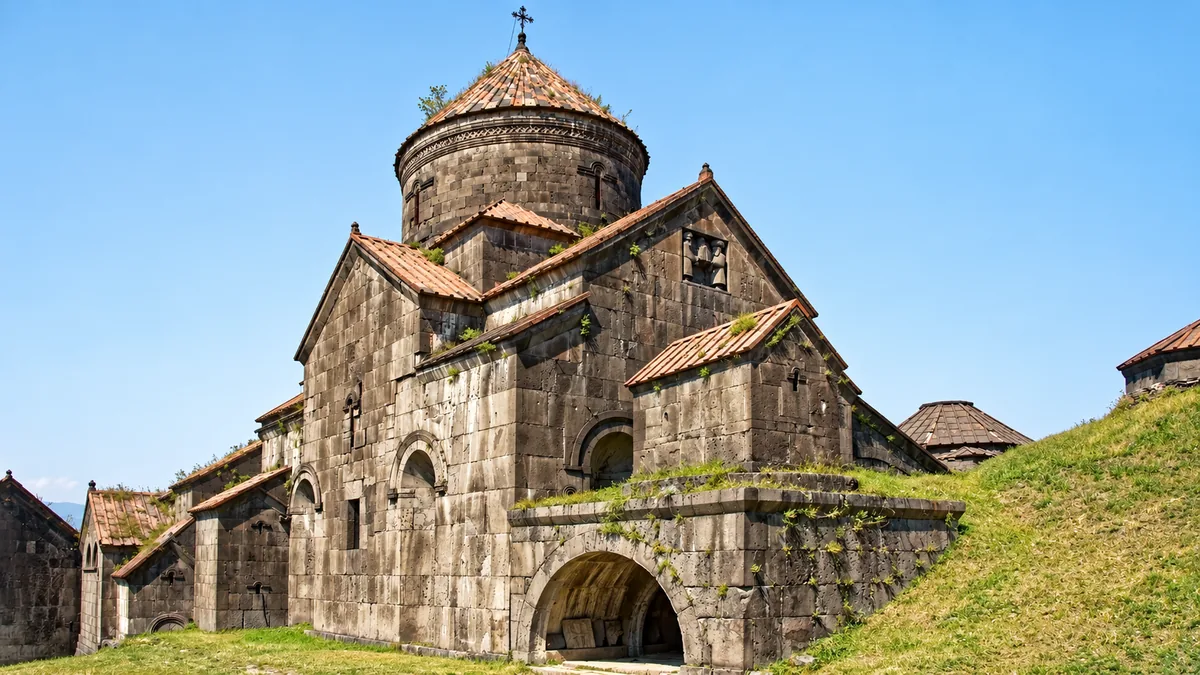
- Haghpat and Sanahin — the UNESCO-listed pair above the Debed Canyon in Lori, medieval centres of scholarship and manuscript production, on the natural route between Yerevan and the Georgian border.
- Gyumri — Armenia's second city, built from black and red volcanic tuff, with the country's best-preserved 19th-century streets, strong crafts traditions and a recovery from the 1988 earthquake that is still part of its story.
South: canyons, wine and Tatev
- Noravank and Areni — a 13th–14th-century monastery in a gorge of red cliffs, and next to it the village whose cave produced the world's oldest known winery.
- Jermuk — a high mountain spa town with mineral springs, a gorge and a 70-metre waterfall.
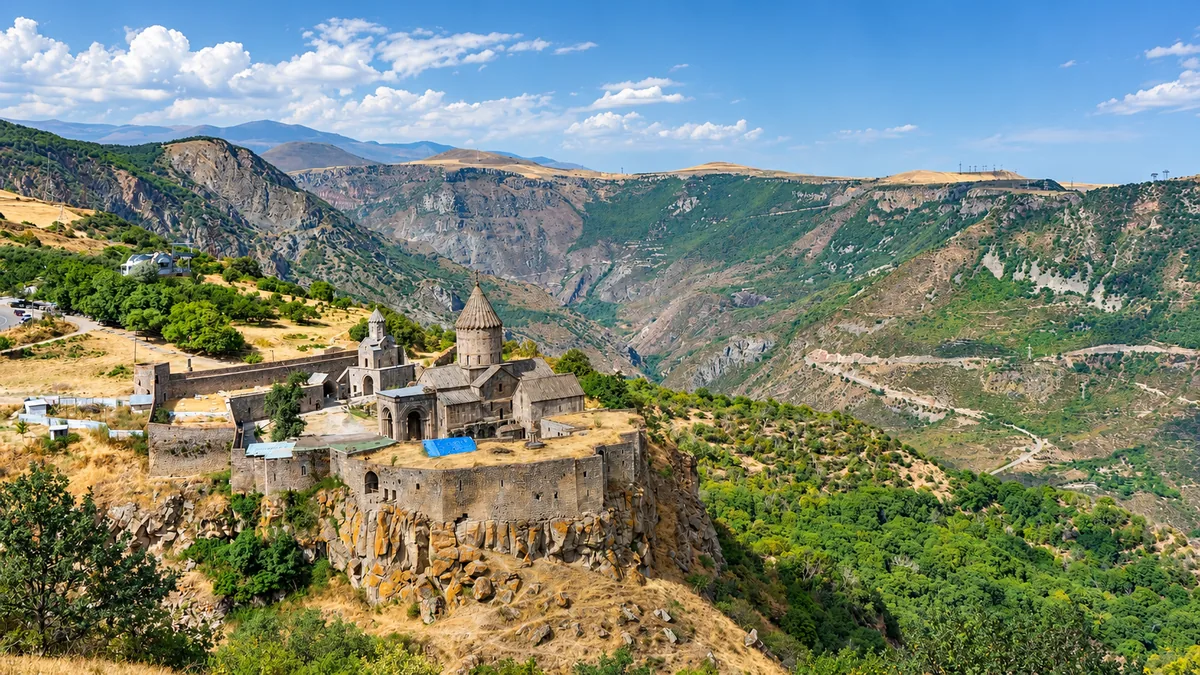
- Goris and Tatev — the stone town that serves as the base for southern Armenia, and the fortified 9th-century monastery above the Vorotan Gorge reached by the Wings of Tatev cableway.
- Sisian and Zorats Karer — a quiet highland town and, just outside it, a plateau of prehistoric standing stones, often called Armenia's Stonehenge.
Yerevan: The Capital
Yerevan was founded in 782 BC as the fortress of Erebuni, which makes it older than Rome, but almost nothing you see in the centre is older than the 1920s. The city was rebuilt in the Soviet period to a plan by the architect Alexander Tamanian, in the pink and orange volcanic tuff that gives it its nickname, and the result is one of the most walkable capitals in the region: a compact ring of boulevards, parks and squares that can be crossed on foot in half an hour.
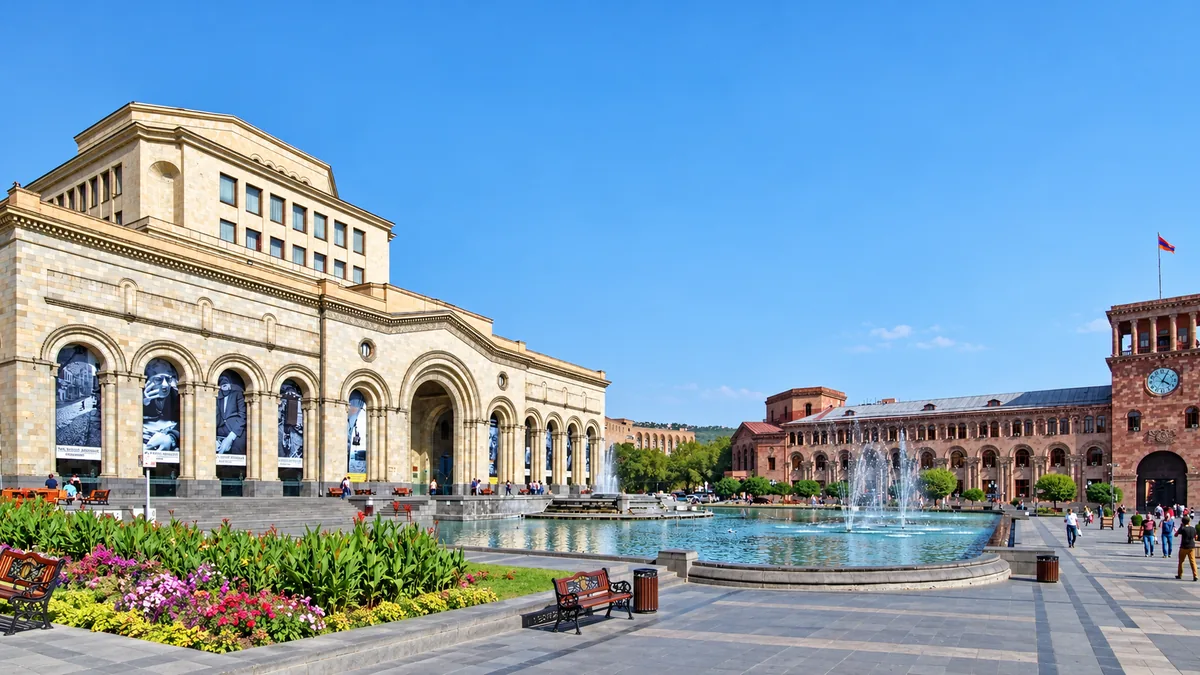
Start at Republic Square, the ensemble of five monumental buildings around an oval paved like an Armenian carpet, where the History Museum holds the 5,500-year-old Areni leather shoe. Walk up to the Cascade, the giant limestone stairway whose terraces hold the Cafesjian Center for the Arts and whose top gives the classic view over the city to Ararat. The Matenadaran, at the head of Mashtots Avenue, keeps one of the world's great collections of medieval manuscripts, and the Tsitsernakaberd memorial and museum on the hill across the Hrazdan gorge are the place to understand the event that shaped modern Armenian identity.
Then slow down. The Vernissage weekend market sells carpets, carved wood and Soviet leftovers; the GUM market is the place for dried fruit, herbs and cheese; the streets around Saryan Street and the Opera have become the city's wine-bar district; and Yerevan's café life, from the Cascade terraces to the shady courtyards of Kentron, is as much a part of the experience as any museum. Two full days is a sensible minimum for the city itself; our things to do in Yerevan guide breaks that down further.
Monasteries and Christian Heritage
You do not need to be religious to find Armenia's churches extraordinary, but it helps to understand why there are so many. Armenia adopted Christianity as a state religion early in the 4th century, developed its own alphabet in 405 to translate the Bible, and spent the next thousand years building in stone as a way of surviving between larger empires. The monasteries were universities, libraries and fortresses as much as places of worship, and they were deliberately put in defensible, remote places, which is why so many of them stand above gorges and on mountain spurs.
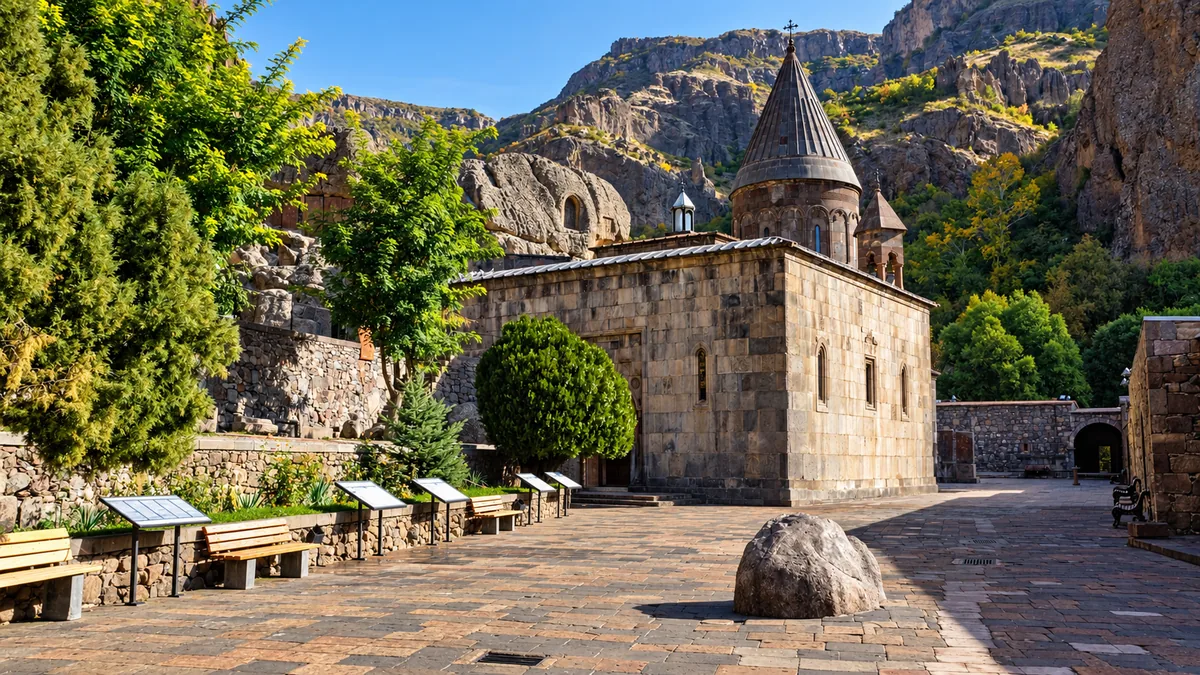
A handful stand out. Etchmiadzin is the Vatican of the Armenian Church, with a cathedral whose origins go back to 301–303 AD. Geghard is the one visitors remember even after a week of churches, because its chapels are hollowed out of the rock and its acoustics are famous. Khor Virap matters more for its story and its view than its architecture. Haghpat and Sanahin, in the north, are the finest examples of the 10th–13th-century monastic complexes that doubled as academies. Noravank is a masterpiece of the sculptor-architect Momik, glowing against red cliffs. Tatev is the great fortified monastery of the south, and Sevanavank is the small 9th-century pair of churches that gives Lake Sevan its most famous silhouette.
A note on accuracy, because guidebooks and tour brochures blur it: only three properties in Armenia are inscribed on the UNESCO World Heritage List, and the others, however remarkable, are not. Everywhere, look for the khachkars, the carved cross-stones that are Armenia's most distinctive art form; the finest are at Noratus, Geghard and Goshavank.
Nature and Landscapes
Armenia is roughly the size of Belgium and around 90 percent of it lies above 1,000 metres, so almost every drive is a mountain drive. The variety within that is what surprises people.
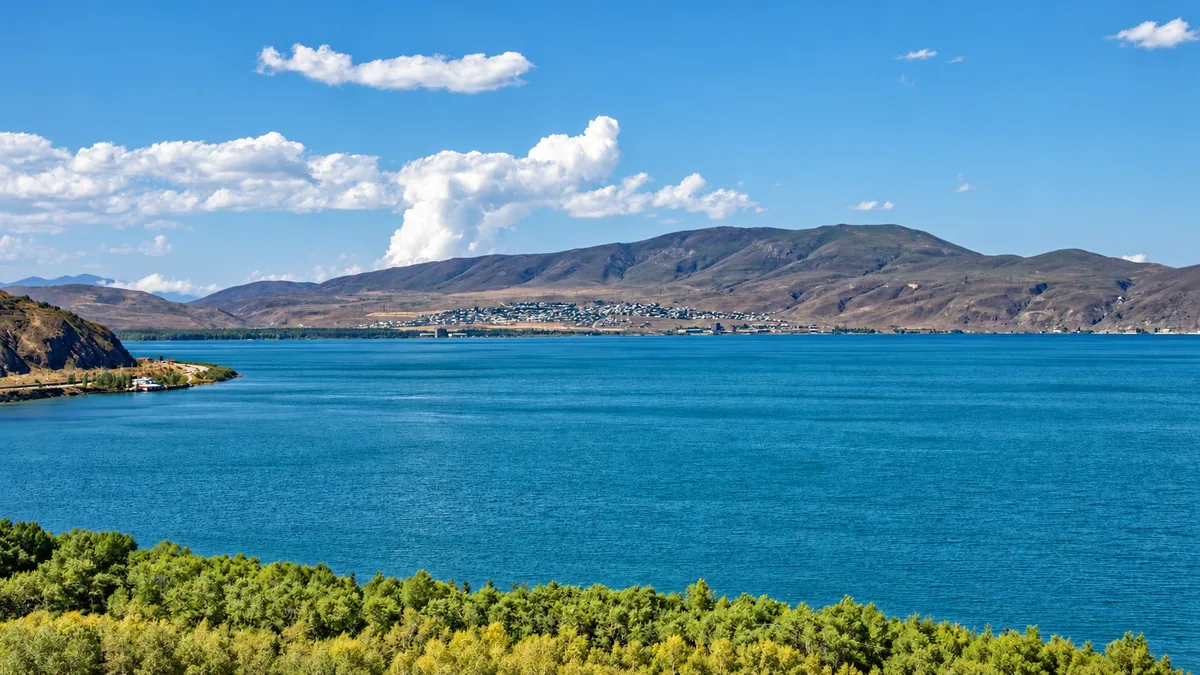
- Lake Sevan covers about 1,240 square kilometres at 1,900 metres, with beaches, fish restaurants and cold, clear water that is swimmable from July to early September.
- Mount Aragats is the country's highest mountain. A paved road climbs to Kari Lake at about 3,200 metres, from where the southern peak is a strenuous day hike in summer; the northern summit is a serious mountaineering objective.
- Mount Ararat lies across the border in Turkey but dominates the view from Yerevan, Khor Virap and the whole Ararat plain on clear mornings, especially in spring and autumn.
- Dilijan National Park and the Tavush forests are the green, wet exception to Armenia's dry highlands, with marked trails between monasteries and villages.
- Vayots Dzor means "valley of woes", but its red canyons, caravanserais on the Selim Pass and gorges around Noravank and Jermuk are the most photogenic drive in the country.
- Syunik, the far south, is the wild region: the Vorotan Gorge below Tatev, the cave villages of Khndzoresk and Old Goris, the Zangezur mountains, and a climate that turns almost subtropical near the Iranian border at Meghri.
- Gorges near the capital: the Azat gorge below Garni, with the Symphony of Stones, and the Debed Canyon in Lori, Armenia's rafting river.
Hiking infrastructure has improved a great deal, with the Transcaucasian Trail and local marked routes around Dilijan, Tatev and Aragats, but away from those areas you should treat trails as unsupported: carry water, download offline maps and tell someone your plan.
Armenian Food
Armenian cooking is Middle Eastern and Caucasian at once, and simpler than its neighbours' in the best sense: bread, grilled meat, vegetables, herbs and dairy, done with care. A few things to know before your first meal:
- Lavash — the thin bread baked against the wall of a clay tonir, inscribed by UNESCO in 2014 as part of Armenia's intangible cultural heritage. It wraps everything.
- Khorovats — Armenian barbecue, usually pork or lamb on long skewers over wood coals, served with grilled vegetables and raw onion. This is the national dish and the centre of any celebration.
- Dolma (or tolma) — minced meat and rice wrapped in vine or cabbage leaves; the summer version stuffs tomatoes, peppers and aubergines.
- Harissa — a slow-cooked porridge of wheat and chicken, historically a dish of resilience and still served at Easter and in Musaler in September.
- Spas — a warm yoghurt soup with wheat and herbs, the everyday comfort dish.
- Ghapama — a pumpkin baked with rice, dried fruit and honey, the showpiece of autumn tables.
- Cheese and greens — salty white Lori and Chanakh cheeses, eaten with bundles of tarragon, basil, coriander and spring onion that arrive with every meal.
- Sweets — gata, a layered sweet bread found at every monastery gate; sujukh, walnuts threaded on a string and dipped in grape must; and the dried apricots, peaches and persimmons that are Armenia's signature export.
Vegetarians eat well: zhingyalov hats, a flatbread stuffed with a dozen wild greens, bean and lentil dishes, grilled vegetables and the endless herb plates make it easy. Markets, above all the GUM market in Yerevan, are the best place to taste your way through the dried fruit, cheese and pickles. Note that khinkali and khachapuri, which you will see on some menus, are Georgian; Armenia's own dishes are the ones above.
On drinks: Armenian brandy, aged in Yerevan since the 1880s and famous through the Ararat brand, is the national spirit, and the Yerevan Brandy Company runs tours and tastings. Oghi, a fruit or mulberry spirit, appears at village tables. Coffee is strong, sweet and boiled in a small pot, and refusing a second cup is close to impossible.
Armenian Wine
Georgia gets the headlines for ancient wine, but Armenia's claim is at least as old. In Areni-1 Cave, beside the Arpa River in Vayots Dzor, archaeologists found a complete winemaking installation, with a press, fermentation vats and drinking cups, dated to around 4,000 BC. That makes it the oldest known dedicated winery discovered anywhere, roughly 6,100 years old, and the cave is still an active excavation you can visit.
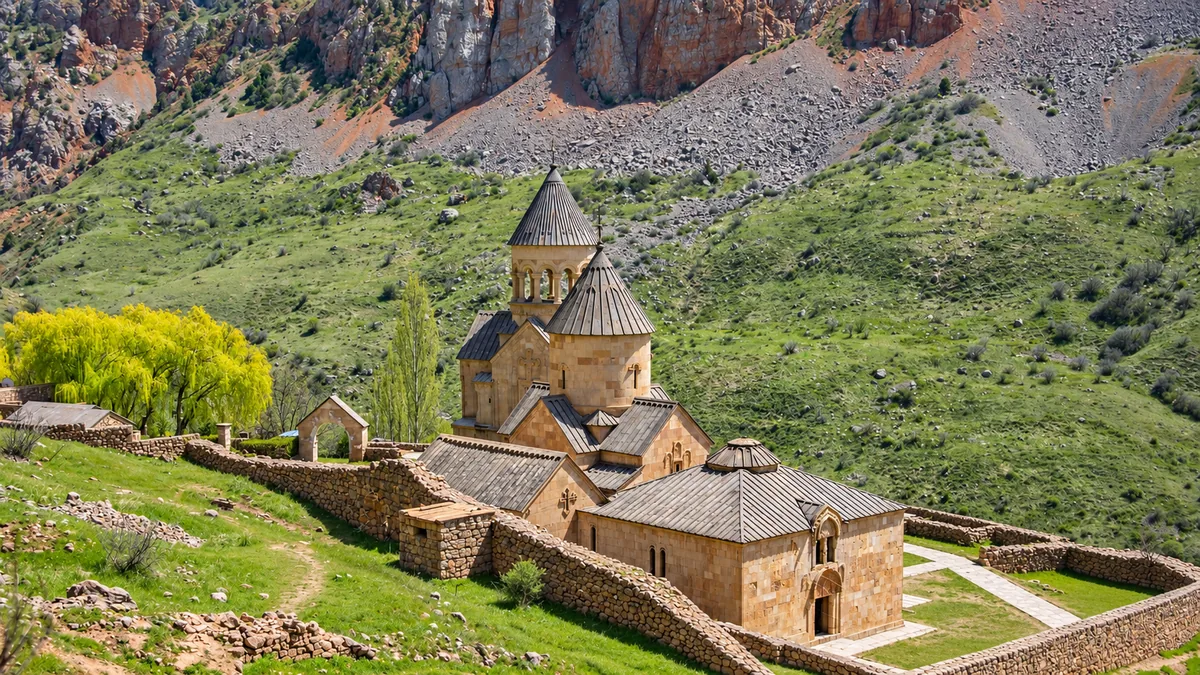
The modern revival is centred on the same valley. Areni village lines the road with family cellars where you taste for a small charge or nothing at all, and a generation of serious producers now works with the indigenous grapes: Areni Noir, a light, spicy red grown at over 1,000 metres, and the white Voskehat, along with Kangun and Khndoghni from the south. Wineries around Areni, Yeghegnadzor and in the Ararat plain welcome visitors, and Yerevan's wine bars pour the results by the glass. If you can time a visit for the harvest festival in Areni in early October, do.
Getting to Armenia
By air. Almost everyone arrives at Zvartnots International Airport (EVN), about 12 kilometres west of Yerevan, with direct flights from many European, Middle Eastern and CIS cities; from most of Western Europe you will connect through hubs such as Vienna, Paris, Warsaw, Athens, Istanbul, Doha or Dubai. A taxi or ride-hailing car to the centre takes about 20 minutes. Gyumri's Shirak Airport handles a smaller number of flights.
Overland from Georgia. The main crossing is Bagratashen–Sadakhlo on the Tbilisi–Yerevan road, about 70 kilometres south of Tbilisi, which operates around the clock. Minibuses, shared taxis and private transfers run daily between the two capitals in roughly five to six hours, and the route passes Haghpat and Sanahin, so many travellers make the crossing a sightseeing day rather than a transit. A second crossing at Bavra–Ninotsminda links Gyumri with Georgia's south. There is also a train between Yerevan and Tbilisi; its schedule changes, so check current timetables. Our border crossings guide covers the practicalities from the Georgian side.
Other borders. The land border with Iran at Agarak is open to travellers with the appropriate visas. Armenia's borders with Turkey and Azerbaijan are closed to crossing; treat any news about changes as something to verify with official sources rather than assume.
Getting Around Armenia
Armenia is small, but public transport is built around cities and market towns rather than monasteries and viewpoints, so how you move around shapes what you see.
- Private driver or private tour. The most efficient way to see the country. A driver-guide can link Garni, Geghard and Sevan in one day, or handle the long southern loop through Vayots Dzor to Tatev, with stops where you want them. This is how most first-time visitors with a week or less travel, and it is what Hikasus arranges.
- Marshrutkas and buses. Minibuses leave Yerevan's Kilikia bus station and smaller hubs for every regional town, cheaply and reasonably often. They are a genuine way to reach Dilijan, Gyumri, Goris, Jermuk or Sevan town; the catch is that most monasteries are several kilometres off the route, so you finish the journey by taxi.
- Trains. Comfortable modern trains link Yerevan with Gyumri, and a seasonal line serves Sevan in summer. The network is limited but pleasant.
- Taxis and ride-hailing. Yerevan taxis are inexpensive, and apps such as Yandex Go and GG give fixed fares without negotiation. Taxi drivers in regional towns will happily agree a price for a half-day monastery circuit.
- Rental car. Gives you complete freedom, especially in Vayots Dzor and Syunik, at the cost of some challenging roads; see the next section. Cross-border rentals from Georgia are possible with the right paperwork.
Driving in Armenia
The main roads from Yerevan to Sevan, Dilijan, Gyumri, the Georgian border and south through Vayots Dzor are paved and in reasonable condition, and traffic outside the capital is light. Beyond that, expect variety: potholes, gravel sections on the way to villages and monasteries, unlit roads at night, and livestock on mountain passes. Yerevan driving is assertive rather than dangerous, and parking in the centre is paid by zone.
Travel times are longer than the map suggests. Yerevan to Tatev is about 250 kilometres but takes four to five hours; Yerevan to Dilijan is 100 kilometres and around an hour and a half. Winter brings snow and ice to the Vardenyats (Selim) and Pushkin passes and to anything above 2,000 metres, and some high roads close. Navigation apps work well, but download offline maps for the south. Drive in daylight, keep the tank full outside the capital, and the driving is enjoyable.
Money in Armenia
The currency is the Armenian dram (AMD). Notes come in denominations from 1,000 to 100,000 dram, and prices are rarely quoted in anything else. Card payment is normal in Yerevan's hotels, restaurants, supermarkets and larger shops, and increasingly common in regional towns, but cash still rules at markets, village cellars, roadside fruit stands, taxis outside the apps and monastery shops, so carry some. ATMs are everywhere in Yerevan and available in every regional centre; exchange offices in the city give fair rates for euros, dollars and Georgian lari, and banks are the sensible option for larger amounts. Exchange rates move, so check them before you travel rather than relying on any figure printed here.
By Western European standards Armenia is good value. A meal in a good Yerevan restaurant, a guesthouse room in the regions and a marshrutka across the country all cost noticeably less than their equivalents at home, while imported goods, fuel and boutique hotels are closer to European prices. Tipping around 10 percent is appreciated in restaurants where no service charge is added.
Language
Armenian is an Indo-European language on a branch of its own, with a unique alphabet created by Mesrop Mashtots in 405 AD, 36 letters then and 39 today. Every visitor notices the script, and a few words go a long way: barev (hello), shnorhakalutyun (thank you, often shortened to the French merci), hajoghutyun (goodbye), ayo (yes), voch (no). Russian is widely understood, particularly by anyone over forty, and remains the most useful second language in villages. English is spoken by younger people, in hotels, in the tourism trade and across central Yerevan, and street signs in the capital and main sights are bilingual. Outside Yerevan, a translation app and patience solve most things.
Internet, SIM Cards and Connectivity
Mobile coverage is good across the inhabited country and 4G reaches most main roads, though it drops in deep gorges and on the high passes. Three operators — Viva (formerly Viva-MTS), Ucom and Team Telecom — sell tourist SIM cards at the airport and in city shops for a modest sum; bring your passport for registration. eSIMs from international providers also work in Armenia. Wi-Fi is standard in hotels, guesthouses and cafés, and Yerevan is comfortably set up for remote work. Power sockets are the European two-pin type at 230 V.
Safety in Armenia
Armenia is generally regarded as a low-crime country, and visitors tend to remark on how relaxed Yerevan feels at night. Normal precautions apply: watch your belongings in crowded markets and on minibuses, use metered or app taxis, and be careful on mountain roads and unfenced viewpoints. Tap water in Yerevan is safe to drink, and the city's public drinking fountains, the pulpulaks, are a local institution.
The one thing to check rather than assume is regional security. Armenia's borders with Azerbaijan and Turkey are closed, and conditions in some border districts have changed in recent years. Government travel advisories from your own country describe which areas, if any, they advise against, and reputable operators plan routes accordingly. None of the places in this guide requires you to go near those zones.
Visa and Entry Requirements
Entry rules depend on your nationality. Citizens of the European Union, the United Kingdom, the United States, Australia and many other countries do not need a visa for tourism; where a visa-free regime applies, the general rule is a stay of up to 180 days within a one-year period. Many other nationalities can apply for an electronic visa online in a few minutes, and a smaller group needs a visa from an Armenian embassy or consulate. Your passport should be valid for the whole of your stay.
These lists change from time to time, so treat them as a starting point rather than a guarantee, and confirm your own status on the official Armenian e-Visa eligibility checker before you book. Our dedicated Armenia visa and entry requirements page keeps the details current, including the rules for travellers who hold residence permits rather than passports from visa-exempt countries.
Culture and Etiquette
Armenians are direct, warm and proud of their country, and hospitality is taken seriously: an invitation for coffee is meant, and an offer of food should be at least tasted. At churches and monasteries, which are working places of worship, dress modestly (shoulders and knees covered; women are often offered a headscarf, though it is not always required), speak quietly, do not walk in front of people praying, and ask before photographing clergy or ceremonies. Photography of the buildings themselves is normally fine.
Removing your hat indoors, standing when an elder enters, and letting your host make the first toast are small courtesies that are noticed. Politics and history, above all the events of 1915, are serious subjects here and are best approached by listening. And be ready for the question every visitor is asked within a day: "Have you seen Ararat yet?"
What to Pack
- Layers, whatever the season. A 35°C afternoon in Yerevan and a 12°C evening at Lake Sevan can be the same day.
- Good walking shoes for monastery steps, gorge paths and cobbles, plus proper boots if you plan to hike Aragats or the trails around Dilijan.
- Sun protection. The altitude makes the sun strong even when the air feels cool; hat, sunglasses and sunscreen are essential in summer.
- A warm jacket, hat and gloves from October to April, and for any high-altitude day in summer.
- A refillable water bottle — the pulpulaks in Yerevan and springs at many monasteries make it easy to top up.
- A scarf that doubles as a head covering in churches, a European plug adapter if you need one, and any prescription medicines, which are easy to find in Yerevan but less so in villages.
Armenia for Different Kinds of Travellers
- History and culture: the three UNESCO ensembles, the Matenadaran, the museums of Yerevan and Gyumri, and the medieval monasteries of Lori and Syunik give a week's worth of serious sightseeing.
- Food and wine: Yerevan's restaurants and wine bars, the Areni cellars, the GUM market and a village khorovats lunch cover the range.
- Hiking and nature: Aragats, Dilijan National Park, the Transcaucasian Trail sections around Tatev and the shores of Sevan, best from June to October.
- Photography: Khor Virap at sunrise, Noravank in late afternoon light, the Cascade at dusk, and the autumn colour of the Debed Canyon.
- Couples: a boutique hotel in Yerevan, a wine-country stay in Vayots Dzor and a cableway ride to Tatev make a very good week.
- Families: short distances, safe streets, the Sevan beaches in summer, the ropeway and gentle walks at Tsaghkadzor, and children are welcomed everywhere.
- Private and tailor-made travel: because the sights are spread across ten regions and public transport reaches only the towns, a private itinerary is the most natural way to experience Armenia in depth, and it lets a week hold what would otherwise take two.
Armenia and Georgia in One Trip
The two countries share a border, a Christian heritage that predates most of Europe's, a love of long tables and toasts, and a mountain landscape that shifts character every hour, but they are not interchangeable. Georgia is greener, wetter and wine-soaked, with the Black Sea and the high Caucasus; Armenia is higher, drier, more monastic and more compact. Seeing both in one journey is common, sensible and easy: Tbilisi to Yerevan is a day's drive with Haghpat and Sanahin on the way, and a two-week trip can comfortably give each country a week.
If you are starting from Georgia, our Georgia travel guide is the companion to this one. A natural combined route runs Tbilisi – Kakheti – the Debed Canyon – Dilijan and Sevan – Yerevan and its day trips – Vayots Dzor – Tatev, or the same in reverse, flying into one capital and out of the other.
Final Travel-Planning Advice
The best Armenia trips balance four things: a couple of unhurried days in Yerevan, the major historic sites within reach of it, at least one regional overnight for the landscapes, and enough slack for the slower experiences — a long lunch in a village garden, a cellar visit that becomes a conversation, an evening watching the light change on Ararat. Try to do everything and the country becomes a checklist of monasteries; give it room and it becomes one of the most rewarding places in the region.
If you would like help turning this into an itinerary, Hikasus Travel plans private Armenia trips, tailor-made Armenia itineraries and combined Armenia and Georgia journeys with local drivers and guides. Start with our Armenia destination pages, and get in touch when you are ready to talk dates.