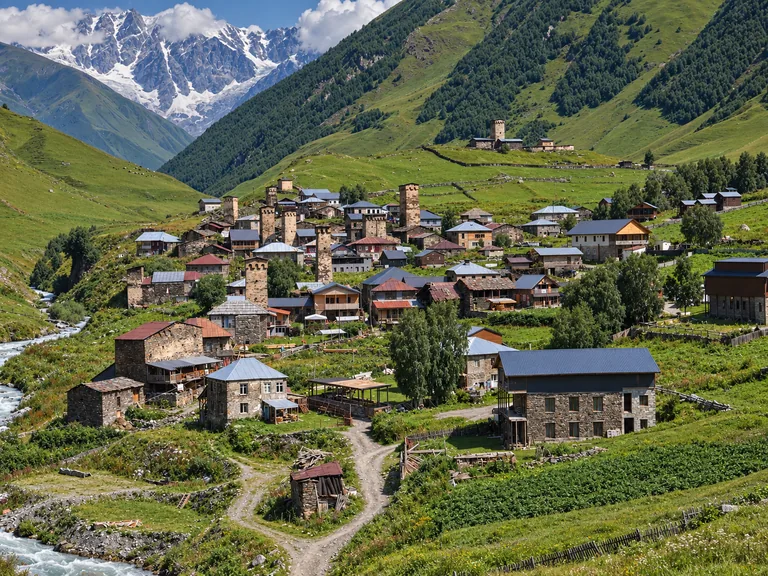
Seven days is enough to see most of what Armenia is known for, but only if you accept that two of those days are mostly spent on the road. Almost everything worth visiting lies within a day's drive of Yerevan, which is why a one-week route can take in the capital, the UNESCO monasteries, the wine villages of Vayots Dzor, the cliff-top monastery at Tatev, Lake Sevan and the forests of Dilijan. What the schedule cannot do is make the distances disappear.
This guide lays out a realistic Armenia itinerary for 7 days, explains why each day is built the way it is, and says plainly where the long days fall and what you could trim. It follows the same route as our private 7-Day Armenia Tour, but you do not need to book anything to use it. For visa rules, money, transport and general trip-planning advice, see our complete Armenia travel guide; this article stays focused on the one-week route.
How to use this 7-day Armenia itinerary
The route starts and finishes in Yerevan, so it works with almost any flight schedule, and it uses three bases: the capital, Goris in the south and Dilijan in the north-east. Yerevan accounts for four of the six nights, with one night each in Goris and Dilijan.
Three things shape the plan:
- Two regional overnights. The south and the north-east are too far to treat as day trips, so the route moves hotels twice instead of returning to Yerevan each night.
- Two long driving days. Day 4 and Day 5 involve about seven and five hours behind the wheel, on top of the sightseeing. We come back to this below.
- A May to October window. The Day 5 road crosses Selim Pass, a high mountain road that is not reliably open or safe to drive in winter, so this exact loop belongs to the warmer months.
A private driver makes the loop much easier, because you stop where you like and nobody has to find parking at a monastery gate. We say more about driving yourself further down.
Armenia in 7 days at a glance
| Day | Route | Driving |
|---|---|---|
| 1 | Arrival and Yerevan city tour | about 30 min |
| 2 | Echmiadzin, Zvartnots and Sardarapat | about 2 hours |
| 3 | Garni, Symphony of Stones and Geghard | about 2 hours |
| 4 | Khor Virap, Areni, Noravank and Tatev, overnight in Goris | about 7 hours |
| 5 | Khndzoresk, Selim Pass, Lake Sevan and Dilijan | about 5 hours |
| 6 | Haghartsin, Goshavank and the return to Yerevan | about 3 hours |
| 7 | Departure | about 30 min |
As a single line on the map: Yerevan, Echmiadzin, Garni and Geghard, Khor Virap, Areni, Noravank, Tatev, Goris, Lake Sevan, Dilijan, and back to Yerevan. Driving times are approximate and include only time in the vehicle, not stops.
Day 1: Yerevan
Use the first day to get oriented rather than to tick things off. If your flight lands in the morning you can start at once; many flights arrive at night, in which case the day is simply a hotel and a late meal.
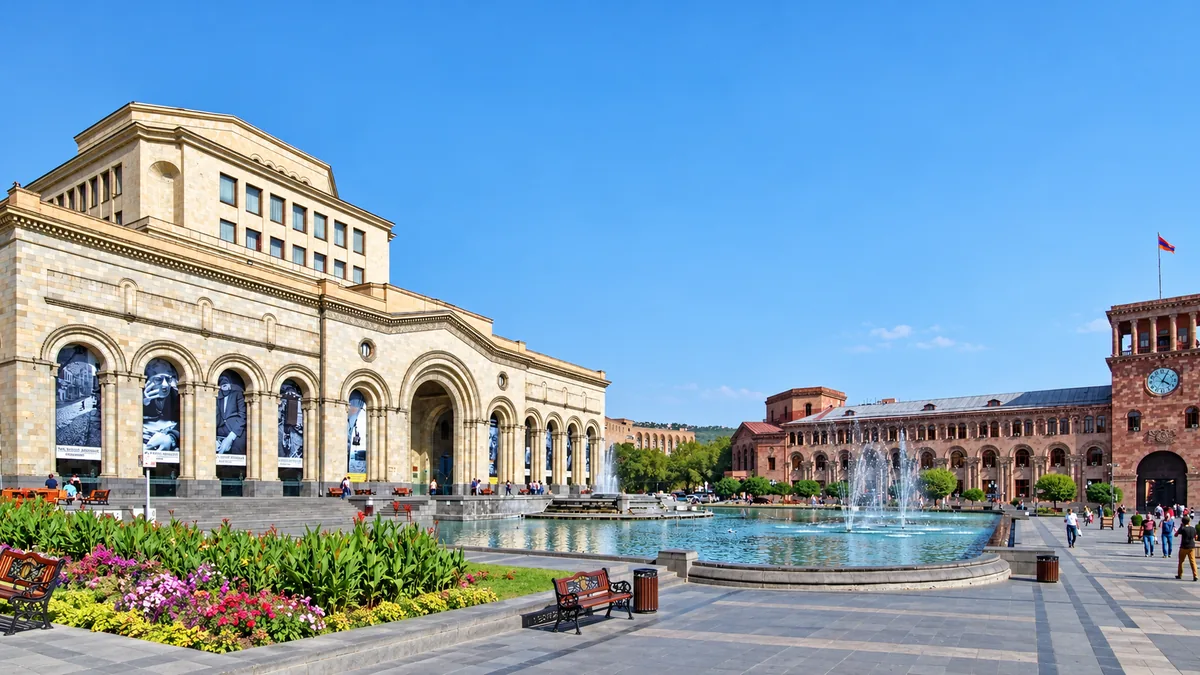
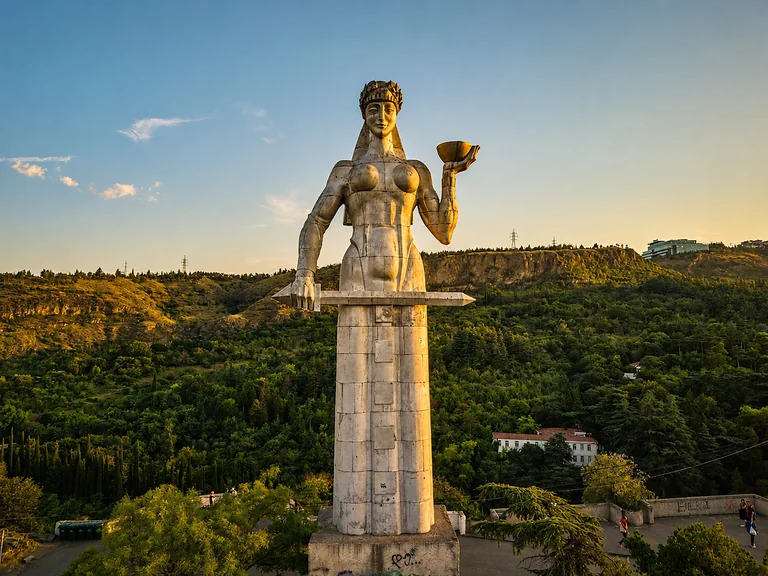
Start at Republic Square, the neoclassical ensemble that sets the tone for the whole city, then walk to the Cascade, a giant stairway of terraces and sculpture climbing the hillside. From the top you can see across the city, and on a clear day toward Mount Ararat. Clear days are not guaranteed, so treat the mountain as a bonus rather than a promise.
If you have the energy, add the Matenadaran, the repository of Armenia's ancient manuscripts, and Victory Park, where the Mother Armenia monument stands above the Cascade. Finish with a proper Armenian dinner: grilled meat, fresh herbs, lavash and a glass of local wine. It is the easiest way to see why Yerevan feels more sociable than first-time visitors expect.
Day 2: Echmiadzin, Zvartnots and Sardarapat
Day 2 heads west into the Armavir plain, Armenia's religious and historical heartland, and it is a short, easy day. Etchmiadzin is the seat of the Armenian Apostolic Church, and its cathedral is among the oldest in the Christian world. Nearby stand the 7th-century ruins of Zvartnots. UNESCO lists the two together as a single World Heritage site.
The two sites make a good pair because they show the same story from opposite directions: a church that is still in daily use, and one that survives only as a field of carved stone and a few reassembled columns. Then drive on to the Sardarapat Memorial, built to mark the 1918 battle that is remembered as securing Armenia's survival, with an ethnography museum on the same grounds. Return to Yerevan for the night.
If you need to shorten it: Sardarapat is the easiest stop to skip, and Etchmiadzin and Zvartnots together fit comfortably into a half day.
Day 3: Garni, Symphony of Stones and Geghard
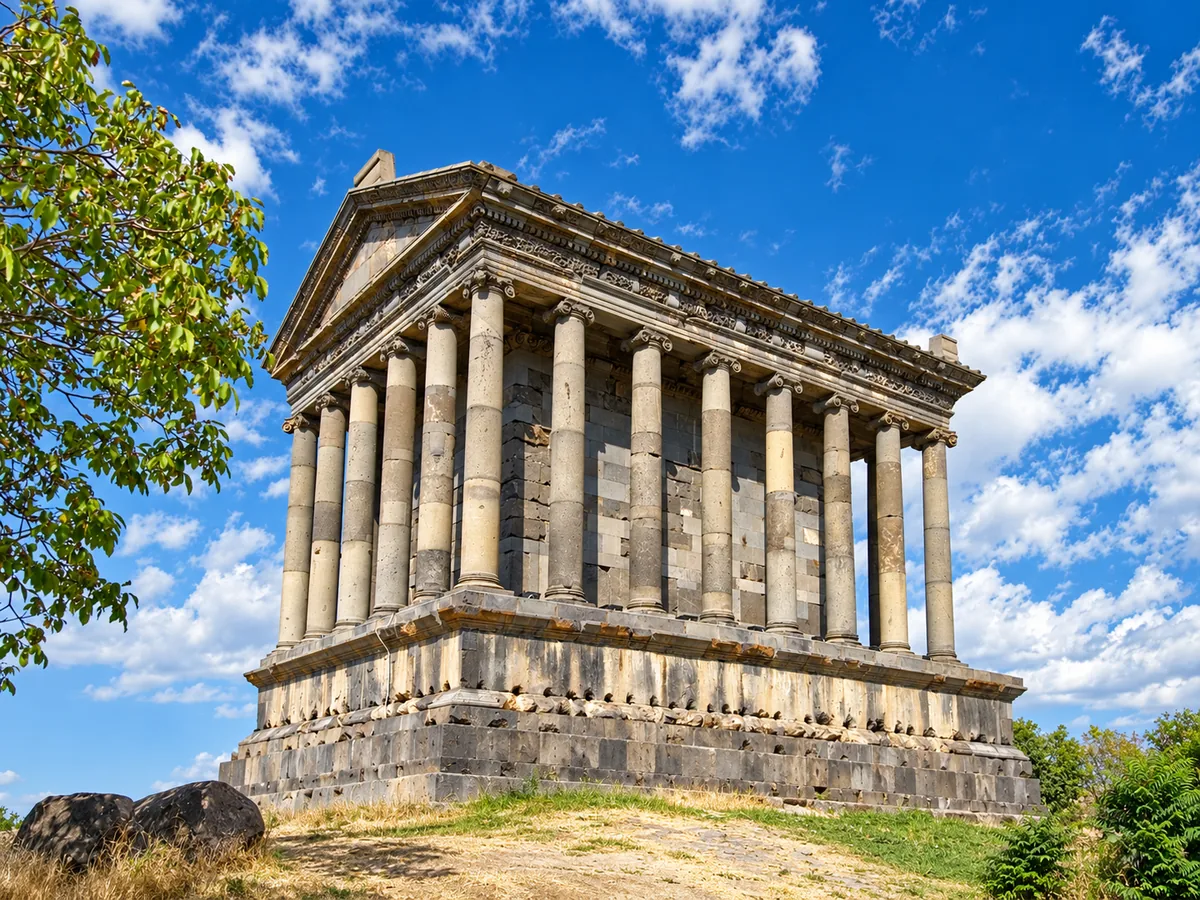
This is the day that shows how far apart Armenia's pre-Christian and Christian heritage sit, and how close they are on the map. The pagan temple at Garni is a 1st-century Greco-Roman building, the only one of its kind to survive in the former Soviet Union, standing on a cliff edge above the Azat Gorge. A short walk or drive below it, the Symphony of Stones is a wall of tall basalt columns that look like organ pipes.
Then continue to Geghard, a UNESCO World Heritage monastery that is partly carved straight into the rock face. The name means "spear", after the relic that tradition says was kept here. Inside, the chambers cut from the cliff stay cool and dim even on a hot day. Both stops are within about an hour of Yerevan, so the drive is short and the day still feels full.
Taken together with Day 2, the first three days cover the capital and both UNESCO-listed ensembles near it without a single hard drive.
Day 4: south to Tatev, the long day
Day 4 is the signature of the route and also its hardest day. Plan for roughly ten to eleven hours from hotel to hotel, with about seven of them in the car. This is not a day to add extra stops to, and it is not a day for anyone who gets restless on long drives.
The morning begins at Khor Virap, on a low hill on the Ararat plain, with one of the closest views of Mount Ararat from anywhere in Armenia. The mountain lies across the border in Turkey and is often hidden by haze or cloud, so visibility cannot be guaranteed on any given day. The monastery is worth the stop even if the summit stays hidden: according to tradition, Gregory the Illuminator was held in the pit here before he went on to convert the Armenian king.
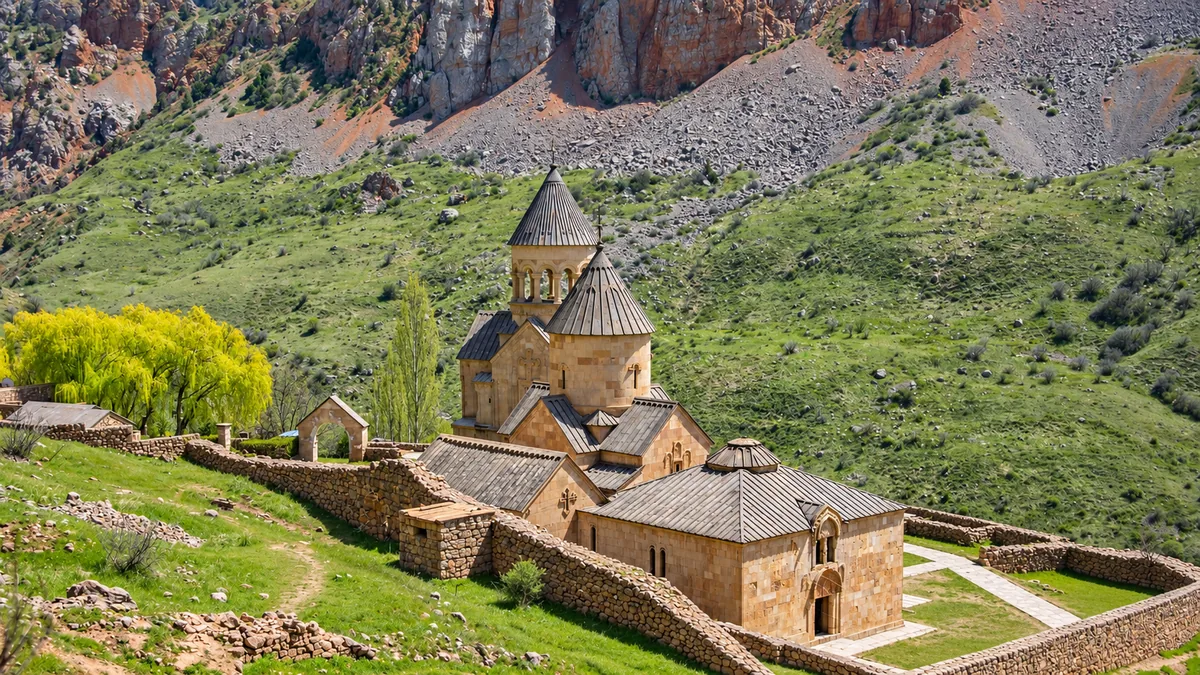
The road then climbs into Vayots Dzor and the wine village of Areni, where a tasting at a local winery is a natural break. Wine has been made in this valley for a very long time; the Areni-1 cave nearby is where archaeologists found a wine press dated to about 4100 BC. After Areni comes Noravank, a 13th-century monastery set at the end of a narrow canyon with red cliffs on both sides. Its two-storey church, with narrow stone steps projecting from the façade, is one of the most recognizable buildings in the country.
The final leg is the Tatev section. From the village of Halidzor you ride the Wings of Tatev, a reversible aerial tramway that crosses the Vorotan Gorge in roughly a dozen minutes, to the monastery on its plateau above the gorge. The ride is part of the experience: the ground simply falls away beneath you. Tatev itself is a fortified monastic complex with a long history as a centre of learning, and it deserves more time than a late-afternoon rush allows. The cable car can pause in strong wind and has maintenance periods, so ask your driver or hotel to check operations before you rely on it. The day ends a short drive away in Goris, a quiet town of old stone houses.
If you need to shorten it: Areni is the stop most easily trimmed to a short tasting, and travelers who prefer a gentler pace sometimes drop Noravank. Do not drop Tatev; it is the reason the south is on the route at all.
Day 5: Goris to Dilijan
After the long day south, Day 5 is another substantial travel day, about five hours of driving and seven to eight hours in total, though the stops are shorter and the scenery changes constantly. Do not imagine a leisurely morning in Goris.
Just outside town, Khndzoresk is a cave village that was inhabited into the 20th century, with a long suspension footbridge across the ravine. The road then climbs over Selim Pass, at roughly 2,400 metres, to the 14th-century Selim Caravanserai, one of the best-preserved stone caravanserais on Armenia's old trade routes. Carry a warm layer; the pass is cool even in summer.
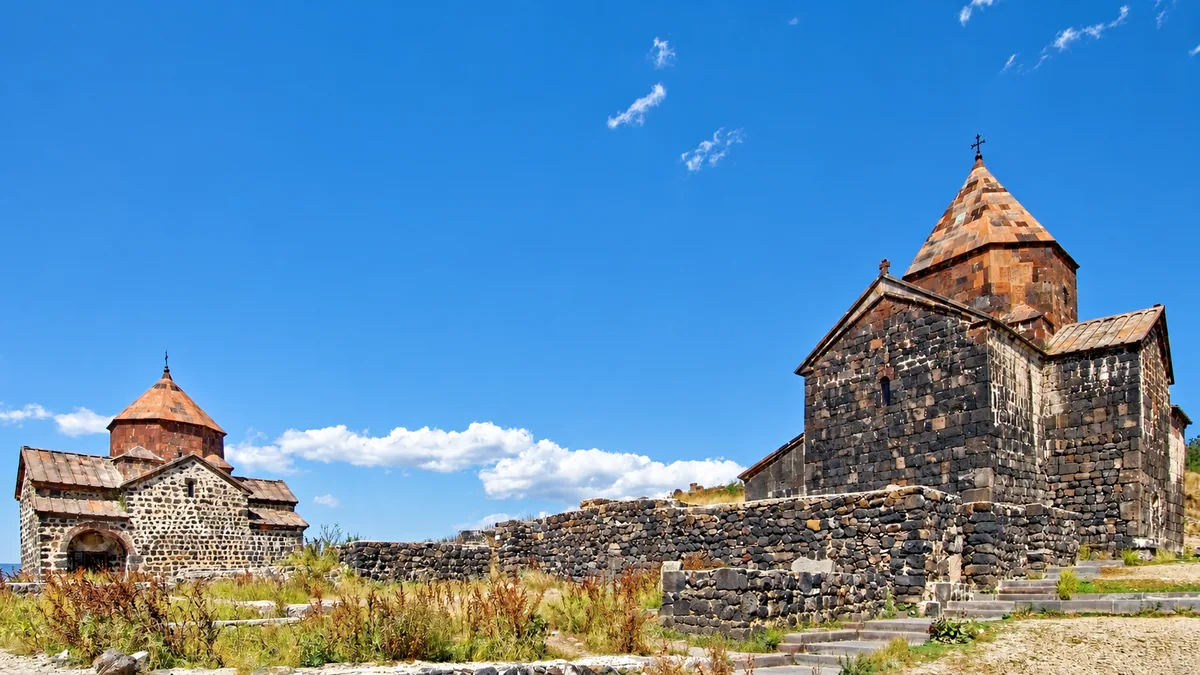
By afternoon you reach Lake Sevan, a large high-altitude lake whose colour changes with the weather, and Sevanavank, two 9th-century churches on a peninsula above the water. A short climb up the steps takes you to the churches and the best views of the lake. From there the road leaves the open highlands and enters the trees to Dilijan, a forested resort town in the north-east, where you sleep.
If you need to shorten it: Khndzoresk is the flexible stop; you can reduce it to the bridge viewpoint or skip it if the morning starts late. Selim Caravanserai is a short stop that fits any schedule.
Day 6: Dilijan, Haghartsin, Goshavank and Yerevan
Day 6 is the gentle one. Haghartsin Monastery sits in a wooded valley a short way outside Dilijan, its 13th-century churches among the trees rather than on open hillside, and Goshavank, a monastic complex of the same era, lies a little further on. The difference from the dry southern monasteries is striking: moss, shade and the smell of beech forest instead of red rock and wind.
Before leaving, walk through Dilijan's old town, known for its wooden balconies and small craft workshops. Then take the road back to Yerevan, about three hours, and arrive in the afternoon or early evening.
Day 7: departure
Day 7 is deliberately short: check out and transfer to Zvartnots International Airport, about thirty minutes from the city. If your flight leaves in the evening, you have a free morning. Good uses of it are the Vernissage market for crafts and souvenirs, the Cascade if you missed its upper terraces, and the Tsitsernakaberd memorial.
If you can add a night or a day, the best use is another day in Yerevan before you fly, which is exactly how the 8-day version of this route works. Our things to do in Yerevan page has more to fill it.
How fast is this itinerary?
It is not slow travel, and it is better to say so than to pretend otherwise. The first three days are comfortable: short drives, long lunches and a capital to wander in the evening. Day 4 is long, Day 5 is another significant travel day, and only Day 6 eases off again.
The trade-off is breadth. In one week you see Yerevan, the south, Lake Sevan and Dilijan, which is most of the country's variety, and you spend only two nights away from the capital. If you would rather see fewer places more slowly, drop a leg instead of rushing all of them, as we explain in the comparison further down.
Travel this route
Want to travel this route without organizing every transfer?
Our 7-Day Armenia Tour follows this journey from Yerevan through Tatev, Lake Sevan and Dilijan with a private guide and driver, and can be adjusted around your dates and pace.
Should you rent a car?
It depends on which half of the route you mean.
- Yerevan and its day trips are straightforward. Taxis and ride-hailing apps are cheap in the capital, and organized transfers or a taxi for the day cover Garni, Geghard, Echmiadzin and Zvartnots without difficulty.
- The full loop is a lot of driving. The southern and northern legs add up to about fifteen hours behind the wheel over three days, on mountain roads and in a country where local driving habits take getting used to.
- Public transport does not fit this itinerary. Minibuses connect Yerevan with Goris, Sevan and Dilijan, but most monasteries are a few kilometers off the main road, so you would be improvising taxis at every stop.
- A rental car suits experienced independent drivers. You gain freedom, and you take on navigation, parking and mountain weather. Our Armenia travel guide covers driving conditions in more detail.
- A private driver and guide makes the loop simpler. You are free to look out of the window, change the order of the stops and spend longer where something is worth it.
Best time for this 7-day route
The route works from May to October. May and June bring green hillsides and mild days, which suit the monasteries and the Tatev cable car especially well. September and October are the other comfortable periods, with clearer air and good light, and autumn colour in the forests around Dilijan toward the end of the season.
July and August are the hottest months, particularly in Yerevan and on the Ararat plain; the high passes and the lake are cooler, but you should plan the hot afternoons accordingly. Outside May to October we would not recommend this exact loop, because of Selim Pass.
Who this route is best for
It suits travelers who want a first trip to Armenia that covers a lot: culture and history, monasteries, wine and landscapes in one week. It works well for couples, friends and families with older children who are comfortable with long days in a vehicle.
It is less suitable if you prefer very slow travel, dislike long road days or want substantial hiking every day. In that case a Yerevan-based trip with day excursions, or a longer itinerary, will feel better. Our region pages are a good starting point for a route with more walking.
Where to stay on this route
The structure matters more than any single hotel: Yerevan, then Goris, then Dilijan, then Yerevan again. Stay in the centre of Yerevan so you can walk to restaurants in the evening, and in Goris and Dilijan choose a hotel close to the town rather than far outside it. Because you leave Yerevan for only two nights, it is worth asking your Yerevan hotel to hold your main bag while you travel, so you only pack for one night in the south and one in the north.
Practical tips for a week in Armenia
- Start and finish in Yerevan. Zvartnots International Airport is the main entry point, and the route is built around it.
- Check entry requirements before you go. Rules vary by nationality and change from time to time; see our Armenia visa and entry requirements page.
- Dress for mountains. Weather changes quickly above 2,000 metres, even in summer. A light jacket and a rain layer are worth carrying.
- Wear shoes with grip. Monastery steps, the Khndzoresk bridge approach and Tatev's stone paths are uneven.
- Respect the monasteries. Dress modestly, keep your voice down inside and ask before photographing a service.
- Carry some cash. Cards are widely accepted in Yerevan and in larger hotels and restaurants, but small villages, roadside stalls and tips are easier in Armenian dram.
- Arrange travel insurance. It covers medical care and cancellations, and it is best bought before you go.
- Plan Tatev ahead. The cable car is popular on summer weekends, and operations depend on wind and maintenance, so keep a little flexibility in the afternoon.
5, 7 or 8 days in Armenia?
The right length depends on how much driving you want to do.
- 5 days: a focused introduction based entirely in Yerevan, with day trips to Etchmiadzin and Zvartnots, Khor Virap, Noravank and Areni, and Garni, Geghard and Lake Sevan. It does not reach Tatev. See the 5-Day Armenia Highlights Tour.
- 7 days: the circuit described here, which adds Tatev and Goris in the south and Dilijan in the north. This is the strong one-week option, and it comes with the two long days.
- 8 days: the same route with a free day in Yerevan before departure, which gives you some breathing room after the road. See the 8-Day Armenia Grand Tour.
Plan it yourself or have it arranged
Prefer to have the route arranged for you? Explore our 7-Day Armenia Tour, or ask us to tailor the itinerary around your flights, pace and interests. If you would rather plan independently, the day-by-day outline above is yours to use as it is.