
Martvili
Martvili is a small town in the Samegrelo region of western Georgia — the country in the South Caucasus — set in the gently rolling landscape between the Rioni lowlands and the foothills rising toward Upper Samegrelo and Svaneti to the north. Around 4,000 people live here, and it has the unhurried character of a provincial town that has never really oriented itself around visitors: the canyon that made it famous lies a few kilometers outside the settlement, and the town carries on its own rhythm largely independent of the tourism nearby. For most people passing through, Martvili is a stop between Kutaisi and Zugdidi, or a base for the canyon and the monastery. For those who slow down, it offers more than that.
Samegrelo has its own distinct cultural identity within Georgia, shaped by the Mingrelian (Megrelian) people — a group with their own language, closely related to but distinct from Georgian, and a set of traditions and culinary practices that set the region apart. Martvili sits in the heart of this territory, and the Mingrelian character is felt in the food, in the speech of older residents, and in a certain local pride that runs through even casual encounters.
Why visit Martvili?
The main reason to visit Martvili is the Martvili Canyon, a deep limestone gorge with turquoise water, overhanging vegetation, and a flat-bottomed boat ride through its narrowest section — one of the most distinctive canyon experiences in Georgia. Add the 7th-century Martvili Monastery on a hill at the edge of town and the distinctive, notably spicy Megrelian cuisine, and the area rewards a half-day to a full day. It works best as a stop or day trip within a western Georgia circuit, usually based in Kutaisi, rather than a destination in itself — accommodation in the town is limited.
Martvili Canyon
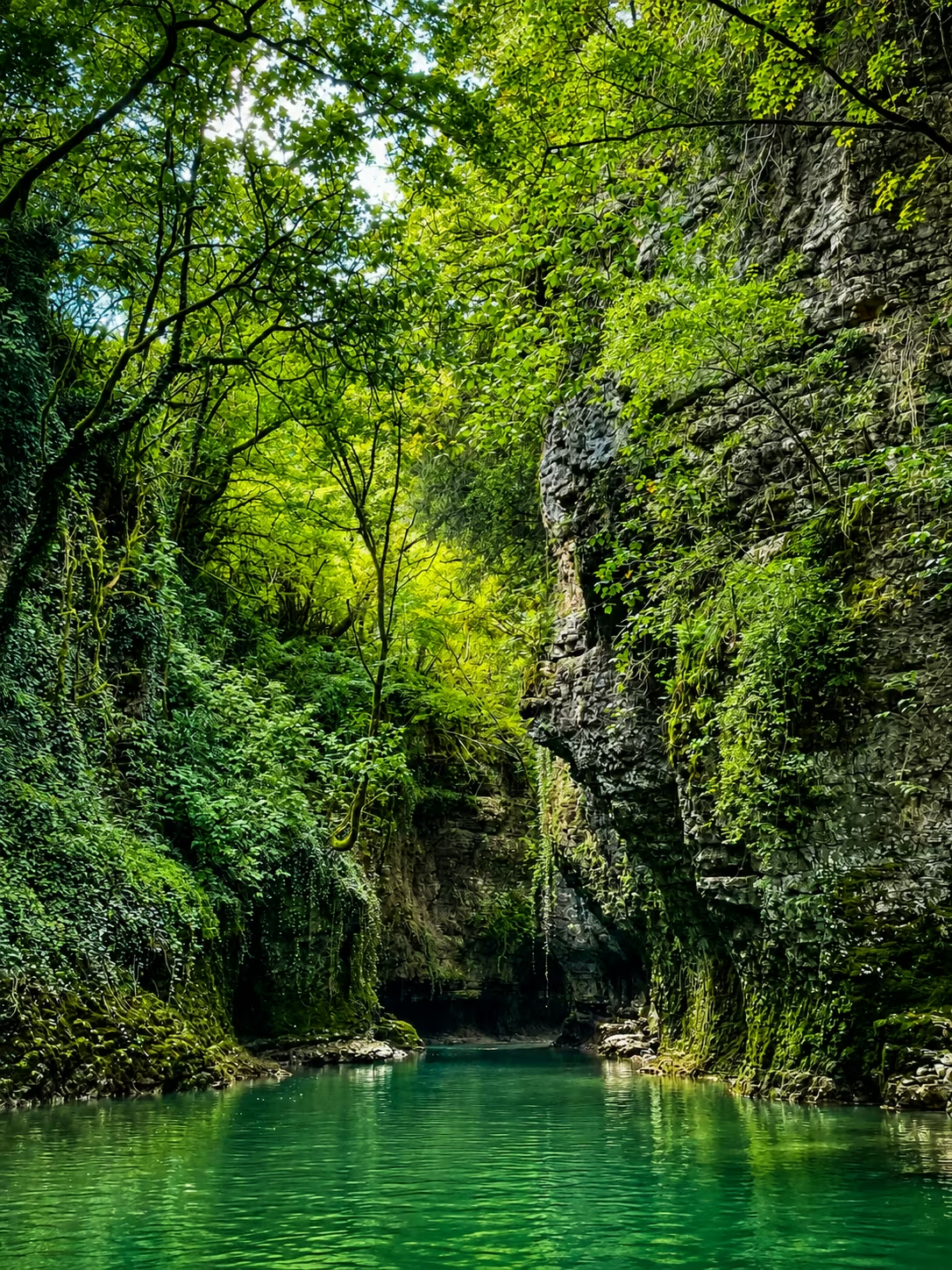
The canyon that put Martvili on the international travel map is a few kilometers outside the town, where the Abasha River has cut through a plateau of Jurassic limestone over millions of years to produce a gorge of considerable depth and striking character. The water carries the turquoise-green color typical of rivers fed by limestone geology, and against the sheer walls — overhung with ferns, moss, and subtropical vegetation clinging to every surface — the effect is genuinely dramatic.
The canyon is accessible by a path along its upper rim and, more distinctively, by flat-bottomed boat through the lower sections where the walls narrow and the river runs deep and slow between overhanging cliffs. The boat section covers roughly a kilometer and takes about twenty to thirty minutes, passing through a sequence of chambers where the walls rise steeply on both sides and only a narrow strip of sky is visible above. Several waterfalls drop into the canyon along this stretch, some reaching the river directly, others dissipating into spray against the rock. The combination of enclosed space, water color, and dense vegetation is quite unlike any other canyon in Georgia.
The upper path gives wider views over the gorge and access to viewpoints above the main waterfall sections, and the full visit — path plus boat ride — takes two to three hours at a comfortable pace. The site is well organized, with a ticket office, designated paths, and life jackets provided for the boat. It's genuinely popular in high season, so arriving early gives the most comfortable experience before the midday crowds. In spring, when snowmelt and seasonal rainfall push the river higher, the waterfalls are at their most powerful and the water color at its most intense.
Martvili Monastery
The Martvili Monastery — formally the Chkondidi Cathedral of St. George — stands on a hill at the edge of town and has dominated this landscape since the 7th century, when the first substantial religious complex was established here. Its importance grew through the medieval period, when Chkondidi became one of the most significant ecclesiastical sees in western Georgia, its bishop holding a rank second only to the Catholicos in the Georgian Orthodox hierarchy at certain periods. The cathedral standing today dates primarily from the 7th century, with later medieval modifications, and retains fragments of fresco in the interior alongside the solid stonework characteristic of early Georgian church construction.
The setting is a large part of the appeal. The hill rises above the surrounding countryside, and the views from the grounds extend across forested hills, small villages, and cultivated land — a clear sense of the Samegrelo countryside at its most typical. The complex is active, well maintained, and far less visited than the major monasteries of Kakheti or the sites around Kutaisi, which gives a visit here an unhurried quality the more famous destinations rarely allow. As an active monastery, modest dress is expected.
Megrelian cuisine
Samegrelo has one of the most distinctive regional cuisines in Georgia, and Martvili is a good place to encounter it, especially in a family guesthouse where the cooking draws on genuine local tradition rather than a standardized restaurant menu. The defining characteristic is heat: the cuisine uses adjika — a paste of hot peppers, garlic, and spices — more aggressively than almost any other Georgian regional tradition, so the table is noticeably spicier than in Tbilisi or Kakheti.
Gebzhalia is a distinctly Megrelian dish: fresh sulguni cheese rolled around a mint filling and served in a sauce made from the whey used to cook it, simple but effective. Elarji is a rich, dense preparation of cornmeal cooked with sulguni until cheese and grain form a stretchy mass that pulls away in long strings — satisfying and caloric in a way that fits a region with a history of hard agricultural work. Megrelian kharcho, a walnut and meat soup with a more complex spice profile than the Kakhetian version, is another regional specialty. Sulguni itself — the stretched, brined cheese central to Georgian cooking — is made throughout western Georgia but particularly associated with Samegrelo, and fresh sulguni eaten the day it's made is quite different from the aged or smoked versions that travel better; finding it fresh in the market or from a producer near Martvili is worth the effort.
Day trips and the surrounding region
Martvili's position in western Georgia makes it a natural pairing with other natural sites. Okatse Canyon, further east toward Kutaisi, is a narrower and more vertically dramatic gorge than Martvili, reached via an elevated cantilevered walkway above the canyon floor. The two complement each other well — different in character, similar in the effort required — and many travelers combine them in a single day trip from Kutaisi, stopping at Martvili on the way out or back.
Kutaisi, with the Bagrati Cathedral, Gelati Monastery, and Prometheus Cave nearby, lies about 50 kilometers southeast and is the natural hub for western Georgian itineraries. Zugdidi, the main city of Samegrelo and the gateway to Svaneti, is roughly 60 kilometers northwest. Martvili sits between these two centers in a way that makes it a logical stop rather than a dedicated detour. The landscape between them is characteristic western Georgian countryside — lush, green for most of the year, and noticeably more humid than the eastern half of the country, with frequent small rivers and dense vegetation. The greenness is most intense in spring and early summer, when rainfall and warming temperatures push the vegetation into rapid growth.
How to get to Martvili
Martvili is most conveniently reached from Kutaisi, about fifty minutes to an hour by road through the characteristic mixed landscape of western Imereti and Samegrelo. Marshrutkas (minibuses) connect Kutaisi and Zugdidi along a route that passes through or near Martvili, making the town reachable by public transport, though for visiting the canyon independently a taxi from the town or your own vehicle gives considerably more flexibility. From Tbilisi it's about three and a half to four hours by road, or a similar time by rail to Kutaisi followed by onward transport. Accommodation in Martvili itself is limited to small guesthouses; travelers wanting a wider choice tend to base in Kutaisi and visit the canyon as a day trip.
Best time to visit Martvili
Spring — especially April through June — is the best season for Martvili Canyon, when the rivers run high from snowmelt and spring rain, the waterfalls are at their most forceful, and the surrounding vegetation is at its most intensely green. Autumn (September–October) offers comfortable temperatures and pleasant light without the peak-summer crowds. July and August are busiest and can be genuinely hot in the lowland landscape, though the canyon itself stays relatively cool thanks to the shade of the walls and the moving water. Winter is mild by Georgian standards at this elevation but much quieter, and the canyon is accessible year-round for those who want to see it in the off-season.
History
The area around Martvili falls within the historical territory of Colchis, the ancient kingdom of the eastern Black Sea coast that appears in Greek sources as early as the first millennium BC and features in mythology as the destination of the Argonauts. The Colchian kingdom was centered further west, nearer the coast, but its cultural and political reach extended across the western Georgian lowlands, and the landscape around Martvili was part of this world long before the medieval period gave it its most visible surviving monument — the Chkondidi cathedral, established in the 7th century and grown over the medieval centuries into one of western Georgia's most important religious centers.
FAQ zu Kaukasus-Reisen
Martvili is best known for the Martvili Canyon, a deep limestone gorge with turquoise water and a flat-bottomed boat ride through its narrow lower section. The town also has a 7th-century monastery (Chkondidi Cathedral) and is a good place to try the distinctive, spicy Megrelian cuisine of the Samegrelo region.
Walk the upper-rim path for wide views over the gorge and waterfalls, and take the roughly 20–30 minute flat-bottomed boat ride through the narrow lower section between overhanging cliffs. The full visit takes two to three hours. Life jackets are provided, and arriving early avoids the midday crowds.
About fifty minutes to an hour by road. Marshrutkas on the Kutaisi–Zugdidi route pass through or near Martvili, but a taxi or your own vehicle is more flexible for reaching the canyon, which is a few kilometers outside the town.
Yes. Okatse, toward Kutaisi, is a narrower, more vertical gorge with a cliff-edge walkway, while Martvili is about turquoise water and a boat ride. They're different in character and often combined in a single day trip from Kutaisi.
Spring (April–June) is best, with high water, powerful waterfalls, and the greenest vegetation. Autumn is comfortable and less crowded; July and August are busiest and hot, though the canyon stays cool. It's accessible year-round.