
Martvili Canyon: Georgia's Turquoise Limestone Gorge
Martvili Canyon is one of the most visited natural sites in Georgia — the country in the South Caucasus — and, by wide agreement among travelers who have covered the country, one of the most immediately impressive. A few kilometers outside the town of Martvili in the Samegrelo region, about an hour's drive northwest of Kutaisi, it is where the Abasha River has cut through a plateau of Jurassic limestone over millions of years to produce a deep, striking gorge. The combination of turquoise-green water, sheer walls draped in dense subtropical vegetation, and waterfalls dropping into the gorge along the route creates a scene that consistently exceeds expectations — one of those rare sites where the photographs, however good, genuinely undersell the experience. Best of all, it's easy: a short walkway and a gentle boat ride deliver the drama with almost no effort.
What is Martvili Canyon?
Martvili Canyon is a deep limestone gorge cut by the Abasha River in the Samegrelo region of western Georgia, about an hour from Kutaisi, near the town of Martvili. Famous for its vivid turquoise water, vegetation-draped walls, and small waterfalls, it's explored in two parts: a short rim walkway with viewpoints over the gorge, and a roughly 20–30 minute boat ride along the canyon floor through its narrowest, most enclosed stretch. Easy for all fitness levels and one of western Georgia's most popular natural attractions, it pairs naturally with the nearby Okatse Canyon and the 7th-century Martvili Monastery in town.
The geology and the water
The turquoise color of the Abasha River is the first thing most visitors notice and the detail in nearly every photograph — ranging from clear aquamarine in the shallows to deeper jade where the water is calm and deep. The color comes from the limestone geology: limestone terrain filters groundwater through porous rock over long periods, producing water of exceptional clarity with a light-scattering quality that gives such rivers their characteristic hue in the right conditions. The karst landscapes of Imereti and Samegrelo produce several rivers with similar properties — the nearby Okatse Canyon runs with comparable water — but the depth of the Martvili gorge, the density of its vegetation, and its specific proportions make the effect here particularly intense.
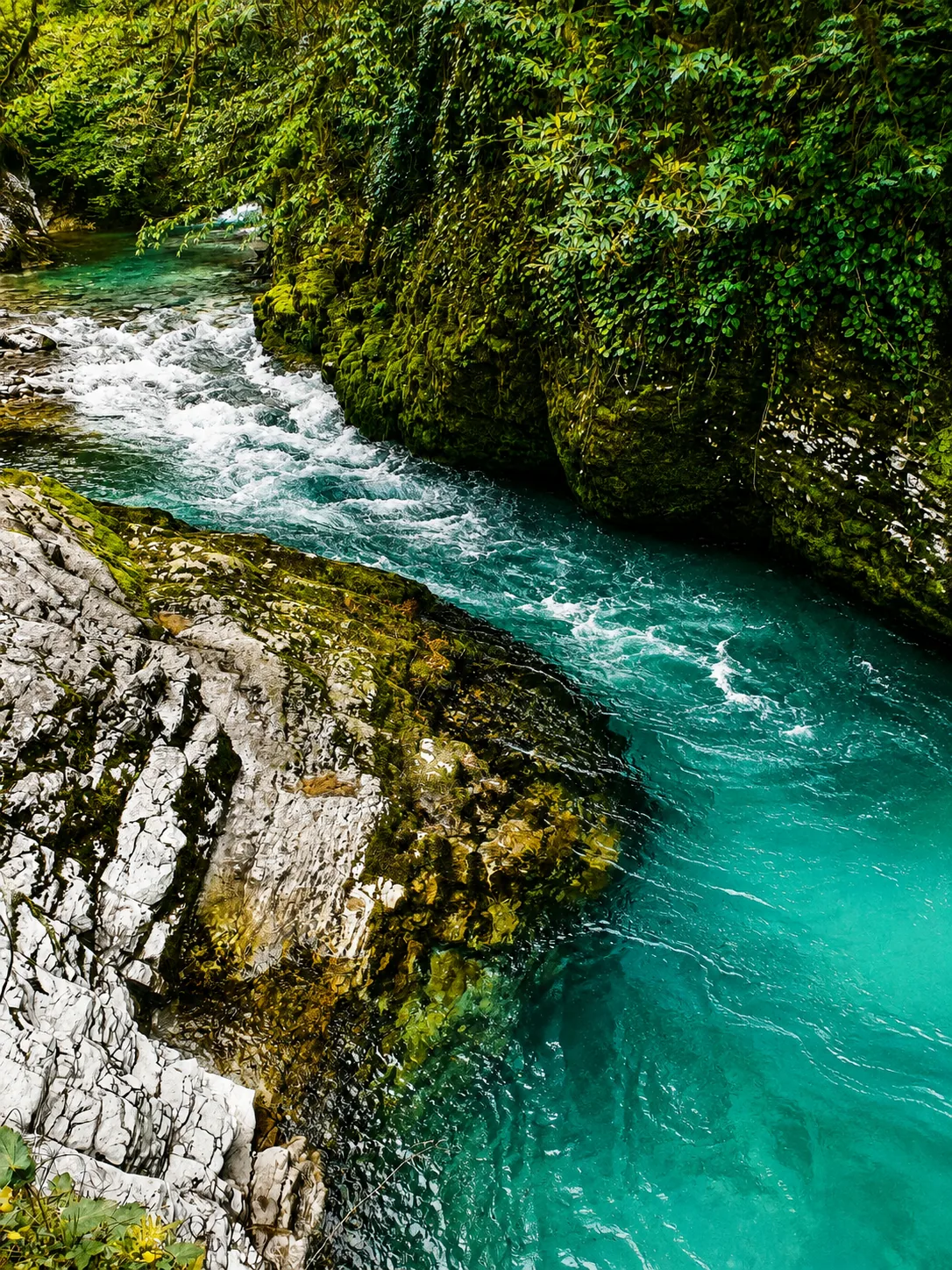
The canyon walls are overhung with vegetation rooted in every crack and ledge — ferns, moss, flowering plants, and the trailing roots of trees on the rim above. That lushness reflects the high rainfall of Samegrelo, one of the wettest parts of Georgia, and gives the walls a living-green quality impossible to sustain in a drier climate. In the right light — morning sun angling into the gorge, or the flat diffuse light of an overcast day that erases harsh shadows — the contrast between the green walls and the turquoise water below is extraordinary.
The walking route
The visit's upper portion follows a path along the canyon rim and a series of wooden walkways cantilevered over the gorge edge, giving views down into the canyon and access to viewpoints over the main waterfall sections. The path is well maintained, the walkways sturdy and railed, and the full route short enough to complete comfortably in thirty to forty minutes. Several viewpoints overlook the most dramatic stretches — where the walls narrow and the waterfalls drop most visibly — and these are where the canyon's scale and the intensity of the water color read most clearly.
The waterfalls vary with season and recent rainfall. In spring and early summer, when snowmelt and the heavy western-Georgian wet season drive the river at full flow, they are at their most powerful — white water dropping through green vegetation into the turquoise pool below, the sound carrying up the walls. In late summer and autumn the flow eases, the falls grow more delicate, and the water often turns even more crystalline as the suspended sediment settles. Both versions reward a visit, but spring and autumn offer genuinely distinct experiences worth understanding before you plan.
The boat ride
The boat ride is what most people come for and remember longest. Small flat-bottomed wooden boats, each carrying a few passengers and steered by a local oarsman, navigate a section of the canyon floor through the narrowest, most enclosed part of the gorge, where the walls rise steeply on both sides and the sky narrows to a strip of light overhead. The ride covers roughly a kilometer at water level, taking about twenty to thirty minutes at a pace that lets the enclosed gorge fully register.
At water level the canyon reveals dimensions the rim walkway can't show. The height of the walls becomes apparent only when you're sitting at the bottom looking up — rock rising from the waterline, vegetation overhanging from ledges, the narrow aperture of sky at the top. Waterfalls that looked like white threads from above become substantial cascades from below, some dropping straight into the water beside the boat and sending spray across the passengers. And the water color, seen over the side rather than from above, has a depth and clarity that photographs consistently struggle to capture.
The boat ride is ticketed separately from the walkway and operates subject to river conditions — water too high after heavy rain, or too low in dry periods, can suspend it. It's worth checking availability on arrival, and buying the combined ticket (walkway + boat) for the complete experience. The ride is the element that most clearly earns the canyon its reputation; visiting without it — while still worthwhile for the walkway alone — misses what's genuinely unique here.
Combining with other sites
Martvili's position makes it a natural part of several itineraries. The most common pairing is with Okatse Canyon, roughly 40 km southeast toward Kutaisi — the two complement each other well, different in character despite sharing a karst origin, and a full day covering both (with a car) gives a comprehensive picture of western Georgia's canyon landscape. Martvili town itself adds a cultural dimension: the Martvili Monastery (Chkondidi) sits on a hill above the town — its main cathedral built in the late 7th century on the site of a sacred oak (the Mingrelian name Chkondidi means "big oak"), rebuilt in the 10th century, and long a major medieval cultural and educational center, with 14th–17th-century frescoes inside. The broader Samegrelo region — quieter and less tourism-developed than Imereti — rewards the extra exploration that using Martvili as a base, rather than a day trip, allows.
Getting there and visiting
- Location: A few km outside Martvili town, Martvili municipality, Samegrelo (Samegrelo–Zemo Svaneti), western Georgia; about 1 hour (northwest) from Kutaisi.
- Getting there: The drive from Kutaisi takes about an hour on a paved road in reasonable condition, through the mixed farmland and forest of the Rioni lowlands into the hillier Samegrelo terrain. Without a car, a taxi from Kutaisi is the most practical option — many travelers arrange for the driver to wait during the visit rather than seeking return transport from the site.
- Facilities: Car park, ticket office, and basic facilities at the entrance; the infrastructure handles high-summer volumes competently.
- Time needed: Around 1.5–2 hours for the walkway and the boat ride together.
- Best time: Spring (April–June) for the fullest flow and most powerful falls; autumn (September–October) for the clearest water and fewer crowds; summer is busiest — arrive early to beat the midday boat queues. Year-round access, though the boat ride may pause in winter depending on water conditions.
Caucasus Travel FAQ
Martvili Canyon is a deep limestone gorge cut by the Abasha River in the Samegrelo region of western Georgia, about an hour northwest of Kutaisi near the town of Martvili. It's famous for its vivid turquoise-green water, sheer walls draped in dense vegetation, and small waterfalls. The visit has two parts: a short rim walkway with viewpoints over the gorge, and a boat ride along the canyon floor through its narrowest, most enclosed stretch. Easy for all fitness levels, it's one of western Georgia's most popular natural attractions.
It's the highlight for most visitors. Small flat-bottomed wooden boats, steered by a local oarsman, carry a few passengers along about a kilometer of the canyon floor through its narrowest section, where the walls rise steeply and the sky narrows to a strip overhead — about 20–30 minutes. From water level you grasp the true height of the walls, waterfalls drop into the water beside the boat (sometimes spraying passengers), and the turquoise color is at its most vivid. The boat ride is ticketed separately from the walkway and runs subject to river conditions — it can be suspended when the water is too high after heavy rain or too low in dry spells — so it's worth checking availability on arrival.
Allow about 1.5–2 hours for both the walkway and the boat ride. It's easy: the rim walkway and its cantilevered viewing platforms take only 30–40 minutes and are railed and well maintained, and the boat ride needs no effort beyond stepping into the boat. That combination of high visual impact and low physical demand is a big part of why it's so popular and suitable for all fitness levels and ages.
Spring (April–June) brings the fullest river flow and most powerful waterfalls, with the vegetation at its greenest. Autumn (September–October) is quieter, with the water at its clearest as the sediment settles and a warmer light on the walls. Summer is the busiest and can mean queues for the boat at midday, so arrive early in July and August. The canyon is open year-round, though the boat ride may be suspended in winter depending on water levels.
The classic pairing is the Okatse Canyon, about 40 km southeast toward Kutaisi — different in character but a natural companion, and the two make a full canyon day with a car. In Martvili town itself, the Martvili Monastery (Chkondidi), with its late-7th-century cathedral on a hill above town, adds a cultural stop. More widely, Martvili is a good base for the quieter Samegrelo region — the Toba, Oniore, and Ochkhomuri waterfalls, the Balda area, and beyond — and fits into a western-Georgia itinerary alongside Kutaisi and the road toward Svaneti.