
Dmanisi Sioni Cathedral: A Medieval Church on a Two-Million-Year-Old Hill
The Dmanisi Sioni Cathedral stands at the heart of one of the most historically layered sites in Georgia — the country in the South Caucasus — on a promontory above the confluence of the Mashavera and Pinezauri rivers in the Kvemo Kartli region, where human presence reaches back not centuries or millennia but 1.8 million years. The cathedral is an early-medieval church that, almost anywhere else, would command attention as a significant monument in its own right. At Dmanisi it occupies just one layer of an extraordinary record: it shares its hill with the ruins of a medieval trading city and with the archaeological deposits that yielded the oldest hominin remains ever found outside Africa. The result is a place of rare historical density, where a medieval cathedral sits atop a stratigraphy that runs back nearly two million years beneath it.
(The wider Dmanisi site — the famous fossils, the medieval town, the museum — is covered in its own dedicated guide; this page focuses on the cathedral itself, within the architectural and religious history of early Christian Georgia.)
What is the Dmanisi Sioni Cathedral?
Dmanisi Sioni is an early-medieval Georgian Orthodox basilica at the center of the Dmanisi historic site in Kvemo Kartli, southern Georgia, about 90 km southwest of Tbilisi. Dedicated to the Dormition of the Mother of God and built of dark local volcanic stone, it was the cathedral of the Dmanisi diocese and a burial place of Georgian royalty and nobility. Classic scholarship dates it to the 6th–7th century, though some recent specialists place it in the 9th — either way it predates the domed churches of mature Georgian architecture. It stands within the walls of the medieval city, on the same promontory as the world-famous Dmanisi fossils, and is visited together with the archaeological site and museum.
History
The Dmanisi Sioni was built in the early medieval period, when the Georgian church was establishing its physical infrastructure across the Kartlian kingdom after the 4th-century adoption of Christianity. Its exact date is debated: the classic dating by major Georgian art historians places it in the 6th–7th century — the broad era of the Anchiskhati Basilica in Tbilisi and not long after the Bolnisi Sioni in the Mashavera valley to the north — but some recent specialists have revised it to the 9th century, and the masonry of parts of the building supports a later date. The honest position is that it is an early-medieval basilica whose precise origins remain a matter of scholarly discussion.
Whatever its exact starting date, the building's fabric records several phases of modification across the medieval centuries during which Dmanisi flourished as a walled city. The town — first recorded in the 9th century as a possession of the Arab emirate of Tbilisi, on a site settled since the Bronze Age — reached its peak between roughly the 11th and 13th centuries, when it was one of the most important fortified trading towns of Lower Kartli, on the routes linking the Caucasus with the Middle East and Central Asia (it is said to have served as a summer residence of Queen Tamar). The prosperity of this period supported the cathedral as the religious center of a wealthy city, and around the 12th–13th century it was enriched with an ornately carved portal and gates. Side annexes added in the 9th–10th centuries to the north and south give the church the character of a "three-church basilica."
The cathedral was the seat of the Dmanisi bishopric, a function it held until the diocese was dissolved around 1750 (and reinstated in 2003). It was also a place of burial for the powerful: by tradition King Vakhtang III (died 1308) was buried here, and from the 16th to 18th centuries the church and its yard served as the necropolis of the Baratashvili noble family and their Orbeliani offshoot. The Mongol invasions of the 13th century disrupted the town's commerce, and the following centuries brought a slow decline to eventual abandonment — yet the cathedral survived, remaining standing as the surrounding domestic and commercial buildings were reduced to the foundation-level ruins seen in the excavations today.
Architecture
The Dmanisi Sioni is a three-nave basilica of the early type, built of the dark local volcanic stone — basalt and tuff — of the Mashavera valley, laid in courses of grayish rubble masonry with sections of dressed and reddish stone that give the façades a peculiarly austere, monumental character suited to the exposed hilltop. The basilica plan gives the building a horizontal emphasis quite different from the vertical, cross-domed churches of the mature Georgian medieval tradition, and the relative simplicity of the exterior reflects the priorities of early Georgian church-building, where structural soundness and spatial clarity were valued over surface elaboration — the main concentration of carved ornament being the later (12th–13th-century) portal. With its 9th–10th-century side chapels, the building reads almost as three churches combined.
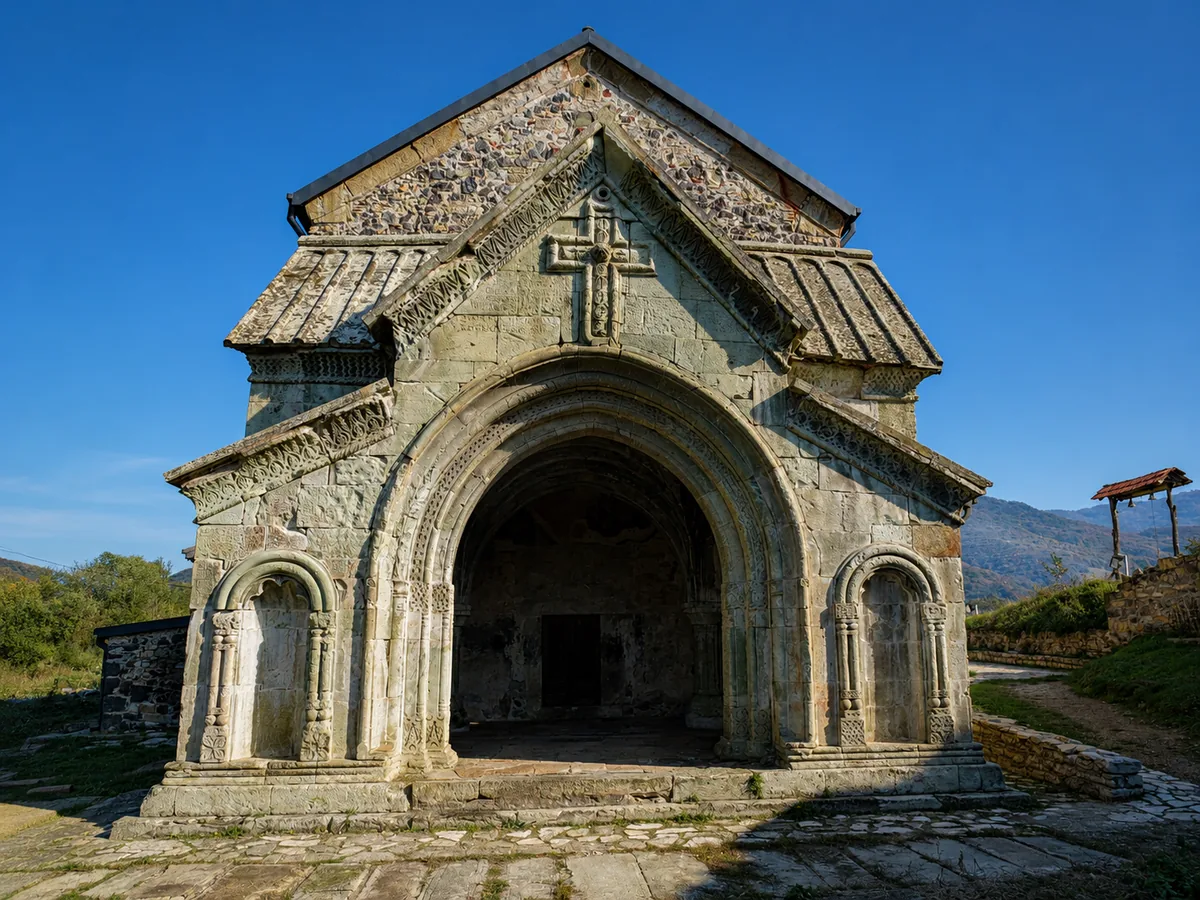
The cathedral stands within the defensive walls of the medieval town's fortification system, and the relationship between church and walls reflects the dual role major churches often played in medieval Georgia — religious centers that were also places of refuge and storage during the frequent conflicts of the medieval Caucasus.
The setting and site context
The cathedral cannot really be understood apart from the promontory it occupies. The stratigraphic relationship between this early-medieval church and the 1.8-million-year-old deposits beneath the same hilltop is the most concentrated expression anywhere in Georgia of the extreme historical depth this site contains: standing at the cathedral, knowing that the same promontory holds fossils of the first humans to leave Africa, is an experience no other Georgian church can offer. The views from the hilltop over the two river gorges that gave the site its natural defenses are striking in their own right, the semi-arid Kvemo Kartli plateau beyond lending Dmanisi a landscape character unlike the greener regions of northern Georgia.
The museum beside the excavations — which presents the paleontological and archaeological finds in a well-organized permanent exhibition — is the natural complement to the cathedral visit, providing the scientific context for the different layers the Dmanisi promontory contains. (Both are covered in the main Dmanisi guide.)
Practical information
- Location: Dmanisi Museum Reserve / Dmanisi historic site, Dmanisi municipality, Kvemo Kartli region, southern Georgia, ~90 km southwest of Tbilisi.
- Getting there: By car, ~1.5–2 hours from Tbilisi; no direct public transport to the site — marshrutka to Dmanisi town, then a taxi/local transport for the final stretch, or an organized day tour from Tbilisi.
- Hours / Admission: The cathedral is within the Dmanisi Museum Reserve, open Tuesday–Sunday, 10:00–18:00 (closed Monday); a single modest entry fee covers the archaeological site, museum, and cathedral. Check current ticket prices before visiting.
- Dress code: Modest dress for the cathedral — shoulders and knees covered (an active church, with regular services).
- Combine with: The Dmanisi archaeological site and museum (same promontory), and the Bolnisi cluster — Bolnisi Sioni, the Bolnisi Museum, the German town — on a Kvemo Kartli day.
Caucasus Travel FAQ
Dmanisi Sioni is an early-medieval Georgian Orthodox basilica at the center of the Dmanisi historic site, in the Kvemo Kartli region of southern Georgia, about 90 km southwest of Tbilisi. Dedicated to the Dormition of the Mother of God and built of dark local volcanic stone, it was the cathedral of the Dmanisi diocese and a burial place of Georgian royalty and nobility. It stands within the walls of a ruined medieval city, on the very same promontory that produced the world-famous Dmanisi fossils — the oldest human remains ever found outside Africa.
Its exact date is genuinely debated. The classic dating by leading Georgian art historians places it in the 6th–7th century — among the earlier Georgian churches — but some recent specialists have revised this to the 9th century, and parts of the masonry support a later date. So it's best described as an early-medieval basilica whose precise origins remain a matter of scholarly discussion. Either way, it predates the domed, cross-in-square churches that became standard in Georgia from the 9th century onward, and it was modified and enriched over the following centuries, including an ornate portal added around the 12th–13th century.
For several reasons. It was the seat of the Dmanisi bishopric (until the diocese was dissolved around 1750, reinstated in 2003) and the religious heart of one of medieval Georgia's most important fortified trading cities. It was a burial place for the powerful — by tradition King Vakhtang III (died 1308) was buried here, and later it served as the necropolis of the Baratashvili and Orbeliani noble families. And its setting is unique: it shares its hill with archaeological deposits 1.8 million years old, making it the most concentrated expression of historical depth of any church in Georgia.
It's a three-nave basilica built of the dark local volcanic stone — basalt and tuff — of the Mashavera valley, laid in grayish rubble masonry with reddish dressed sections that give it an austere, monumental character. The basilica form gives it a horizontal emphasis, unlike the vertical domed churches of later Georgian architecture, and its exterior is fairly plain apart from the richly carved later portal. Side chapels added in the 9th–10th centuries to the north and south give the building the appearance of a "three-church basilica." It stands within the defensive walls of the medieval town.
It's part of the Dmanisi Museum Reserve, about 90 km southwest of Tbilisi (1.5–2 hours by car), and a single entry fee covers the archaeological site, the museum, and the cathedral. There's no direct public transport to the site — you can take a marshrutka to Dmanisi town and a taxi for the final stretch, but an organized day tour from Tbilisi is easiest, often combined with the Bolnisi sites. As an active church, modest dress is required (shoulders and knees covered). It's naturally seen together with the rest of the Dmanisi site and the wider Kvemo Kartli heritage.