
The Bolnisi Museum: Gateway to Kvemo Kartli's Deep History
The Bolnisi Museum is a regional history and archaeology museum in the town of Bolnisi, in the Kvemo Kartli region of southern Georgia — the country in the South Caucasus — presenting the heritage of one of the most layered and least-visited parts of the country in a format far more polished than its provincial location might suggest. It opened in its current form relatively recently, with a design that reflects contemporary museum practice rather than the older Soviet-era style of many regional Georgian institutions: clear bilingual labeling, logical chronological organization, well-lit cases, and an interpretive approach that makes the collection accessible to visitors without a background in Georgian archaeology. For travelers moving through Kvemo Kartli toward the Bolnisi Sioni Cathedral, Dmanisi, or the region's German colonial heritage, the museum supplies the historical context that makes those sites far more meaningful — and it does so in a way that rewards the time it takes.
What is the Bolnisi Museum?
The Bolnisi Museum is a modern, well-presented regional archaeology and history museum in the town of Bolnisi, Kvemo Kartli, about 65 km south of Tbilisi. Its collection spans the deep human history of this crossroads region — from Neolithic and Bronze Age material through the early Christian and medieval periods — and includes a notable section on the 19th-century German (Swabian) settlers who founded the town as Katharinenfeld. It works best as the historical introduction to the Bolnisi area, especially the nearby Bolnisi Sioni Cathedral — Georgia's oldest surviving church (478–493 AD), home to among the oldest dated Georgian inscriptions and the original "Bolnisi cross" that inspired the national flag. Allow about 30–60 minutes; it pairs naturally with the cathedral, the town's German heritage, and the wider Kvemo Kartli circuit.
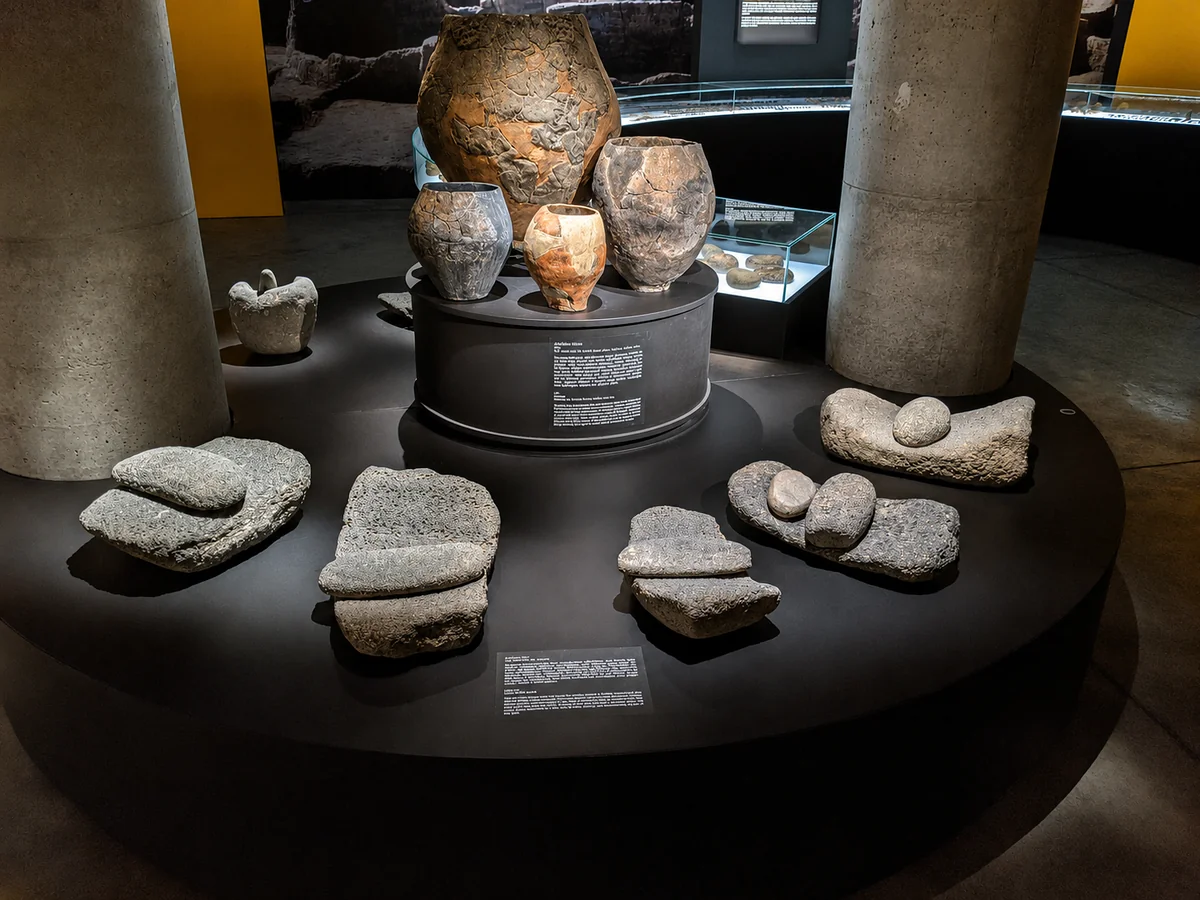
The collection and its significance
The collection covers the archaeology and history of Kvemo Kartli across the full range of human activity here — from prehistoric material through the Bronze and Iron Ages, the ancient and late-antique centuries, the early Christian era, and into the medieval period that produced the region's most visible monuments. That breadth reflects the genuine depth of human history in Kvemo Kartli, continuously inhabited and agriculturally productive since at least the early Bronze Age, and positioned — at the southern approaches to the Georgian heartland, on the routes linking the Caucasus with the Armenian highland and the Iranian plateau — to be a consistent focus of human activity across many cultural and political eras. (This is the same region that, further southwest at Dmanisi, produced the earliest hominin remains found outside Africa.)
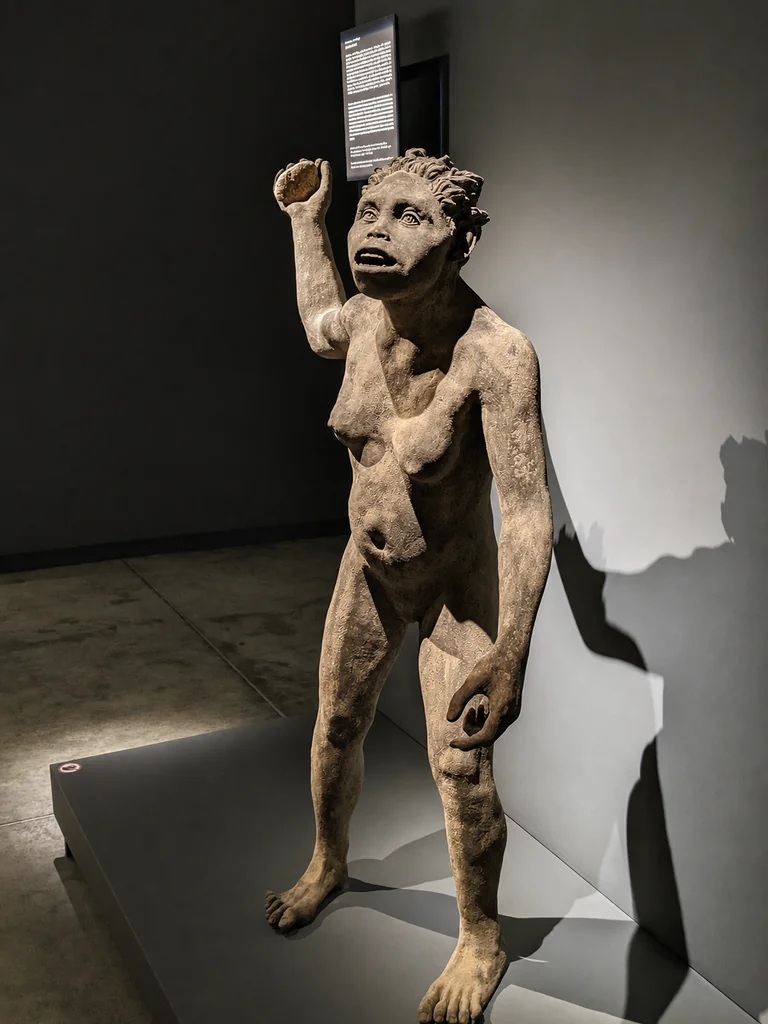
The early Christian material is the most historically significant part of the collection and the section most directly relevant to the monuments most travelers come to see. The Bolnisi Sioni Cathedral, built between 478 and 493 AD, is the oldest surviving church building in Georgia and the defining monument of early Christian culture in the region; the museum provides the archaeological context — artifacts, building materials, liturgical objects — that the cathedral, as a living monument rather than a museum, cannot itself display. Seeing this material before visiting the cathedral gives the architectural experience a historical grounding the building alone doesn't automatically provide.
The stone carvings and inscriptions are of particular interest for the history of the Georgian script. The Georgian alphabet emerged in the 5th century — one of the few writing systems in the world created for a single language rather than adapted from an existing one — and the material evidence of that earliest scribal culture is concentrated in this part of southern Georgia. The famous Bolnisi inscriptions at the cathedral, in the Asomtavruli script and dated to 493/494 AD, are among the oldest Georgian inscriptions in the world and the oldest securely dated inscriptions on Georgian soil (slightly older Georgian inscriptions survive abroad, at a Georgian monastery near Jerusalem). The museum places this scribal heritage in its archaeological and cultural context. Carved at the cathedral too is the "Bolnisi cross" — a distinctive geometric cross whose form became a national emblem and appears on the modern Georgian flag, giving this quiet site a direct line to a symbol every visitor to Georgia will have seen.
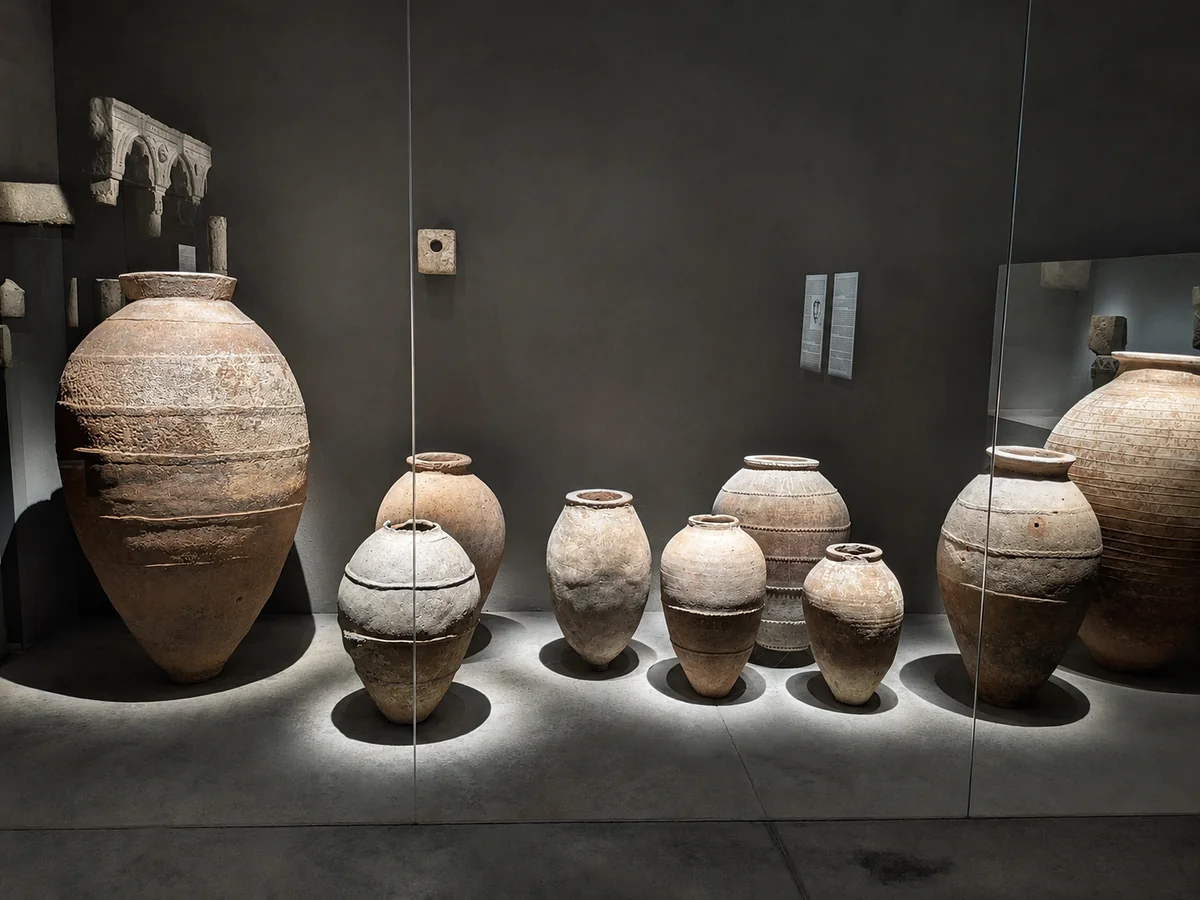
The broader archaeological finds document a region at a crossroads of civilizations. Objects showing contact with the Hellenistic world to the west, the Achaemenid and Parthian spheres to the south and east, and the specifically Georgian traditions of the Caucasus sit together in a way that makes ancient Kvemo Kartli's cultural complexity immediately visible, and the variety of object types — ceramics, metalwork, jewelry, agricultural tools, architectural fragments — conveys the texture of daily life across different periods that monumental archaeology alone cannot.
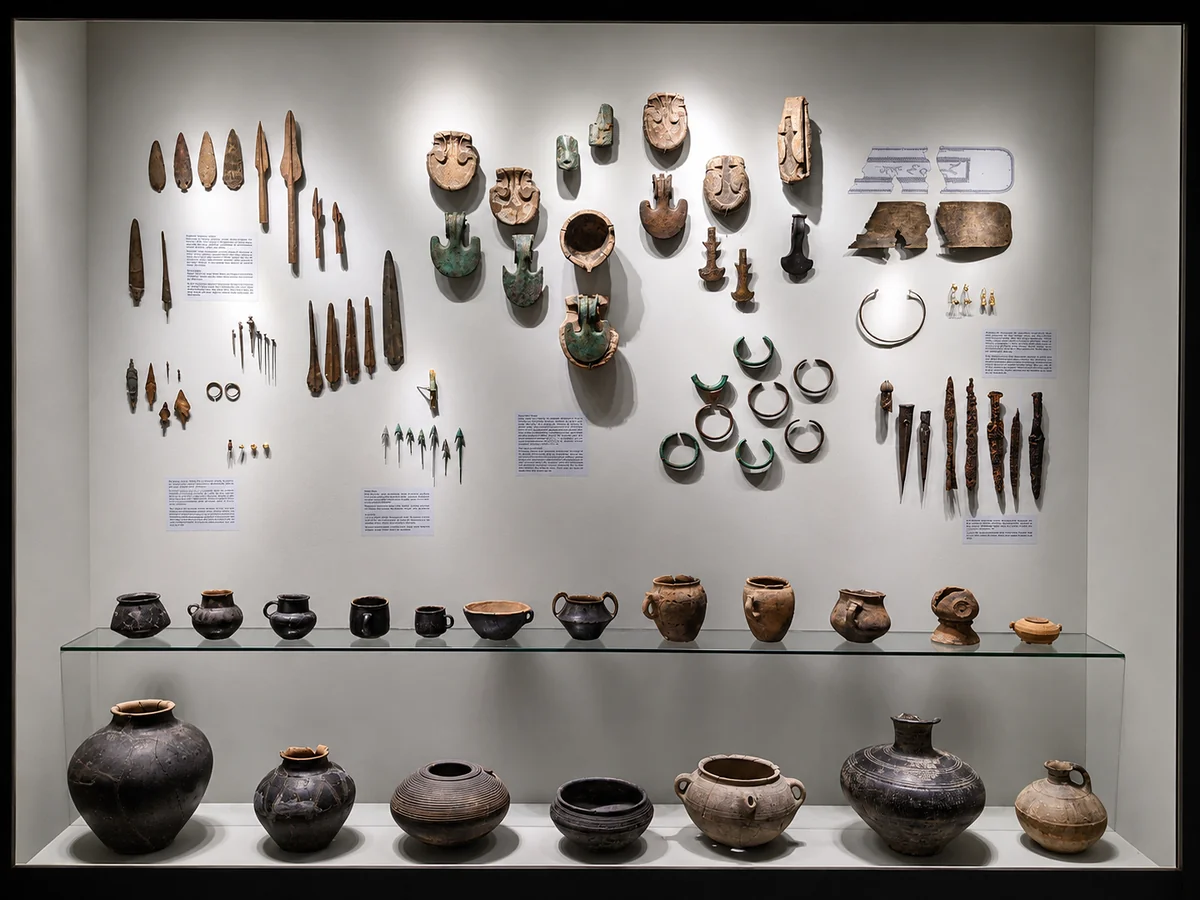
The sections on the medieval and modern periods connect this material to the region's more visible heritage — the fortifications, churches, and successive layers of Georgian, Arab, and later authority in Kvemo Kartli — and to its most unexpected chapter, the German colonial story below.
The German chapter: Katharinenfeld
Bolnisi's most surprising historical layer is German. In 1816–1818, families of Swabian Lutheran Pietists from the Württemberg region settled here under Russian imperial auspices, founding a colony they named Katharinenfeld (after Queen Catherine of Württemberg, sister of Tsar Alexander I). They built a distinct, orderly European community — solid farmhouses along straight streets, a Lutheran church, a school, a newspaper, and a European-style viticulture that still echoes in the area's wineries today — and many of their handsome houses still stand, giving central Bolnisi a tidy, un-Georgian regularity that surprises arriving visitors.
The story has a hard ending, told straight: in 1941, during the Second World War, most of the town's ethnic Germans were deported to Central Asia and Siberia in the Soviet Union's wartime removal of its German population, and the town was subsequently renamed (briefly Luxemburg, then Bolnisi). The German buildings remained; the community that built them did not. The museum addresses this German chapter as part of the region's demographic and cultural complexity — with photographs and everyday objects of Swabian life — giving travelers who have noticed the anomalous European architecture a context for what they're seeing, and a sense of the full, and ultimately poignant, arc of that history.
The presentation
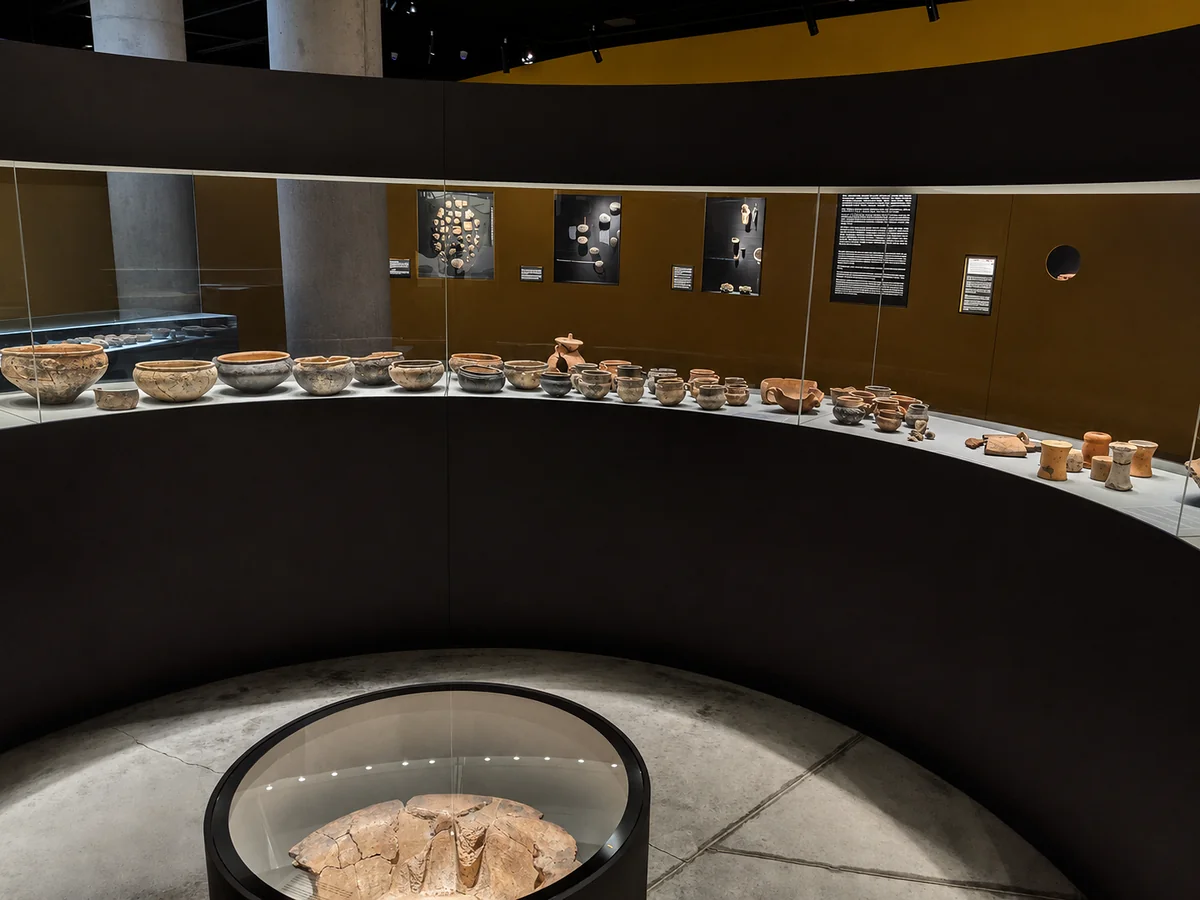
The quality of presentation is worth flagging, because it's genuinely above average for a regional Georgian institution and expectations shaped by more variable provincial museums may undersell it. The exhibition design uses good lighting, clear case organization, and explanatory text in Georgian and English sufficient for international visitors to grasp the significance of objects without prior specialist knowledge, and the galleries follow a logical chronological and thematic structure that builds understanding progressively. This reflects a broader recent investment in Georgia's regional museum infrastructure — developing the interpretive capacity of provincial institutions alongside the physical conservation of monuments — and the Bolnisi Museum is one of its more successful results: an institution that treats its collection as a public resource and presents it accordingly.
Combining with nearby sites
The museum works best as the opening chapter of a Bolnisi-area day rather than a standalone stop. Combine it with the nearby Bolnisi Sioni Cathedral (in the village of Kvemo Bolnisi, a short distance from the town) and the German colonial townscape of Bolnisi itself, and — for a fuller Kvemo Kartli circuit — with the 13th-century Tsughrughasheni church a couple of kilometers beyond Sioni, the extraordinary paleoanthropological site at Dmanisi to the southwest, and the region's wineries (some in old German cellars). Used this way — as the historical introduction to a day of site-visiting — the museum repays its half-hour-to-hour many times over in the depth it adds to everything you see afterward.
Getting there and practical information
- Location: Central Bolnisi, Kvemo Kartli region, southern Georgia, ~65 km south of Tbilisi (about 1–1.5 hours by road).
- Getting there: Marshrutkas from Tbilisi (Isani/Samgori) to Bolnisi; the town is compact and walkable. A car gives far more flexibility for the outlying sites — Dmanisi is ~40 km further southwest, and the Bolnisi Sioni Cathedral is a short hop to the village of Kvemo Bolnisi.
- Time needed: About 30–60 minutes (longer for the keen).
- Hours / Admission: Modest entry fee; open Tuesday–Sunday, 10:00–18:00, closed Monday, but confirm current hours as they can vary seasonally.
- Character: Quiet and uncrowded by Georgian-attraction standards — an unhurried visit at your own pace.
Caucasus Travel FAQ
It's a modern, well-presented regional archaeology and history museum in the town of Bolnisi, in the Kvemo Kartli region of southern Georgia, about 65 km south of Tbilisi. Its collection spans the deep human history of this crossroads region — from Neolithic and Bronze Age material through the early Christian and medieval periods — and includes a section on the 19th-century German (Swabian) settlers who founded the town as Katharinenfeld. It works best as the historical introduction to the Bolnisi area, especially the nearby Bolnisi Sioni Cathedral, and takes about 30–60 minutes.
Because it holds two remarkable layers. First, the Bolnisi Sioni Cathedral (built 478–493 AD) is the oldest surviving church building in Georgia, and its walls carry the Bolnisi inscriptions — in the Asomtavruli script, dated 493/494 AD, among the oldest Georgian inscriptions in the world and the oldest securely dated ones on Georgian soil. The cathedral is also where the "Bolnisi cross" is carved — the geometric cross that became a national emblem and appears on the Georgian flag. Second, Bolnisi was founded in 1816–1818 by German settlers as the colony of Katharinenfeld, giving it an unexpected European heritage. The museum is the place to make sense of both.
They were Swabian Lutheran Pietists from the Württemberg region of Germany who settled here in 1816–1818 under Russian imperial auspices, founding a colony they called Katharinenfeld (after Queen Catherine of Württemberg). They built an orderly European town — solid farmhouses, a Lutheran church, a school, a newspaper, and European-style viticulture — much of which still stands and gives central Bolnisi its distinctive look. In 1941, during the Second World War, most of the German community was deported to Central Asia and Siberia, after which the town was eventually renamed Bolnisi. The museum documents this history with photographs and everyday objects.
Yes — especially as context for the area's sites. It's notably well-presented for a regional Georgian museum, with good lighting, logical chronological displays, and bilingual (Georgian/English) labeling, and it gives the archaeological and historical background that brings the nearby Bolnisi Sioni Cathedral, the German townscape, and the wider region to life. It's quiet and uncrowded, takes only 30–60 minutes, and adds real depth to a day of site-visiting in Kvemo Kartli. On its own it's a modest stop; as the opening chapter of a Bolnisi-area day, it's genuinely valuable.
Bolnisi is about 65 km south of Tbilisi, roughly 1–1.5 hours by road; marshrutkas run from Tbilisi (Isani/Samgori), though a car gives far more flexibility for the outlying sites. The natural combination is the museum plus the Bolnisi Sioni Cathedral (in the nearby village of Kvemo Bolnisi) and the German colonial streets of the town, with options to extend to the 13th-century Tsughrughasheni church, the famous Dmanisi archaeological site (~40 km southwest), and the region's wineries — some in former German cellars. The museum makes the ideal first stop to frame everything else.