
Ambrolauri
Ambrolauri is the administrative center of Racha, a mountain region in northwestern Georgia — the country in the South Caucasus. It's a small town of a few thousand people in the valley of the Rioni River at around 500 meters, hemmed in by steep, densely forested mountains that make Racha feel closer and more enclosed than the open landscapes of eastern Georgia. This is one of the least visited regions in the country, partly because the road from Tbilisi takes four to five hours through mountain terrain, and partly because Racha has never set itself up as a tourist destination. It's a working agricultural region where visitors are welcome but daily life doesn't revolve around them.
Planning your visit? See our full guide to things to do in Ambrolauri for specifics, timings, and local tips.
Why visit Ambrolauri?
The main reason to visit Ambrolauri is wine — specifically Khvanchkara, one of Georgia's most famous wines, produced in the villages just outside town. Beyond the wine, the draws are the 11th-century Nikortsminda Cathedral with its exceptional stone carving, the forested Shaori Reservoir, and the slower, less touristed character of Racha itself. This is a destination for travelers who want a quieter, more rural side of Georgia rather than headline sights; the long drive from Tbilisi means it rewards those who build in the time.
The Racha region
To understand Ambrolauri, it helps to understand Racha. The region sits in a high mountain valley system on the southern slopes of the Greater Caucasus, bordered by Svaneti to the north, Imereti to the south, and South Ossetia to the east. It's one of the smallest and most sparsely populated regions in Georgia, with terrain that shifts from gentle river valleys near Ambrolauri to serious high-altitude country further north. The population has dropped over recent decades as younger residents moved to Tbilisi and other cities, and many upper-valley villages are now only partly inhabited or abandoned.
What has kept Racha on the map for Georgians is its wine and its reputation for a traditional way of life that has changed more slowly here than in more accessible parts of the country. The region has its own dialect, its own building traditions, and a strong local identity residents take real pride in.
Khvanchkara and Racha's wine culture
Ambrolauri's name is tied to Khvanchkara, a naturally semi-sweet red wine and one of the most celebrated wines in Georgia. It's made from two indigenous grapes — Aleksandrouli and Mujuretuli — grown in a specific microclimate around the villages of Khvanchkara and Nagvazao, a short distance from town. The mountain-valley climate, the particular soils of this stretch of the Rioni valley, and traditional qvevri fermentation together produce a deep red wine with natural residual sweetness and more complexity than most semi-sweet wines elsewhere. Khvanchkara is often said to have been among Stalin's favorite wines, which gave it a Soviet-era fame it has never quite shed.
Production is small. The area suitable for the Aleksandrouli and Mujuretuli grapes is limited, and most vineyards belong to small family producers rather than large wineries. That makes visiting around Ambrolauri a different experience from the bigger wine operations in Kakheti. Don't expect grand estate cellars or polished tasting rooms — visits here are usually informal arrangements with local families making wine from their own small plots, often by the same methods their grandparents used. For travelers who care about Georgian wine, that directness is much of the appeal. The flip side is that tastings need to be arranged in advance rather than dropped in on.
Beyond Khvanchkara, Racha makes other wines worth trying, including ones from Tetra, an indigenous white grape found almost only in this region. Local winemakers will often pour these lesser-known wines alongside the famous semi-sweet red, so a tasting in Ambrolauri opens a window onto a wine culture that gets far less attention than Kakheti.
Nikortsminda Cathedral
Nikortsminda Cathedral is the most significant historical monument in Racha, in the village of the same name about 12 kilometers east of Ambrolauri. Built in the 11th century under King Bagrat IV, it's considered one of the finest examples of medieval Georgian church architecture in the country. The exterior is the reason to go: intricate stone relief carvings cover much of the facade and have survived in unusually good condition for a building this old, with biblical scenes, ornamental borders, and symbolic imagery that rank among the high points of Georgian medieval stone carving. Inside, fragments of the original frescoes survive alongside later work. It's still an active church, set in a quiet rural spot, so the visit stays unhurried.
Shaori Reservoir
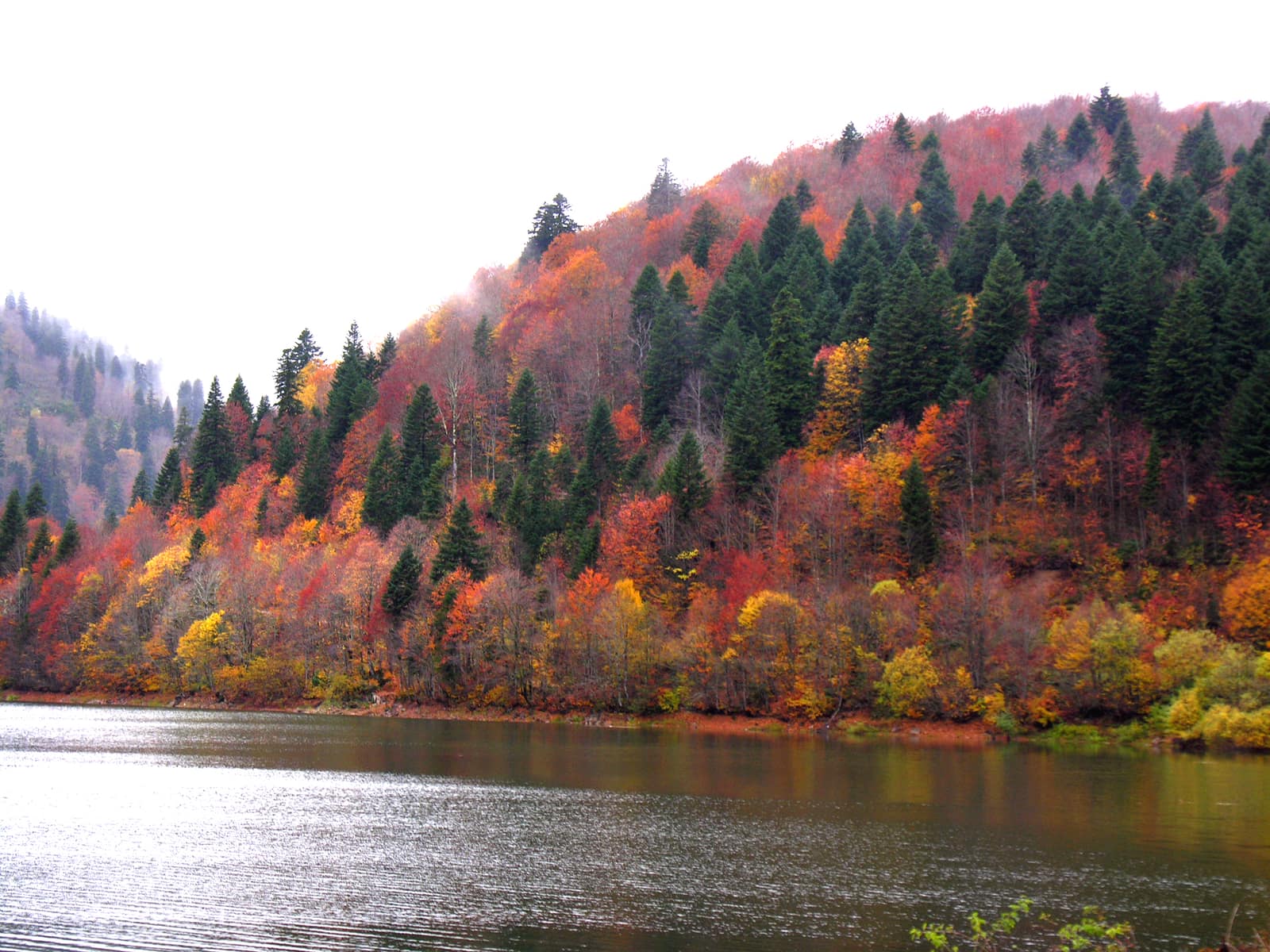
A few kilometers from Ambrolauri, the Shaori Reservoir is an artificial lake built in the Soviet era for a hydroelectric project on the Shaori River. It sits at around 1,000 meters, ringed by forested hills, and looks far more scenic than its utilitarian origins suggest. It's a popular spot for fishing — trout and other cold-water species live here — and for quiet lakeside walks. The forest reflected in the still water makes it a pleasant hour or two, especially in autumn when the leaves turn.
How to get to Ambrolauri
Ambrolauri is connected to Tbilisi by marshrutka (minibus), with the trip usually taking four to five hours. The road runs through Imereti and climbs into the Racha valley on a scenic but demanding route with long winding mountain stretches. A rail connection also exists but is considerably slower than the marshrutka and runs infrequently. Within Racha the main road is paved but varies in condition, and reaching the more remote villages and upper valleys generally needs a vehicle with reasonable ground clearance.
Best time to visit Ambrolauri
Racha has a mountain climate, cooler and wetter than lowland Georgia. Winters are cold and snowy, and the road in can be difficult from December through March. The comfortable window is May through October. Late summer and early autumn — especially September and October — line up with the grape harvest and are the best time to come if local wine culture is your priority. October is also when the forests around Ambrolauri are at their most striking, with fall color and clear mountain air.
Caucasus Travel FAQ
Ambrolauri is the center of Georgia's Racha region and is best known for Khvanchkara, a naturally semi-sweet red wine made from the Aleksandrouli and Mujuretuli grapes grown in nearby villages. The area is also known for Nikortsminda Cathedral and a quieter, traditional mountain way of life.
Khvanchkara is a naturally semi-sweet red wine from the Racha region, made from two indigenous grapes, Aleksandrouli and Mujuretuli, grown in a small microclimate near Ambrolauri. It has a deep color and natural sweetness, and most of it comes from small family producers rather than large wineries.
Yes, if you want a direct, informal experience. Unlike Kakheti's larger wineries, tastings here are usually arranged with local families making wine on small plots by traditional methods. It suits travelers who value authenticity over polished tasting rooms.
May through October, with September and October best for the grape harvest and wine culture. October is also when the surrounding forests are at their most colorful. Winters are cold and snowy, and the access road can be difficult from December through March.