
Gudauri Panorama: Soviet Mosaics and a Caucasus Viewpoint
Gudauri Panorama stands at about 2,384 meters on the ridge above the Devil's Valley, directly beside the Georgian Military Highway between the Gudauri ski resort and the Jvari Pass, roughly two hours north of Tbilisi in Georgia, the country in the South Caucasus. It's a large circular observation platform built in 1983 to mark the bicentennial of the Treaty of Georgievsk — the 1783 agreement by which the Kingdom of Kartli-Kakheti placed itself under Russian imperial protection — and its interior is covered in large Soviet-era mosaics depicting scenes from Georgian and Russian history in the bold, colorful style of Soviet public art at its most expressive. The panoramic views from the platform over the Devil's Valley and the surrounding Caucasus are among the most dramatic from any roadside stop in Georgia, and the combination of Soviet artistic heritage with the natural setting has made it one of the most photographed single locations on the Military Highway and one of the more discussed examples of Soviet monumental art surviving in the South Caucasus.
What is Gudauri Panorama?
It's a circular Soviet-era monument and viewpoint on the Georgian Military Highway near Gudauri, built in 1983 for the 200th anniversary of the 1783 Treaty of Georgievsk. Designed by architect Giorgi Chakhava with the artist Zurab Tsereteli, its curved interior wall is covered with vivid mosaics of Georgian and Russian history, and its platform — perched on the edge of a cliff at about 2,384 meters above the Devil's Valley — gives one of the best panoramic mountain views on the Tbilisi–Kazbegi route. It's a free, 20–30-minute stop and a major paragliding launch site.
The monument and its history
The Treaty of Georgievsk, whose 200th anniversary the monument commemorates, was one of the most consequential diplomatic acts in Georgian history. Signed in the Russian fortress town of Georgievsk in 1783 between King Erekle II of Kartli-Kakheti and the Russian Empire — the arrangement overseen on the Russian side by Prince Grigory Potemkin — it placed the Georgian kingdom under Russian imperial protection in exchange for a guarantee of territorial integrity and dynastic continuity. Erekle intended it as a defense against the existential threat of the Persian and Ottoman empires, and the Russian protection it offered seemed to promise the survival of Georgian statehood in a regional environment that had been destroying smaller kingdoms for centuries.
The outcome was more complex than the signatories anticipated. Russia provided none of the promised military assistance when Persia invaded and sacked Tbilisi in 1795, and just eighteen years after the treaty was signed, Russia annexed Kartli-Kakheti outright, ending Georgian independence for the following two centuries. The Soviet monument built for the treaty's bicentennial in 1983 presented the agreement as a symbol of fraternal friendship between the Georgian and Russian peoples — an interpretation the Soviet state's need for legitimating historical narratives in the Caucasus required, and one the actual consequences of the treaty complicate considerably. (At the time, not everyone welcomed the celebrations: anti-Soviet Georgians protested the bicentennial.) The post-Soviet decades have given Georgians a different set of frameworks for interpreting both the treaty and its monument, and the structure now occupies a complicated cultural position — at once a genuine artistic achievement of the Soviet period and a physical artifact of an ideology and a political relationship Georgia has moved away from. It was one of three monuments built for the anniversary, the others in Moscow and on the edge of Tbilisi.
The mosaics
The interior of the circular monument is decorated with mosaics of considerable scale and ambition — large panels covering the curved inner wall with imagery from Georgian and Russian historical and folkloric tradition, in the bold, saturated palette and stylized figurative approach characteristic of Soviet monumental art. The imagery includes Georgian historical heroes, scenes from the medieval Georgian literary and military tradition, agricultural and pastoral motifs, and the symbolic representations of Georgian–Russian friendship the monument's purpose required; a couplet from Shota Rustaveli's medieval epic The Knight in the Panther's Skin appears in both Georgian and Russian. The artistic quality is genuine — the composition, the handling of color, and the skill of the mosaic execution all reflect the serious investment Soviet public art at its best brought to monumental decoration — and the work rewards close attention from anyone interested in Soviet visual culture, independent of its ideological content.
The combination of the circular form with the panoramic views through the open sections gives the mosaic-viewing a specific spatial quality: the colorful historical imagery of the interior panels seen alongside the natural drama of the mountains outside, the two frames of reference juxtaposed so that both the artistic and the natural content of the site are concentrated in a single physical experience.
The panoramic view
The viewpoint that gives the monument its popular name — Panorama Gudauri — is what draws the largest number of visitors and defines the site's reputation beyond the specialist interest in Soviet architecture and history. The platform overlooks the Devil's Valley, the dramatic gorge of the Aragvi river system below the Jvari Pass, with forested and rocky slopes falling away steeply to the valley floor several hundred meters below and the ridges of the Greater Caucasus extending across the horizon in multiple directions. The structure sits on the edge of a roughly 600-meter cliff, which is much of why the drop feels so dramatic.
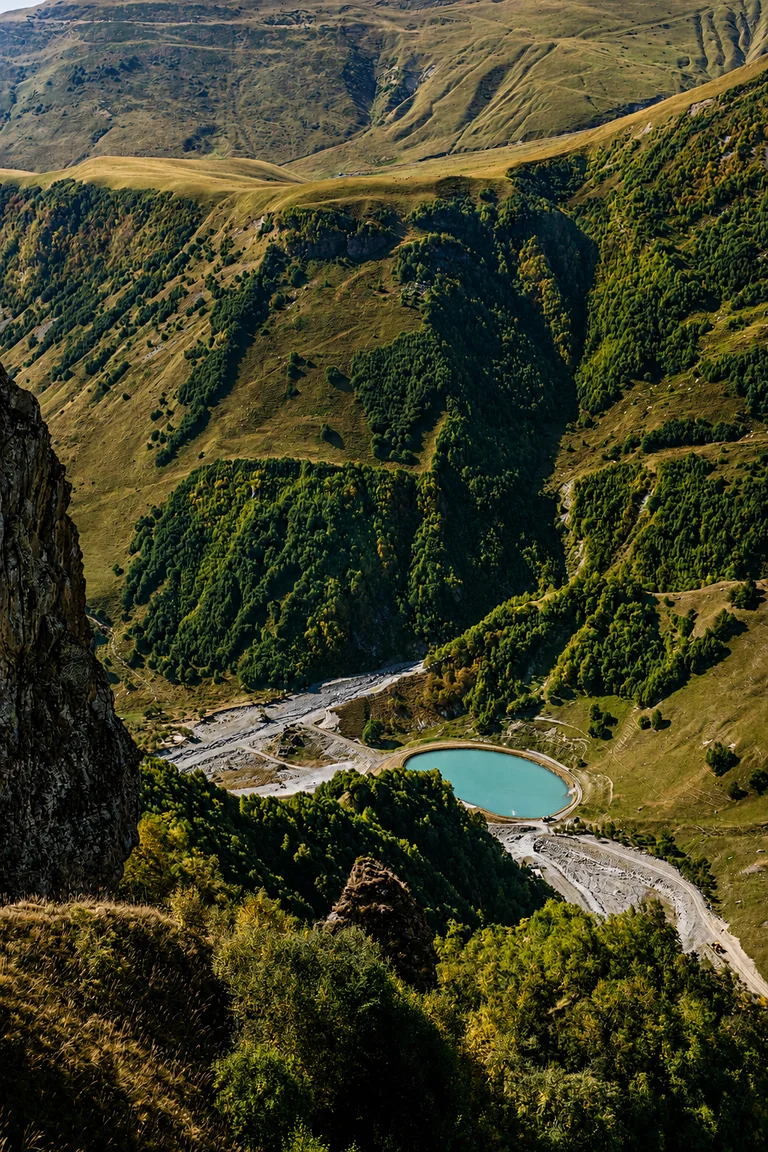
At about 2,384 meters, the viewpoint sits above most of the surrounding terrain and gives an unobstructed perspective over a broad sweep of the Caucasus — the Military Highway switchbacks visible below, the Gudauri ski slopes across the valley, and, on clear days, the higher peaks of the main Caucasus divide rising above the intermediate ridgelines. The scale of the view is the most immediately impressive thing about the site, and the combination of the vertical drop directly below the platform edge with the horizontal sweep of the panorama gives it a quality of spatial exposure that more sheltered viewpoints can't match.
The best conditions vary by season and time of day in ways that reward deliberate timing over a casual stop. Sunrise and sunset give the most dramatic light, the low angles illuminating the ridgelines and valley walls with a warmth and directionality that midday light flattens. Clear autumn days give the sharpest visibility, the cooler, drier air of October and November transmitting mountain detail with a clarity summer haze can reduce. Winter — snow over the surrounding terrain, white against dark rock and blue sky — gives the site its most austere and dramatically photogenic character, though the wind at this elevation in winter can make extended time on the exposed platform genuinely uncomfortable.
Paragliding
Panorama Gudauri is one of Georgia's most established paragliding sites: the elevation, the reliable upwind conditions generated by the valley terrain below, and the extraordinary setting give it an international reputation within the paragliding community. Tandem flights with experienced pilots launch from the slopes near the monument and fly over the Aragvi valley, giving an aerial perspective on the Military Highway landscape that no ground viewpoint can match. The sight of paragliders over the valley from the platform — colorful canopies against the grey and white of the mountains — adds a kinetic element to an already dramatic scene, and even visitors with no intention of flying tend to find the activity an enhancement of the viewpoint.
Getting there
The monument is directly on the Georgian Military Highway, about 10 kilometers north of Gudauri and roughly 30 kilometers south of the Jvari Pass, making it an entirely natural stop on the Tbilisi–Kazbegi journey. The parking area beside the highway gives easy access to the monument and platform, and a visit needs no hiking or preparation beyond the short walk from the car to the structure. The strong winds of the exposed ridge should be expected — warm, windproof outer layers are advisable year-round, and the platform edge, while accessible, calls for basic awareness of the exposure and the cliff drop, particularly with children. The site is accessible year-round from the highway, though the road itself can be affected by winter conditions requiring snow chains or winter tires. Entry is free, and most visitors spend 20–30 minutes.
When to visit
The monument rewards a stop in any season and at any time of day, but clear weather is the essential condition for the full panorama — cloud and mist can cut visibility at this elevation to a few meters, eliminating the view that is the whole point of stopping. Checking weather along the Military Highway before leaving Tbilisi gives a reasonable indication of what to expect, though mountain weather changes fast and a clear departure doesn't guarantee clear conditions at the site. Summer (June through September) is busiest, with the largest volume of Tbilisi–Kazbegi travelers stopping here; in those months, early morning or late afternoon gives both better light and fewer people competing for the best photo positions.
Caucasus Travel FAQ
It's a large circular Soviet-era monument and viewpoint on the Georgian Military Highway near Gudauri, built in 1983 for the 200th anniversary of the 1783 Treaty of Georgievsk. Its curved interior is covered with colorful mosaics of Georgian and Russian history, and its platform, perched on a cliff at about 2,384 meters above the Devil's Valley, gives one of the best panoramic mountain views on the Tbilisi–Kazbegi route.
It's directly beside the Georgian Military Highway, about 10 km north of Gudauri and roughly two hours' drive north of Tbilisi, on the way to Kazbegi (Stepantsminda). There's a parking area right next to it, and reaching the platform takes only a short walk from the car — no hiking required. Most people stop here as part of a Tbilisi–Kazbegi trip.
Yes — it's one of the highlights of the Military Highway, combining striking Soviet mosaic art with a spectacular clifftop panorama over the Devil's Valley and the Greater Caucasus. It's free, takes only 20–30 minutes, and sits right on the route to Kazbegi. Clear weather is essential, though, since cloud can erase the view entirely at this elevation.
The name reflects its Soviet-era purpose: it was built in 1983 to present the 1783 Treaty of Georgievsk as a symbol of Georgian–Russian friendship. The actual history is more troubled — Russia failed to defend Georgia as promised and annexed the kingdom in 1801 — so today the monument is viewed in a complicated light, valued as Soviet-era art rather than for its original political message.
Yes — it's one of Georgia's most established paragliding sites, with tandem flights launching from the slopes near the monument over the Aragvi valley. The elevation and reliable wind conditions make it popular with the international paragliding community, and watching the canopies over the valley is part of the atmosphere even if you don't fly.